Archive for 27 August 2008
Understanding Professors: Graphical Expositions
| Peter Klein |
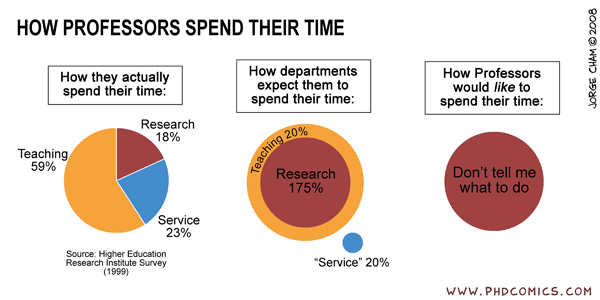
Here are some diagrams to help you understand how professors think. First, how they spend their time, from PhD Comics (via Art Carden). Click to enlarge.
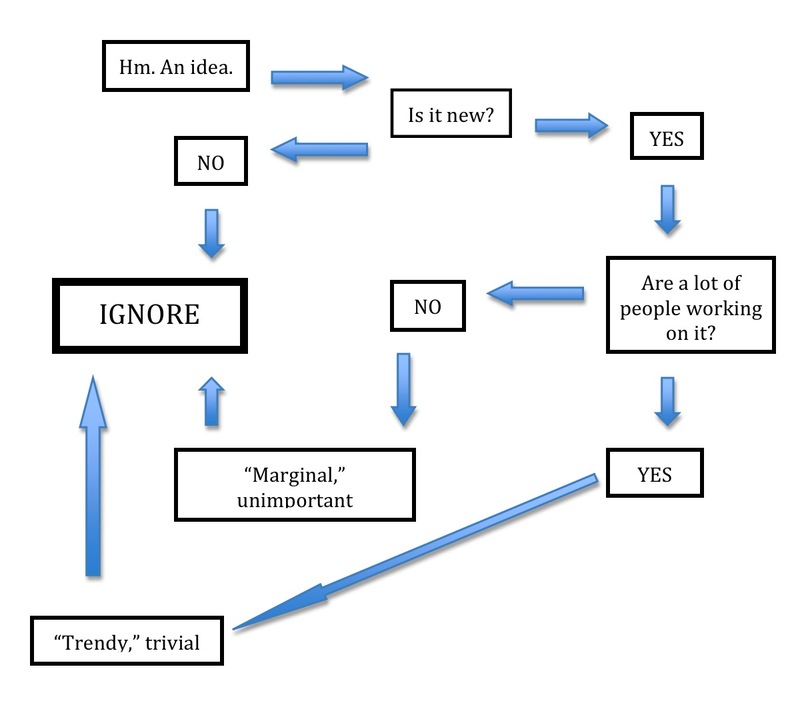
Second, how they choose research topics, from Marc Liberman (via Newmark):
Tullock on the Corporation
| Peter Klein |
Gordon Tullock is retiring this year from George Mason Law School. In the coming weeks you’ll probably be reading a lot of Tullock tributes and Tullock anecdotes (for example, about his famous put-downs). I don’t have much to add on the personal side, but I thought I’d share a remark or two about one of my favorite, and little-known, Tullock articles, “The New Theory of Corporations,” in Erich Streissler, ed., Roads to Freedom: Essays in Honor of Friedrich A. von Hayek (Routledge and Kegan Paul, 1969).
Tullock offers a number of insights into the corporate form and, in particular, the Berle-Means problem, that are well ahead of their time. As Tullock notes in the essay, he draws heavily here on Henry Manne’s work (and, he tells us, many conversations with Manne about these issues). In 1969 the consensus view was that corporations were almost exclusively controlled by salaried managers, running firms in their own interests and largely ignoring the wishes of shareholders. However, Tullock notes:
The theory of management control of corporations, of course, is subject to one very obvious difficulty. It offers no explanation of how managements are changed, and changes of management are an everyday occurrence as any reader of the Wall Street Journal can appreciate. It is true that presidents of large corporations frequently stay in office rather longer than the president of the United States, but they don’t stay in office as long as congressmen and senators, and we would hardly argue that the long tenure of congressmen and senators indicates that we do not have democracy in the United States. Thus, the current orthodoxy that the management actually runs the corporation cannot explain how the management got there or how the everyday occurrence of a change in management occurs. For some reason, this does not seem to disturb the partisans of the . . . Berle and Means theory. (more…)





 Organizations and Markets
Recent Comments