Archive for 1 October 2008
I’m From the Government, and I’m Here to Make You Some Money
| Peter Klein |
I’ve noted before how most commentators on the financial crisis are ignoring political economy. Virtually everyone, with the exception of the good folks at Mises.org, The Beacon, and a few other sites, treats Paulson, Bernanke, bank regulators, members of Congress, and other principals as the benevolent dictators of neoclassical welfare economics. (This is true even of people you’d think might know something about public choice.) But it’s impossible to analyze the current situation without reference to special interests — not only those whose actions are responsible for the current mess, but also those taking advantage of the situation to rewrite the rules and increase their authority.
One example: A particularly foolish (and dangerous) meme working its way through Washington and the surrounding punditocracy is the idea that the Paulson or modified Paulson plan isn’t really a $700 billion bailout. It’s an asset purchase, the argument goes, not a transfer payment; the Treasury buys $700 billion of bad securities, holds them, and sells them later, once market conditions improve. Maybe the Treasury can sell these assets for, say, $500 billion, so the net cost to the taxpayer is only $200 billion. Heck, if prices rise enough, taxpayers may even make money on the deal! (That’s what the junior senator from Missouri said today. Plenty of clever-silly people are saying this kind of thing too.)
The scenario is pure fantasy. Think of it this way. Treasury gets the $700 billion by borrowing (say, from the Chinese) or through increased tax revenue. Suppose the value of these assets really does rise to $500 billion, and the Treasury sells them back to investors. What will the US government do then — return the 500 billion to taxpayers? Does anyone seriously think Congress would cut taxes or offer rebates to give that money back? Not on your life. Congress will simply take that $500 billion and spend it on new programs. The Paulson plan represents an increase in government expenditures of $700 billion, period. Joe and Jane taxpayer will never get a penny of that $700 billion back, no matter what happens to asset prices.
Teaching Economics through Cinema
| Peter Klein |
 I wrote something a while back on the entrepreneur in film. Here’s a working paper on the use of cinema in economics education more generally. Gherardo Girardi experiments with movies in the clasroom and reports the results, summarized by this (perhaps unintentionally) droll remark: “The results from the student surveys show that the students strongly wish to see the proposed module introduced.” No kidding.
Girardi’s recommendions include some surprises along with familiar items:
- Death of a Salesman (Arthur Miller, 1949, US) – Choice of profession, sense of self worth based on economic performance;
- Grapes of Wrath (John Steinbeck, 1939, US) – Property rights, migration, trade unions;
- Oliver Twist (Charles Dickens, 1838, UK) – Economics of crime, economics of charities;
- Rogue Trader (James Dearden, 1999, US) / Wall Street (Oliver Stone, 1987, US; C) – Psychology of financial markets, business ethics;
- Balkanizateur (Sotiris Goritsas, 1998, Greece; C) – Efficiency of capital markets;
- La Terra Trema (Luchino Visconti, 1948, Italy) – Poverty and the risks of entrepreneurship;
- St. Francis (Michele Soavi, 2002, Italy) / Francis, God’s Jester (Rossellini, 1950, Italy) – Choice between wealth and poverty
- Mother India (Mehboob Khan, 1957, India; C) – Rural financial markets in poor countries;
- Pride and Prejudice (Jane Austin, 1813, UK) – Dowries, economics of inheritance;
- Ashani Sanket (a.k.a. Distant Thunder, Satyajit Ray, 1973, India) – Economics of famines;
- Robin Hood (author unknown, 1973 Walt Disney production recommended) – Morality of stealing from the rich/the state
See also From ABBA to Zeppelin, Led: Using Music to Teach Economics.
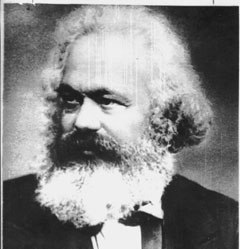
Karl’s Revenge
 | Peter Klein |
I closed my first post on the bailout mess with “Capitalism, requiescat in pace.” Here’s Martin Masse with the details. (Thanks to Mark Thornton.)





 Organizations and Markets

Recent Comments