Archive for 5 November 2008
Halo Alert
 | Peter Klein |
Phil Rosenzweig’s excellent Halo Effect takes to task the typical “guru” book in business, one that picks a few successful companies, describes their business practices, and attributes success to those practies, without any attempt to design a “controlled experiment.” As I wrote last year:
The most common problems are sampling on the dependent variable (i.e., choosing a sample of high-performing companies and explaining what their managers did, ignoring selection bias) and using independent variables based purely on respondents’ ex post subjective assessments of strategy, corporate culture, leadership, and other “soft” characteristics. The latter is the “Halo Effect” of the book’s title. When a company’s financial or operating performance is strong, managers, consultants, journalists, and management professors tend to rate strategy, culture, and leadership highly, while rating the same strategies, cultures, and leadership poorly when a company’s performance is weak. It’s as if the authors of “guru” books have never taken a first-year graduate course on empirical research design. Or, as Rosenzweig puts it (p. 128): “None of these studies is likely to win a blue ribbon at your local high school science fair.” Ouch.
Look for a series of Halo-style analyses of the Presidential contest. Today’s NY Times, for example, contains a lengthy profile of the Obama campaign, “Near-Flawless Run Is Credited in Victory,” which recapitulates the Obama campaign’s hodge-podge of tactics, some good and some bad, without trying to isolate and identify the effects of particular tactics. The writers note that Obama’s chief strategists, David Axelrod and David Plouffe, have never before been involved with a successful campaign, which right away makes you wonder how “flawless” their strategy could have been. Still, the Times describes almost everything the campaign did as exactly right. Had Obama lost, no doubt the same pundits would be calling the same hodge-podge of tactics an obvious failure, placing the blaime on Alexrod and Plouffe and praising the McCain campaign’s own strategy and tactics. Post hoc, ergo propter hoc!
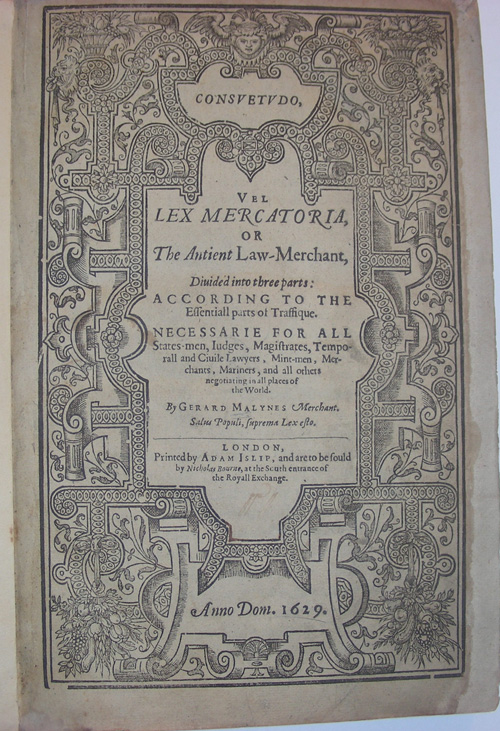
The Emergence of English Commercial Law
 The English system of commercial law or the lex mercatoria has been described as an example of “spontaneous order,” a set of rules that emerged without central direction and yet provided remarkable stability and favorable institutional environment for trade. Harold Berman and Bruce Benson, among others, have written extensively on this. Here’s an interesting paper by Daniel Klerman on the early history of English commercial law, framed as a comparison of the English and Ottoman systems:
Thirteenth-century England was a commercial backwater whose trade was dominated by foreigners. To accommodate and encourage foreign merchants, England modified its legal system by creating legal institutions which were available to both domestic and foreign traders. Among the most important of these institutions were streamlined debt collection procedures and mixed juries composed of both Englishmen and foreigners. By introducing institutions which treated locals and foreigners equally, England created a level playing field which enabled English merchants to become increasingly prominent in the later Middle Ages. England’s ability to modernize its law was facilitated by the secular nature of English law, the representation of merchants in Parliament, and legal pluralism. Medieval England contrasts sharply with the early modern Ottoman Empire. The latter created special institutions for foreign merchants, which eventually put Ottoman Muslims at a competitive disadvantage.
Food Miles
| Peter Klein |
My favorite economic geographer, Pierre Desrochers, has written (along with his better half, Hiroko Shimizu), a critique of the “food-miles” approach to measuring environmental impact.
As modern food production and distribution becomes ever more complex and globalized, a “buy local” food movement has arisen. This movement argues that locally produced food is not only fresher and better tasting, but it is also better for the environment: Because locally produced food does not travel far to reach your table, the production and transport of the food expend less energy overall. The local food movement has even coined a term, “food miles,” to denote the distance food has traveled from production to consumption and uses the food miles concept as a major way to determine the environmental impact of a food.
This Policy Primer examines the origins and validity of the food miles concept. The evidence presented suggests that food miles are, at best, a marketing fad that frequently and severely distorts the environmental impacts of agricultural production. At worst, food miles constitute a dangerous distraction from the very real and serious issues that affect energy consumption and the environmental impact of modern food production and the affordability of food.
See also these comments from Peter Gordon.





 Organizations and Markets
Recent Comments