Archive for March, 2007
Pomo Periscope IX: Pomo in the US Campaign Season
| Nicolai Foss |
The first major viral video of the campaign season appears to be this one. Perhaps the most disturbing fact about Hillary is her continued use of the pomo lingo of “getting the conversation started.”
Economies of Scope?
| Nicolai Foss |
Yesterday’s WSJ features an article on economists’ consulting jobs with (UC Berkeley Professor — and CBS Honorary Doctor) David Teece playing the main role. The article notes that Teece “… doesn’t dispute estimates that his career earnings from expert consulting amount to at least USD 50 million.” Teece has done important work on the role that economies of scope play in explaining diversification (here and here). Is he living his own theory?
HT to Marginal Revolution.
Brayden King, Fabio Rojas at Missouri
| Peter Klein |
If you’re within driving distance of the University of Missouri campus in Columbia please join us for two upcoming seminars. Brayden King of BYU and orgtheory.net will present his paper with Gordon Smith, “Contracts as Organizations,” in the CORI seminar series April 11. Indiana University’s Fabio Rojas (also blogging at orgtheory.net) will present work on social movements and networks in an April 16 seminar jointly sponsored by McCEL and the Division of Applied Social Sciences. Visitors are welcome. (Contact me for details.)
Utility Strategy
| Steven Postrel |
Skeleton of a Harvard Business Review article:
How do you get sustainable advantage in a service business today? One approach: Become a new-wave utility. Think about Google or Yahoo, eBay, Amazon, etc. on the Internet; think about UPS or FedEx, Grainger, Ryder, Public Storage in logistics; think about McDonald’s, Starbucks, 7-Eleven, in convenience food consumption. (more…)
John McMillan (1951-2007)
| Peter Klein |
For several years I used John McMillan’s book Games, Strategies, and Managers as a supplemental text in my managerial economics courses. I was saddened to learn that McMillan died last Tuesday at the age of 56 after losing a battle with cancer. Here is an obituary. McMillan taught at Stanford’s Graduate School of Business, edited the Journal of Economic Literature, and wrote many articles and books, including Reinventing the Bazaar: A Natural History of Markets.
David Warsh says “Give him a couple of paragraphs — on the evolution of folk football into rugby, soccer, and American football; or the various ways to rig an auction; or the reasons China and Vietnam grew so successfully out of their planned economies while Russia did not — and he could make economics jump right off the page and into the mind of his reader.”
Secondary Markets
| Peter Klein |
Bet these guys prefer cap-and-trade to Pigouvian taxes:
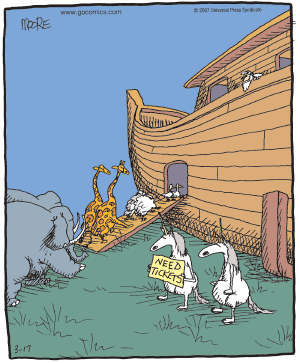
I think this was a case of command and control, however.
Speaking of secondary markets, my longtime associate Dwight Lee proposes setting up a market for citizenships. “America’s homeless and panhandlers . . . are actually quite wealthy. Almost all own an asset — their United States citizenship — that is worth several hundred thousand dollars. The problem is that they are denied the right to sell that asset.” Dwight has a unique talent for spotting potential gains from trade where others fear to tread. . . .
Political Economy of the Internet
| Peter Klein |
Some time ago I wrote a short, popular piece on the political economy of the internet, focusing on its origins as a set of federal government projects. For a more comprehensive, scholarly take, see this paper by Massimiliano Neri, presented at this past weekend’s Austrian Scholars Conference.
Thanks to Cliff Grammich
| Peter Klein |
Many thanks to Cliff Grammich for joining us as a guest blogger over the last several weeks. We look forward to his continued participation as a regular reader and commentator. Also, Cliff has promised to share the results of work he’s doing on global attitudes toward markets and other research projects of interest to the O&M crowd.
Comment Spam
| Peter Klein |
Like most blogs we filter our comments for spam, and lately the spam filter has been picking up a number of false positives. If you leave a comment on the site (and are not pushing Cia!lis or re.fin.ancing) and it does not appear right away, please let us know.
Discover Who Is Citing You in Books
| Nicolai Foss |
We academics are a narcissisic bunch. I know colleagues who check their citations on Google Scholar or the SSCI on a weekly basis. Of course, I myself would never, ever indulge in such egocentric excesses!!! That being said, however, I am still mildly interested in who may think that my modest contributions are good enough to cite.
A constant source of irritation is that while it is rather easy to find out who is citing you in the journals, it is more difficult to find out who is citing you in books (this may not matter to deans and research bureaucrats, but it is still nice to know). Until, that is, I discovered books.google.com — which allows you to do exactly this! Enjoy!
The Long Tail: Extreme Dining Edition
| Peter Klein |
The great thing about the long tail is that every taste, no matter how idiosyncratic, can be accommodated. Literally. Thanks to the web, no one need do without alligator, antelope, bison/buffalo, caribou/reindeer, elk, frog, kangaroo, kobe beef, lamb, llama, rabbit, rattlesnake, snapping turtle, venison, wild boar, yak, duck, goose, guinea fowl, ostrich, pheasant, quail, squab, or wild turkey. All are available from exoticmeats.com. Next best thing to the Gourmet Club! (HT: Jeff Tucker)
Reminds me of one of my favorite billboards:

New JC Spender Essay
| Nicolai Foss |
JC Spender is one of my favorite management thinkers. I may disagree with him, but he is usually challenging and very often profound (in contrast to some other management thinkers who have been discussed here at O&M). And he writes extremely well. JC has a new essay coming out in Journal of Management Inquiry, “Management as a Regulated Profession.” (It can also be downloaded from JC’s site). Much of the content of the paper is a discussion and diagnosis of the theory-practice gap, including pointing out that this discussion has been going for a very long time: “Redlich (1957) tells of the 19th-century German steel town that, its business failing, pressed the local business school principal to take charge. The business failed anyway, and he was put in jail — where he died — to ponder the gap between rigor and relevance. Deans beware!” (more…)
The Elusive Concept of Corporate Culture
| Peter Klein |
Corporate culture, like pornography, is difficult to define, but perhaps easy to recognize. Attitudes, beliefs, ways of solving problems — “cognitive frames,” if you prefer a fancy term — seem to differ among organizations, and to affect performance and characteristics. But a scientific explanation of corporate culture has proved elusive. Economists, in particular, have not gotten much past the analysis in Kreps’s 1986 paper “Corporate Culture and Economic Theory,” despite important contributions from Crémer (1993), Lazear (1995), and Hermalin (1998). (Ben Hermalin provides a nice summary of the literature here, and George Akerlof and Rachael Kranton provide some related discussion here.) Certainly there has been little empirical work on the economics of corporate culture.
So I was pleased to see this paper by Henrik Cronqvist, Angie Low, and Mattias Nilsson, “Does Corporate Culture Matter for Firm Policies?” The paper takes the Forrest Gump approach (which I’ve advocated elsewhere) that “corporate culture is what corporate culture does.” In other words, rather than try to define it, treat it as a latent concept and look for its effects. From the abstract:
We construct a parent-spinoff firm panel dataset that allows us to identify culture effects in firm policies from behavior that is inherited by a spinoff firm from its parent after the firms split up. We find positive and significant relations between spinoff firms’ and their parents’ choices of investment, financial, and operational policies. Consistent with predictions from economic theories of corporate culture, we find that the culture effects are long-term and stronger for internally grown business units and older firms. Our evidence also suggests that firms preserve their cultures by selecting managers who fit into their cultures. Finally, we find a strong relation between spinoff firms’ and their parents’ profitability, suggesting that corporate culture ultimately also affects economic performance. These results are robust to a series of robustness checks, and cannot be explained by alternatives such as governance or product market links.
This strikes me as a fruitful approach. Culture is treated as a residual, like Solow’s (1957) treatment of technological change. Of course, the drawback is that culture itself remains a black box. But perhaps this is the best economic analysis can do.
Management Journal Impact Factors 2005
| Nicolai Foss |
The 2006 figures aren’t there, but the 2005 ones are out on the Web of Science (SSCI) (you should be able to find these if your library has access to the Web of Science; look under “Journal Citation Reports”). (more…)
Taxes al Carbon
| Steven Postrel |
Let’s suppose you’ve been swept up in the recent frenzy and decided that it actually makes sense to apply coercive regulations to reduce human carbon dioxide emissions. Let’s further suppose that you’ve caught up to the 21st century and know that imposing specific technology standards on particular sources of emissions is a sign of policy incompetence: (more…)
The History of Economic Thought is Alive and Well (Outside Economics Departments)
| Peter Klein |
Jeffrey Young, reviewing Leonidas Montes and Eric Schliesser’s New Voices on Adam Smith (Routledge, 2006) for EH.Net, opens with the following observation:
George Stigler began his banquet speech at the Glasgow University bicentennial of the publication of the Wealth of Nations with the now frequently quoted salutation, “I bring you greetings from Adam Smith, who is alive and well and living in Chicago.” (quoted in Meek, p. 3) Thirty odd years later the remark remains true, though ironically not in the Economics Department. Of the fourteen young scholars whose work is published in this book, five earned their Ph.D.s at the University of Chicago, none in economics. Indeed of the fifteen only four are economists, despite the book’s placement in Routledge’s Studies in the History of Economics series. This is reflective of the fact that Smith scholarship has largely moved away from seeing WN and its seminal role in the nineteenth century development of economics as a discipline as Smith’s crowning achievement. The focus today is largely on seeing Smith’s system as a whole, of which The Theory of Moral Sentiments is the foundational work.
This is undoubtedly true, but surely reflects not only this particular trend in Smith scholarship, but also the lack of interest in the history of economic thought more generally among economists, a theme we’ve touched on before.
Preserving Anonymity, Electronically
| Peter Klein |
Heard the one about the sign in the Buddhist public park: “Stay on path”?
Here’s a case where the path can get you in trouble. Nicolai and I were recently discussing the problem of preserving author anonymity when sending electronic referee reports or other documents. As many of you know, word processing programs typically preserve the author’s name and (often) affiliation as part of the document header. When submitting a manuscript or referee report in Word you should click File, Properties, Summary and delete your name and other identifying information before sending. If you convert your file to PDF, however, there is another danger. Acrobat saves the full path of the source file (e.g., the Word document used to create the PDF) under File, Document Properties, Description, Location. So even if the source file contains no identifying information, the PDF file may include something like “C:\Documents and Settings\Peter Klein\My Documents\Referee Reports\Really Bad Papers\” under Document Properties. Windows users should make sure their documents are stored in a generic location like c:\ or c:\temp before converting to PDF. If they want to preserve their anonymity, that is.
Ben Klein’s Reply to Coase
| Peter Klein |
Ben Klein’s new paper, “The Economic Lessons of Fisher Body – General Motors,” appears in the February 2007 issue of the International Journal of the Economics of Business. He is not about to give Ronald Coase the last word. Indeed, Klein writes, the newest evidence on the history of the relationship between Fisher and GM confirms his earlier claim that GM’s acquisition of Fisher in 1926 was a response to opportunistic behavior by Fisher. This evidence
sheds new light on the conduct underlying these events, most importantly on how Fisher Body accomplished its holdup of General Motors in 1922. . . . The analysis presented in this paper reconciles [my] previous evidence of Fisher Body’s reluctance to locate its body plants adjacent to GM assembly facilities and Fisher Body’s reduction in its capital to sales ratio with [Coase’s] new evidence regarding contract restrictions on the use of inefficient production technology and the lack of mis-located plants. In the process we not only more fully explain what happened in the Fisher Body-General Motors relationship but also provide significant insights into the economics of holdup behaviour. The conclusion that Fisher Body held up General Motors not only stands, but is substantially strengthened by the analysis because Fisher’s conduct is shown to be consistent with what we would expect from economics.
What of Coase’s contention that there was no holdup, and that the entire case illustrates economists’ tendency to disregard the facts? (more…)
Pomo Periscope VIII: Jean Baudrillard “Dies”
| Nicolai Foss |
Apparently, it happened Tuesday last week, but I didn’t notice until this morning: Pomo-thinker Jean Baudrillard has fallen victim to the Keynesian long run (see this). Baudrillard became famous for his notion of hyper-reality, and for his habit of indicating the (media) manufactured nature of events by an extensive use of quotation marks (the most notorious example being the “Gulf War”). He was the author of sentences such as this one: “Perhaps history itself has to be regarded as a chaotic formation, in which acceleration puts an end to linearity and the turbulence created by acceleration deflects history definitively from its end, just as such turbulence distances effects from their causes” (quoted from this classic piece). And here is an example of a profound contribution to political philosophy: “All of our values are simulated,” he told the New York Times in 2005. “What is freedom? We have a choice between buying one car or buying another car? It’s a simulation of freedom.” The problem now is what to make of media reports of his death. A simulated reality?
Funny Professor Names
| Peter Klein |
Great names for economists: Price Fishback, Thomas Saving, Jim Stock, Eric Bond.
Ernst Fehr specializes in — what else? — fairness (Fehrness?).
All-time best name for a law professor: my friend Bob Lawless.
My colleague Sandra Mortal has a great name for a professor of medicine, but unfortunately she teaches finance.
Your sugestions?





 Organizations and Markets
Recent Comments