Tips for Presenting Your Research
7 June 2008 at 12:30 am Peter G. Klein 2 comments
| Peter Klein |
One of the most important skill young scholars must develop is the ability to give a technical presentation to a non-specialist audience. Everyone likes to strut his stuff but dissertation committee members, prospective academic employers, seminar audiences in various contexts, and others to whom you expose your work don’t necessarily want the gory details. Background, context, motivation, results, and implications are usually the most important parts of a presentation, but often the most neglected.
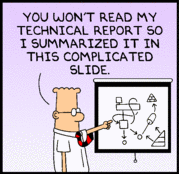 Two cartoons in my local paper today, this from Dilbert and this from Pickles, highlight that theme. Also, check out this article from Web Worker Daily, “10 Tips for Working with the Not-So-Tech-Savvy,” illustrated beautifully with an abacus. It’s written for techies working with regular folk, but many of the principles — avoid jargon, use analogies, include visuals, reference case studies, link to current events, be patient — apply to scholarly communication.
See also: Fabio’s Grad Skool Rulz.
2 Comments Add your own
Leave a comment
Trackback this post | Subscribe to the comments via RSS Feed





 Organizations and Markets
1. bobvis | 7 June 2008 at 8:45 am
It is possible to spend too much time on motivation and implications as well leaving the listener with the impression that they are being sold vaporware. I have been in academic presentations where I feel like asking “yes, but what did you actually *do*?”
So, there is a need to achieve some sort of balance.
2. Rafe Champion | 7 June 2008 at 6:08 pm
Richard Hamming did a nice paper on the attributes and work practices of high achieving researchers.
Click to access YouAndYourResearch.pdf
Work on the right problems, be at the right places, have lunch with the right people and know how to present your results. He actually used the term “sell” and of course that can be overdone, but it can be under-done by people who think that selling is beneath our dignity.
He noted three kinds of presentation and most researchers focus on the kind that presents their work in all its novelty, depth and complexity. That loses most of a general audience who need to know where the work fits into the bigger picture of the field. So the second type of presentation goes for context and connections more than the tecnical details. He found that was hard at first so he made a point of going out of his way to do more of that kind of thing to get good at it.
The third kind is the one that is really hard for the quiet achievers, that is the contribution to the discussion that you make off the cuff, standing in a crowd of not necessarily friendly strangers.