Archive for April, 2009
IRBs Gone Wild
| Peter Klein |
We’ve noted before the strange behavior of university Institutional Review Boards. My own campus has a particularly prickly IRB, the result of an unpleasant incident a few years back involving the medical school. So, even social-science researchers must receive IRB training and have individual research projects — yes, every research project that involves “human subjects,” which includes research using secondary data — approved by the campus IRB.
My certification expired recently and I took an online test today to be re-certified. Some of you may find the questions interesting. Here is a selection. Keep in mind these are questions for an economist wishing to do research in economics and management, not for a pharmacologist or epidemiologist. (more…)
Kaplan on Sutton
| Peter Klein |
Here’s Steve Kaplan’s reply to Sutton, which makes several good points. The best, to me, is that Sutton et al. have no systematic evidence relating the incorporation of economics into the business-school curriculum and any particular economic or managerial outcomes. There were booms and busts, Ponzi schemes, corruption, and irrational exuberance long before “opportunism” and “agency costs” entered the MBA lexicon.I wonder what Sutton thinks caused the S&L crisis, stagflation, the Great Depresssion, the Panic of 1907, Tulip Mania, the South Sea Bubble, or any other past economic crisis? For someone who claims to favor evidence-based management, Sutton applies a pretty weak standard of evidence to his own sweeping condemnation of an entire academic discipline.
Kaplan also notes:
Sutton does not really present a viable alternative. He believes that business schools should teach the nitty gritty of leadership and organization life. The challenge in doing this is that the nitty gritty often becomes just a collection of stories or anecdotes that cannot be generalized. The advantage of economics and the other academic disciplines is that they provide general, actionable frameworks that can be applied to new circumstances. In fact, this is probably a large part of reason the economics-type analysis has crowded out some of the other areas in the social sciences.
My Question About Ward Churchill
| Peter Klein |
I haven’t followed the Ward Churchill case too closely, but was aware that last week a Denver jury ruled that he had been fired unjustly from his tenured faculty position at the University of Colorado (and presumably will be reinstated). Fabio’s post yesterday reminded me of the biggest puzzle about this whole thing: How on earth did a person without a terminal degree, with few scholarly publications, and no record of the usual academic activities (membership on journal editorial boards, leadership positions in professional societies, mentoring of graduate students, etc.) get to be a tenured full professor at a major public university?
Assuming the wikipedia entry is correct, we learn:
Churchill received his B.A. in technological communications in 1974 and M.A. in communications theory in 1975, both from Sangamon State University, now the University of Illinois at Springfield.[8] Churchill began working as an affirmative action officer at the University of Colorado at Boulder in 1978. He also lectured on Indian issues in the ethnic studies program. In 1990, he was hired as an associate professor, although he did not possess the academic doctorate usually required for such a position. The following year he was granted tenure in the communications department, without the usual six-year probationary period, after being declined by the sociology and political science departments. He was presented with an honorary Doctorate of Humane Letters from Alfred University after giving a lecture there about American Indian history in 1992. He moved to the new ethnic studies department in 1996 and was promoted to full professor in 1997. He became chair of the department in June 2002.[12][13][14]
Out of curiosity I googled his CV and found this copy (not hosted on a university site, so possibly inaccurate). There are a few items listed under “Scholarly Essays.” I’ve never heard of any of the journals (except Social Text, Stanley Fish’s journal and the hapless victim of Alan Sokal’s famous prank). Maybe they are highly ranked in the field of ethnic studies; I don’t know (but would be curious to see the impact factors).
Could someone tell me: Would this kind of academic record get someone a tenured full professorship at the University of Colorado in, say, biochemistry or political science?
Kahneman on Judgment and Intuition
| Peter Klein |
Still confused about the differences between judgment and intuition? This lecture by Daniel Kaheman, “Judgment and Intuition,” might help. It’s one of several posted on Kahneman’s website.
Another Regulation Not Worth Its Salt
| Mike Sykuta |
Thanks to Randy Westgren for calling attention to an April 7 article in the New York Times concerning a new regulatory initiative in the Big Apple. It seems Mayor Bloomberg has decreed that salt consumption should be cut in half and has pledged the coercive power of New York City’s food industry regulatory system to launch a “nationwide initiative” to pressure the food industry to change its salty ways.
Apparently Mayor Bloomberg has identified salt consumption as a major public health crisis. Never mind that scientific research fails to demonstrate a causal relationship between salt consumption and actual health outcomes. Never mind that the human body requires some level of salt and there is no research demonstrating the potential health consequences of restricting persons’ salt intake to the level the Mayor prescribes. And don’t even think about the idea of personal responsibility and liberty in choosing what to eat and whether (and how much) salt to consume.
“if the salt has become tasteless, how can it be made salty again? It is no longer good for anything, except to be thrown out and trampled under foot by people.” Perhaps a better approach would be to throw out such ill-founded regulations and trample them under foot.
Best NCAA Championship Game Headline
| Peter Klein |
From the New York Daily News: “No bailouts for Michigan State in NCAA final loss.”
I have to admit, as an auto-industry-bailout opponent, I was getting a little tired of the “Michigan State basketball brings a ray of sunshine to struggling Detroit” storyline. Sheesh. Oh, did I mention that I’m also a rabid UNC basketball fan?
 (I’m really happy for Carolina star Tyler Hansbrough, with whom I feel a close connection. Tyler’s a Missourian who went to UNC; I did my undergraduate work at UNC and now live in Missouri. My former next-door neighbors are from Tyler’s home town of Poplar Bluff, MO. My wife taught Tyler’s older brother Greg here at Mizzou. And, like Tyler, I have some pretty sweet post-up moves . . . NOT!)
Sutton Alert
| Peter Klein |
I haven’t made way through all of Bob Sutton’s contribution to the HBR symposium, “How to Fix Business Schools,” but I read the summary on Sutton’s blog, and Bob manages to work two whoppers into the opening paragraph. First, he calls Oliver Williamson “a major proponent of Agency Theory.” (Bob, for the differences between agency theory and transaction cost economics, try Williamson’s 1988 Journal of Finance paper. Or any introductory textbook.) OK, a nit-pick. But consider this: “Many economists teach and believe that humans are selfish and greedy.” Apparently Bob has read Williamson’s description of opportunism as “self-interest seeking with guile.” Rather than think about what this means, or consider the context in which Williamson uses the term, Bob turns to his dictionary, which tells him that guile means “treacherous cunning, skillfull deceit.” Ergo, economics teaches cunning and deceit!
In the HBR piece itself, Bob manages to make the obligatory link between Alan Greenspan and Ayn Rand, though calling Greenspan a follower of Rand is a bit like saying the Black Panthers were inspired by Gandhi. (As Greenspan repeatedly reminded us, he believed in Rand’s ideas “at the high philosophical level,” i.e., not at all, where actual policies were concerned.) The opening of the HBR piece is informative, however, in suggesting how Sutton may have came to his views about economics and economists:
In my experience, most economists at top business schools are clueless about the nitty-gritty of management, which can’t be captured in elegant mathematical models. They treat any teaching remotely related to what leaders actually do on their jobs as a low status activity; at faculty meetings, I’ve seen economists and their followers dismiss and ridicule professors who teach “soft” skills. Those who speak in simple language and use words instead of numbers are often screened out, expelled or sentenced to spend their days at the bottom of the pecking order. And even faculty who bring rigorous evidence that challenges economic assumptions are badly treated.
I’m sorry that Sutton’s interactions with economists haven’t been more pleasant. But, really, what do his personal experiences have to do with the substance of economic doctrine, or its application to management? You won’t learn anything about these from reading this stuff.
Today, SNL or the Onion, Tomorrow . . . ?
| Peter Klein |
From the opening sketch of last weekend’s Saturday Night Live:
My administration intends to do to every industry in this country, exactly what we are doing to the automakers. Every company will be vetted for fiscal soundness. Those judged best able to compete in the global economy will be offered a governmental subsidy. The others will be asked to cease operations at once. Hopefully, they will do so voluntarily, if not, they will be shut down by force.

Thanks to Gary Peters for the pointer.
Open Innovation: Not So New
| Peter Klein |
The new issue of the always-interesting Industrial and Corporate Change features a paper by the always-interesting David Mowery, “Plus Ca Change: Industrial R&D in the Third Industrial Revolution.” Picking up this blog’s theme that Very Little Is New Under the Sun (OK, not explicitly), Mowery argues that the much-touted New Econonmy concept of “open innovation” is not, in fact, completely new, but an incremental change from previous R&D practices:
The structure of industrial R&D has undergone considerable change since 1985, particularly in the United States. But rather than creating an entirely novel system, this restructuring has revived important elements of the industrial research system of the United States in the late 19th and early 20th centuries. In particular, many of the elements of the Open Innovation approach to R&D management are visible in this earlier period. This article surveys the development of industrial R&D in the United States during the postwar period. In addition to emphasizing continuity rather than discontinuity, this discussion of the development of US industrial R&D during the Third Industrial Revolution stresses the extent to which industrial R&D in the United States, no less than in other nations, is embedded in a broader institutional context. My discussion also highlights the extent to which its development has been characterized by considerable path dependency.
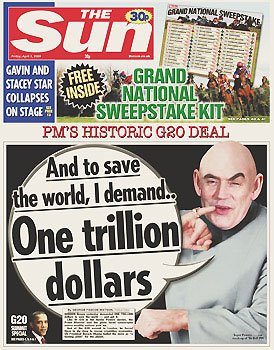
If Only the US Media Were as Clever as their British Counterparts
| Peter Klein |
Today’s cover of the Sun (via Per):
Value Creation in Middle-Market Buyouts
| Peter Klein |
Here’s a paper by John Chapman and me, “Value Creation in Middle-Market Buyouts: A Transaction-Level Analysis,” forthcoming in Douglas J. Cumming, ed., Companion to Private Equity (New York: Wiley, 2009). Get your copy today, while they’re hot. Abstract:
Is private equity an effective governance structure, or simply a means of transferring wealth from “Main Street” to “Wall Street”? How do buyouts affect target-company organization and strategy? How do deal characteristics such as size, industry, transaction complexity, buyer characteristics, holding period, and the like affect the performance of private-equity transactions? Are revenue improvements driven primarily by changes in employment and capital expenditures, or by changes in organization and strategy? Despite a healthy literature on buyouts, little is known about the details of private equity transactions, as most studies rely on publicly available data or confidential data from a single buyout firm. This paper uses a unique sample of 288 exited transactions over a 20-year period across 19 industries from 13 buyout firm firms, based on confidential data from detailed interviews with the general partners of several leading private-equity partnerships. While prior studies have focused on whole-company, going-private buyouts, our sample includes transactions with minority stakes, syndicate deals, and consolidating roll-up or add-on strategies, and we have detailed information on internal rates of return, leverage, equity stakes, and other deal characteristics. We find that the pursuit of ancillary consolidating acquisitions is the biggest driver of post-buyout revenue and profit growth, that solo deals and deals with controlling stakes outperform syndicated or “club” deals, that rates of return have declined over time as buyout markets have become more competitive, that mitigation of agency costs is critical for deal success, and more generally, that private equity can improve the performance even of sound businesses by providing access to resources, industry-specific expertise, capital for recombining assets (most often, consolidation in a fragmented industry), or recapitalization and ownership transition. Finally, our findings suggest the potential for further research of private equity at the transaction level.
It’s Not Autism
| Lasse Lien |
Here is a piece of good news, everyone. Economic science does not suffer from autism (though apparently there are parallels). As far as I know the jury is still out on the Tourette’s Syndrome. . . .
Abstract: A popular claim among critics is that economic science is suffering from autism, a severe developmental disorder characterised by impairments in social relations and communication, combined with rigid and repetitive behaviour. So far, this allegation has not been substantiated. This essay explores the claim of autism in economics based on modern schemes of diagnostics. A key finding is that the structure of the critique against mainstream economics bears a striking resemblance to the structure of the diagnostic criteria for autism. Based on an examination of three groups of key symptoms, I conclude that the required set of criteria for the autism diagnosis are not met. However, there are parallels which may serve as constructive reminders for the future development and application of economic theories and models.
HT: Klaus Mohn
Cooking by the Numbers
| Peter Klein |
Management by the numbers is out; will cooking by the numbers be next? The WSJ reports:
[A]s people look for quicker and easier ways to make everyday meals, some are moving away from the rigidity of recipes and advocating improvisational cooking, where measurements are approximations and ingredients are interchangeable.
It’s common to distinguish between two personalities in the kitchen: the deliberate, systematic, careful personality, which tends to excel in baking, and the wilder, risk-taking, adjust-on-the-fly personality, which does better with other types of cooking. But the use of careful and precise measurements has been a staple of most kinds of home cooking for a hundred years:
The rise of recipes that use precise measurements is widely credited to Fannie Farmer, a student, and later, director of the Boston Cooking School, who published “The Boston Cooking-School Cookbook” in 1896. Until Ms. Farmer’s manual, cookbooks were written in prose, calling for a pinch of this or a handful of that.
“The Boston Cooking-School Cookbook,” which survives today as “The Fannie Farmer Cookbook,” featured nearly 2,000 recipes that gave detailed instructions using a standardized system of measurement (teaspoon, cup, etc.). Ms. Farmer also included scientific explanations with her recipes, and wrote essays on housekeeping and cleaning. The rising middle-class and subsequent growth in the number of women looking to homemaking as a profession turned Ms. Farmer’s book into a hit — it has sold more than 4 million copies to date. (more…)
April Fool’s!
| Peter Klein |
I’m too lazy to come up with an April Fool’s post (this comment notwithstanding), so I’ll just recycle a couple of old ones:
Here are some other good ones.





 Organizations and Markets
Recent Comments