Author Archive
Selection à la Banks
| Lasse Lien |
Ideally, the competitive process would select for productivity. It doesn’t actually do that. Presumably it selects for expected profitability, which is close enough — assuming market power isn’t too common. What has the economy been selecting for in the past year or so? The state of low demand means that it’s harder for firms to finance operations and investment, and firms depend more than ever on external capital. For most firms this means the bank. So banks’ credit decisions will to an unusual degree decide who gets to grow and who has to shut down. Simultaneously, banks are cutting back on credit — so which firms will the banks select? Since banks have no upside, they will ration credit on the probability of losses. This is clearly a worse criterion than expected profitability because it involves a degree of risk aversion that cannot be healthy. Presumably new firms, high-debt firms, small firms, and firms with mainly intangible assets can all be selected out (or unduly constrained in their growth), not because they have low productivity or low expected profitability, but because large, established, low-productivity, low-debt, tangible-capital firms represent a somewhat lower credit risk.
Hopefully, the period of bank-driven selection will be short and expected profitability will be restored. The only thing worse, I guess, is selection by lobbying productivity (or scale).
Internal Capital Market Activeness
| Lasse Lien |
In these Williamsonian times, here is a nice new working paper relevant to his internal capital market hypothesis. The paper measures, in various ways, how active a firm is in reallocating capital across its businesses. The paper finds that the more active a firm is, the lower the firm’s industry-adjusted profitability tends to be. This of course raises the question of whether active internal capital markets cause inferior performance, or whether inferior performance causes active internal capital markets. Using an impressive battery of robustness checks the authors conclude that internal capital markets are inefficient.
If the subject appeals to you, you have presumably already read this and this.
Wiliamson Linking with Guile
| Lasse Lien |
Now that Williamson got what he deserved, the race is on to associate oneself as closely as possible with the great man (Williamson linking with guile). Some try to link him to their research field, saying that he is really in sociology, strategy, organization theory, IO, or whatever is their own field. Some go for the personal link: “I know him like the inside of my pocket,” or “he is like a father/son to me.” My version will be the institutional link (which seems appropriate for Williamson). My own institution gave Williamson his first honorary doctorate, at the initiative of my own department. Apparently we recognized greatness quite early. Unfortunately this was back in 1986, well before my time.
A New Negative Externality
| Lasse B. Lien |
If you haven’t been brilliant lately, here is a possible explanation. It’s not at all your fault, it’s just that your colleagues are too good-looking. Note, though, that this excuse can apparently only be used by men.
Abstract: The present research tested the prediction that mixed-sex interactions may temporarily impair cognitive functioning. Two studies, in which participants interacted either with a same-sex or opposite-sex other, demonstrated that men’s (but not women’s) cognitive performance declined following a mixed-sex encounter. In line with our theoretical reasoning, this effect occurred more strongly to the extent that the opposite-sex other was perceived as more attractive (Study 1), and to the extent that participants reported higher levels of impression management motivation (Study 2). Implications for the general role of interpersonal processes in cognitive functioning, and some practical implications, are discussed.
Isn’t this a classic case of a negative externality? Surely there must be some kind of taxation or side payment scheme that can reduce this burden to society.
Source: Johan C. Karremans, Thijs Verwijmeren, Tila M. Pronk, and Meyke Reitsma, “Interacting with women can impair men’s cognitive functioning,” Journal of Experimental Social Psychology 45(4), July 2009, 1041-44.
Skewness in Journal Rankings
| Lasse Lien |
Here is an interesting piece about journal rankings in economics (abstract below). See also Steve Phelan’s comment and link about similar issues in management (#3).
Nearly all journal rankings in economics use some weighted average of citations to calculate a journal’s impact. These rankings are often used, formally or informally, to help assess the publication success of individual economists or institutions. Although ranking methods and opinions are legion, scant attention has been paid to the usefulness of any ranking as representative of the many articles published in a journal. First, because the distributions of citations across articles within a journal are seriously skewed, and the skewness differs across journals, the appropriate measure of central tendency is the median rather than the mean. Second, large shares of articles in the highest-ranked journals are cited less frequently than typical articles in much-lower-ranked journals.
Source: Wall, Howard J. (2009), “Don’t Get Skewed Over by Journal Rankings,” The B.E. Journal of Economic Analysis & Policy: Vol. 9 (1).
The Roadmap to Success
| Lasse Lien |
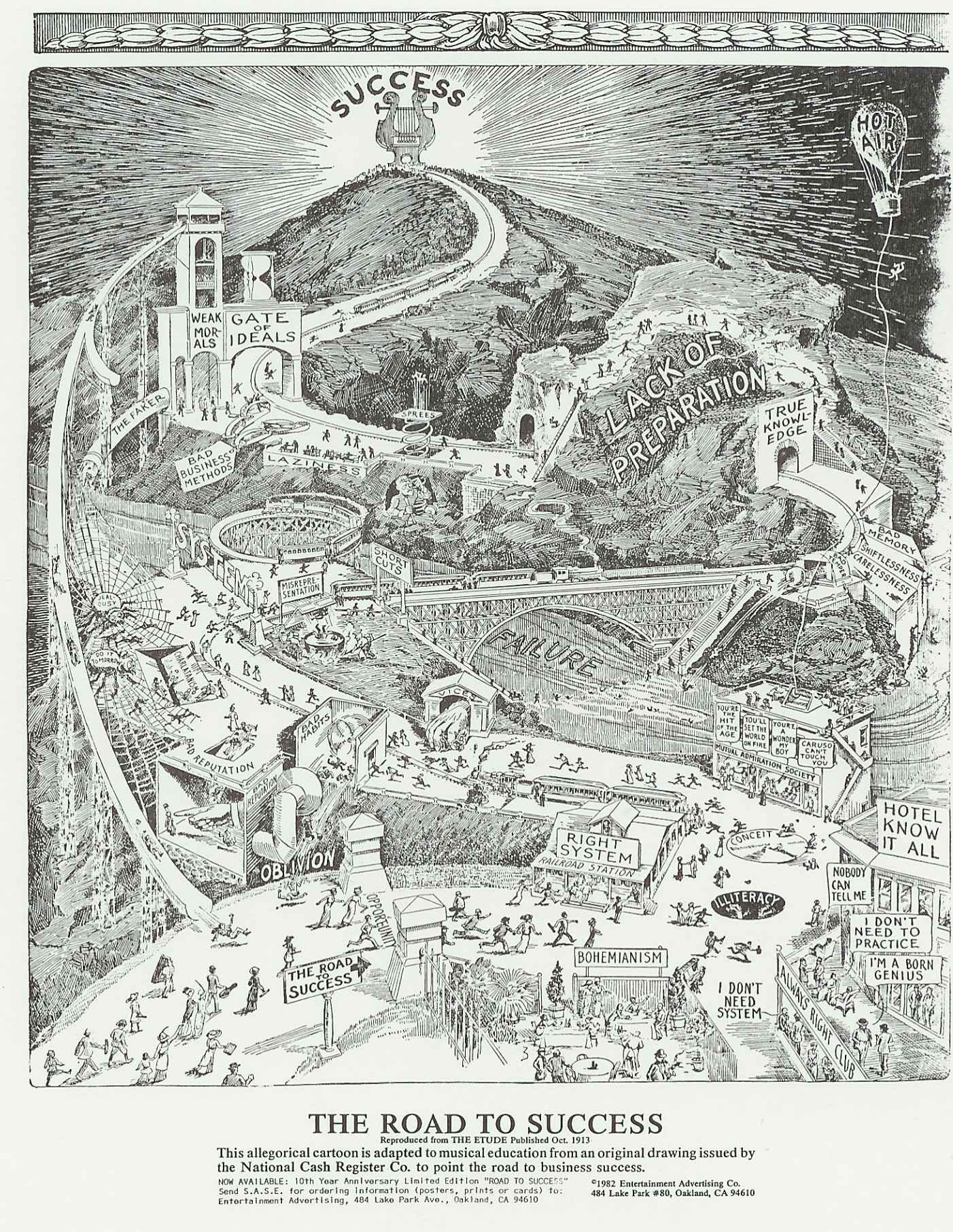
Here it is. The roadmap to success.
I guess it was Bohemianism that sealed my fate.
BTW: Peter, you’ll be glad to know that apparently there is no sidetrack for blogging.
(Via Flowingdata)
What’s Wrong Here?
| Lasse Lien |
A rich tourist came to a small town in the middle of the financial crisis. He went into the local hotel, placed a 200-dollar bill on the counter and went upstairs to check out what kind of rooms the hotel had to offer. In the meantime the hotel manager grabbed the bill, walked over to the butcher and used the bill to pay his debt. The butcher then took the bill to the cattle farmer and paid his debt to him. Next, the cattle farmer took the bill to the cattle feed supplier and paid his debt there. The cattle feed supplier then paid his debt to the local prostitute. The local prostitute brought the bill back to the hotel and paid her debt to the hotel manager. The hotel manager put the bill back on the counter. Then the rich tourist returns down the stairs and proclaims that he didn’t like the any of the rooms. He grabs the bill and leaves the city. A pity, but more importantly, the town was now debt free and optimism was back.
Source unknown. HT: Tore Hillestad.
Rankings and Journal Competition
| Lasse Lien |
Like many other B-schools, mine has a bonus system for publications in top journals. Every so often this list gets revised, which generates heated debate as each academic discipline tries to get more of “its” journals on the bonus list. One recent suggestion was to drop all the in-fighting and just use the journal list the Financial Times uses in constructing its B-school rankings. This seems like a good way to get rid of a lot of influence costs, and at the same time link the bonus to something that is important for the school: the FT rankings. The potential problem is that if all B-schools start thinking like this, what will happen to the competition between journals? Won’t the FT-list incumbents be a little too safe?
A Dark Summer Reflection
| Lasse Lien |
Words like science, scientific, university, professor, etc. still command considerable respect in society. Why? I would suggest that the brand equity of “scientific” (and associated concepts) is almost entirely created by the great advances and visible impact of fields such as physics, engineering, chemistry, medicine, mathematics, and other natural sciences. The massive advantages and explanatory power these fields have provided to society have created a status that the social sciences benefit from, but offer (relatively) modest contributions to. If I were in, say, physics or medicine, I think I would be particularly provoked by those strands of the social sciences that seem to want all the benefits of the “brand,” but also insist on the freedom to break all the rules that created it. I would presumably cry out that if you don’t like our brand, build your own, don’t destroy ours. But then again, I might just have a bad case of physics envy.
Gloves Are Definitively Off Now
| Lasse Lien |
Here is a pretty remarkable story about four elderly German pensioners who kidnapped and tortured their financial adviser.
Who should we feel sorry for, that’s what I want to know.
Campello and Fluck
| Lasse Lien |
Here is a paper from 2006 by Maurillo Campello and Zsuzsanna Fluck that is even more interesting now than it was in 2006. If you are interested in the micro-implications of the current crisis, you’ll surely like this one.
Abstract: We model the interaction of product market competition and firms’ financing decision when firms face capital market imperfections and consumers face switching costs. In our model, consumers anticipate that capital market frictions may drive their supplier out of business and account for welfare losses that firm bankruptcy imposes upon them. Likewise, managers, when investing in long-term market share building, take into account the possibility of business failure and the residual value they may capture from the firm’s liquidation process. Our theory yields four central implications. In response to a negative shock to demand: (1) more leveraged firms will experience significant market share losses; (2) the market share losses of more leveraged firms will be more pronounced in industries where low debt usage is the norm; (3) the market share losses of more leveraged firms will be more pronounced in industries where consumers face higher switching costs; and (4) the market share losses of more leveraged firms will be magnified in industries where asset liquidation is less efficient. Using detailed firm- and industry-level data from U.S. manufacturers over the 1990-91 recession, we present empirical evidence supporting our model’s predictions. We later expand our empirical analysis, studying a large panel of firms over the various phases of the full business cycles contained in the 1976-96 period. Results from these broader tests provide additional evidence in support of our theory.
The Geography of Sin
| Lasse Lien |
I used to think geography was a dry and slightly boring subject, but then I found this. Peter, where is your house again?
Debt, Relationship-Specific Investments, and Boundaries
| Lasse Lien |
Here is a link to a nice paper by Jayant R. Kalea and Husayn Shahrurb from JFE back in 2007. The key finding in the paper is that low leverage is used as a commitment device to induce customers and suppliers to make relationship-specific investments (RSI). In short; the higher the need for RSI, the lower the choice of leverage. This raises some intriguing questions about the financial crisis. On the one hand the crisis should generally reduce the willingness to make RSI, as leverage and bankruptcy risks are driven upwards. Presumably then, firms will want to take compensating measures, but what can those measures be? The classical Williamsonian response would be vertical integration. For a given sensitivity to RSI, the inventive to integrate vertically should be strongest for highly leveraged firms. But who would want to integrate with a highly leveraged firm in these times? Or vertically integrate with any firm for that matter? And if the crisis is a temporary phenomenon, vertical integration seems pretty drastic. Another obvious counter measure would be to reduce leverage. That is of course easier said than done during the crisis. A third alternative is increased use of hybrids and alliances of various kinds, but it is difficult to see how this can alleviate the fundamental problem of liquidation risk. So is bruxism the only option?
Contracting Hazards (Adult Edition)
| Lasse Lien |
If you need a rich example of the hazards of contracting, this one is particularly pregnant. Make sure you read it through to the end. Best suited for mature audiences.
Killing the Fax
| Lasse Lien |
I’m in Spain, and I just got a fax. It’s been quite a while since I got one of those (faxes). The experience got me thinking about why the fax network still exists. The technology is clearly inferior to other technologies for any use I can think of, and has been so for quite a while now. Still you will be hard-pressed to find a business address that does not include a fax number. We seem to be in a prisoner’s dilemma situation now. The aggregate benefits are probably smaller than the aggregate costs, but nobody wants to exit first.
In general there seems to be a bias in the literature on network technologies, where a lot of attention has been devoted to bandwagon effects on the adoption side, but little has been said about the exit phase (based on a 5-minute poolside literature review). This could be because the two phases are completely symmetric, with the disincentive to exit early mirroring the disincentive to enter early. If the two phases are not fully symmetric, however, it would be nice to know more about the exit side. Since new network technologies are invading our lives at an accelerating pace (MsN, Facebook, Twitter, etc.), the problem of exit is IMHO as acute as the problem of adoption.
HT: Peter Klein (who adopts them all).
It’s Not Autism
| Lasse Lien |
Here is a piece of good news, everyone. Economic science does not suffer from autism (though apparently there are parallels). As far as I know the jury is still out on the Tourette’s Syndrome. . . .
Abstract: A popular claim among critics is that economic science is suffering from autism, a severe developmental disorder characterised by impairments in social relations and communication, combined with rigid and repetitive behaviour. So far, this allegation has not been substantiated. This essay explores the claim of autism in economics based on modern schemes of diagnostics. A key finding is that the structure of the critique against mainstream economics bears a striking resemblance to the structure of the diagnostic criteria for autism. Based on an examination of three groups of key symptoms, I conclude that the required set of criteria for the autism diagnosis are not met. However, there are parallels which may serve as constructive reminders for the future development and application of economic theories and models.
HT: Klaus Mohn
New AEA Journals
| Lasse Lien |
The AEA has recently introduced no less than four new journals. AEJ: Microeconomics, AEJ: Macroeconomics, AEJ: Applied Economics and AEJ: Economic Policy. I’m sure all four will all be great journals, but judging from the first issue, I think AEJ: Microeconomics will be my favorite. Here are two examples why:
Reputational Incentives for Restaurant Hygiene
Ginger Zhe Jin and Phillip Leslie
How can consumers be assured that firms will endeavor to provide good quality when quality is unobservable prior to purchase? We test the hypothesis that reputational incentives are effective at causing restaurants to maintain good hygiene quality. We find that chain affiliation provides reputational incentives and franchised units tend to free-ride on chain reputation. We also show that regional variation in the degree of repeat customers affects the strength of reputational incentives for good hygiene at both chain and nonchain restaurants. Despite these incentives, a policy intervention in the form of posted hygiene grade cards causes significant improvements in restaurant hygiene.
The Geography of Trade in Online Transactions: Evidence from eBay and MercadoLibre
Ali Hortaçsu, F. Asís Martínez-Jerez and Jason Douglas
We analyze geographic patterns of trade between individuals using transactions data from eBay and MercadoLibre, two large online auction sites. We find that distance continues to be an important deterrent to trade between geographically separated buyers and sellers, though to a lesser extent than has been observed in studies of non-Internet commerce between business counterparties. We also find a strong “home bias” for trading with counterparties located in the same city. Further analyses suggest that location-specific goods such as opera tickets, cultural factors, and the possibility of direct contract enforcement in case of breach may be the main reasons behind the same-city bias.
Top Four Implications for Competitive Advanatage
| Lasse Lien |
I recently blogged my top-three list of consequences of the financial crisis for firm boundaries. Here is my top-four list of consequences for competitive advantage. They are to be read as broad-stroke changes on the margin, and with a ceteris paribus clause.
1. Valuable: Kind of obvious, but cost-based advantages increase in value compared to differentiation-based advantages as prices fall and demand converges on no-frills offerings.
2. Rare: Cost-based advantages will be more contested, as competitors respond to demand changes by de-differentiating (cf. #1).
3. Imitable: Time-consuming imitation processes become less likely, as firms become more impatient and risk averse.
4. Substitutable: Advantages based on branding and product development will become more vulnerable to substitution from advantages based on scale and process development.
Now, who has a list of implications for intra-firm organization and management?
21 Economic Models Explained
| Lasse Lien |
In celebration of Mahoney and Pitelis’s impressive achievement in strategic management, here is a related classic on economic systems (HT: K. Isrenn):
21 Economic Models Explained
SOCIALISM
You have 2 cows.
You give one to your neighbour.
COMMUNISM
You have 2 cows.
The State takes both and gives you some milk.
FASCISM
You have 2 cows.
The State takes both and sells you some milk.
NAZISM
You have 2 cows.
The State takes both and shoots you.
BUREAUCRATISM
You have 2 cows.
The State takes both, shoots one, milks the other, and then throws the milk away.
TRADITIONAL CAPITALISM
You have two cows.
You sell one and buy a bull.
Your herd multiplies, and the economy grows.
You sell them and retire on the income.
SURREALISM
You have two giraffes.
The government requires you to take harmonica lessons.
AN AMERICAN CORPORATION
You have two cows.
You sell one, and force the other to produce the milk of four cows.
Later, you hire a consultant to analyze why the cow has dropped dead. (more…)
Klein Seminar at NHH
| Lasse Lien |
Monday will be a big day at the Norwegian School of Ecomics and Business Administation. P. G. Klein will give a seminar under the title “Putting Entreprenurship Into Organization and Strategy Research.” Not only will he give a seminar, but we shall have the pleasure of his company from Sunday until Wednesday. If Peter’s blogging frequency goes down early next week it will be because he’s having such a good time here, and if it goes up, it will be because he is so inspired by being here.





 Organizations and Markets
Recent Comments