Author Archive
Entrepreneurship and Knowledge
| Peter Klein |
Hayek famously argued that prices embody information and that economic actors, responding to price changes, act as if they knew the underlying circumstances generating these changes. “[I]n a system in which the knowledge of the relevant facts is dispersed among many people, prices can act to coordinate the separate actions of different people in the same way as subjective values help the individual to coordinate the parts of his plan.” To economize, people don’t need “knowledge of the particular circumstances of time and place,” they only need access to prices. “The mere fact that there is one price for any commodity . . . brings about the solution which (it is just conceptually possible) might have been arrived at by one single mind possessing all the information which is in fact dispersed among all the people involved in the process.” Hayek illustrates with his famous example of the tin market: “All that the users of tin need to know is that some of the tin they used to consume is now more profitably employed elsewhere and that, in consequence, they must economize tin. There is no need for the great majority of them even to know where the more urgent need has arisen, or in favor of what other needs they ought to husband the supply.”
Hayek offers a powerful argument against interference with the price mechanism. But we should remember that prices embody information about the past, and the entrepreneur’s job is to anticipate, or “appraise,” the future. Entrepreneurs, far from discovering and exploiting “gaps” in the existing structure of prices, deploy resources in anticipation of expected — but uncertain — profits generated by future prices. For this, they rely on what Mises called a “specific anticipative understanding of the conditions of the uncertain future,” an understanding that requires a lot of knowledge of particular circumstances of time and place!
The knowledge requirements of the successful entrepreneur or arbitrageur are vividly illustrated in this passage from Carsten Jensen’s magnificent novel, We the Drowned, in a passage about 19th-century ship brokers, entrepreneurs who own, lease, and manage ships and shipping contracts:
A ship broker needs to know how the Russo-Japanese War will hit the freight market. He doesn’t need to be interested in politics, but he has to pay attention to his skippers’ finances, so a knowledge of international conflict is essential. Opening up a newspaper — he’ll see a photograph of a head of state and if he’s bright enough, he’ll read his own future profits in the man’s face. He might not he interested in socialism, in fact he’ll swear he isn’t: he’s never heard such a load of starry-eyed nonsense. Until one day his crew lines up and demands higher wages, and he has to immerse himself in union issues and other newfangled notions about the future organization of society. A broker must keep up to date with the names of foreign heads of state, the political currents of the time, the various enmities between nations, and earthquakes in distant parts of the world. He makes money out of wars and disasters, but first and foremost he makes it because the world has become one big building site. Technology rearranges everything, and he needs to know its secrets, its latest inventions and discoveries. Saltpeter, divi-divi, soy cakes, pit props, soda, dyer’s broom — these aren’t just names to him. He’s neither touched saltpeter nor seen a swatch of dyer’s broom. He’s never tasted soy cake (for which he can count himself lucky), but he knows what it’s used for and where there’s a demand for it. He doesn’t want the world to stop changing. If it did, his office would have to close. He knows what a sailor is: an indispensable helper in the great workshop that technology has made of the world.
There was a time when all we ever carried was grain. We bought it in one place and sold it in another. Now we were circumnavigating the globe with a hold full of commodities whose names we had to learn to pronounce and whose use had to be explained to us. Our ships had become our schools. They were still powered by the wind in their sails, as they had been for thousands of years. But stacked in their holds lay the future.
New Review Paper on Multinational Firms
| Peter Klein |
The econ and strategy literatures on multinational firms have grown dramatically since the pioneering works of Caves, Casson, Teece, and others. Besides established journals like the Journal of International Economics and Journal of International Business Studies, there is the new Global Strategy Journal and plenty of space in the general-interest journals for issues dealing with multinationals.
Pol Antràs and Stephen Yeaple have written a new survey paper for the Handbook of International Economics, 4th edition, and it’s available as a NBER working paper, “Multinational Firms and the Structure of International Trade.” The review focuses on the mainstream economics literature but should be useful for management and organization scholars as well — particularly section 7 on firm boundaries which includes both transaction cost and property rights theories. Here’s the abstract:
This article reviews the state of the international trade literature on multinational firms. This literature addresses three main questions. First, why do some firms operate in more than one country while others do not? Second, what determines in which countries production facilities are located? Finally, why do firms own foreign facilities rather than simply contract with local producers or distributors? We organize our exposition of the trade literature on multinational firms around the workhorse monopolistic competition model with constant-elasticity-of-substitution (CES) preferences. On the theoretical side, we review alternative ways to introduce multinational activity into this unifying framework, illustrating some key mechanisms emphasized in the literature. On the empirical side, we discuss the key studies and provide updated empirical results and further robustness tests using new sources of data.
The NBER version is gated but I’m sure our intrepid readers can dig up an open-access copy.
Hayek and Organizational Studies
| Peter Klein |
That’s the title of a new review paper by Nicolai and me for the forthcoming Oxford Handbook of Sociology, Social Theory, and Organizational Studies, edited by Paul Adler, Paul du Gay, Glenn Morgan, and Mike Reed (Oxford University Press, 2013). No, we haven’t gone over to the Dark Side (I mean, the good side), we just think Hayek’s work deserves to be better known among all scholars of organization, not only economists. Unlike many treatments of Hayek, we don’t focus exclusively, or even primarily, on tacit knowledge, but on capital theory, procedural rules, and other aspects of Hayek’s “Austrian” thinking.
You can download the paper at SSRN. Here’s the abstract:
We briefly survey Hayek’s work and argue for its increasing relevance for organizational scholars. Hayek’s work inspired aspects of the transaction cost approach to the firm as well as knowledge management and knowledge-based view of the firm. But Hayek is usually seen within organizational scholarship as a narrow, technical economist. We hope to change that perception here by pointing to his work on rules, evolution, entrepreneurship and other aspects of his wide-ranging oeuvre with substantive implications for organizational theory.
Creativity and Property Rights
| Peter Klein |
I haven’t been following the Cato Unbound debate on US copyright law, but Adam Mossoff directs me to Mark Schultz’s post, “Where are the Creators? Consider Creators in Copyright Reform.” Mark thinks current debates over copyright law neglect the role of creativity: “Too often, the modern copyright debate overlooks the fact that copyright concerns creative works made by real people, and that the creation and commercialization of these works requires entrepreneurial risk taking. A debate that overlooks these facts is factually, morally, and economically deficient. Any reform that arises from such a context is likely to be both unjust and economically harmful.” Adam thinks Mark’s position “calls out the cramped, reductionist view of copyright policy that leads some libertarians and conservatives to castigate this property right as ‘regulation’ or as ‘monopoly.'”
As one of those libertarians critical of copyright law, but also an enthusiast for the fundamental creativity of the entrepreneurial act, let me respond briefly. Mark is certainly right that creative works are created by individuals (not, “discovered,” as some of the entrepreneurship literature might lead you to believe). But I don’t see the implications for copyright law. The legal issue is not the ontology of creative works, but the legal rights of others to use their own justly owned property in relation to these creative works. Copyright law is, after all, about delineating property rights, and whether legal protection should be extended to X does not follow directly from the fact that X was “created” instead of “discovered.”
Mark uses the language of entrepreneurship, and I think this argues against his conclusion. Property law protects the property of the entrepreneur, and the ventures he creates, not the stream of income accruing to those ventures. Suppose Mark has the brilliant insight to open a Brooklyn-style deli on a street corner here in Columbia, Missouri, makes lots of money, and then I open a similar shop across the street, cutting into his revenues. No one would argue that I’ve violated Mark’s property rights; the law rightly protects the physical integrity of Mark’s shop, such that I can’t break in and steal his equipment, but doesn’t protect him against pecuniary externalities. The fact that Mark’s restaurant wouldn’t have existed if he hadn’t created it — that “real people make this stuff,” as he puts it — has no bearing on the legality of my opening up a competing restaurant, even though this harms him economically.
Does Boeing Have an Outsourcing Problem?
| Peter Klein |
Jim Surowiecki is a good business writer (and my college classmate) and I always learn from his essays (and his 2004 book The Wisdom of Crowds). But I think he gets it wrong on the Boeing 787 case. Jim echoes what is becoming the conventional management wisdom on the Dreamliner, namely that it’s long list of woes (the current battery problem being only the most recent) results from the decision to outsource most of the plane’s production. “The Dreamliner was supposed to become famous for its revolutionary design. Instead, it’s become an object lesson in how not to build an airplane.” Specifically:
[T]he Dreamliner’s advocates came up with a development strategy that was supposed to be cheaper and quicker than the traditional approach: outsourcing. And Boeing didn’t outsource just the manufacturing of parts; it turned over the design, the engineering, and the manufacture of entire sections of the plane to some fifty “strategic partners.” Boeing itself ended up building less than forty per cent of the plane.
This strategy was trumpeted as a reinvention of manufacturing. But while the finance guys loved it — since it meant that Boeing had to put up less money — it was a huge headache for the engineers. . . . The more complex a supply chain, the more chances there are for something to go wrong, and Boeing had far less control than it would have if more of the operation had been in-house.
The assumption here is that vertical integration is better for quality control and for coordinating complex production systems. But that assumption is just plain wrong. As the property-rights approach to the firm has emphasized, control and coordination problems occur in internal as well as external contracting. As Thomas Hubbard points out,
The more modern thinking about procurement emphasizes that this problem appears — albeit in different forms — both when a company procures internally and when it subcontracts. The problem of getting procurement incentives right does not disappear when you produce internally rather than subcontract; it just changes. Companies struggle to get their subcontractors to produce what they want at low cost; they also struggle to get their own divisions to do so.
In other words, Boeing might have had the same problems with in-house production. “It is certainly possible that the Dreamliner’s current problems are derived from its design — it relies far more on electrical systems than Boeing’s previous planes — and that these problems would have been just as significant (and worse on the cost front) had Boeing sourced more sub-assemblies internally.” Hubbard’s essay includes a number of additional insights derived from modern theories of the firm, such as the Williamsonian idea that adaptation is the central issue distinguishing markets from hierarchies.
So, the next time you read that firms should vertically integrate to maintain quality, as yourself, are employees always easier to control than subcontractors?
The Myth of the Flattening Hierarchy
| Peter Klein |
We’ve written many posts on the popular belief that information technology, globalization, deregulation, and the like have rendered the corporate hierarchy obsolete, or at least led to a substantial “flattening” of the modern corporation (see the links here). The theory is all wrong — these environmental changes affect the costs of both internal and external governance, and the net effect on firm size and structure are ambiguous — and the data don’t support a general trend toward smaller and flatter firms.
Julie Wulf has a paper in the Fall 2012 California Management Review summarizing her careful and detailed empirical work on the shape of corporate hierarchies. (The published version is paywalled, but here is a free version.) Writes Julie:
I set out to investigate the flattening phenomenon using a variety of methods, including quantitative analysis of large datasets and more qualitative research in the field involving executive interviews and a survey on executive time use. . . .
We discovered that flattening has occurred, but it is not what it is widely assumed to be. In line with the conventional view of flattening, we find that CEOs eliminated layers in the management ranks, broadened their spans of control, and changed pay structures in ways suggesting some decisions were in fact delegated to lower levels. But, using multiple methods of analysis, we find other evidence sharply at odds with the prevailing view of flattening. In fact, flattened firms exhibited more control and decision-making at the top. Not only did CEOs centralize more functions, such that a greater number of functional managers (e.g., CFO, Chief Human Resource Officer, CIO) reported directly to them; firms also paid lower-level division managers less when functional managers joined the top team, suggesting more decisions at the top. Furthermore, CEOs report in interviews that they flattened to “get closer to the businesses” and become more involved, not less, in internal operations. Finally, our analysis of CEO time use indicates that CEOs of flattened firms allocate more time to internal interactions. Taken together, the evidence suggests that flattening transferred some decision rights from lower-level division managers to functional managers at the top. And flattening is associated with increased CEO involvement with direct reports —the second level of top management—suggesting a more hands-on CEO at the pinnacle of the hierarchy.
As they say, read the whole thing.
Handbook of Organizational Economics
| Peter Klein |
It’s edited by Bob Gibbons and John Roberts, just published by Princeton, and you can read about it here, including the table of contents and the introduction. As Gibbons and Roberts note:
Organizational economics involves the use of economic logic and methods to understand the existence, nature, design, and performance of organizations, especially managed ones. As this handbook documents, economists working on organizational issues have now generated a large volume of exciting research, both theoretical and empirical. However, organizational economics is not yet a fully recognized field in economics — for example, it has no Journal of Economic Literature classification number, and few doctoral programs offer courses in it. The intent of this handbook is to make the existing research in organizational economics more accessible to economists and thereby to promote further research and teaching in the field.
This is a fair assessment, though some O&M readers may find the editors’ definition of the field too narrow. The volume covers a wide variety of issues, topics, and applications but nearly all from the perspective of modern neoclassical economics (there’s a chapter on TCE by Williamson and Steve Tadelis, but nothing on “old” property rights theory, capabilities, the knowledge-based view, etc.). Still, it appears to be an excellent collection of state-of-the-art papers. Besides the usual topics like incentives, authority, complementarity, innovation, ownership, vertical integration, and the like, there’s also an interesting methodological section featuring “Clinical Papers in Organizational Economics” by George Baker and Ricard Gil, “Experimental Organizational Economics” by Colin Camerer and RobertoWeber, and “Insider Econometrics by Casey Ichniowski and Kathy Shaw. Check it out.
Searle Center Conference Innovation and Entrepreneurship:
| Peter Klein |
Northwestern’s Searle Center, headed by Dan Spulber, is holding its sixth annual conference on innovation and entrepreneurship 6-7 June 2013. I have attended before and the papers and discussion are typically very high quality. Proposals are due 15 February. The full call for papers is here and below the fold. (more…)
The “Market Power” of Top Journals
| Peter Klein |
When elite academic journals impose stricter submission requirements, authors comply. When lower-ranked journals impose these restrictions, authors submit elsewhere. Key insight for editors: know your place.
Revealed Preferences for Journals: Evidence from Page Limits
David Card, Stefano DellaVigna
NBER Working Paper No. 18663, December 2012Academic journals set a variety of policies that affect the supply of new manuscripts. We study the impact of page limit policies adopted by the American Economic Review (AER) in 2008 and the Journal of the European Economic Association (JEEA) in 2009 in response to a substantial increase in the length of articles in economics. We focus the analysis on the decision by potential authors to either shorten a longer manuscript in response to the page limit, or submit to another journal. For the AER we find little indication of a loss of longer papers – instead, authors responded by shortening the text and reformatting their papers. For JEEA, in contrast, we estimate that the page length policy led to nearly complete loss of longer manuscripts. These findings provide a revealed-preference measure of competition between journals and indicate that a top-5 journal has substantial monopoly power over submissions, unlike a journal one notch below. At both journals we find that longer papers were more likely to receive a revise and resubmit verdict prior to page limits, suggesting that the loss of longer papers may have had a detrimental effect on quality at JEEA. Despite a modest impact of the AER’s policy on the average length of submissions (-5%), the policy had little or no effect on the length of final accepted manuscripts. Our results highlight the importance of evaluating editorial policies.
Top Posts of 2012
| Peter Klein |
It’s been a wild and crazy 2012, with the continued global recession, new developments and trends in strategic management and entrepreneurship research and practice, the resurgence of the Austrian school, and perhaps the most exciting worldwide event of 2012, the publication of the Foss and Klein book. We have an exciting 2013 planned as well.
Here are our most popular posts written in 2012:
- The Sorry State of Economic Journalism
- Life in the Echo Chamber
- What Is a Firm?
- Italian Social Science: Generalized Low Quality?
- Perceptions of Opportunities – Part 1
- Hayek on Schumpeter on Methodological Individualism
- The Bizarro World of Professor Sen
- A Curious Case of Vertical Integration
- “Give Me Money!”
- Handbook of Economic Organization
- Coase-Theorem Behavior Actually Does Happen
- Perceptions of Opportunities – Part 2
- Economists, (Hard) Data, and (Soft) Data
- First, They Ignore You. . . .
- Against Brainstorming
Quickmemes for Academics
| Peter Klein |
True confession: I love quickmemes. Yes, I know, they’re juvenile, most are silly, and more than a few are vulgar. But they make me laugh, sometimes uncontrollably. What about versions for academics? We could have Success Prof, Overly Attached Coauthor, Successful Grad Student, Sheltering Suburban Department Head, and so on. I’ve made a few below; try your hand at the quickmeme site and share the results in the comments.



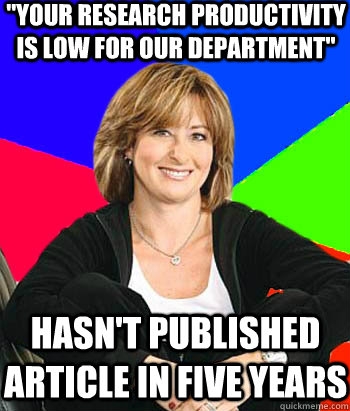


Bonus: Earlier this year I was struggling with a particularly difficult revision and created this Karate Kyle collage as a therapeutic exercise. (It did make me feel better.)
You See the Apocalypse, I See a Profit Opportunity
| Peter Klein |
Game theorists often discuss finitely repeated games by asking, “What if both parties know the world ends in period T?” If the principle of backwards induction holds, then I suppose no Mayans have been able to achieve cooperation in a repeated prisoners’ dilemma game for thousands of years — both parties know the other will defect in T-1, so each defects in T-2, and so on. . . . But where beliefs about the end of the world differ, there are potential gains from trade.

See also this Hummer commercial, one of my favorites in explaining how time preference and discount rates affect behavior.
Review Paper on Prospect Theory
| Peter Klein |
We haven’t been entirely kind to behavioral economics, but we certainly recognize its importance, and have urged our colleagues to keep up with the latest arguments and findings. A new NBER paper by Nicholas Barberis summarizes the literature, focusing on prospect theory, and is worth a read.
Thirty Years of Prospect Theory in Economics: A Review and Assessment
Nicholas C. Barberis
NBER Working Paper No. 18621, December 2012Prospect theory, first described in a 1979 paper by Daniel Kahneman and Amos Tversky, is widely viewed as the best available description of how people evaluate risk in experimental settings. While the theory contains many remarkable insights, economists have found it challenging to apply these insights, and it is only recently that there has been real progress in doing so. In this paper, after first reviewing prospect theory and the difficulties inherent in applying it, I discuss some of this recent work. While it is too early to declare this research effort an unqualified success, the rapid progress of the last decade makes me optimistic that at least some of the insights of prospect theory will eventually find a permanent and significant place in mainstream economic analysis.
TILEC Workshop on “Economic Governance and Organizations”
| Peter Klein |
The Tilburg Law and Economics Center (TILEC) is organizing a very interesting workshop on ” Economic Governance and Organizations,” 6-7 June 2013 in Tilburg. The core themes revolve around governance mechanisms — legal, contractual, social, etc. — that can address social dilemmas (free riding). Keynote speakers are Luis Garicano, Henry Smith, Henry Hansmann, and Guido Tabellini. See the full details here. Sample questions of interest:
- What makes organizations that combine classical incentives with some kind of pro-social mission, e.g. religious organizations or charities, more or less suitable to solve economic governance problems?
- Can firms whose owners are mainly driven by profit incentives mitigate economic governance problems equally good as nonprofit organizations?
- What are the effects on “industry structure” and performance of allowing for-profits to enter into traditional not-for-profit sectors? Are there important differences between sectors?
- There has been a recent trend to run charities as tightly controlled and efficiency-oriented as business firms (e.g. the Gates Foundation). What are the effects of this development on the effectiveness of those organizations (measured by the number of poor people helped, etc.)? What is the risk of crowding out charity workers’ intrinsic motivation by control?
- (How) can organizations help to support political movements in the internet age, where decentralized social online networks seem omnipotent to coordinate citizens’ actions?
- Is there a need to foster new organizational forms, such as “societal enterprises” next to traditional firms and not-for-profit organizations? If so, in which sectors, and what forms?
- Is the decline of formal private organizations providing social capital, such as clubs or many other nonprofits, an inevitable consequence of technological advancements that enable individuals to do many things on their own that required big organizations in earlier times on their own today? If so, is this a problem?
- What is the (a) de facto (b) optimal role of the state in allowing or promoting different types of organizations in order to mitigate economic governance problems? (How) does it differ between countries?
- Is it true that the state has crowded out many private initiatives to support collective action, e.g. in the provision of local public goods such as water and sewage, but less so in contract enforcement? If so, which types of organizations are best suited to mitigate this or that economic governance problem? Why?
- It seems that the number of old for-profit firms is very limited. In contrast, there are quite some religious (nonprofit) organizations which mitigate economic governance problems and are hundreds or even thousands of years old (e.g. Churches, monasteries or religiously affiliated hospitals/nursing homes). Is this impression true? If so, why? What can we learn from the longevity of many religious organizations for the organizational design of other nonprofit organizations?
Web-Savvy Profs
| Peter Klein |
 I’m #57 on a new list of Top 100 Web-Savvy Professors. Teppo smokes me at #19, but I’m right up there with Clay Christensen, Noriel Roubini, Austan Goolsbee, Richard Thaler, and other luminaries. I don’t know the group behind the list or how the ranking was compiled, but it looks good to me. In any case, this will give you more names to follow on blogs or Twitter. Enjoy!
Complementaries in the Age of the App
| Peter Klein |
Josh Gans asks if “we have yet evolved to the right set of institutions in the app economy,” comparing contracts between app developers and distributors/publishers to those between book authors and publishers. He also notes, correctly I think, that app development may have more to do with signaling programming skill than making money from selling the app. Still, there are important contractual issues to be sorted out in the age of the app.
More generally, Josh’s post highlights the need for organizational scholars to think more broadly about the complementarities between technology, organization, and strategy. Milgrom and Roberts (1990, 1995) are the pioneers here, but there management literatures on modularity and other aspects of fit among organizational attributes are relevant too. (Here’s an example from outside the tech sector.) Milgrom and Roberts put it this way:
[C]hange in a system marked by strong and widespread complementarities may be difficult and . . . centrally directed change may be important for altering systems. Changing only a few of the system elements at a time to their optimal values may not come at all close to achieving all the benefits that are available through a fully coordinated move, and may even have negative payoffs. Of course, if those making the choices fail to recognize all the dimensions across which the complementarities operate, then they may fail to make the full range of necessary adaptations, with unfortunate results. At the same time, coordinating the general direction of a move may substantially ease the coordination problem while still retaining most of the potential benefits of change. Moreover, the systematic errors associated with centrally directed change are less costly than similarly large but uncoordinated errors of independently operating units.
In other words, when a system is characterized by strong complementarities, the diffusion and evolution of business practices requires simultaneous, coordinated changes among all complementary features within the system — technology, organizational form, strategy, and perhaps other elements as well. When simultaneous or coordinated changes occur within strongly complementary systems, business practices like contractual form will also tend to evolve, and to do so rapidly. By contrast, when simultaneous or coordinated changes within systems characterized by strong complementarities do not occur, organizational change will tend to be slow or uneven.
The rapid growth of the app economy might seem an exception to these principles, as the app market has exploded without (it appears) complementary changes in the contractual and organizational aspects of app production. As noted above, this may be because app design performs a signaling role independent of its ability to generate profits. If this becomes less important over time — perhaps because clever programmers find more effective ways to signal ability — then getting the compensation system right will be critical to ensure the success of this particular business model.
The Perfect Christmas Tree
| Peter Klein |
Looking for the perfect holiday gift for that special someone? Lots of friends and family on your Nice List? Get them a book from your favorite O&M authors. If you really want to show your love, get the whole bunch! Links and ordering information are on the right-hand sidebar on the O&M home page (you may have to scroll down to see them). Several are available as e-books as well as the traditional versions. Beats the heck out of a lump of coal. (Naughty Listers can be given a complimentary one-year subscription to orgtheory.net.)

Against Scientism
| Peter Klein |
Hayek defined “scientism” or the “scientistic prejudice” as”slavish imitation of the method and language of Science” when applied to the social sciences, history, management, etc. Scientism represents “a mechanical and uncritical application of habits of thought to fields different from those in which they have been formed, and as such is “not an unprejudiced but a very prejudiced approach which, before it has considered its subject, claims to know what is the most appropriate way of investigating it.” (Hayek’s Economica essays on scientism were collected in his 1952 Counter-Revolution of Science and reprinted in volume 13 of the Collected Works.)
Austin L. Hughes has a thoughtful essay on scientism in the current issue of the New Atlantis (HT: Barry Arrington). Hughes thinks “the reach of scientism exceeds its grasp.” The essay is worth a careful read — he misses Hayek but discusses Popper and other important critics. One focus is the “institutional” definition of science, defined with the trite phrase “science is what scientists do.” Here’s Hughes:
The fundamental problem raised by the identification of “good science” with “institutional science” is that it assumes the practitioners of science to be inherently exempt, at least in the long term, from the corrupting influences that affect all other human practices and institutions. Ladyman, Ross, and Spurrett explicitly state that most human institutions, including “governments, political parties, churches, firms, NGOs, ethnic associations, families … are hardly epistemically reliable at all.” However, “our grounding assumption is that the specific institutional processes of science have inductively established peculiar epistemic reliability.” This assumption is at best naïve and at worst dangerous. If any human institution is held to be exempt from the petty, self-serving, and corrupting motivations that plague us all, the result will almost inevitably be the creation of a priestly caste demanding adulation and required to answer to no one but itself.
Creative Destruction Chart of the Day
| Peter Klein |
Via John Hagel, a chart from Mary Meeker showing the percent of personal computing devices (including, today, phones and tablets) accessing the web from various operating systems. Joseph Schumpeter, call your office!

Business and Poetry
| Peter Klein |
Wallace Stevens was one of America’s greatest poets. The author of “The Emperor of Ice-Cream” and “The Idea of Order at Key West” was awarded the Pulitzer Prize for Poetry in 1955 and offered a prestigious faculty position at Harvard University. Stevens turned it down. He didn’t want to give up his position as Vice President of the Hartford Accident and Indemnity Company.
This lyrically inclined insurance executive was far from alone in occupying the intersect of business and poetry. Dana Gioia, a poet, Stanford Business School grad, and former General Foods executive, notes that T.S. Eliot spent a decade at Lloyd’s Bank of London; and many other poets including James Dickey, A.R. Ammons, and Edmund Clarence Stedman navigated stints in business.
Sure, quants rule, but literary types have a role to play in business too. And some of the great literary and artistic figures, such as Dickens, Rubens, and even Shakespeare, were successful business managers. The quoted passage is from John Coleman’s “The Benefits of Poetry for Professionals” in the HBR blog.





 Organizations and Markets

Recent Comments