Author Archive
The Wrong Way to Measure Returns to Public Science Funding
| Peter Klein |
A new Milken Institute report purports to show that “[t]he benefit from every dollar invested by National Institutes of Health (NIH) outweighs the cost by many times. When we consider the economic benefits realized as a result of decrease in mortality and morbidity of all other diseases, the direct and indirect effects (such as increases in work-related productivity) are phenomenal.” There are so many problems with the study I hardly know where to begin. For instance:
1. The authors measure long-term benefit to society as real GDP for the bioscience industries. This is a strange proxy. It is well-known that one of the major impact of public science funding is higher wages for science workers. It is hardly surprising that NIH funding results in higher wages and profits for those in the bioscience industry. Moreover, even if industry activity were the variable of interest, don’t we care about the composition of that activity, not the amount? Which projects were stimulated by NIH funding, and were they the right ones?
2. The results are based on a panel regression of the following equation:
Real GDP for the bioscience industries = f (employment in bioscience industry, labor skill, capital stock, real NIH funding, Industrial R&D in all industries) + state fixed effects + error term.
They interpret the coefficient on NIH funding as the causal effect of NIH funding on bioscience performance. E.g.: “Preliminary results show that the long-term effect of a $1.00 increase in NIH funding will increase the size (output) of the bioscience industry by at least $1.70.” But all the right-hand-side variables are potentially endogenous. For instance, the positive correlation between the dependent variable and NIH funding could reflect winner-picking: the NIH funds projects that are likely to be successful, with or without NIH funding. (The authors briefly mention endogeneity but dismiss it as unimportant.)
This is a version of the basic methodological flaw I attributed to the the political scientists lobbying for NSF money. The issue in question — even assuming the dependent variable is a reasonable measure of social benefit — is what bioscience industry output would have been in the absence of NIH funding. (And, even more important, what would have been the direction of that activity.) Public funding could crowd out private funding, and almost certainly changes the direction of research activity, for good or ill.
3. There are a host of econometric problems, aside from endogeneity — no year fixed effects, no interactions between federal and private funds, the imposition of linear relationships, etc.
If I’m being unfair to the authors, I hope readers will correct me. But this looks to me like another example of special pleading, not careful analysis.
Conference in Honor of Oliver Williamson
| Peter Klein |
The University Paris-Dauphine is awarding an honorary doctorate to Oliver Williamson Friday, 19 October 2012, and organizing a one-day conference to honor his work. The conference is co-sponsored by the European School on New Institutional Economics (ESNIE). Speakers include Carmine Guerriero (U. of Amsterdam), Roger Guesnerie (Collège de France), David Martimort (EHESS & PSE), Marian Moszoro (IESE Business School, Barcelona), Jens Prüfer (Tilburg U.), and Brian Silverman (Rotman Business School, U. of Toronto), and Williamson will give a speech during the formal award ceremony. Registration is required. See the conference website for details.
More on Obsolete Technologies
| Peter Klein |
Following up an earlier post on the longevity of obsolete technologies, as specialty markets: Francesco Schiavone has a nice paper, “Vintage Innovation: How to Improve the Service Characteristics and Costumer Effectiveness of Products becoming Obsolete,” reviewing the core theory and discussing the case of the analog turntable (little did I know, not being a club DJ, that you can by a “vinyl emulator” to go wacka-wacka-wacka on your MP3s). Francesco’s Vintage Innovation website has more examples. Check it out!
Carpenter’s Strategy Toolbox
| Peter Klein |
Carpenter’s Strategy Toolbox, named for the late Mason Carpenter, is a terrific resource for teachers in strategic management and related fields. Here’s an advertisement from former guest blogger Russ Coff:
Some of you may be familiar with Mason Carpenter’s old teaching toolkit. I have initiated a new site that includes everything from that site plus quite a few additional exercises and videos. Please check it out at:
www.CarpenterStrategyToolbox.com
You can filter by type of tool (exercise, video, etc.) using the tabs at the top or you can filter by topic (entrepreneurship, 5 forces, RBV, global, alliances, etc.) using the categories on the right side. You should find something useful in no time at all.
Here are links to a few exercises and resources that you might find especially useful (to give you a quick feel):
- Egg Drop Auction is an exercise where profit is determined by finding new uses for materials that others did not anticipate.
- Blue Ocean Strategy summary video (plus several related videos like Cirque Du Soliel).
- Tinkertoy exercise for scenario planning or first mover advantage.
- Entrepreneurship and innovation tool page. This is a listing of the resources that are tagged for entrepreneurship content.
Please help make the site more useful:
- Comment on tools you have used (adding tips, etc.)
- Submit new tools so the resource is always growing
- Let me know if you have any questions or suggestions
Do Bosses Matter?
| Peter Klein |
Do bosses matter? Stephen Marglin famously argued that management doesn’t affect productivity, just the share of output appropriated by managers. (I’ll take David Landes instead, thank you very much.) Despite a huge management literature on bosses, economists have not quite known how to answer the question. Ed Lazear, Kathryn Shaw (ironically, a former boss of mine), and Christopher Stanton have an interesting new take on this using detailed microdata, showing substantial effects of supervisor on worker productivity:
The Value of Bosses
Edward P. Lazear, Kathryn L. Shaw, Christopher T. Stanton
NBER Working Paper No. 18317, August 2012Do supervisors enhance productivity? Arguably, the most important relationship in the firm is between worker and supervisor. The supervisor may hire, fire, assign work, instruct, motivate and reward workers. Models of incentives and productivity build at least some subset of these functions in explicitly, but because of lack of data, little work exists that demonstrates the importance of bosses and the channels through which their productivity enhancing effects operate. As more data become available, it is possible to examine the effects of people and practices on productivity. Using a company-based data set on the productivity of technology-based services workers, supervisor effects are estimated and found to be large. Three findings stand out. First, the choice of boss matters. There is substantial variation in boss quality as measured by the effect on worker productivity. Replacing a boss who is in the lower 10% of boss quality with one who is in the upper 10% of boss quality increases a team’s total output by about the same amount as would adding one worker to a nine member team. Using a normalization, this implies that the average boss is about 1.75 times as productive as the average worker. Second, boss’s primary activity is teaching skills that persist. Third, efficient assignment allocates the better bosses to the better workers because good bosses increase the productivity of high quality workers by more than that of low quality workers.
NB: For some reason, my graduate students are circulating this piece from last week’s WSJ.
Cooking as Entrepreneurship
 | Peter Klein |
To honor Julia Child on her 100th birthday, Lynne Kiesling writes a nice post combining three of my favorite things: cooking, entrepreneurship theory, and Austrian economics. Good cooking is about the combination of heterogeneous resources, it requires experimentation and creativity, and it either works or it doesn’t. Most important:
A system that will yield the most valuable and pleasing combinations of entrepreneurial economic or cooking activities will have low entry barriers (anyone can try to cook!) and a robust feedback-based system of error correction. Low entry barriers facilitate creativity in discovering new useful products from the raw elements, as well as enabling new value creation when some of those raw elements change. Error correction, whether a “yuck, that’s gross!” at home or a lack of profits due to low repeat business at a restaurant, is most effective and valuable when there are feedback loops that can inform the cook-producer about the value that the consumer did or did not get from the dish.
This emphasis on error correction highlights one of my differences with Kirzner’s approach to entrepreneurship. In Kirzner’s system, which emphasizes entrepreneurship as a coordinating agency, the entrepreneur is modeled as “piercing the fog” of uncertainty — hence the familiar metaphor of entrepreneurship as the discovery of preexisting profit opportunities. My approach focuses on action, not discovery, and gives a larger role to uncertainty. What generates coordination, in this approach, is the entrepreneurial selection process, not the “correctness” of entrepreneurial decisions.
Incidentally, Saras Sarasvathy often uses cooking to illustrate her “effectual” approach to entrepreneurial decision-making (i.e., cooks don’t always follow a recipe to produce a known dish, but use the ingredients they have in a sequential, experimental process). And for more on food, see here and here.
Live Blogging Organizing Entrepreneurial Judgment
| Peter Klein |
 Have you been dying to read Organizing Entrepreneurial Judgment but haven’t quite found the time? Are you a busy executive waiting for the Summary version? Hoping for an HBO Special? Not to worry, the good folks at HansEconomics are live-blogging the book, and the first chapter is up today. Thanks to John Dellape for doing this.
Bonus: Tom Snyder is preparing an abridged version of my 2010 book The Capitalist and the Entrepreneur.
Management Scholars and the Media
| Peter Klein |
Reporting today from the Academy of Management meetingin Boston. Too many interesting sessions to list them all. Today I attended a very good Professional Development Workshop on the opportunity-discovery perspective in entrepreneurship studies, organized by Henrik Berglund, Steffen Korsgaard, and Kåre Moberg and featuring Bill Gartner, Per Davidsson, and others. Lots of discussion of “discovery opportunities” and “creation opportunities,” and even my own case for dropping the concept of opportunities altogether.
Then, a PDW session called “Engaging the Media: Equipping Management Faculty to Share Their Knowledge More Effectively” featuring me, Jay Barney, Ron Mitchell, Maria Minniti, Mike Lenox, and Scott Kirsner, an ambassador from the world of journalism. I gave the blogger’s perspective, arguing for this medium as an effective way of sharing research results and informed opinion with students, journalists, policymakers, and the lay public. I also shared some practical tips borrowed from Mike Munger.
During the session there was a lot of discussion of economics, and how economists have been much more successful than management scholars at engaging the media. I argued that this has less to do with technique than with substance — economists have a long history of involvement with key social and policy issues of interest to journalists. But there are pitfalls to such a cozy relationship. The desire for relevance and influence can lead to compromise on rigor and and a loss of independence (Exhibit A). Management scholarship is already prone to faddishness and buzzwords, and a closer engagement with the media could exacerbate those unfortunate trends.
But, a question near and dear to our hearts here at O&M: Why are there so few academic blogs devoted to management and organizational scholarship? Economics and law have many influential academic blogs. Management has just a handful (most linked from our sidebar). When I talk to management colleagues about blogging, manyt are reluctant. Will I have something to say? How much time will it take? Will it hurt my academic reputation? Economists don’t seem too worried about these. In part, the difference may be due to core theories and approaches. A little economic theory goes a long way in addressing social and policy issues, and most economists feel comfortable talking about current events without deep knowledge of the specifics. “It involves a price control? Well, let me tell you how that will play out…” Management scholarship is far more eclectic and often calls for deeper knowledge of the concrete phenomena at hand. Is this the most important difference? Or are there other reasons why management scholars don’t blog?
Hierarchy, French Style
| Peter Klein |
The French love hierarchy, right? Well, yes, but all hierarchies are not alike. Here’s a comoprehensive study of French manufacturing firms:
The Anatomy of French Production Hierarchies
Lorenzo Caliendo, Ferdinando Monte, Esteban Rossi-Hansberg
NBER Working Paper No. 18259, July 2012We use a comprehensive dataset of French manufacturing firms to study their internal organization. We first divide the employees of each firm into `layers’ using occupational categories. Layers are hierarchical in that the typical worker in a higher layer earns more, and the typical firm occupies less of them. In addition, the probability of adding (dropping) a layer is very positively (negatively) correlated with value added. We then explore the changes in the wages and number of employees that accompany expansions in layers, output, or markets (by becoming exporters). The empirical results indicate that reorganization, through changes in layers, is key to understand how firms expand and contract. For example, we find that firms that expand substantially add layers and pay lower average wages in all pre-existing layers. In contrast, firms that expand little and do not reorganize pay higher average wages in all pre-existing layers.
Conference Honoring Larry Ribstein
| Peter Klein |
I only met Larry Ribstein a few times but was deeply impressed with his erudition and insight. He is best known for his work on unincorporated businesses but was an expert in a number of areas of business law (as well as music and cinema).
This November the GMU Law School is hosting a conference in his honor, “Unlocking the Law: Building on the Work of Professor Larry Ribstein.” Speakers include Henry Manne, Richard Epstein, Gillian Hatfield, Todd Henderson, Cliff Whinston, and many others. Hit the link above for the details.
Macroeconomics QOTD
| Peter Klein |
Courtesy of David Stockman (via Dennis):
[T]he clamoring and clattering that you hear from the Keynesians . . . that austerity is bad forgets the fact that austerity isn’t an elective course. Austerity is something that happens to you when you’re broke.
Obama on Small Business
| Peter Klein |
 President Obama’s gaffe about business creation — “If you’ve got a business, you didn’t build that. Somebody else made that happen” — has been met with the usual reactions. Defenders claim he simply used infelicitous language to describe the vital role of government in providing essential goods, while critics point out, for instance, that he didn’t even get it right on the Golden Gate Bridge (which received no federal money). I actually feel sorry for the guy. It was an pretty dumb thing to say, politically, and may end up hurting him more than Romney’s role in “exporting American jobs” (gag) hurts the challenger.
The idea that no one builds a business on his own, without help from other people, is in once sense trivially true, as Leonard Read never tired of explaining. No one person knows how to make a pencil, let alone a microprocessor. As a defense of government spending on infrastructure (not only roads and bridges, but things like the internet), it falls completely flat. Of course some entrepreneurs profit from government spending on infrastructure — not just directly (e.g., road contractors, engineering companies hired by ARPA, etc.) but indirectly (from lower transportation or transmission cost, net of tax payments). But such anecdotes do not at all “justify” the expenditures. As I once wrote about the internet:
[E]nthusiasts tend to forget the fallacy of the broken window. We see the internet. We see its uses. We see the benefits it brings. We surf the web and check our email and download our music. But we will never see the technologies that weren’t developed because the resources that would have been used to develop them were confiscated by the Defense Department and given to Stanford engineers. Likewise, I may admire the majesty and grandeur of an Egyptian pyramid, a TVA dam, or a Saturn V rocket, but it doesn’t follow that I think they should have been created, let alone at taxpayer expense.
A gross benefit to particular entrepreneurs from a government program does not, by itself, demonstrate net benefits to the taxpaying community. Vague references to spillovers and multipliers may sound good in a press conference, but are no substitute for serious analysis.
Hardware Matters
| Peter Klein |
 Joe Salerno’s post at Circle Bastiat, “There’s No Such Thing as a Free Cloud,” could have been an entry in our nothing new under the sun series. Joe highlights a recent HBR blog piece on the physical footprint and energy requirements of server farms, showing that success in the digital age depends, for some players, on access to tangible capital assets and energy. There are important implications:
The notion of a world without scarcity is thus usually propagated by leftist social theorists–but not always. There were some libertarian futurists around in the early 1970s. But lately many libertarians are among the vanguard of those who, dazzled by the marvels of the Digital Age, argue that many goods have become costlessly and, therefore, infinitely producible. Without government interference, they contend, humankind will be able to satisfy more and more of their wants using the resources freely available inside the Cloud.
Our Post-Scarcity libertarians should tell this to the owners of the 500,000 data centers, which contain the hundreds of millions of servers worldwide that constitute the real and indispensable infrastructure of the Cloud.
There are also the wires, cables, switches, cell towers, and client machines (PCs, smartphones, tablets, etc., not to mention smart refrigerators, cars with OnStar, thermostats, and more) that give us access to the cloud. To be sure, Moore’s law allows us to consume this hardware as never before. But software without hardware is like, hmmmm, peanut butter without jelly, Sonny without Cher, a Tim Burton movie without Johnny Depp. Notes Joe: “Once again, common sense observation of the real world reveals the ceaseless struggle of human actors to economize on the use of resources and vindicates the old and true economics of scarcity.”
SMS Career and Paper Development Workshop
| Peter Klein |
Join Laura Cardinal, Bill Schulze, Tomi Laamanen, Bruce Lamont, Gerry McNamara, Karen Schnatterly, and me for a research-focused senior PhD/junior faculty and paper development workshop at the 2012 Strategic Management Society meetings in Prague. Full details below the fold. (more…)
Entrepreneurship and the Auteur Theory
| Peter Klein |
 I’ve been reading Jack Mathews’ The Battle of Brazil: Terry Gilliam v. Universal Pictures in the Fight to the Final Cut, a fascinating — if absurdly one-sided — look at director Terry Gilliam’s struggle to get his 1985 film Brazil distributed in the US. Mathews tells the story as a noble crusade by a brilliant, iconoclastic, visionary filmmaker against the evil studio system, run by corporate toadies who care only about making money, even if it means destroying the artistic unity of the filmmaker’s creative vision. Gilliam had “final cut” rights for a version released in Europe, but his US distributor, Universal, demanded substantial edits, which Gilliam refused to make. Universal, led by Sid Sheinberg (who comes across heroically in documentaries about Steven Spielberg’s Jaws), was completely within its contractual rights to insist on these changes, but the result was a very different film that has been lampooned by critics. (The Sheinberg version was canned and an alternate Gilliam version eventually shown in the US after a long, ugly, public battle between Gilliam and the studio.)
It’s great reading for those interested in movies and the business of making movies. But there’s an interesting entrepreneurship angle as well. Most film critics, including author Mathews, accept the auteur theory of cinema, which sees movies as the highly personal products of a director’s creative vision. The studio approach, which treats moviemaking as a collaborative enterprise designed to make money, is anathema to the auteurs. The case is usually made with familiar anecdotes: 24-year-old Orson Welles had final control over Citizen Kane and created one of the medium’s great masterpieces, while RKO destroyed the follow-up Magnificent Ambersons (and all Welles’s subsequent films). The studios thought Star Wars would flop, and after George Lucas made his zillions he decided to finance and produce his subsequent films on his own, without studio interference — the dream of every auteur. American art-house darlings like Robert Altman, Peter Bogdonavich, Quentin Tarantino, Jim Jarmusch, etc. are always portrayed as fighting to keep Hollywood from turning their edgy, original films into bland, corporate drivel pitched at suburban soccer moms.
As Paul Cantor and others have explained, however, the auteur theory is bunk. Moviemaking is, in fact, a collaborative venture, and many of the best films are studio pictures created by large teams — the best example being Casablanca, which was essentially written by committee. Or, as Cantor puts it: “Just three words: Francis Ford Coppola.” (The Godfather films were studio pictures; virtually everything Coppola did since, with the partial exception of Apocalypse Now, has been a disaster.) And take George Lucas: Does anybody think the problem with the prequel trilogy was too many people standing around saying, “George, you can’t do that”?
Consider the parallels with entrepreneurship. (more…)
Handbook of Economic Organization
| Peter Klein |
Kudos to Anna Grandori for her edited volume, Handbook of Economic Organization: Integrating Economic and Organization Theory, currently making its way through the editorial process at Edward Elgar. Blurb:
The volume distinctively aims at integrating economic and organization theories for the explanation and design of economic organization. Economic organization is therefore intended both as an object of enquiry and as an emerging disciplinary field: not economics applied to organization as an object, but a forefront interdisciplinary field attracting researches and integrating insights from economics, organization theory, strategy and management, economic sociology, and cognitive psychology. The authors are distinguished scholars at their productive peak in those fields, sharing an in interest in an integrated and enlarged approach to economic organization. Each chapter not only addresses foundational issues and provides a state-of-art, but also offers original contributions and identifies key issues for future research.
Table of Contents is below the fold. You”ll find many of your favorite authors. (more…)
Ockham’s Razor
| Peter Klein |
 This looks like a mighty interesting conference:
Scientific theory choice is guided by judgments of simplicity, a bias frequently referred to as “Ockham’s Razor”. But what is simplicity and how, if at all, does it help science find the truth? Should we view simple theories as means for obtaining accurate predictions, as classical statisticians recommend? Or should we believe the theories themselves, as Bayesian methods seem to justify? The aim of this workshop is to re-examine the foundations of Ockham’s razor, with a firm focus on the connections, if any, between simplicity and truth.
The conference started yesterday; here’s a report on day 1 from Cosma Shalizi. Parsimony, for example, turns out to be more complicated than it appears; here is Shalizi on (recent University of Missouri visitor) Elliott Sober:
What he mostly addressed is when parsimony . . . ranks hypotheses in the same order as likelihood. . . . The conditions needed for parsimony and likelihood to agree are rather complicated and disjunctive, making parsimony seem like a mere short-cut or hack — if you think it should be matching likelihood. He was, however, clear in saying that he didn’t think hypotheses should always be evaluated in terms of likelihood alone. He ended by suggesting that “parsimony” or “simplicity” is probably many different things in many different areas of science (safe enough), and that when there is a legitimate preference for parsimony, it can be explained “reductively”, in terms of service to some more compelling goal than sheer simplicity.
Today’s Mini-Rant
| Peter Klein |
From my colleague John Howe. Here’s the news item:
MarketWatch (June 20, Orol), meanwhile, has learned that “regulatory observers urged policy makers on Wednesday to require companies to make road-show discussions available to the broader public.” Among them was Ann Sherman, associate professor of finance at DePaul University. She spoke at the Senate Banking Committee hearing that was devoted to whether the IPO process was working for ordinary investors and stated: “It is very important that we try to give everyone the same information.” Lise Buyer, founder of Class V Group LLC, a firm that guides IPO-bound companies, agreed with Sherman. She added that one way to improve the flow of information would be to require companies on a road show to hold a scheduled “Ask the Management” Q&A session via the Internet.
John asks:
Do people actually think we can level the information playing field? Not only is that naive (stupid), but it leads small/individual investors to the wrong conclusion — that they are not at a comparative disadvantage in the financial markets. They are, and they’re better off knowing it.
What Is a Firm?
| Peter Klein |
Some of you have heard me suggest — at least half seriously — that we ban the word “entrepreneurship” from scientific discourse. The word has so many definitions that its use often obfuscates rather than clarifies. (If you mean self-employment, better to say say “self-employment”; if you mean opportunity discovery, say “opportunity discovery”; and so on.)
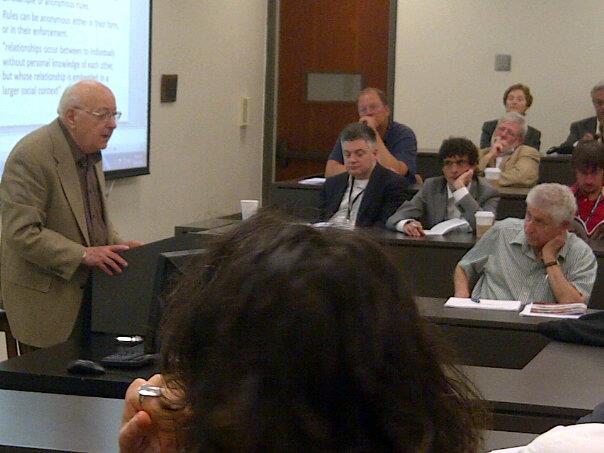
Yoram Barzel (right) listens to Harold Demsetz.
Harold Demsetz gave an interesting and entertaining presentation yesterday at ISNIE, in a session honoring Yoram Barzel on his 80th birthday. Demsetz’s remarks made me wonder if we should ban “firm” as well. Demsetz pointed out, quite rightly, that Coase (1937) defines the firm in terms of the employment relation. A one-person operation, in this definition, is not a firm, and vertical integration deals with the question of adding producers of intermediate products to the firm’s employment roll. Demsetz thinks independent contractors are firms, and hence it makes little sense to speak of “firm” and “market” as alternatives, as Coase does. (Oliver Williamson, during an earlier session, noted that Coase expressed more interest in intermediate product markets in his 1988 article than in “The Nature of the Firm.”)
For Knight, Williamson, Hart, and other notables, in contrast, the firm is defined not by the employment relationship, but by the ownership of alienable assets. In this approach, the question is who owns what, not who is employed by whom. (Dan Spulber offers yet another approach, defining the firm as nexus of transactions with objectives different from those of its owners.) Of course, even in the Knightian approach, to get from the one-person firm to the multi-person firm requires some theory about the relative transaction costs of employment versus independent contracting, a theory Nicolai and I try to provide in chapter 8 of our recent book, focusing on the conditions under which the entrepreneur can delegate judgment to subordinates.
So, what is a firm? Perhaps the better question is, What are the important research questions that can be answered when the firm is defined as X?
ISNIE 2012
 | Peter Klein |
The 16th annual meeting of the International Society for New Institutional Economics starts today at the USC Gould School of Law at the University of Southern California. President-Elect Lee Epstein has put together a very interesting program with the usual set of good papers and keynotes, including two special sessions in honor of Yoram Barzel on his 80th birthday. No live streaming, but the papers are available online, and I’ll pass along any good gossip to the O&M readership.





 Organizations and Markets
Recent Comments