Author Archive
Rothbard, Friedman on Health Care
| Peter Klein |
Murray Rothbard and Milton Friedman are no longer with us, unfortunately, but their opinions live on. Lew Rockwell is running a 1994 piece by Rothbard on what was then called Hillarycare, while the Saturday WSJ reprinted a 1996 essay by Friedman on “Soviet-Style Health Care.” My favorite excerpts:
Rothbard on “universal access”:
[T]here is one simple entity, in any sort of free society, that provides “universal access” to every conceivable good or service, and not just to health or education or food. That entity is not a voucher or a Clintonian ID card; it’s called a “dollar.” Dollars not only provide universal access to all goods and services, they provide it to each dollar-holder for each product only to the extent that the dollar-holder desires.
Friedman, quoting a a physician character in Solzhenitsyn’s 1967 novel The Cancer Ward, on Soviet-style “free” health care:
What do you mean by “free”? The doctors don’t work without pay. It’s just that the patient doesn’t pay them, they’re paid out of the public budget. The public budget comes from these same patients. Treatment isn’t free, it’s just depersonalized. If the cost of it were left with the patient, he’d turn the ten rubles over and over in his hands. But when he really needed help he’d come to the doctor five times over. . . .
Is it better the way it is now? You’d pay anything for careful and sympathetic attention from the doctor, but everywhere there’s a schedule, a quota the doctors have to meet; next! . . . And what do patients come for? For a certificate to be absent from work, for sick leave, for certification for invalids’ pensions: and the doctor’s job is to catch the frauds. Doctor and patient as enemies — is that medicine?
Agribusiness Economics and Management
| Peter Klein |
Congratulations to my colleague Mike Cook for his review paper on “Agribusiness Economics and Management” (with Rob King, Mike Boehlje, and Steve Sonka) in the new issue of the American Journal of Agricultural Economics. It’s a special issue commemorating the centennial of the American Agricultural Economics Association. Lots of good stuff here on the history and development of management theory and pedagogy, the evolution of the food sector, and the effects of the institutional environment on firm structure. Here’s the abstract:
Agribusiness scholarship emphasizes an integrated view of the food system that extends from research and input supply through production, processing, and distribution to retail outlets and the consumer. This article traces development of agribusiness scholarship over the past century by describing nine significant areas of contribution by our profession: (1) economics of cooperative marketing and management, (2) design and development of credit market institutions, (3) organizational design, (4) market structure and performance analysis, (5) supply chain management and design, (6) optimization of operational efficiency, (7) development of data and analysis for financial management, (8) strategic management, and (9) agribusiness education.
Kauffman Economics Bloggers Forum
| Peter Klein |
I’ll be in Kansas City tomorrow for the Kauffman Economics Bloggers Forum. Speakers include David Warsh, Paul Romer, Tim Kane, Bob Litan, Donald Marron, and many others. You can watch it live here. Hopefully I’ll get some good ideas for increasing blog revenue, so watch out for our new paid subscription policy. Ha ha ha ha.
Jargon Watch
| Peter Klein |
- Hydrocarbon denier — you know who you are
- YouTube or it didn’t happen — common response from young people to a report of some event
- The G-2 — the US and China, jointly controlling the world economy
- Acluistic — clueless
- Break your crayons — what that last journal reviewer did to me
Bonus material: Andrew Gelman’s urban dictionary for stats
Financial Constraints and Innovation
| Peter Klein |
Why are firms in poor countries less productive than firms in rich countries? Is it lack of technical know-how? Poor infrastructure? Insufficient human capital? Weak intellectual-property protection? Actually, the evidence suggests a more prosaic explanation: financial constraints.
One stylized fact that appears from emerging markets and transition economies . . . is that foreign owned fi rms tend to be more productive than domestically owned firms. . . . To the extent that foreign owned fi rms embody the technological frontier, one can interpret this fact as suggesting that some forces prevent domestically owned firms from emulating the best practices and techniques. . . .
We show that a fi rm’s decision to invest into innovative and exporting activities is sensitive to fi nancial frictions which can prevent fi rms from developing and adopting better technologies. Furthermore, we demonstrate that in a world without financial frictions, innovation and exporting goods are complementary activities. Thus, easing financial frictions can have an ampli ed eff ect on firms’ innovation eff ort and consequently the level of productivity. However, as financial frictions become increasingly severe, these activities become eff ectively substitutes since both exporting and innovation rely on internal funds of fi rms.
That’s from “Financial Constraints and Innovation: Why Poor Countries Don’t Catch Up” by Yuriy Gorodnichenko and Monika Schnitzer. One implication is that diversified firms, whose operating units have access to the firm’s internal capital market, have particular advantages in developing countries, an argument explored in several papers by Khanna and Palepu (e.g., here). In the US, these advantages may not outweigh other drawbacks of unrelated diversification.
Ross Emmett on Innovation
| Peter Klein |
Here are some provocative videos on innovation from Ross Emmett. The series is called “The Constitution of Innovation.” The first three are posted at vimeo:
- Why “Picking Winners” Robs Us All of a Better Future
- National Innovation Systems: Too “National”; Not “Constitutional”
- The Promise of Failure
See Ross’s website for more information.
Mannepalooza at Austrian Scholars Conference
| Peter Klein |
Tune in here at 3:45 EST today for a live broadcast of the ASC session, “The Contributions of Henry G. Manne,” organized by yours truly. Panelists include me, Alexandre Padilla, Richard Vedder, Thomas DiLorenzo, and Henry Manne. And buy your copy of the Collected Works.
Update: audio files are now available: Klein, Padilla, Vedder, DiLorenzo, Manne.
Interesting Paper on Research Design
| Peter Klein |
Ed Leamer famously argued, back in 1983, that empirical economists should do more sensitivity analysis. A new NBER paper by Joshua Angrist and Jörn-Steffen Pischke says that econometric practice has indeed gotten much better, not because of sensitivity analysis, but because of a new focus on research design. “[T]he credibility revolution in empirical work can be traced to the rise of a design-based approach that emphasizes the identification of causal effects. Design-based studies typically feature either real or natural experiments and are distinguished by their prima facie credibility and by the attention investigators devote to making the case for a causal interpretation of the findings their designs generate.” They are clearly right that identification has become a Really Big Deal (choosing a dissertation topic in economics is sometimes referred to these days as “the search for a good instrument”). But natural experiments and instrumental variables have their own potential problems as well. Perhaps Verstehen can still play a role.
Shareholder-Stakeholder Smackdown: Jensen, Freeman, Mintzberg, Khurana
| Peter Klein |
This looks like a fun event. Watch the Big Guys debate the future of the firm, management, and management education. It’s Fordham University’s W. Edwards Deming Memorial Conference, 11 May 2010 in New York City. Kudos to Mike Jensen for his willingness to walk into what will be, presumably, a line of fire. And remember, management theory is not to blame.
Mises Quote of the Day
| Peter Klein |
Nothing can be known about such matters as inflation, economic crises, unemployment, unionism, protectionism, taxation, economic controls, and all similar issues, that does not involve and presuppose economic analysis. All the arguments advanced in favor of or against the market economy and its opposites, interventionism or socialism (communism), are of an economic character. A man who talks about these problems without having acquainted himself with the fundamental ideas of economic theory is simply a babbler who repeats parrotlike what he has picked up incidentally from other fellows who are not better informed than he himself.
This is from Mises’s introduction to the 1959 edition of Böhm-Bawerk’s massive 3-volume set, Capital and Interest. Mises gives some further admonitions: “A man not perfectly familiar with all the ideas advanced in these three volumes has no claim whatever to the appellation of an economist.” This is, shall we say, a minority view. And my personal favorite: “A citizen who casts his ballot without having studied to the best of his abilities as much economics as he can fails in his civic duties. He neglects using in the appropriate way the power that his citizenship has conferred upon him in giving him the right to vote.”
Those lacking time to study Capital and Interest in its entirety may enjoy this new edition of Böhm-Bawerk’s essay “Control or Economic Law,” which is more easily digested.
Google Public Data Explorer
| Peter Klein |
How long before we are doing all our empirical research on Google?
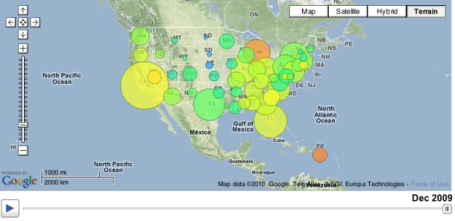
You can bet that commercial and subscription-based academic data providers like Thompson Financial, CRSP, Compustat, Global Insight, etc. are paying close attention. (BTW I still think the World Freedom Atlas is cooler.)
It Was the Best of Times, It Was the Worst of Times
| Peter Klein |
Many are enjoying the irony of Sandra Bullock winning a best-actress Oscar (for The Blind Side) and a worst-actress Razzie (for All About Steve) in the same year. It made me think of Robert Hodgson’s recent paper in the Journal of Wine Economics, noting that wines winning awards in a particular competition are no more likely to win awards in other competitions. “An analysis of the number of Gold medals received in multiple competitions indicates that the probability of winning a Gold medal at one competition is stochastically independent of the probability of receiving a Gold at another competition, indicating that winning a Gold medal is greatly influenced by chance alone.” Perhaps acting awards work the same way?
Jobs Of Yesteryear: Obsolete Occupations
| Peter Klein |
A fascinating pictorial from NPR on jobs made obsolete by technological innovation. Great illustrations of the labor-market side of creative destruction. (Planet Money via Russ Roberts.)

Org. Structure and Diversification
| Peter Klein |
The March 2010 issue of the Journal of Industrial Economics has just come out, and it features my paper with Marc Saidenberg, “Organizational Structure and the Diversification Discount: Evidence from Commercial Banking.” I’m quite happy with the paper, which went through many rounds of revision and consumed a great deal of time and energy. I blogged the details earlier. The published version is behind a firewall; if you can’t get through I’d be happy to mail you a copy.
Gene Fama’s Autobiography
| Peter Klein |
 Here’s an autobiographical essay by Gene Fama written for the Annual Review of Financial Economics. Fama’s work on agency theory (with Mike Jensen) and on corporate finance (with Ken French) should be of particular interest to O&Mers, though some may disagree with his introductory claim that “[f]inance is the most successful branch of economics in terms of theory and empirical work, the interplay between the two, and the penetration of financial research into other areas of economics and real-world applications.”
Fama’s Chicago-Booth colleagues add the following note about Fama’s institutional leadership, presumably directed at today’s Fama-bashers:
Rather than rest on his laurels or impose his own views on the group, Gene has always sought the truth, even when it appeared at odds with his own views. . . . The current finance group at Chicago includes a diverse set of people who specialize in all areas of modern finance including, behavioral economics, pure theory, and emerging, non-traditional areas such as entrepreneurship and development that were unheard of when Gene arrived at Chicago. Contrary to the caricatured descriptions, there is no single Chicago view of finance, except that the path to truth comes from the rigorous development and confrontation of theories with data.
I, Taco
| Peter Klein |
Some California design students tracked the ingredients in their favorite local taco and came up with this cool image.

Of course, it’s supposed to show us the horror of all those food miles, but what I see is the miracle of the market.
How Grad School Is Just Like Kindergarden
| Peter Klein |
Another gem from the PhD Comics guy (click to enlarge).

Vertical Integration and the Informational Content of Prices
| Peter Klein |
Many years ago, when I was taking Williamson’s Economics of Institutions class at Berkeley and fishing around for dissertation topics, I had the idea to do some empirical work on the relationship between inflation and vertical integration or conglomerate diversification. The basic idea is that monetary expansion not only raises price levels, but also increases the dispersion of relative prices — introducing “noise” into the price mechanism — giving entrepreneurs an incentive to internalize transactions, on the margin, they would have otherwise conducted in the market. My interest was partly piqued by an off-hand remark by Dick in a review of Chandler’s Scale and Scope:
Things began to go wrong in the 1960s with the wave of conglomerate diversification, that is, with diversification by companies into areas wholly unrelated to their “core competence.” ITT was the paradigm of this phenomenon. Originally an international maker of telephone switching equipment, it bought, among other things, an insurance company and the maker of Hostess Twinkies. Chandler sees this as an inefficient practice, with many of the disbenefits of overextended British personal capitalism. There is no historical precedent for such unrelated diversification, he notes, except for German Konzerne during the hyperinflation of the 1920s. What is interesting — and what Chandler doesn’t mention — is that it is precisely inflation, in this case the Lyndon Johnson inflation of the 1960s, to which many have pointed as the cause of the wave of conglomerate mergers. The conglomerate is in effect an “internal capital market” that invests in a diversified portfolio of unrelated interests. But why? The stock market is much better at diversifying away risk than is such an arrangement, and it has many other advantages as well. In a time of inflation, the argument goes, price signals become distorted as managers find it difficult to disentangle changes in relative prices (that is, real prices) from changes in the price level. In such a world, the internal information and control within a conglomerate may have advantages that outweigh the disadvantage.
But, in any case, the trend in the less-inflationary 80s was the opposite one, the breaking apart of corporate holdings. . . .
The idea that conglomerate diversification, and “hierarchies” more generally, are responses to conditions in external markets has proven very useful in my own work; it also appears in Amar Bhidé’s neglected 1990 paper on diversification. Dick’s review cites a 1989 paper by Don Boudreaux and Bill Shughart linking US inflation rates and a measure of vertical integration but I couldn’t find such a relationship for diversification, and ended up going in a different direction. (more…)





 Organizations and Markets
Recent Comments