Author Archive
Rethinking the Diversification Discount
| Peter Klein |
A very good summary by Don Sull of recent literature on diversification. I like points #1 and #4 the best. He missed a few of the seminal papers (1, 2, 3) but nobody’s perfect. Note also that Sull is focusing on the corporate finance literature, which generally ignores inter-industry relatedness. In the strategic management literature, by contrast, relatedness (and its measurement) has been a central concern (see the references here).
Infographic of the Day: Bailouts Around the World
| Peter Klein |
Via HBR, bank bailouts and stimulus packages as percentages of GDP. China tops (bottoms?) the list with stimulus goodies worth a whopping 47% of GDP.

Now That’s a Complete Contract!
| Peter Klein |
A major theme of the contracting literature in organizational economics is that formal contracts are inevitably incomplete, meaning that they do not specify actions and remedies for every possible set of circumstances. Given genuine uncertainty about the future, parties may decide that formal contracts to not adequately protect relationship-specific investments, providing an important rationale for vertical integration or another mechanism to protect quasi-rents (alliances, equity-sharing arrangements, reputation, and other “hybrids”).
A recent WSJ piece suggests that writing complete contracts may not be so hard after all:
Decked out in sequined black and gold dresses, Anne Harrison and the other women in her Bulgarian folk-singing group were lined up to try out for NBC’s “America’s Got Talent” TV show when they noticed peculiar wording in the release papers they were asked to sign.
Any of their actions that day last February, the contract said, could be “edited, in all media, throughout the universe, in perpetuity.”
My Mom says she once told me I was the best little boy in the world, to which I responded, “and all the planets too?” The WSJ gives several examples of similarly expansive coverage:
- The terms of use listed on Starwars.com, where people can post to message boards among other things, tell users that they give up the rights to any content submissions “throughout the universe and/or to incorporate it in other works in any form, media or technology now known or hereafter developed.”
- In a May 15, 2008, “expedition agreement” between JWM Productions LLC, a film-production company, and Odyssey Marine Exploration Inc., a shipwreck-exploration outfit, JWM seeks the rights to footage from an Odyssey expedition. The contract covers rights “in any media, whether now known or hereafter devised, or in any form whether now known or hereafter devised, an unlimited number of times throughout the universe and forever, including, but not limited to, interactive television, CD-ROMs, computer services and the Internet.”
And my personal favorite:
A 189-word sentence in a September agreement between Denver-based Spicy Pickle Franchising Inc. and investment bank Midtown Partners & Co. — which has helped raise capital for the sandwich and pickle shops dotted across the region — unconditionally releases Spicy Pickle from all claims “from the beginning of time” until the date of the agreement.
Says Spicy Pickle’s Marc Geman, “the length of the paragraph is only limited by the creativity of the attorney.”
The Era of Laissez-Faire?
| Peter Klein |
One of the established memes about the financial crisis is that it demonstrates the failure of unfettered capitalism, the dog-eat-dog, laissez-faire environment that prevailed in the West over the last few decades, all driven by the ideology of “free-market fundamentalism.” This seems to be a truism among most of the Commentariat. Of course, as pointed out repeatedly on this blog, the truth is virtually the opposite: there was never any “deregulation,” the Bush Administration spent public money like a drunken sailor, and government continued to expand as it always does. But a picture is worth a thousand words, so try these on for size. (US data; click charts for sources.)

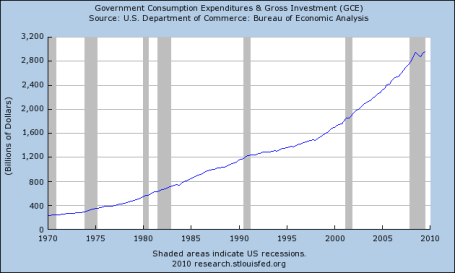

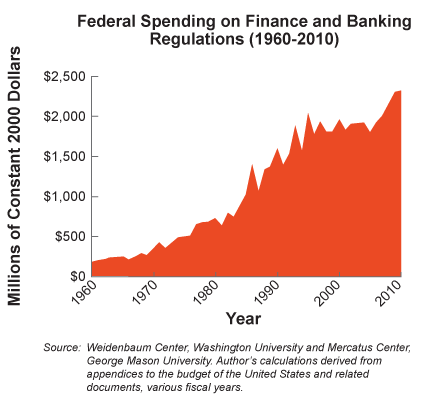
One response I sometimes hear is “Sure, there are more regulations and more government spending, but the set of things that should be regulated and the amount of government spending the economy needs are growing even faster!” This is essentially the Krugman-DeLong view about the stimulus: it just wasn’t big enough. Or they say that financial markets were “deregulated,” de facto, because the number of regulations and regulators increased more slowly than the number of new financial instruments and new markets. I wonder, though: are these falsifiable propositions? No matter how big the government is, if there are any problems, it’s always because the government isn’t big enough!
Hayekian Comments on Student Papers
| Peter Klein |
A grad student inspired these:
“The writer clearly suffers from a fatal conceit.”
“Reading this proposal helps me understand the knowledge problem.”
“Your paper appears to be the result of human action, but not human design.”
“The proposed outline reveals how little people really know about what they imagine they can design.”
Your suggestions?
ISNIE 2010 Call for Papers
| Peter Klein |
The Call for Papers is out for the International Society for New Institutional Economics’s 2010 meeting, 17-19 June in Stirling, Scotland. Proposals are due 1 March. President-Elect Frank Stephen is putting together an impressive program with keynotes from Bruno Frey and two longtime ISNIE members you may have heard of: Elinor Ostrom and Oliver Williamson. Don’t miss it!
Positive Spillovers from Bad Behavior
| Peter Klein |
When I introduce in class the concept of influence activities I emphasize that these, like other forms of discretionary behavior, can have benefits as well as costs. Think of self-assessments, such as a faculty member’s annual report to the department head or Dean. Certainly, faculty will find creative ways to overstate their accomplishments, minimize their failures, make themselves look better relative to their peers, and so on, and the time and energy spent doing this can be considered influence costs. At the same time, a savvy department head or Dean knows how to read between the lines, to separate signal from noise, and generally how to extract useful information from these reports, information he or she might not otherwise have. The challenge for organizational design, then, is not to eliminate influence activities altogether, but to limit them to the point where marginal benefit equals marginal cost.
This popped into my mind the other day when I read (courtesy of Stephan Kinsella) the confessions of a self-described “law school asshole.” University of Pennsylvania 3L Steve Mendelsohn (writing in 1990) tells his fellow students: “You know who we are. We’re the ones who always have our hands up in class volunteering to answer the professor’s questions, or ready to ask one of our own at seemingly any and every opportunity. Everytime you hear one of our names called, you groan and turn to the person next to you and slowly shake your head from side to side.” He even admits his name was in the center square of the Asshole Bingo cards his fellow students would bring to class.
As with influence activities, however, law-school assholery seems to have public benefits: keeping the discussion going and the atmosphere lively, eliciting from the professor information that other students would like to have but are afraid to ask for, and so on. I confess that, as an instructor, I’d rather have a few such assholes in class than a room full of polite, well-behaved dullards.
The serious question is whether this applies to organizations more generally. Are “civilized” workplaces necessarily better than rough-and-rowdy ones? It’s easy to come up with examples of organizations run by jerks that failed, but do we have systematic empirical evidence that nice-guy firms finish first? Do the marginal costs of costs of placing rude, self-centered people in management positions outweigh the marginal benefits?
CFP: “Understanding Firm Growth”
| Peter Klein |
The Ratio Institute invites paper proposals from young scholars (sorry, O&M bloggers!) in economics, economic history, entrepreneurship, management, sociology, statistics, psychology, and related disciplines for a workshop on firm growth in Stockholm, 12-14 August 2010. David Audretsch and Alex Coad are keynoting. Suggested topics include the role of high-growth firms, determinants of the growth of firms, growth ambitions and attitudes towards growth, firm growth and the characteristics of the entrepreneur, the persistence of firm growth, barriers to growth, post-entry performance, firm growth in a historical perspective, and innovation and firm growth. Details here.
The Virtual Firm
| Peter Klein |
If the proprietor has been to business school, it can never be smaller than two persons:

Bonus material, via Craig Newmark: the Boston Globe ponders “The End of the Office.” But it won’t happen, IMHO.
OECD Data on Entrepreneurship
| Peter Klein |
A new OECD report provides data on startups and similar measures for 39 countries. Lots of variables, e.g.:
- Number of enterprises by size class
- Employment by size class
- Value added by size class
- Exports by size class
- Employer enterprise birth rates (manufacturing and services by industry, by size class)
- Employer enterprise death rates (manufacturing and services, by industry, by size class)
- One- and two-year survival rates (manufacturing and services)
- Share of one- and two-year-old employer enterprises in the population (manufacturing and services)
- Share of high-growth firms (employment)
- Share of high-growth firms (turnover)
- Share of gazelles (employment)
- Share of gazelles (turnover)
- Employment creation by enterprise deaths
PowerPoint Version of “I Have a Dream”
| Peter Klein |
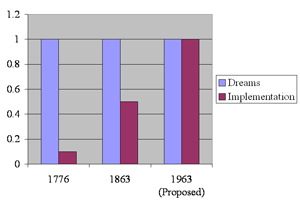
Bill Easterly tries his hand at PPTParody and hits a winner. The Gettysburg Address version remains the standard, of course. See also our PowerPoint archive.
Call for Applications: “International Business in Historical Perspective: The Emergence of Global Entrepreneurship”
| Peter Klein |
The Henley Business School at the University of Reading and the Institute for Economic and Social History at the Georg August University of Göttingen are organizing a Conference/Summer School on “International Business in Historical Perspective: The Emergence of Global Entrepreneurship,” 19-20 March (conference) and 21-25 March (summer school) 2010. Details here. “During the combined conference and summer school, scholars and students will explore the concept of entrepreneurship applied to historical examples in an international context. Topics include, for instance, the performance of multinationals in foreign markets, immigrant entrepreneurship, international family firms, and the institutional framework in which entrepreneurial decisions were made.”
Experimental versus Conceptual Entrepreneurs?
| Peter Klein |
The latest paper in David Galenson’s artist series deals with architects, distinguishing between “experimental” and “conceptual” designers. The distinction calls to mind the different emphases of Knight’s and Kirzner’s concepts of the entrepreneur, the former centered on action and market feedback, the latter on the cognitive act of discovery. What do you think?
Innovators: Architects
David W. Galenson
NBER Working Paper No. 15661
Issued in January 2010Frank Lloyd Wright, Le Corbusier, and Frank Gehry were experimental architects: all worked visually, and arrived at their designs by discovering forms as they sketched. Their styles evolved gradually over long periods, and all three produced the buildings that are generally considered their greatest masterpieces after the age of 60. In contrast, Maya Lin is a conceptual architect: her designs originate in ideas, and they arrive fully formed. The work that dominates her career, the Vietnam Veterans Memorial, was designed as an assignment for a course she took during her senior year of college. The dominance of a single early work makes Lin’s career comparable to those of a number of precocious conceptual innovators in other arts, including the painter Paul Sérusier, the sculptor Meret Oppenheim, the novelist J.D. Salinger, and the poet Allen Ginsberg.

The Division of Labor, 1886
| Peter Klein |
Another interesting passage from Graham Robb’s The Discovery of France:
Every [French] town and village was a living encyclopedia of crafts and trades. In 1886, most of the eight hundred and twenty-four inhabitants of Saint-Étienne-d’Orthe, on a low hill near the river Adour, were farmers and their dependents. Of the active population of two hundred and eleven, sixty-two had another trade: there were thirty-three seamstresses and weavers, six carpenters, five fishermen, four innkeepers, three cobblers, two shepherds, two blacksmiths, two millers, two masons, one baker, one rempailleur (upholsterer or chair-bottomer), and one witch (potentially useful in the absence of a doctor), but no butcher and no storekeeper other than two grocers. In addition to the local industries and the services provided by itinerant traders (see p. 146), most places also had snake collectors, rat catchers with trained ferrets, and mole catchers who either set traps or lay in wait with a spade. There were rebilhous, who called out the hours of the night, “cinderellas,” who collected and sold ashes used for laundering clothes, men called tétaïres, who performed the function of a breast pump by sucking mothers’ breasts to start the flow of milk, and all the other specialists that the census listed under “trades unknown” and “without trade,” which usually meant gypsies, prostitutes, and beggars (p. 99).
This book is filled with economics. Here’s a passage about repeated games:
Deceit was a particular specialty of pedlars from the Auvergne. A single piece of cloth could be made to last a whole season if it was sold with the promise that a tailor would come the next day and make up the clothes for nothing. The tailor would arrive, measure the customer, take the cloth, and never return. The drawback was that a dishonest salesman had to cover vast areas compared to a pedlar who earned the trust of his clientele (p. 150).
Josh Lerner on Public Policy Toward Entrepreneurship
| Peter Klein |
Speaking of public entrepreneurship, here’s an interview with Josh Lerner about his new book Boulevard of Broken Dreams: Why Public Efforts to Boost Entrepreneurship and Venture Capital Have Failed — and What to Do About It (Princeton, 2009). Excerpt:
There are two well-documented problems that can derail government programs to boost new venture activity. First, they can simply get it wrong: allocating funds and support in an inept or, even worse, a counterproductive manner. Decisions that seem plausible within the halls of a legislative body or a government bureaucracy can be wildly at odds with what entrepreneurs and their backers really need. . . .
Economists have also focused on a second problem, delineated in the theory of regulatory capture. These writings suggest that private and public sector entities will organize to capture direct and indirect subsidies that the public sector hands out. For instance, programs geared toward boosting nascent entrepreneurs may instead end up boosting cronies of the nation’s rulers or legislators. The annals of government venturing programs abound with examples of efforts that have been hijacked in such a manner.
Thanks to Ross Emmett for the tip.
Recession and Recovery: Six Fundamental Errors of the Current Orthodoxy
| Peter Klein |
A very good summary by Bob Higgs of “vulgar Keynesianism,” defined by Bob as the “pseudointellectual mishmash . . . that has passed for economic wisdom in this country for more than fifty years.” The key feature of VK is an emphasis on crude aggregates (“national income,” “the employment rate,” “the interest rate,” etc.) at the expense of relative prices, firm and industry effects, and cause and effect. Echoing one of this blog’s favorite themes, Bob highlights the VK economist’s inability to grasp the concept of capital structure, “the fine-grained patterns of specialization and interrelation among the countless specific forms of capital goods in which past saving and investment have become embodied. In [the VK] framework of analysis, it matters not whether firms invest in new telephones or new hydroelectric dams: capital is capital is capital.”
Update: See also David Henderson on aggregation.
New Book: The Invention of Enterprise
| Peter Klein |
I’m putting this one on my Amazon wish list: The Invention of Enterprise:
Entrepreneurship from Ancient Mesopotamia to Modern Times, edited by David Landes, Joel Mokyr, and Will Baumol (Princeton, 2010). Check out the Table of Contents — an all-star lineup of entrepreneurship scholars and economic and business historians.
Is Grad School a Cult?
| Peter Klein |
 A Chronicle piece by a pseudonymous English professor, urging prospective humanities PhD students to consider alternative career paths, generated some buzz last week. I prefer the same writer’s 2004 article, “Is Graduate School a Cult?” (via Vedran Vuk). “For all its claims to the contrary, graduate education does not seem to enhance the mental freedom of many students, some of whom are psychologically damaged by the experience.” The writer focuses on the humanities, but the arguments could just as well apply to the social sciences. Check out this list of cult characteristics, and see if they sound familiar:
- Behavior control: “major time commitment required for indoctrination sessions and group rituals”; “need to ask permission for major decisions”; “need to report thoughts, feelings, and activities to superiors.”
- Information control: “access to non-cult sources of information minimized or discouraged (keep members so busy they don’t have time to think)” and “extensive use of cult-generated information (newsletters, magazines, journals, audio tapes, videotapes, etc.).”
- Thought control: “need to internalize the group’s doctrine as ‘Truth’ (black and white thinking; good vs. evil; us vs. them, inside vs. outside)” and “no critical questions about leader, doctrine, or policy seen as legitimate.”
- Emotional control: “excessive use of guilt (identity guilt: not living up to your potential; social guilt; historical guilt)”; “phobia indoctrination (irrational fears of ever leaving the group or even questioning the leader’s authority; cannot visualize a positive, fulfilled future without being in the group; shunning of leave takers; never a legitimate reason to leave”; and “from the group’s perspective, people who leave are ‘weak,’ ‘undisciplined.'”
Comments are open for everyone except University of Missouri graduate students.
Do Top Scholars Make the Best University Leaders?
| Peter Klein |
Yes, says Amanda Goodall here and here. Here’s a summary and here’s some commentary. Her argument is based on inside knowledge, the ability to set appropriate standards, signaling, and legitimacy. Signaling strikes me as the most plausible (non-academic administrators may not have knowledge or legitimacy but they can hire subordinates who do). I haven’t studied the work carefully, however. Kudos to Goodall for tackling an important subject.
Her Vox article singles out economist-administrators for special mention. They seem to be doing quite well, Larry Summers notwithstanding.





 Organizations and Markets
Recent Comments