Author Archive
What Does the Rule of Law Variable Measure?
| Peter Klein |
Bill Easterly poses this question, referring to his NYU colleague Kevin Davis’s work on law and development. Davis has several papers criticizing economists’ use of rule-of-law variables in development research (1, 2, 3). As summarized by Easterly:
Kevin points out that two current measures of “rule of law” used by economists in “institutions cause development” econometric research are by their own description a mixture of some characteristics of the legal system with a long list of non-legalistic factors such as “popular observance of the law,” “a very high crime rate or if the law is routinely ignored without effective sanction (for example, widespread illegal strikes),” “losses and costs of crime,” “corruption in banking,” “crime,” “theft and crime,” “crime and theft as obstacles to business,” “extent of tax evasion,” “costs of organized crime for business” and “kidnapping of foreigners.” Showing that this mishmash is correlated with achieving development tells you what exactly? Hire bodyguards for foreigners?
What if “institutions” are yet another item in the long list of panaceas offered by development economists that don’t actually help anyone develop?
Easterly opens with a clever example of a legal rule that doesn’t make sense outside an informal, non-rule context. But overall I think he’s a little unfair to the development and financial economists working in this area, many of whom are sensitive to these problems but are doing the best they can with the data available. It’s true, however, that much of the early work, particularly in the LLSV tradition, conflated de jure and de facto rules (particularly in over-emphasizing differences between common-law and civil-law countries). Benito Arruñada’s critique of the Doing Business Project is also informative in this regard.
Postrel on Competitive Advantage
| Peter Klein |
Former guest blogger Steve Postrel gave an interesting presentation at last week’s AoM Professional Development Workshop on competitive advantage: “Competitive Advantage: Can’t Live With It, Can’t Live Without It.” Steve sent me the slides and was happy to share them here. Add your questions and comments below.
Steve provides a set of conditions that must be met for competitive advantage to be internally consistent and operationally meaningful, then presents his own (unique) definition, a simple and precise formulation in terms of gains from trade:
Seller 1 has competitive advantage over Seller 2 with respect to a specific transaction if and only if the economic surplus (gains from trade = V – C) from a transaction between 1 and the buyer is greater than the surplus from a transaction between 2 and the buyer. The difference in surplus is the CA.
A series of implications, qualifications, and applications follows. What do you think?
Bruce Kogut on the Daily Show
| Peter Klein |
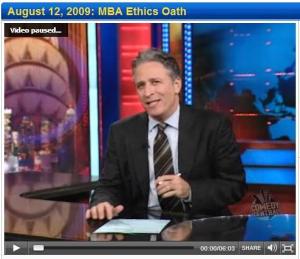
Nicolai Facebooked this the other day but neglected to share it with the wider blogosphere. The clip made me laugh out loud. Of course, I don’t agree with the premise, that business schools are responsible for the current crisis (and that the MBA Oath, which we discussed before, is the solution). But it’s still funny as Hades.
Rose Friedman and Frank Knight
| Peter Klein |
You probably heard that Rose Friedman died yesterday. I haven’t read the Friedmans’ memoir and didn’t know, until Ross Emmett and Greg Ransom pointed it out yesterday, that Rose had been Frank Knight’s research assistant at Chicago and was planning a PhD dissertation on capital theory. She never finished nor, to my knowledge, published anything on the topic. What do you think she would have written? Knight produced very few PhD students (perhaps, given his idiosyncratic views, he was not the ideal dissertation adviser) and it would be interesting to know more about Rose’s experiences and her views on capital (presumably close to Knight’s, not Hayek’s).
Here’s what she says in Two Lucky People (p. 51):
After considerable discussion with Professor Knight, I decided that I would concentrate on a history of capital theory as a Ph.D. thesis topic. It would fit into my assisting with his research and was a kind of research that I found interesting. Knight approved, adding, “I have been working on that for twenty years without success but perhaps you will succeed.” I never did. During Milton’s and my honeymoon, I completed drafts of the contributions to capital theory by Longfield and Senior. However, when we started life in New York, I went to work for the National Bureau [of Economic Research] on a bond study postponing, I thought temporarily, my dissertation. I have never finished it.
Greif’s Response to Rowley
| Peter Klein |
Avner Greif has written a response to Charles Rowley’s odd claim that Greif “denied Janet Landa her full intellectual property rights with respect to her contributions to the economic analysis of trust and identity.” Public Choice, which published Rowley’s critique, will run the reply. Avner kindly sent me an advance copy and gave me permission to post it here. Full text below the jump.
My $0.02: This is a very effective reply, pointing out that Landa’s and Greif’s explanations for trust are quite different (one based on preferences, the other on beliefs). Avner, perhaps wisely, steers clear of the general epistemological problem: How do you know if scholar A has cited predecessor B “enough”? Expecting A to show he hasn’t unfairly neglected B is asking A to prove a negative. Ultimately, the whole exercise seems petty to me. B’s defenders should focus on elevating B’s reputation, not complaining about A, C, and D’s failure to show the love.
The Curious Commentary on the Citation Practices of Avner Greif
By Avner Greif
August 2009
Forthcoming at Public Choice
Abstract: Rowley (2009) failed, among other faults, to recognize the substantive distinction between the lines of research pursued by Professor Landa and myself. Its claim that I have “expropriated” (p. 276) intellectual property rights from Professor Landa by insufficiently citing her works is vacuous. (more…)
Times Are Tough
| Peter Klein |
At the University of Southern Mississippi, which is responding to the economic crisis by eliminating its economics department (Tomas Sjostrom via Sandeep Baliga). Even tenured faculty will go
Stanford dumped its Food Research Institute (where a good friend of mine was employed) about a decade ago, also terminating the contracts of tenured economists, though not in response to a particular external event (as far as know). I’m sure there are other examples. Thank goodness it wasn’t sociology!
Your Vote Counts After All!
| Peter Klein |
The average American had a 1-in-60 million chance of affecting the outcome in the last Presidential election. Boy, do I feel bad!
Mintzberg Interview
| Peter Klein |
 A short interview with Henry Mintzberg, mostly about his forthcoming book Managing, in today’s WSJ (not sure if it is gated). Best line:
I talk about what I call “the inevitably flawed manager.” We’re all flawed, but basically, effective managers are people whose flaws are not fatal under the circumstances. Maybe the best managers are simply ordinary, healthy people who aren’t too screwed up.
Obama Administration Needs Sociologists
| Peter Klein |
And fewer economists, according to the sociologists interviewed by Inside Higher Ed:
Donald Tomaskovic-Devey, a professor of sociology at the University of Massachusetts at Amherst, described watching the news in December, as the economy was in a free fall and Barack Obama, as president-elect, was naming people to key positions in his administration. From the social sciences, he said, it was “the same old cast of characters,” and that means economists.
Obama’s election had brought “a sense of possibility,” but “as a sociologist I was pissed off,” he said.
“I have economist envy on a good day and worse things on a bad day,” he said.
I have great respect for my sociologically trained brethren and sistren (cistern?) but am not sure what, exactly, they are asking for. One sociologist thinks economists downplay race and gender — “their supply and demand curves don’t deal with these questions” — which is silly, as much of the analysis of subprimes by labor economists focuses exactly on this. I’m not claiming that sociology (or anthropology or history or psychology) has no useful policy implications, of course, only asking for specifics. (more…)
Four Talks on Keynes
| Peter Klein |
Videos from February’s inaugural event of Duke University’s Center for the History of Political Economy, a series of lectures on Keynes:
- Maynard Keynes of Bloomsbury by Craufurd Goodwin
- Keynes as Policy Advisor by E. Roy Weintraub
- Keynes and Economics by Kevin D. Hoover
- Keynes and Hayek by Bruce Caldwell
The texts are here. Thanks to Ross Emmett for the pointer.
Greif Under Fire Again
| Peter Klein |
We noted previously Jeremy Edwards and Sheilagh Ogilvie’s challenge to Avner Greif, contenting that he misread his primary source material, and Greif’s response. Now Charles Rowley has published a paper in Public Choice accusing Greif of academic dishonesty, namely by failing to cite Janet Landa’s prior work on the economics of identity and trust:
This commentary demonstrates that Avner Greif, through his citation practices, has denied Janet Landa her full intellectual property rights with respect to her contributions to the economic analysis of trust and identity. He has done so by systematically failing to cite her published papers in this field, incidentally promoting his own publications as meriting priority. In consequence, he has effectively blocked out Janet Landa’s work from the mainstream economics literature, albeit not from the literature of law and economics, where his own writings have not been directed.
It’s an odd piece. I’m not sufficiently familiar with Landa’s work to evaluate its place in the history of thought in this area, or to judge whether Greif has appropriated her ideas without attribution. Rowley doesn’t accuse Greif of plagiarism, only of failing to cite an important predecessor and overstating the novelty of his own work. This is a difficult claim to substantiate; obviously the evaluation of prior contributions in one’s own area is highly subjective. And the implication (later in the piece) that Greif’s citation practices contributed to his Genius Award seems like a cheap shot. It is true, however, that contemporary economists tend to be woefully ignorant of the history of economic thought (and, as Rowley implies, that game theorists have what might be called a “healthy sense of self”).
Update: I missed earlier discussions of the Rowley piece at Monkey Cage and Crooked Timber. The Monkey Cage commentary is disappointing, mostly ad hominem snarks at Rowley, the field of public choice, and (most bizarre, but it’s Brad Delong), the Mont Pelerin Society. Henry’s analysis at Crooked Timber is more serious, and I think he gets it right.
Coasean Bargaining Around Wrigley Field
| Peter Klein |
While enjoying the Phillies’ 12-inning victory over the Cubs Tuesday night Joe Mahoney, Jongwook Kim, and I talked about the implications of the Coase Theorem for the Wrigley Rooftops. The rooftop seats are still there — and some are quite fancy — despite many attempts by the Cubs over the years to have them removed, as beneficiaries of an unwarranted positive externality. Apparently a few years back the Cubs sought an injunction against the rooftop owners on grounds of copyright infringement, and most of the owners agreed in an out-of-court settlement to pay royalties to the team in exchange for official endorsement.
One can imagine other ways to internalize the externality — the team could build a wall to obscure the view, buy out the rooftop buildings’ owners, or pay them to take down the seats. There are only a dozen or so buildings, so I don’t imagine that the bargaining costs are very high, suggesting that the current arrangement is the one that maximizes joint surplus, but some of you readers must be much more familiar with the details. What’s going on, from a Coasean perspective? Certainly this is an interesting example for a classroom discussion of property rights and the Coase Theorem. I thought I’d find several online discussions but a quick Google search came up with just one law-review article. It seems that more recently, the club has been going after the rooftop owners not for selling seats, but for using the Cubs logo without permission.
Heterogeneity and Health Care
| Peter Klein |
Further to Russ’s post: One of the most frustrating aspects of the discussion surrounding health-care reform is the tendency of politicians, activists, and even a few economists to talk about “health care” as if it’s a homogeneous blob, or an intangible thing like “love” or “happiness.” Of course, what we produce and consume, what we exchange on markets, is not “health care” but specific, discrete health-care goods and services (procedures, medications, insurance policies, etc.). If you never go to the doctor and consume only one aspirin per year, do you have “health care”? If not, what specific bundle of goods and services constitutes a unit of “health care”?
Once we realize we are really talking about discrete, marginal units of particular goods and services the very notion of “universal access to health care” becomes problematic. What exactly is it that people have a universal right to? It’s analogous to debates about the environment. One can have a sort of philosophical or meta-economic commitment to “the environment,” and its protection (hoo-boy), but this means very little in terms of specific trade-offs at the margin. Is it better to have one more house or airport runway or corn field, or one more patch of meadow or forest? Being an “environmentalist” doesn’t answer that question. You know the old story: everybody values “safety,” but that doesn’t mean you never leave your house or, when you do, drive to work in a Sherman tank. You willingly sacrifice some amount of safety in exchange for units of other scarce and valuable goods (like access to the world outside your house, time spent traveling, money). Each of us evaluates this trade-off differently. Likewise, the marginal valuations of specific health-care goods and services, relative to other consumption and investment goods, cash balances, etc. varies from individual to individual. There’s no such thing as “health care.” As always, heterogeneity matters.
John Hughes
| Peter Klein |
You probably heard that John Hughes, director of the great youth comedies of the 1980s, passed away last week. Perhaps his most lasting achievement was making a star out of Ben Stein. Everyone knows “Bueller? Bueller?” and “Anyone? Anyone?” But do you remember the subject of Stein’s famous lecture?
Naturally, when Hollywood wants to portray the most boring academic subject imaginable, it turns to. . . .
Statistics Is Sexy
| Peter Klein |
So say Hal Varian, Erik Brynjolfsson, and Peter Orszag, among others quoted in this NY Times piece (via Laura M). “I keep saying that the sexy job in the next 10 years will be statisticians,” says Varian, who now toils away as chief economist at Google, though he’s not far from the hearts of most economics PhD students. Here’s Brynjolfsson: “We’re rapidly entering a world where everything can be monitored and measured. But the big problem is going to be the ability of humans to use, analyze, and make sense of the data.”
The article doesn’t actually say much about the substance of the “new” statistics, but the writer has in mind inductive, very-large-N, data-mining exercises (the kind of analysis not taught to social-science and business-administration graduate students, except perhaps some marketing and finance PhDs). Of course we still make our students take multiple semesters of classical statistics and econometrics.
Solution to a Credit Bubble? More Credit
| Peter Klein |
As noted before (1, 2, 3), policymakers (and some economists) seem immune to the argument that the credit bubble may have been caused by, you know, too much credit, and that encouraging people to increase their debt levels even more might not be the optimal policy response.
Bill Shughart, a very good economist, notes some disturbing parallels between the monetary and regulatory policies that led to the housing crisis and the US government’s “cars for clunkers” program. Whatever its effect on improving air quality (marginal) or stimulating aggregate demand (barf), one consequence is that people who would not otherwise have taken out a new car loan will do so, increasing total and average leverage in the economy. Will banks be pressured to extend new-car credit to “subprime” borrowers? Well, if all you care about is total lending, this is a good thing.
Better Coauthoring Tools in Office 2010
| Peter Klein |
Despite several highly rewarding coauthoring relationships I do write some papers by myself. One problem with coauthored papers and presentations, as you probably know, is version confusion: Am I editing the latest version? Is one of my coauthors editing the same version at the same time? Did I remember to accept or reject her changes before working on mine? As the number of coauthors increases to three or even four, these coordination problems multiply.
According to WWD the new version of Office includes much better coauthoring tools:
Word 2010, OneNote 2010, and PowerPoint 2010 now include a co-authoring feature, enabling multiple authors to work on the same document at the same time. This is a welcome change from having to use SharePoint, where only one author at a time can check a document out for editing. The addition of co-authoring is really ratcheting Office 2010’s collaboration options.
In related news, the newest version of Skype allows you to share your desktop with a colleague, which might be another good way to make slides for a joint presentation.
Short Piece on Probability Theory
| Peter Klein |
“Risk, Uncertainty, and Economic Organization” is my contribution to the Hoppe Festschrift. I got the topic idea from some blogger guy. My chapter focuses, as the title suggests, on Knightian uncertainty. Hoppe places Knight, along with Ludwig von Mises, squarely in the frequentist camp (typically associated with Ludwig’s brother Richard). I tend to agree with Hoppe although, as I discuss in the paper, there are many interpretations of Knight, and some commentators argue that subjective (Bayesian) probability theory renders untenable the Knightian distinction between insurable risk and true uncertainty (see, for example, Dick’s 1982 paper).
Ultimately, however, I don’t think the approach to the firm promoted on this blog depends on a particular interpretation of Knight. The central claim is that judgment represents a kind of decision-making that cannot be traded on the market, and that therefore requires the entrepreneur exercising such judgment to establish a firm (more specifically, to take ownership of capital resources). To put it differently, ownership of assets implies a kind of ultimate responsibility that the owner cannot delegate. I think one can be agnostic about exactly why judgment isn’t tradable — it could be a form of asymmetric information, rather than ontological differences between types of knowledge — and still buy the basic Knight-Mises-Foss-Klein approach to the firm.
HR Graphic of the Week
| Peter Klein |
From Wired’s “New Rules for Highly Evolved Humans” feature: “Use a Plausible Excuse When You Call In Sick.”

The Integration of Micro and Macroeconomics from a Historical Perspective
| Peter Klein |
That’s the title of a conference next week at the University of São Paulo featuring eminent economists and historians of economic thought such as Robert Gordon, Kevin Hoover, Wade Hands, and Phil Mirowski. According to the conference website the proceedings will be streamed live, so you can participate even if you can’t make it to São Paulo.





 Organizations and Markets
Recent Comments