Author Archive
Introducing Guest Blogger Russ Coff
| Peter Klein |
We’re delighted to introduce Russell Coff as our newest guest blogger. Russ is Associate Professor of Organization and Management at Emory University’s Goizueta Business School. He has published widely on the knowledge- and resource-based foundations of competitive advantage, with a particular focus on human capital and its role in M&A, compensation policy, and other aspects of organizational design. Russ is past Chair of the Academy of Management’s BPS Division and will be pretty busy leading up to and during the AoM meeting, but he’s promised to carve out some blogging time now and between sessions. We’re really looking forward to his insights. Welcome, Russ!
Plus ça change. . .
| Peter Klein |
Another quip from 1215:
The politician’s need to peer at least a short distance into the future, in the hope of getting the timing of difficult choices right, meant that few rulers could afford to dismiss astrology. Non-astronomical methods were tried too: Henry II’s chancellor, Thomas Becket, consulted a palm-reader before embarking on an expedition against the Welsh in 1157. But the transfer of Arabic science made astrology the most impressively academic of all methods for telling the future in the twelfth-century West and many rulers turned to astrologers much as politicians today turn to economists.
Danzinger and Gillingham go on to discuss some twelfth-century critics of astrology: “Evidently then, as now, different people held varying opinions about the science of forecasting.”
IBM Buys SPSS for $1.2 billion
| Peter Klein |
Wow. “In acquiring SPSS, IBM said it was expanding its focus on business-analytics technology and services to meet a growing client need to cut costs. According to IDC estimates, the world-wide market for business analytics software will grow by 4% to $25 billion this year.” SPSS must be the most valuable product ever created by a political science professor. (I may or may not mean just monetary value.) HT: Cliff.
Alliances and Internal Capital Markets
| Peter Klein |
An interesting contribution to the literature on internal capital markets from David Robinson, “Strategic Alliances and the Boundaries of the Firm,” appeared recently in the Review of Financial Studies (now the third-ranked journal in finance behind the JF and JFE):
Strategic alliances are long-term contracts between legally distinct organizations that provide for sharing the costs and benefits of a mutually beneficial activity. In this paper, I develop and test a model that helps explain why firms sometimes prefer alliances over internally organized projects. I introduce managerial effort into a model of internal capital markets and show how strategic alliances help overcome incentive problems that arise when headquarters cannot pre-commit to particular capital allocations. The model generates a number of implications, which I test using a large sample of alliance transactions in conjunction with Compustat data.
The model builds on Williamson’s concept of forbearance, the idea that courts will enforce contracts between distinct legal entities but will not intervene in intra-firm disputes. The idea is that moving project with particular characteristics — Robinson calls them “longshots” — from a subunit of a diversified firm to an alliance partner allows the firm’s management to make a credible commitment not to expropriate value from the project manager ex post. Empirical evidence shows that projects with longshot characteristics, measured in various ways using Compustat segment data, are indeed more likely to undertaken by alliance partners. A nice paper with a good mix of theory and evidence.
Is This In the Training Manual for Academic Deans?
| Peter Klein |
Matilda, mother of King Henry II, advising her son on the business of royal patronage (quoted in Danny Danzinger and John Gillinghman, 1215: The Year of Magna Carta, London, Hodder and Stoughton, 2003, p. 178):
He should keep posts vacant for as long as possible, saving the revenues from them for himself, and keeping aspirants to them hanging on him hope. She supported this advice by an unkind parable: an unruly hawk, if meat is often shown it and then snatched away or hid, will become keener, more attentive, and more obedient.
 Speaking of deans, I happened to catch Indiana Jones and the Kingdom of the Cyrstal Skull the other day. The film, you probably know, takes place in the 1950s and centers on Indy’s confrontation with a group of Soviet treasure-hunters. Early in the film Indy loses his academic post because of suspected Communist sympathies. At the end, after defeating the bad guys (hope that’s not a spoiler), Indy not only gets his job back, but is made Associate Dean. That this is considered a reward shows how little anyone in Hollywood knows about university life!
Thanks to Guest Blogger Benito Arruñada
| Peter Klein |
Thanks to Benito Arruñada for a provocative and insightful series of posts over the last few weeks. We look forward to Benito’s continuing participation in the comment threads here at O&M. You can also follow the action (in English and Spanish) at Benito’s own blog.
Watch for more guest bloggers to be announced soon!
More on Wall Street
| Peter Klein |
Further to my recent Wall Street post, see Jeff Tucker’s take, “Capitalism as Drama”:
In the same way that the Godfather movies shaped the culture of organized crime, Wall Street continues to influence the way traders and high-flying capitalists understand themselves.
And it’s no wonder. The impression one is left with is all about the courage, the thrill of the fight, the riskiness of entrepreneurship, that struggle to obtain vast wealth, and the striving for the status of “master of the universe.” It pictures commerce as a gladiator fight, a magnificent and relentless struggle for progress, an epoch and massively important terrain in which the fate of civilization is determined. (more…)
Scandals and Financial Panics in Historical Perspective
| Peter Klein |
The Spring 2009 issue of Business History Review focuses on scandals and panics. Here’s the TOC. Follow the link for abstracts and ordering information.
A SPECIAL ISSUE ON SCANDALS AND PANICS
With an introduction by guest-editor Per H. HansenNaomi R. Lamoreaux: “Scylla or Charybdis? Historical Reflections on Two Basic Problems of Corporate Governance”
Thomas Max Safley: “Business Failure and Civil Scandal in Early Modern Europe”
Richard Sylla, Robert E. Wright, and David J. Cowen: “Alexander Hamilton, Central Banker: Crisis Management during the U.S. Financial Panic of 1792”
Eric Hilt: “Rogue Finance: The Life and Fire Insurance Company and the Panic of 1826”
Edward J. Balleisen: “Private Cops on the Fraud Beat: The Limits of American Business Self-Regulation, 1895-1932”
Federal Reserve “Independence”
| Peter Klein |
I was invited to sign the Open Letter in support of Fed independence but, like Jerry O’Driscoll, Bob Higgs, and Larry White, I don’t support the cause. Follow the links above for detailed arguments. For my part:
1. The Open Letter focuses exclusively on monetary policy, as if the Fed’s Congressional critics like Ron Paul just want to know how the Federal Funds Rate is set. But the Fed conducts not only monetary policy, but fiscal policy as well, especially during the last 18 months. If the Fed can buy and hold any assets it likes, if it works hand-in-hand with the White House and the Treasury to coordinate trillion-dollar bailouts, isn’t it reasonable to have some oversight? (And don’t forget bank supervision. Even the Fed’s defenders recognize a need to separate its monetary-policy and bank-supervision roles. But as long as the Fed continues as a bank regulator, shouldn’t someone should be watching the watchmen?)
2. The Open Letter itself is poorly crafted, full of unsubstantiated assertions and misleading statements. There’s no argument there, as Higgs emphasizes. Actually, neither the time-series or cross-sectional evidence suggests any correlation between central-bank independence (whatever that means) and economic performance.
3. More generally, the Fed is a central planning agency, and it performs about as well as every central planning agency in history. Have we learned nothing from the huge literature on comparative economic systems? “Independence,” in this context, simply means the absence of external constraint. There are no performance incentives and no monitoring or governance. There is no feedback or selection mechanism. There is no outside evaluation (outside the blogosphere). Why on earth would we expect an organization operating in that environment to improve social welfare? Is this institution run by men, or gods?
Rizzo on “Methodological Exclusivism”
| Peter Klein |
Great anecdotes on contemporary social-science methodology in Mario Rizzo’s post, “The Failure of Macroeconomics” (including the comments). Young economist to senior scholar: “All that is in Adam Smith.” Senior scholar: “Maybe — but until my theory it was not science.” Deepak Lal asks distinguished colleague what should be done about the current crisis. Reply: “I do not consider that an intellectually respectable question.” My own beloved dissertation adviser indulged my quirkier interests, but stated plainly: “Methodology is a swamp.” And of course there’s the famous Ed Leamer analogy.
Here’s Mario’s take:
This is the great problem with economics today: methodological exclusivism (or in my more intemperate moments I call it “methodological fascism”).A young person goes to graduate school. He or she is filled with the excitement of ideas. Today, in particular, some may come with a great desire to understand what has happened in the real world of the bailouts, recessions, stimulus, and so forth. And then academic reality hits.
Formal modeling, axiomatic foundations, tractability, technical power, and topological studies. Shall I get an MA in mathematics? Do I need to take a third semester of macro-econometrics? . . .
It seems pretty clear that what we have is a collective insecurity. If we open the floodgates to methodological inquiry, or even worse, to methodological pluralism, we shall become like political science, or God forefend, like sociology. So let’s keep those with disruptive instincts out of the profession. If this is not possible, then let’s at least keep them out of the good schools.
If you’re feeling subversive, you can browse our methodology/theory of science archive for more forbidden thoughts. (more…)
The Organization of Firms Across Countries
| Peter Klein |
Interesting new NBER paper by Nicholas Bloom, Raffaella Sadun, and John Van Reenen, “The Organization of Firms Across Countries” (ungated version here, may be older):
We argue that social capital as proxied by regional trust and the Rule of Law can improve aggregate productivity through facilitating greater firm decentralization. We collect original data on the decentralization of investment, hiring, production and sales decisions from Corporate Head Quarters to local plant managers in almost 4,000 firms in the US, Europe and Asia. We find Anglo-Saxon and Northern European firms are much more decentralized than those from Southern Europe and Asia. Trust and the Rule of Law appear to facilitate delegation by improving co-operation, even when we examine “bilateral trust” between the country of origin and location for affiliates of multinational firms. We show that areas with higher trust and stronger rule of law specialize in industries that rely on decentralization and allow more efficient firms to grow in scale. Furthermore, even for firms of a given size and industry, trust and rule of law are associated with more decentralization which fosters higher returns from information technology (we find IT is complementary with decentralization). Finally, we find that non-hierarchical religions and product market competition are also associated with more decentralization. Together these cultural, legal and economic factors account for four fifths of the cross-country variation in the decentralization of power within firms.
The emphasis on institutional determinants of organizational form makes this a welcome addition to the (slim) set of papers relating institutional arrangements to the institutional environment. (more…)
Social Media Venn Diagram
| Peter Klein |
In case you haven’t seen it (via Randy):

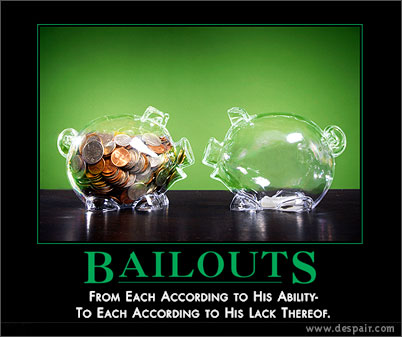
From the good folks at Despair, Inc. Don’t miss their new bailout-themed tees here and here. And here’s a good one for Facebook users.
Videos from Entrepreneurship Research Exemplars Conference
| Peter Klein |
Dick blogged previously about the Entrepreneurship Research Exemplars Conference held at UConn in May. The conference organizers have uploaded videos of the keynote speeches by Howard Aldrich, Jay Barney, Mike Hitt, Duane Ireland, Patricia McDougall, and Venkat Venkataraman. You can also watch the editor/author panel sessions in which editors of AMJ, AMR, ET&P, JAP, JBV, JOM, JMS, Org Science, SEJ, and SMJ discuss publication strategies and authors of recently published papers talk about their experiences with writing and revision (Fabio, direct ’em here!). I especially like the SEJ session featuring Yasemin Kor’s discussion of this excellent paper, which I’m told is the most-downloaded paper on the SEJ website. Go figure.
The Five-Minute University
| Peter Klein |
This clip is making the rounds. How many of you Old Timers remember Father Guido Sarducci? Both economics and business get mentioned.
Lamoreaux and Sokoloff’s Financing Innovation in the United States
| Peter Klein |
Nice EH.Net review by Charles Calomiris of Naomi Lamoreaux and Sokoloff’s edited volume Financing Innovation in the United States: 1870 to the Present (MIT Press, 2007).
Anyone interested in the organization of innovation, and the nexus between finance and the organization and process of innovation, must read this book. All of the chapters are original, scholarly, and packed with insightful gems (truly a font of inspiration for Ph.D. students), and the analysis manages to be both sophisticated (theoretically and statistically) and accessible to a broad audience. While the volume is too rich to boil down to a single theme, the editors’ introduction does point to a common thread that runs through many of the essays: “… perhaps the most striking aspect of the record of innovation over American economic history is the flexibility that technologically creative entrepreneurs have exhibited in adjusting their business and career plans so as to obtain financing for, and extract returns from, their projects.”
Goldman Sachs, Best in the Business
| Peter Klein |
 The business of political capitalism, that is. Like Enron, Goldman operates primarily in the nebulous world of public-private interaction. It is the US’s most politically powerful financial firm, skilled at navigating the byzantine regulations governing the virtually nationalized US financial sector. Goldman’s eye-popping $3.4 billion second-quarter earnings shouldn’t surprise anyone; as Craig Pirrong notes, these earnings reflect good old-fashioned moral hazard, with Goldman exploiting its too-big-to-fail status by taking on huge amounts of risk:
Goldman knows it is too big to fail. How does it know this? Well, the government bailed out AIG not so much for AIG’s sake, but for the sake of big AIG counterparties — most notably Goldman. Moreover, given the conventional wisdom that the government’s primary error in the financial crisis was its failure to bail out Lehman — a piker compared to Goldman — it doesn’t take a rocket scientist to figure out that it won’t repeat that mistake in the future, and let Goldman go down. So Goldman knows it can get bigger, and take more risk. It is the classic heads Goldman wins, tails the sucker taxpayer eats the loss gambit. If nobody steps in to rein in the firm, it will continue to add risk, thereby enhancing the value of the Treasury put hiding in the equity entry on its balance sheet.
Somebody should be stepping in — but nobody is. Why not? Partly, no doubt, it is Goldman’s political heft. It is likely too that important policy makers don’t want to crack down on a major source of risk capital to the markets in the fear that this would impede a recovery. Even though in reality, that risk capital is your money and mine, with the exception that we have no chance of capturing the upside, and are left with a good chunk of the downside. This is a piece with the hair-of-the-dog strategy being pursued by Treasury and the Fed.
Teaching Generation Me
| Peter Klein |
Thanks to Maria Rodriguez for passing along this gem: Jean M. Twenge, “Generational Changes and their Impact in the Classroom: Teaching Generation Me,” Medical Education 43(5): 398-405. From the abstract:
Methods: This paper reviews findings from a number of studies, most of which rely on over-time meta-analyses of students’ (primarily undergraduates’) responses to psychological questionnaires measuring IQ, personality traits, attitudes, reading preferences and expectations. Others are time-lag studies of nationally representative samples of high school students.
Results: Today’s students (Generation Me) score higher on assertiveness, self-liking, narcissistic traits, high expectations, and some measures of stress, anxiety and poor mental health, and lower on self-reliance. Most of these changes are linear; thus the year in which someone was born is more relevant than a broad generational label.
In the immortal words the Bette Midler character from Beaches: “But enough about me, let’s talk about you. . . . What do you think of me?”
Kline Mystery Solved
| Peter Klein |
Thanks to Maureen Kline for solving the Peter Kline mystery:
Hi, just came across this post although it’s over a year old and you have surely solved the mystery by now; the “real” Peter Kline is my father, who currently lives in the Washington DC area (Silver Spring, MD). He started out as an English and Drama teacher in Washington area private schools, and co-founded Thornton Friends School in the 1970s. The school had a very innovative approach and great success, particularly in turning around “problem students.” Eventually he and his then-wife Nancy turned the school over to others to pursue other projects, and Dad has been “free-lancing” ever since, mainly training teachers in various school systems around the country, writing the books you mentioned, and doing extensive training within companies (Kodak, IDC and others).
Update: PK himself checks in with a comment to the original post.
Peter: If you get any of my letters from the Nobel Committee, will you please pass them on?
Ken Lay as Political Capitalist
| Peter Klein |
This blog has taken a special interest in Ken Lay, not just because of his local connections but also because he typifies the modern CEO of a regulated industry, more lobbyist and PR man than manager. Lay, a long-time energy regulator before becoming Enron CEO, was skilled in the ways of Washington — making his reputation as poster-boy for “unbridled capitalism” all the more ironic.
Here is Rob Bradley, quoting from his book Political Capitalism, on Lay and Enron:
Who was Ken Lay, the architect and chairman of Enron from its formation in the mid-1980s until its bankruptcy? The once-celebrated visionary of the energy industry was not an engineer, as were most leaders in the energy sector. Lay did not possess an accounting or finance background, as did some senior executives. He never clawed his way up the corporate ladder in various operational divisions, much less built a company from scratch. No, Enron’s leader was a Ph.D. economist, interested in the big picture and the ways of political power. His résumé was top-heavy with Washington experience, acquired at three federal jobs, the last two regulating the energy industry. . . .
Government favor propelled Enron’s profit-centers in domestic power plants, natural gas and electricity marketing, wind and solar power, infrastructure in underdeveloped countries, and unconventional natural gas production. Enron was all about complex federal laws and administrative regulations, such as special provisions within the Natural Gas Policy Act of 1978, Public Utility Regulatory Policies Act of 1978, Omnibus Budget Reconciliation Act of 1990, and Energy Policy Act of 1992 — or FERC rulings such as Regulation of Natural Gas Pipelines after Partial Wellhead Decontrol (FERC Order No. 436: 1985), Pipeline Service Obligations and Revisions to Regulations Governing Self-Implementing Transportation Under Part 284 of the Commission’s Regulations (FERC Order No. 636: 1992), and Promoting Wholesale Competition Through Open Access Non-discriminatory Transmission Services by Public Utilities; Recovery of Stranded Costs by Public Utilities and Transmitting Utilities (FERC Order 888: 1996). The arcane was pure gold to Enron.





 Organizations and Markets
Recent Comments