Author Archive
Corrected Winter Quote
| Peter Klein |
I misquoted Sid Winter in this post. Here’s what he actually said:
“High standards for statistical techniques are tending to crowd out high standards for performance on the central scientific task, causal explanation.”
I was going from memory, then later found the exact wording in my notes. The meaning is the same, but I wanted to correct this for the historical record.
Department of They Just Don’t Get It
| Peter Klein |
Paul Ehrlich, author (with Anne Ehrlich) of The Population Bomb (1968), one of the biggest, um, bombs of the last several decades, is unrepentant. Ehrlich’s main thesis was that the world was running out of natural resources, and population growth was expanding exponentially, leading to an inevitable decline in living standards. Needless to say, none of the three predictions came true, and Bomb became one of those books that cultural anthropologists study for its train-wreck value. Now, apparently for laughs, the Electronic Journal of Sustainable Development has invited the Ehrlichs to write “The Population Bomb Revisited” for a forthcoming symposium. After all these years, the Ehrlichs are no closer to grasping the Econ 101 concept of “resources,” namely means used by human actors to achieve desired ends — not physical stocks of raw materials, but raw materials interacted with human knowledge and purpose. (more…)
The Sociological Imagination
| Peter Klein |
That’s the name of a new sociology blog started by grad students Josh McCabe, David Pontoppidan, and Brian Pitt. I’m already enjoying the first few posts. These guys are influenced by economics (in particular, Austrian economics), so watch out.
New Directions for SSRN
| Peter Klein |
I see that registered users of SSRN can now post comments on other people’s papers. Maybe this feature has been around for some time but I just noticed it. Is this a small step toward open-source peer review? Or a move toward social networking? (What’s next, the SSRN status update or Super Poke?)
McNamara
| Peter Klein |
 I haven’t read all the obituaries of Robert S. McNamara, who died early this morning, but the ones I’ve seen focus almost exclusively on his tenure as US Secretary of Defense during the Vietnam War. Few mention how he got to be Secretary — an HBS professorship, WWII experience in procurement as a member of Tex Thornton’s “Whiz Kids,” a stint at Ford Motor Company after the war, and the presidency of Ford just before taking the job as Defense Secretary. The Times notes, in passing, that “Mr. McNamara had risen by his mastery of systems analysis, the business of making sense of large organizations — taking on a big problem, sorting it out, studying every facet, finding simplicity in the complexity.” Um, OK, I guess that’s one way to describe it. In any case, none of the obituaries I’ve seen so far discusses this in any detail, or seems to realize that McNamara’s approach to managing large organizations is controversial among researchers and practitioners.
Here’s a brief comment I made last year on McNamara’s management style.
The Higher Education Bubble
| Peter Klein |
Will it be the next to burst? Yes, say Joseph Marr Cronin and Howard E. Horton. “Consumers who have questioned whether it is worth spending $1,000 a square foot for a home are now asking whether it is worth spending $1,000 a week to send their kids to college. There is a growing sense among the public that higher education might be overpriced and under-delivering.” Of course it is, which explains the unbridled hostility of the higher-ed establishment toward alternative organizational models. Adds Mark Taylor:
Make no mistake about it, education is big business and, like other big businesses, it is in big trouble. What people outside the education bubble don’t realize and people inside won’t admit is that many colleges and universities are in the same position that major banks and financial institutions are: their assets (endowments down 30-40 percent this year) are plummeting, their liabilities (debts) are growing, most of their costs are fixed and rising, and their income (return on investments, support from government and private donations, etc.) is falling.
These commentators do not, however, speculate on root causes. There’s no doubt the traditional model for producing higher education is grossly inefficient and that there’s been tremendous overinvestment in facilities and staff (malinvestment, in Austrian lingo) over many decades. But why, and why now? One hypothesis is that the democratization of higher education that began in the 1960s not only increased enrolments, but created a wedge between expectations of faculty (we’re here to create and disseminate knowledge and to challenge, engage, and enlighten our students — in the humanities, to teach them political slogans) and those of students (we’re here to party, find mates, and prepare for the job market). Another possibility is that political correctness has distorted the curriculum, creating large and well-funded departments in ethnic studies and postmodern literature with high overhead and few students, leaving insufficient resources for, and interest in, traditional subjects like math and history. What are some other hypotheses? (Thanks to Dennis Lubahn for the pointers.)
Scott Shane Blogging at the NYT
| Peter Klein |
Scott joins the “You’re the Boss” blogging team (via Dane Stangler).
The Professional Strategy of the Early Austrian Economists
| Peter Klein |
O&M, like other niche academic blogs, deals occasionally with the history and sociology of this or that school of economic or management thought. We think often about professional strategy — how to promote our ideas, how to secure financial and institutional support, how to recruit students and fellow-travelers (“groupies,” according to Nicolai), what competing and complementary movements and schools of thought (not to mention rival blogs) are up to, and so on.
Given our close association with the Austrian school, you might be surprised to learn that the founding Austrians were not at all “strategic” in this sense. They held strongly to the view that truth wins out in the long run, so there is no need to build formal institutions or establish a “movement.” This comes out in a passage from Mises’s recently released Memoirs (a new translation of his earlier Notes and Recollections):
It is necessary to correct the misunderstandings that can be called forth by using the expression “Austrian School.” Neither Menger nor Böhm-Bawerk wanted to found a school in the sense customarily used in university circles. They never attempted to turn young students into blind disciples, nor did they, in turn, provide these same students with professorships. They knew that through books and an academic course of instruction they could promote an understanding suited to dealing with economic problems, thus rendering an important service to society. They understood, however, that they could not rear economists. As pioneers and creative thinkers, they recognized that one cannot arrange for scientific progress, nor breed innovation according to plan. They never attempted to propagandize their theories. Truth would prevail of its own accord when man possessed the faculties necessary to perceive it. Using impertinent means to cause people to pay lip service to a teaching was of no use if they lacked the ability to grasp its substance and significance. (more…)
Does Macroeconomic Theory Influence Macroeconomic Policy?
| Peter Klein |
Not really, according to John Wood’s History of Macroeconomic Policy in the United States (Routledge, 2008). As David Wheelock notes in his EH.Net review:
Wood argues that U.S. fiscal and monetary policy have been remarkably consistent over the decades and largely uninfluenced by macroeconomic theory. Economists have rationalized more than influenced policy, Wood contends, and the direction of influence between economic theory and practice is primarily from the latter to the former.
This is of course the classic explanation for the spread of Keynesianism after 1936: rather than proposing a new approach to macroeconomic policy, the General Theory simply rationalized the massive deficit-spending and easy-money policies already in place (and long desired by disreputable economists such as Foster and Catchings).
Pioneers of Law and Economics
| Peter Klein |
Profiles of the leading scholars in contemporary law and economics, now out from Edward Elgar. Congratulations to Josh Wright and Lloyd Cohen for putting this together. Table of contents below the fold. (more…)
Journalists Duped Again
| Peter Klein |
From Walter Duranty to Judith Miller to recent reporting on the financial crisis (1, 2), the mainstream press continues to do what it has always done: print what it wants to be true, rather than investigate what’s actually going on. I got a chuckle out of the latest example: a French magazine that gave its student photojournalism award to a series of dramatic pictures of French youth living in poverty, only to learn the pictures were fakes. Oops! Not quite in the same class as the Sokal affair, but in the same spirit. (HT: Mario Rizzo.)
Slides from Foss-Klein PhD Course
| Peter Klein |
Slides from the PhD course, “The Theory of the Firm and Its Applications in Management Research I,” are now available on the course webpage (scroll down to the bottom).
PS: Did you notice the course title ends with “I,” implying there will be a II and maybe a III? Gotta love that precommitment device. It’s as if Stallone had named his first film “Rocky I.”
Doug North Line of the Day
| Peter Klein |
From Bob Margo’s EH.Net review of North, Wallis, and Weingast’s Violence and Social Orders: A Conceptual Framework for Interpreting Recorded Human History:
In my book people are iconic if I can summarize their life’s work in ten words or less. North takes two: “Institutions matter.”
He adds: “The opposite perspective — viewed in isolation most institutions don’t matter much, being Harberger triangles and small ones at that — has its fans in modern economics. But North has convinced the majority of economic historians, a goodly share of world’s development wonks, and the Nobel Prize Committee that he’s right.”
Update: Art Carden beat me to this.
Austrian Theory of the Firm Bleg
| Peter Klein |
This post is for devotees and fellow-travelers of the Austrian school. As some of you know I maintain an online bibliography of articles and books dealing with applications of Austrian economics to the theory of the firm (and strategic management more generally). Happily, this literature has grown dramatically in the last few years. Sadly, I have not had time to update the bibliography on a consistent basis. So, please send me your suggested additions and corrections (ideally with URLs). Self-nominations are welcome!
Sid Winter on Methodology
| Peter Klein |
Overheard at last week’s DRUID conference, in Sid Winter’s discussion of three papers on technology strategy:
“Our near-exclusive focus on statistical significance has distracted us from the main task of scientific explanation: the determination of cause and effect.”
Three cheers to Sid for standing with Menger over Walras!
Copenhagen Fun
| Peter Klein |
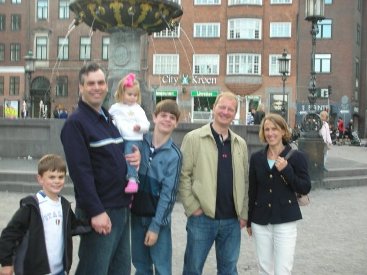
A selection of Kleins and Fosses at Gammel Torv in central Copenhagen (another Foss is in the background, hiding behind a lamppost, and the head of Clan Klein is behind the camera). No real reason to post this except to prove that Nicolai and I both smile occasionally. Note to colleagues at home: This is a business trip, I promise.
Rajshree Agarwal on the US Government’s Response to the Financial Crisis
| Peter Klein |
Nice interview with Rajshree Agarwal on the US government’s response to the financial crisis. “Has It Helped?” Rajshree’s answer in brief: No.
Show Us Some Love
| Peter Klein |
Thanks to Randy for these pictures of science-related tatoos. The phrase “beyond awesome” comes to mind. Who among you will be the first to get an O&M-themed body decoration?
Sameulson on the Crisis
| Peter Klein |
Is it wrong to pick on a 94-year-old? Mario Rizzo doesn’t think so, and neither do I — if it’s Paul Samuelson, perhaps the most influential economist of the twentieth century and bête noire to Austrians, libertarians, and many other types I hold near and dear. Samuelson, champion of “scientific” economics (i.e., the nineteenth-century physics model so effectively skewered by Phil Mirowski), the neo-Keynesian synthesis, and the everything-but-the-kitchen-sink approach to economics textbooks, now says prediction is impossible and deficit spending unsustainable. What’s next, a startling pronouncement that, contrary to what Samuelson wrote in the pre-1991 editions of his textbook, the Soviet Union was not actually more productive than the US?
Bonus Keynesian material (via Ross Emmett): Did Keynes die of a bad tooth?
Events @CBS
| Peter Klein |
I’ve just arrived in Copenhagen, where I’m spending a month as a visiting professor at the SMG. Copenhagen Business School has become one of the most intellectually exciting places in Europe. This week alone the school is hosting the DRUID summer conference which features people like Anita McGahan, Sid Winter, Will Mitchell, Russ Coff, Mike Ryall, and many others, along with a workshop on corporate governance with keynotes by Mark Roe, Randall Morck, Annette Poulsen, and Florencio Lopez-de-Silanes Molina. Of course these are only appetizers for the next week’s main course, the PhD seminar on The Theory of the Firm and Its Applications in Management Research conducted by Professors F. and K. Truly an embarrassment of riches!





 Organizations and Markets
Recent Comments