Author Archive
Peter L. Bernstein (1919-2009)
| Peter Klein |
I was saddened to learn (from Kenneth Anderson) that Peter L. Bernstein, author of Against the Gods: The Remarkable Story of Risk and other popular works, died June 5. Bernstein was a terrific writer and a clear and provocative thinker with a gift for making difficult concepts accessible. I was greatly influenced by an earlier book, Capital Ideas: The Improbable Origins of Modern Wall Street, which I came across in graduate school while searching for a dissertation topic. Bertstein’s characterization of the brokerage industry in the 1960s and early 1970s, before the deregulation of brokerage fees — an Old Boys Club, lacking competition and innovation — inspired me to examine the role of corporate internal capital markets in replicating the resource-allocation function normally performed by external capital markets, and how the growth and development of financial markets following liberalization contributed to the end of the conglomerate period.
Here are obituaries in the WSJ and NYT and here is Bernstein’s wiki.
Men of Few Words
| Peter Klein |
Those of you into Flesch-Kincaid scores and similar metrics probably appreciate men who can say a lot with a few words. The Bud Light “Dude” guy — whose Fog index, if my calculations are correct, is 1 — may be the best-known modern example:
He’s good, but before him there was Donnie Brasco:
Can your favorite academic writers be that parsimonious?
Fughetaboudit.
De Figueiredo on Political Strategy
| Peter Klein |
We’ve previously mentioned the chapters by Nicolai and Nils Stieglitz and by Lasse and me in the forthcoming Advances in Strategic Management volume titled Economic Institutions of Strategy. John de Figueiredo’s chapter, “Integrated Political Strategy,” is now available as an NBER Working Paper. John is a leader of this emerging field, which studies how firms attempt to influence the legal and political environment to achieve competitive advantage. As he points out:
Legal and acceptable competitive behavior is determined endogenously by legislators, regulators and judges who are influenced, positively and negatively, by the very same firms the regulations are designed to control. By understanding the theories of how firms affect politics, one can better determine how to gain competitive advantage through political institutions. This is a natural extension of the traditional tools of strategic management. Moreover, for young scholars, this is an area in which the lines of investigation are clear and the openings for serious research opportunities available. In this sense, it is robust area for future research and major contributions to understanding firm performance.
2009 SES Boot Camp
| Peter Klein |
Just received the Call for Papers for the 2009 edition of the Society for Entrepreneurship Scholars Manuscript Boot Camp, this year at Johns Hopkins University right before the SMS Conference in October. I participated last year and had a terrific experience (OK, it was at a ski resort, but that has nothing to do with it). Submissions due 4 August 2009. Details below the fold. (more…)
A Reason To Keep Laptops Out of the Classroom
| Peter Klein |
I missed this Doonesbury strip when it came out in 2007 (click to enlarge). Made me cringe. (HT: John Drobak)

Thanks to Mike Sykuta
| Peter Klein |
Thanks to Mike Sykuta for a great series of guest posts on contracting, transaction cost theory, and the crazy political and regulatory world around us. We look forward to Mike’s continued participation in the O&M comment threads and elsewhere in the blogosphere. If you need Mike you can reach him through the usual virtual channels or, if you prefer something meatier, let me know and I’ll walk the 10 feet to his office and bop him over the head.
The MBA Oath
| Peter Klein |
As a manager, my purpose is to serve the greater good by bringing people and resources together to create value that no single individual can create alone. Therefore I will seek a course that enhances the value my enterprise can create for society over the long term. I recognize my decisions can have far-reaching consequences that affect the well-being of individuals inside and outside my enterprise, today and in the future. As I reconcile the interests of different constituencies, I will face choices that are not easy for me and others.
Therefore I promise:
- I will act with utmost integrity and pursue my work in an ethical manner.
- I will safeguard the interests of my shareholders, co-workers, customers and the society in which we operate.
- I will manage my enterprise in good faith, guarding against decisions and behavior that advance my own narrow ambitions but harm the enterprise and the societies it serves.
- I will understand and uphold, both in letter and in spirit, the laws and contracts governing my own conduct and that of my enterprise.
- I will take responsibility for my actions, and I will represent the performance and risks of my enterprise accurately and honestly.
- I will develop both myself and other managers under my supervision so that the profession continues to grow and contribute to the well-being of society.
- I will strive to create sustainable economic, social, and environmental prosperity worldwide.
- I will be accountable to my peers and they will be accountable to me for living by this oath.
This oath I make freely, and upon my honor.
This comes from a group of second-year Harvard MBAs and was featured in last Friday’s New York Times (HT: MGK). Here’s their blog. I eagerly await the analysis of the O&M commentariat.
Seat-of-the-Pants Sports Management
| Peter Klein |
The WSJ recently ran a sort of anti-Moneyball piece on the NBA’s Denver Nuggets that belongs in our “by the numbers” series. Love the title: “Textbook Management? Hardly. — Assembled Largely by Instinct, the Denver Nuggets Keep Winning; Mastering a ‘Curious Business.'” Here’s the central passage:
[The Nuggets] don’t describe their success as the inevitable result of a carefully designed strategy. Rather, in an era when sports executives like to play themselves off as masters of mathematical analysis and risk management — and in a year when most NBA teams chose fiscal prudence over expensive superstars — the Nuggets are an anomaly. They owe their success to a bizarre combination of luck, good health, opportunism and a management strategy that is more six-shooter than Six Sigma.
The story caught my eye partly because it profiles Nuggest owner Stan Kroenke, a real estate developer who lives here in Columbia, Missouri and whose son Josh was Mizzou’s starting shooting guard from 2000 to 2003. (Stan’s wife also happens to be Ann Walton Kroenke, one of Sam Walton’s two nieces; it’s nice to have connections!)
Introducing Guest Blogger Benito Arruñada
| Peter Klein |
We’re delighted to announce Benito Arruñada as our newest guest blogger. Benito is Professor of Business Organization at Pompeu Fabra University in Barcelona, a former President of ISNIE, and a prolific researcher in the areas of organization, law and economics. Most of his work focuses on the organizational conditions that facilitate impersonal exchange, from property titling or business regulation to moral systems. He has published widely in journals such the Journal of Law and Economics, Industrial & Corporate Change, Harvard Business Review, Journal of Law, Economics, and Organization, Journal of Economic Behavior & Organization, Journal of Comparative Economics, and International Review of Law and Economics.
Benito will be blogging about his new book on property and business formalization, Building Market Institutions: Property Rights, Business Formalization, and Economic Development, coming out next year from the University of Chicago Press, and other topics that strike his fancy. Welcome, Benito!
Government-Made Cars
| Peter Klein |
Former Romanian car czar Ion Mihai Pacepa’s confession in today’s WSJ, and Jeff Tucker’s commentary, reminds me of our Trabant series from a while back (the video link is still among our most popular). Look forward to a future video of a GM (i.e., government) worker putting the finishing touches on the next Nova.
Shop Class as Soulcraft
| Peter Klein |
 After hearing Matthew Crawford interviewed this morning on the Diane Rehm show I’ve put his book, Shop Class as Soulcraft: An Inquiry Into the Value of Work, on my summer reading list. After earning a PhD in political philosophy at Chicago and doing a postdoc with the Committee on Social Thought, he worked for a while in a DC policy shop, then gave it up to start a motorcycle-repair business. Fixing bikes, he explains, involves complex analytical reasoning, application of scientific methods, Verstehen, and related cognitive skills far beyond those he used in his white-collar job. He also finds the work much more intellectually and emotionally satisfying than typical desk work. “The trades suffer from low prestige,” writes Crawford (see this excerpt published in last week’s Times), “and I believe this is based on a simple mistake. Because the work is dirty, many people assume it is also stupid. This is not my experience.” By contrast:
As in any learned profession, you just have to know a lot. If the motorcycle is 30 years old, from an obscure maker that went out of business 20 years ago, its tendencies are known mostly through lore. It would probably be impossible to do such work in isolation, without access to a collective historical memory; you have to be embedded in a community of mechanic-antiquarians. These relationships are maintained by telephone, in a network of reciprocal favors that spans the country. My most reliable source, Fred, has such an encyclopedic knowledge of obscure European motorcycles that all I have been able to offer him in exchange is deliveries of obscure European beer.
There is always a risk of introducing new complications when working on old motorcycles, and this enters the diagnostic logic. . . . The attractiveness of any hypothesis is determined in part by physical circumstances that have no logical connection to the diagnostic problem at hand. The mechanic’s proper response to the situation cannot be anticipated by a set of rules or algorithms.”
In the excerpt and in this 2006 essay, on which the book is based, Crawford draws out broader social, political, and personal implications of the joy of working with your hands, not all of which I necessarily buy. But I think I understand where he’s coming from. Personally, I don’t really know how to build stuff (unlike, say, Kevin Murphy), but I do enjoy cooking, and find that creating a wonderful meal is, in some ways, more satisfying than producing a wonderful journal article. (No wisecracks about the half-life of the meal versus the article, please.)
The Hawthorne Effect Revisited
| Peter Klein |
The ever-resourceful Steve Levitt, working with John List, uncovers the original data from the Hawthorne experiments — data long thought to have been lost or destroyed — and finds there actually wasn’t much of a Hawthorne effect:
Our analysis of the newly found data reveals little evidence to support the existence of a Hawthorne effect as commonly described; i.e., there is no systematic evidence that productivity jumped whenever changes in lighting occurred. On the other hand, we do uncover some weak evidence consistent with more subtle manifestations of Hawthorne effects in the data. In particular, output tends to be higher when experimental manipulations are ongoing relative to when there is no experimentation. Also consistent with a Hawthorne effect is that productivity is more responsive to experimenter manipulations of light than naturally-occurring fluctuations. . . . We conclude that the evidence for a Hawthorne effect in the studies that gave the phenomenon its name is far more subtle than has been previously acknowledged.
The short paper, “Was there Really a Hawthorne Effect at the Hawthorne Plant? An Analysis of the Original Illumination Experiments,” is available from NBER. I couldn’t find an ungated copy but the search led me to a large secondary literature, much of it by organizational and industrial psychologists, also questioning the original findings, though apparently without use of the primary data.
And Meet the New Bud Fox
| Peter Klein |
Further to my Wall Street post: There’s another scene in which we learn that Bud Fox, the twenty-something broker played by Charlie Sheen, will be made CEO of Blue Star Airlines during its reorganization if Gordon Gekko’s hostile takeover is successful. We’re supposed to laugh at the absurdity of a baby-faced kid with an Ivy League education but no knowledge of airplanes or management running an airline. But when the federal government does it, it’s all good. (HT: Randy.)
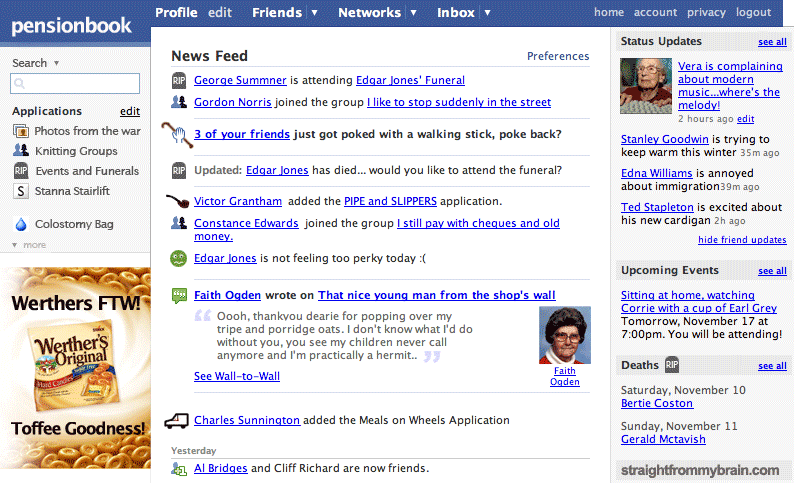
Obama’s Facebook Feed
| Peter Klein |
I admit, it made me laugh. (Thanks to Cliff for the pointer.)
I like pensionbook too.
You Go, Gordon Gekko!
| Peter Klein |
Several folks in my part of the blogosphere have noted John Hasnas’s terrific op-ed in yesterday’s WSJ, “The ‘Unseen’ Deserve Empathy, Too.” Hasnas invokes the great Bastiat to counter President Obama’s call for judges who have compassion, empathy, and understanding of “people’s hopes and struggles.” As Hasnas points out, judges should consider the effects of legal rulings not only on the parties before the bar, but also on the “unseen” whose lives will be affected:
One can have compassion for workers who lose their jobs when a plant closes. They can be seen. One cannot have compassion for unknown persons in other industries who do not receive job offers when a compassionate government subsidizes an unprofitable plant. The potential employees not hired are unseen. . . .
The law consists of abstract rules because we know that, as human beings, judges are unable to foresee all of the long-term consequences of their decisions and may be unduly influenced by the immediate, visible effects of these decisions. The rules of law are designed in part to strike the proper balance between the interests of those who are seen and those who are not seen. The purpose of the rules is to enable judges to resist the emotionally engaging temptation to relieve the plight of those they can see and empathize with, even when doing so would be unfair to those they cannot see.
 This was on my mind when, channel surfing last night, I came across Oliver Stone’s 1987 classic “Wall Street,” which I haven’t seen in its entirety in years. To my surprise (perhaps not yours), I found myself rooting for Michael Douglas’s Gordon Gekko, the corporate raider who serves as the movie’s arch-villain. The main sub-plot revolves around Gekko’s attempted buyout of Blue Star Airlines. Bud thinks the buyout can save the struggling airline, where his father still works, and helps convince the pilots’ and flight attendants’ unions to Gekko’s move. Later, Bud discovers Gekko is really planning to break up the company and sell off the pieces and Bud feels betrayed, leading to a climactic confrontation. (The film feels remarkably fresh, despite the glowing green CRT screens and brick-sized cellular phones, and Douglas’s performance is dazzling.) (more…)
How Many Strategists Does It Take to Change a Light Bulb?
| Peter Klein |
More profound musings from Joe Mahoney and Christos Pitelis, with additional contributions from Anita McGahan, Yasemin Kor, and myself (no attribution is given for individual entries, for our own protection). Please add your suggestions in the comments.
How many strategists does it take to change a light bulb?
“Only one, that will be $125, please.” — strategy consultant
“One, and the one who changes it achieves sustained competitive advantage.” — mainstream strategy scholar
“Approximately 1.0000000000000000000.” — one of the small cadre of mathematicians in the strategy field
“The first person who discovers the burned-out light bulb has an opportunity for entrepreneurial gain.” — Kirznerian strategic entrepreneurship scholar
“The old bulb will be swept away by the perennial gale of creative
destruction.” — Schumpeterian strategic entrepreneurship scholar“Light bulbs are social constructs.” — trendy contemporary management scholar
“I can’t answer without first knowing the relevant players, strategy spaces, and preference maps.” — game theorist (more…)
The Industrious Revolution
| Peter Klein |
Hans-Joachim Voth calls Jan de Vries’s new book on household behavior during the early modern period “staggeringly erudite, insightful, stimulating, and on all the main points, convincing.” The book, The Industrious Revolution: Consumer Behavior and the Household Economy, 1650 to the Present (Cambridge, 2008) builds on de Vries’s earlier concept of an Industrious Revolution, the two centuries before the Industrial Revolution in which consumers increased their production of marketable goods, largely at the expense of leisure time. “The industrious revolution was a household-level change with important demand-side features that preceded the Industrial Revolution, a supply-side phenomenon” (De Vries, 1994). Adds Voth:
The sheer amount of hard work that went into every aspect of these chapters is hard to convey. Surveying the rise of consumer items through the prism of probate inventories shows the author confidently mastering the abundant historical literature in four or five languages. De Vries’ reconstruction of Europeans’ increasing consumption of “colonial luxuries” — sugar, tea, and coffee — alone is going to be useful for all scholars working in the area.
This book may be of interest not only to economic and business historians, but also to management scholars in marketing and consumer behavior.
Way to Go Curtis
| Peter Klein |
A teacher’s greatest accomplishment is seeing his students go where he himself has never gone. So it was with great delight that I saw that one of my former undergraduate students, Curtis Melvin, got his picture on the front page of last Friday’s Wall Street Journal. Larry White and Radley Balko have already written on the substance of the story, which profiles Curtis’s activities as a North Korea sleuth. Way to go, Curtis!

PAL Team on Microfinance
| Peter Klein |
As a microfinance skeptic I was particularly interested in the new paper from the J-PAL team of Banerjee, Duflo, Glennerster, and Kinnan, “The Miracle of Microfinance? Evidence from a Randomized Evaluation.” Despite the pedestrian abstract, the findings are pretty significant:
To date there have been no randomized trials examining the impact of microcredit. Using such a design, 52 of 104 slums in Hyderabad, India were randomly selected for opening of an MFI branch while the remainder were not. We show that the intervention increased total MFI borrowing, and study the effects on new business starts, investment, and consumption. Households with an existing business at the time of the program invest in durable goods, and their profi ts increase. Households with high propensity to become business owners see a decrease in nondurable consumption, consistent with the need to pay a fixed cost to enter entrepreneurship. Households with low propensity to become business owners see nondurable spending increase. We find no impact on measures of health, education, or women’s decision-making.
Ryan Hahn puts it this way: The verdict is in on microfinance. . . . And it’s not pretty.” He means that microfinance does appear to have a positive marginal effect on business formation and expansion, but the effect is modest and does not (at least within a 15-18-month timeframe) have any discernible effect on well-being.
Research Workshop on Institutions and Organizations
| Peter Klein |
The IV Research Workshop on Institutions and Organizations takes place at Insper (formerly Ibmec) São Paulo 5-6 October 2009. Lee Alston and David Stark are keynoting. There are panels on “Judicial Norms and Development,” “New Theories of the Firm,” and “Social Capital and Organization.” There’s an open call for papers, with abstracts due 20 July.
I attended the 2007 version and enjoyed it very much.





 Organizations and Markets

Recent Comments