Author Archive
Cheer Up With the Depression Bundle
| Peter Klein |
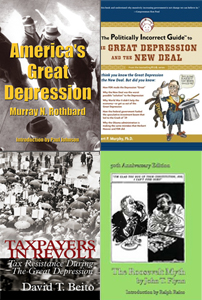 Sorry, couldn’t resist the headline. But check it out: Murray Rothbard’s America’s Great Depression, Bob Murphy’s Politically Incorrect Guide to the Great Depression and the New Deal, Dave Beito’s Taxpayers in Revolt, and John T. Flynn’s Roosevelt Myth, all for $49! That’s quite an uplifting deal.
More great news: Contra Keynes and Cambridge, vol. 9 of Hayek’s Collected Works, is now out in paperback from Liberty Fund, and just $14.50.
The Ethics of Bankruptcy
| Peter Klein |
I like this 2003 HBR piece from Joe Bower and Stuart Gilson on bankruptcy. Substitute “Chrysler” and “foreign auto makers” for “WorldCom” and “competing telecom firms” and you’ll get the idea:
WorldCom’s bankruptcy, however, highlights an important, potentially very large social cost of the U.S. bankruptcy system. Competing telecom firms, which have played by the accounting rules and have used more prudent financing, now find themselves — once again — at a competitive disadvantage relative to the company. Unlike WorldCom, these firms had to stay current on their debt and service their lease obligations. They did not get to write down their assets and debt, nor have they been able to reduce taxes by claiming that their profits never existed.
Is this fair? Do the benefits of the system outweigh its costs? The system works well to protect assets and employees, to be sure. But are WorldCom’s assets and employees really the ones that should be protected? What about those of more efficient firms? In capital-intensive industries like petrochemicals, steel, telecoms, and airlines, doesn’t bankruptcy law make it harder for efficient companies to drive inefficient assets out of business? In the majority of bankruptcy cases in these industries, the top managers are gone, but old capacity returns to the market with an improved balance sheet. This can easily prolong a period of industrywide overcapacity as well as unfairly disadvantage competitors.
Their focus is bankruptcy resulting from corporate fraud, but the question applies equally well, in my view, to bankruptcy resulting from managerial incompetence.
BTW, for a primer on bankruptcy, Michelle White’s 1989 Journal of Economic Perspectives paper, “The Corporate Bankruptcy Decision,” is a good place to start.
Macroeconomic Policy Quote of the Day
| Peter Klein |
Mike Rozeff makes the Hayekian point that is probably obvious to the O&M community, but virtually absent from public debate:
Bernanke is just a man. He is fallible. We learned this week that he pressured Bank of America into absorbing Merrill Lynch. In doing this, he pressured the leader of Bank of America into withholding critical information from his shareholders about Merrill Lynch losses. Technically, he can be charged with conspiracy to defraud. The loans he had the FED make to AIG look far from wise. A number of his other actions are highly questionable in making various kinds of loans to questionable borrowers.
I am saying that Bernanke doesn’t actually know what he’s doing. But I am using him only as an example. He’s not special. The more important point is that no one knows how to do fiscal and monetary policy, and they never have and never will. No one. For that reason alone, which is a narrowly practical one, no one should have those powers.
“New Economy” Bleg
| Peter Klein |
The heady dot-com days of the late 1990s brought breathy pronouncements from journalists and some academics that the “new economy” had changed all the old rules. Intellectual capital, not physical capital, is the source of value, so plant and equipment is irrelevant. Information goods are produced at zero marginal cost so firms should give away, rather than sell, their products. Profits don’t matter, only installed base counts. Managerial hierarchy is obsolete; cost curves are flat; supply-and-demand analysis is passé; even opportunity costs don’t matter anymore. The dot-com crash and subsequent shakeout brought many people back to their senses, but even today we continue to hear hyperbolic claims about the newness of the new economy.
I’d like to include some of these wildly exaggerated claims in my talk next week at the GMU/Microsoft forum. Can readers supply some quotes I can use (the more outrageous the better)? Like this:
[W]hen it comes to technology, even the most bearish analysts agree the microchip and Internet are changing almost everything in the economy.
— Greg Ip, WSJ, 18 January 2000
One curious aspect of the Network Economy would astound a citizen living in 1897: The very best gets cheaper each year. This rule of thumb is so ingrained in our contemporary lifestyle that we bank on it without marveling at it. But marvel we should, because this paradox is a major engine of the new economy. . . . Through most of the industrial age, consumers experienced slight improvements in quality for slight increases in price. But the arrival of the microprocessor flipped the price equation. In the information age, consumers quickly came to count on drastically superior quality for less price over time. The price and quality curves diverge so dramatically that it sometimes seems as if the better something is, the cheaper it will cost.
— Kevin Kelly, New Rules for the New Economy, 1998
Once a marketing gimmick, free has emerged as a full-fledged economy. . . . The rise of “freeconomics” is being driven by the underlying technologies that power the Web. Just as Moore’s law dictates that a unit of processing power halves in price every 18 months, the price of bandwidth and storage is dropping even faster. Which is to say, the trend lines that determine the cost of doing business online all point the same way: to zero.
— Chris Anderson, Wired, February 2008
Why have [stock] exchanges at all? Certainly not to help investors. Exchanges are at last being exposed as anachronisms, sustained by inertia and by the desire of incumbents, with help from regulators, to keep raking in monopoly rents. But the curtain is coming down.
— James Glassman, WSJ, 8 May 2000
I’m sure there are much more colorful statements (i.e., straw men for me to knock down) out there. Any suggestions?
Best Financial-Markets Sentence I Read Today
| Peter Klein |
From Gene Fama:
George Soros claims (in his op-ed in the Wall Street Journal) that the Efficient Market Hypothesis is invalid, because prices in financial markets “always provide a biased view of the future, and that distortions of prices in financial markets may affect the underlying reality.” Thoughts?
EFF: All the evidence I know says that market predictions are unbiased. It’s understandable, however, that hedge fund managers are immune to this evidence since it’s a threat to their existence.
Tweets That Might Get You Fired
| Peter Klein |
Some of these made me laugh (via FastCompany). I assume they’re real. If I had more time I’d perform a similar exercise, searching online for tweets that might get one of my students an F.
As ResumeBear reminds its readers:
It may not seem important to you now, but what you post and share online could come back to haunt you someday when you least expect it. Everything on the internet can be archived, which means it is also searchable. Your online profiles might be just for friends now, but later on, your online content might keep you from getting that scholarship, the job of your dreams or even prevent you from running for public office.
Think before you post — especially before you post to social networking sites or blogs.
Wait a minute, I blog, don’t I?
Knights, Raiders, and Targets
| Peter Klein |
When doing my dissertation research long, long ago I was influenced by an edited volume called Knights, Raiders, and Targets: The Impact of the Hostile Takeover (Oxford University Press, 1988). It collected the proceedings of a 1985 Columbia Law School conference that must have been terrific. The authors include Robert Shiller, John Coffee, Mel Eisenberg, Oliver Williamson, David Ravenscraft and F. M. Scherer (previewing results of their important 1987 book), Richard Roll, Michael Bradley, and Gregg Jarrell, among others, with several contributions appearing in a comments-and-replies format. I just learned that one of the editors, Louis Lowenstein of Columbia Law, passed away this month. I’m not familiar with his best-known book, What’s Wrong With Wall Street: Short-Term Gain and the Individual Shareholder (1988). Apparently it proposes a tax on short-term trading profits to reward buy-and-hold investors, which doesn’t sound great to me.
Take My Joke, Please
| Peter Klein |
Like other boring professors, I try to liven up my lectures and after-dinner speeches with a few jokes. Naturally, this effort is plagued by radical uncertainty. And of course I steal the jokes. Indeed, I maintain a computer file of one-liners and funny stories — none original — for possible future use. Then again, as Fabio notes, many stand-up comedians are known as prodigious copiers. Milton Berle once said another comedian made him laugh so hard, “I nearly dropped my pencil.”
Good thing I’m not a professional comedian. According to this paper by Dotan Oliar and Christopher Jon Sprigman, the community of stand-up comedians is characterized by strong social norms that take the place of formal rules in enforcing “ownership” of jokes. A complex system of norms has emerged over the last half-century that “regulates issues such as authorship, ownership, transfer of rights, exceptions to informal ownership claims and the imposition of sanctions on norms violators. Under the norms system, the level of investment in original material has increased substantially.” Presumably the community of professional comedians satisfies the Ellickson requirements of being a small, well-defined, close-knit group. Lucky for me I’m not in it. (HT: orgtheory commentator Johann.)
O&M Turns Three
| Peter Klein |
 Saturday, April 25, 2009, marked this blog’s three-year anniversary. During the past three years we’ve served up 1,801 posts, hosted 4,597 comments, and entertained 525,624 unique users (that last figure comes from StatCounter and may or may not mean anything). Thanks to the O&M community for making blogging such a fun and interesting experience!
Jargon Watch: “Green Shoots” of Recovery
| Peter Klein |
Thanks to Bill Easterly for noticing that Chauncey Gardner is In the House. G7 officials are now telling us they see “green shoots” of recovery. Can’t you just imagine this behind-the-scenes conversation at the summit?
President “Bobby”: Mr. Gardner, do you agree with Ben, or do you think that we can stimulate growth through temporary incentives?
[Long pause]
Chance the Gardener: As long as the roots are not severed, all is well. And all will be well in the garden.
President “Bobby”: In the garden.
Chance the Gardener: Yes. In the garden, growth has it seasons. First comes spring and summer, but then we have fall and winter. And then we get spring and summer again.
President “Bobby”: Spring and summer.
Chance the Gardener: Yes.
President “Bobby”: Then fall and winter.
Chance the Gardener: Yes.
Benjamin Rand: I think what our insightful young friend is saying is that we welcome the inevitable seasons of nature, but we’re upset by the seasons of our economy.
Chance the Gardener: Yes! There will be growth in the spring!
Benjamin Rand: Hmm!
Chance the Gardener: Hmm!
President “Bobby”: Hm. Well, Mr. Gardner, I must admit that is one of the most refreshing and optimistic statements I’ve heard in a very, very long time.
[Benjamin Rand applauds]
President “Bobby”: I admire your good, solid sense. That’s precisely what we lack on Capitol Hill.
Actually, this level of analysis can also be found at the typical graduate macroecomomics seminar. Oops, did I say that?
My Working Relationship with Lasse
| Peter Klein |
Every coauthoring relationship is unique. Scholars bring different strengths and weaknesses to the table, and there are many opportunities to exploit gains from trade. The best coauthoring relationships are marked by strong complementarities (a theorist and an empiricst, a conceptual thinker and a detail-oriented person, an expert in literature A and an expert in literature B, a “starter” and a “finisher,” etc.). It doesn’t always work, but — as has been frequently noted — sole-authored papers are increasingly rare in business and the social sciences, suggesting that the benefits, on average, outweigh the costs.
Lasse and I have an excellent working relationship resulting in several published and forthcoming papers, numerous works in progress, some joint teaching projects, and more. If there were any doubt that my role in the partnership is basically that of a glorified research assistant, this website, in which one Peter Klein offers “Pre-Lien Services,” should put those doubts to rest.
Tragedy in Athens, Georgia
| Peter Klein |
You may have heard about George Zinkhan, a University of Georgia marketing professor who reportedly shot to death his wife and two others this afternoon before fleeing the scene. As of this writing he remains on the loose and is considered armed and dangerous. A nationwide manhunt is supposedly under way. (Here’s the Google News feed.)
 I was Zinkhan’s colleague at UGA’s Terry College of Business from 1995 to 2002 and knew him casually. We had lunch together on occasion and played basketball together in a faculty/staff league. I didn’t know much about his personal life, only that he had two young children (I think from a second marriage). He was head of the Marketing department when I was there and was, by all accounts, a productive scholar and an effective teacher.
What a surreal experience to see pictures of SWAT teams assembled outside Brooks Hall — apparently staked out in case Zinkhan went there after the shootings, which occurred off campus — where I had my office and taught most of my classes.
One Part of the Financial Sector Is Still Growing
| Peter Klein |
Courtesy of EconomPicData:
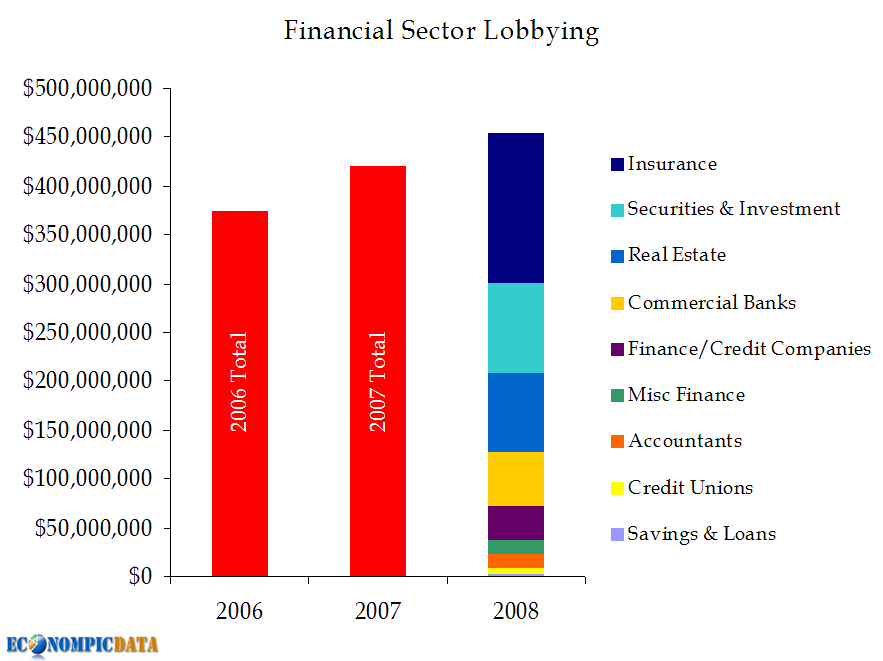
It takes money to make money, you know.
Vive la Révolution!
| Peter Klein |
So says the all-star team of Acemoglu, Cantoni, Johnson, and Robinson in “The Consequences of Radical Reform: The French Revolution.” Check it out:
The French Revolution of 1789 had a momentous impact on neighboring countries. The French Revolutionary armies during the 1790s and later under Napoleon invaded and controlled large parts of Europe. Together with invasion came various radical institutional changes. French invasion removed the legal and economic barriers that had protected the nobility, clergy, guilds, and urban oligarchies and established the principle of equality before the law. The evidence suggests that areas that were occupied by the French and that underwent radical institutional reform experienced more rapid urbanization and economic growth, especially after 1850. There is no evidence of a negative effect of French invasion. Our interpretation is that the Revolution destroyed (the institutional underpinnings of) the power of oligarchies and elites opposed to economic change; combined with the arrival of new economic and industrial opportunities in the second half of the 19th century, this helped pave the way for future economic growth. The evidence does not provide any support for several other views, most notably, that evolved institutions are inherently superior to those ‘designed’; that institutions must be ‘appropriate’ and cannot be ‘transplanted’; and that the civil code and other French institutions have adverse economic effects.
Think of this as a fixed-effects model estimating the within-country effect of legal origin; what happens when a society’s institutional (particularly, legal) environment changes suddenly and unexpectedly? If a common-law country is invaded and occupied by a civil-law country, what happens to financial-market development? An interesting counterpoint to the cross-sectional studies that are the norm in this field.
The Latest Management Bestseller
| Peter Klein |
Followers of the management-guru literature won’t be surprised by this Daily Telegraph report that Mein Kampf is a business bestseller in India. Alas, like Good to Great, the book suffers from the fatal flaws of sampling on the dependent variable and choosing a non-representative sample period. (In a longitudinal sample, the Führer’s managerial performance doesn’t doesn’t look so great, does it?)
As is often the case, the best commentary on this (apparently true) story comes from the Onion: “Well, they sure don’t want to follow Gandhi’s model. All that guy ever did was lose money.”
Peters Against Aggregation
| Peter Klein |
When I saw the title of Brayden’s post, “Don’t Give Up on Aggregation Yet, Peter,” I thought he’d been reading my macroeconomics posts. Alas, Brayden, prefers meatier fare, such as this post by Barnard College sociologist Peter Levin. Levin is worried about the aggregation of knowledge represented by the open-source, wikified, crowdsourcing movement about which people are all, well, atwitter. (We’ve expressed more than a few reservations about this stuff ourselves.) His main concern, if I understand correctly, is the possibility of information cascades. However, much of the cascades literature deals not with the wisdom of crowds, but the wisdom of experts (tulip-bulb traders, mortgage-backed securities underwriters, etc.). The more expertise decision-makers grant to their peers, the more likely they — in the face of uncertainty — will interpret their peers’ (ostensibly expert) opinions as reliable indicators of underlying reality, and hence the greater the likelihood of cascades.
Brayden takes a different tack, arguing that aggregation mechanisms can be designed to mitigate the chance of outliers biasing the results. I think Brayden is right but am not sure his comments address the underlying mechanism — the microfoundations, to use a certain co-blogger’s favorite term — that Levin is worried about.
SecondMarket
| Peter Klein |
Props to Molly Burress for pointing me to this article in today’s NYT on SecondMarket, a website that acts as a market-maker for illiquid assets. According to the Times SecondMarket is developing secondary markets for restricted public equities, bankruptcy claims, mortgage-backed securities, collateralized debt obligations, and other non-marketed financial claims. As the Times points out, the weak IPO market of the last few years has made VCs reluctant to invest in early-stage ventures; by giving VCs an additional exit option, SecondMarket may increase the flow of venture funding.
Not addressed in the article: If SecondMarket succeeds, and grows, and begins to impose disclosure requirements on the companies whose (now-liquid) assets are traded, will private equity lose its purported advantrages over public equity, in the Jensen (1989) sense?
Diversity of Opinion at the University of Missouri
| Peter Klein |
Who says the modern US university doesn’t reflect the full diversity of American social, cultural, and political opinion? Sure, most of the faculty at my university are Birkenstock-wearing, tree-hugging, Prius-driving, union-loving, New-York-Review-of-Books reading ACLU supporters, but they also like to hear from the other side:
Chairperson of U.S. Communist Party to Speak on Campus
Sam Webb, the Chair of the Communist Party, USA, will be speaking on Tuesday April 28th at 7:00pm in Ellis Auditorium. The event is free and open to the public. Sam Webb’s speech will address the current role of/possibilities for the Communist Party, USA and other progressives in the current political climate, confronted as our country is with the economic crisis, environmental crises and two wars. Webb writes extensively on politics, economics, international affairs, and Marxism, and is the author of a number of theoretical pamphlets, including “Reflections on Socialism,” and “The Nature, Role and Work of the Communist Party,” both of which were published in English and Spanish.
Announcement sponsored by ORG — Organization Resource Group
Thanks to Per for noticing.
Macroeconomics Quote of the Day
| Peter Klein |
From Kenneth Boulding’s review essay on Samuelson’s Foundations, published in the JPE in 1948:
[I]t is a question of acute importance for economics as to why the macroeconomics predictions of the mathematical economists have been on the whole less successful than the hunches of the mathematically unwashed. The answer seems to be that when we write, for instance, “let i, Y, and I stand, respectively, for the interest rate, income, and investment,” we stand committed to the assumption that the internal structures of these aggregates or averages are not important for the problem in hand. In fact, of course, they may be very important, and no amount of subsequent mathematical analysis of the variables can overcome the fatal defect of their heterogeneity.
More on heterogeneity in macroeconomics here.
Economic Institutions of Strategy
| Peter Klein |
That’s the title of a forthcoming volume of Advances in Strategic Management edited by Jackson Nickerson and Brian Silverman. You’ll recognize the allusion to a certain classic book. Like that book, this volume maps out an ambitious agenda for new scholarship on institutions and organizations, particularly within the field of strategic management. The chapters provide critical reviews and syntheses of various strands of the strategy literature, intended to support and to challenge new and established scholars starting work in these areas. (They should make excellent readings, for example, for doctoral courses in strategy and the economics of organization.)
Lasse and I contributed a chapter, “Diversification, Industry Structure, and Firm Strategy: An Organizational Economics Perspective,” that you can download on SSRN. Here’s the abstract:
We review theory and evidence on corporate diversification, industry structure, and firm strategy from an organizational economics perspective. First, we examine the implications of transaction cost economics (TCE) for diversification decisions. TCE is essentially a theory about the costs of contracting, and TCE sheds light on the firm’s choice to diversify into a new industry rather than contract out any assets that are valuable in that industry. While TCE does not predict much about the specific industries into which a firm will diversify, it can be combined with other approaches, such as the resource-based and capabilities views, that describe which assets are useful where. We also discuss the transaction-cost rationale for unrelated diversification, which focuses on the potential efficiencies from exploiting internal capital markets. We review this argument as it emerged in the transaction cost literature in the 1970s and 1980s and, more recently, theoretical and empirical literature in industrial organization and corporate finance. We then discuss how diversification decisions, both related and unrelated, affect industry structure and industry evolution. Here, the stylized facts suggest that diversifying firms have a crucial impact on industry evolution because they are larger than average at entry, grow faster than average, and exit less often than the average firm. We conclude with thoughts on unresolved theoretical, methodological, and empirical issues and problems and provide suggestions for future research.





 Organizations and Markets
Recent Comments