Author Archive
Mark Casson’s The Entrepreneur at 30
| Peter Klein |
2012 marked the 30th anniversary of Mark Casson’s classic work The Entrepreneur: An Economic Theory. Casson was one of the first economists since Frank Knight to elaborate on the role that uncertainty and judgment play in entrepreneurial decisions. Casson’s book offers not only a critique of the theories of competition and the firm offered in neoclassical microeconomics, but also a positive theory of the entrepreneur as a judgmental decision-maker under uncertainty. Casson’s work had a strong influence on the Foss-Klein approach to entrepreneurship, as well as Dick’s work on the theory of the firm.
Sharon Alvarez, Andrew Godley, and Mike Wright have written a nice tribute to The Entrepreneur in the latest edition of the Strategic Entrepreneurship Journal.
Mark Casson’s The Entrepreneur: An Economic Theory (1982) has become one of the most influential books in the field of entrepreneurship. For the first time, this article outlines its origins and summarizes its main themes. The article goes on to show how Casson’s subsequent research has closely followed the research agenda he set for himself in The Entrepreneur and illustrates the continuing challenge his work presents to entrepreneurship scholars. The article is based on an interview the authors conducted with Mark Casson on the thirtieth anniversary of the book’s publication.
As Sharon, Andrew, and Mike note, “Casson’s incorporation of Knightian judgment into a broader economic framework is probably the area where the book has had its greatest impact (albeit mostly among management scholars and not economists).” For Casson — as well as Knight — judgment constitutes decision-making under uncertainty that cannot be captured in a set of formal decision rules, such that “different individuals, sharing similar objectives and acting under similar circumstances, would make different decisions” (Casson, 1982, p. 21). Unfortunately, while judgment continues to play an important role in entrepreneurship research, it has been largely overshadowed (in my reading) by the opportunity-discovery perspective that builds on Kirzner rather than Knight (though that perspective is itself coming under heavy fire).
The paper is gated, unfortunately. But you can access Casson’s own summary of his (and others’) ideas in this EconLib article.
Business Cycles and the Structure of Production
| Peter Klein |
A new paper from former guest blogger Peter Lewin:
A Financial Framework for Macroeconomic Cycles: The Structure of Production is Relevant
Peter Lewin
University of Texas at Dallas – School of Management – Department of Finance & Managerial EconomicsNicolas Cachanosky
Metropolitan State University of DenverA comprehensive understanding business-cycles needs to account not only for the allocation of resources over time, but also for resource allocation across industries at any point in time. Intertemporal disequilibrium has been a common theme of many theories of the business-cycle. But to properly understand how these “time-distortions” take place and how the price-mechanisms that drive them work, a clear and well-defined conceptualization of the “average length” of the structure of production, is required. The insights provided by Macaulay’s duration and Hicks’s Average Period do this. We show that financial duration and related concepts have a direct connection to macroeconomic stability. By doing this we point to important implications for macroeconomic policy. We claim not only that a low interest rate contributes to the creation of asset bubbles, we show also the market mechanism through which the real sector is affected. We argue that to accept that duration matters for resource allocation is to accept the core of the Austrian Theory of the Business Cycle (ABCT) and, therefore, that to reject the ABCT core thesis suggests also rejecting the importance of duration for resource allocation.
Management and entrepreneurship scholars new to business-cycle theory might find this, this, and this to be useful background reading.
The Paradox of the New Economic History
| Peter Klein |
MIT’s Peter Temin on the “paradox of the New Economic History,” from his keynote speech to the BETA-Workshop in Historical Economics (published as an NBER working paper):
New economic historians have turned their back on traditional historians and sought their place among economists. This has provided good jobs for many scholars, but the acceptance by economists is still incomplete. We therefore have two challenges ahead of ourselves. The first is to argue that economic development can only be fully understood if we understand the divergent histories of high-wage and low-wage economies. And the other big challenge is to translate our economic findings into historical lessons that historians will want to read. These challenges come from our place between economics and history, and both are important for the future of the New Economic History.
His broader claim is that the disciplines of economic history and economic development should be more closely integrated. “Both subfields study economic development; the difference is that economic history focuses on high-wage countries while economic development focuses on low-wage economies.”
Friday Fun: The Market Value of Research Topics
[A guest post from Peter St. Onge, Assistant Professor of Marketing at Feng Chia University in Taiwan.]
Is academia the epitome of mankind’s quest for knowledge? Is it an adjunct to the productive forces that drive us ever-closer to a utopia of plenty? Or is it a self-licking ice cream cone? Here are a few data points.
For each keyword or phrase-in-quotes, the first column measures google searches (average ttm, in thousands, reported 5/15/14 on Google Adwords Keyword Planner). The second column measures academic papers on Google scholar between 2012-2013 (as of 5/15/14). The third column measures the ratio of academic papers divided by monthly searches. And the fourth column gives Google Adwords’ “suggested bid” — this suggests what an advertiser might offer for a “click” when somebody enters the search term or phrase, so is roughly the market value of a visitor searching for that term.
These measures are roughly intended to capture popular interest (the quest for knowledge) and market value (adjunct to production) compared to academic interest.
First, some general business terms, with “gender identity” thrown in for fun, ranked by papers-to-search ratios:
| Google Scholar | Google monthly searches (k) | Papers 12-13 (k) | Papers/ searches | Suggested Bid |
| management | 40.5 | 785 | 19.4 | $5.25 |
| “gender identity” | 8.1 | 146 | 18.0 | $1.99 |
| “Corporate Strategy” | 1.9 | 20.9 | 11.0 | $10.83 |
| accounting | 40.5 | 343 | 8.5 | $7.66 |
| marketing | 60.5 | 342 | 5.7 | $6.45 |
| entrepreneurship | 33.1 | 80.1 | 2.4 | $4.58 |
| finance | 823.0 | 301 | 0.4 | $8.22 |
The highest ratio of academic vs popular interest? Management. Beating even “gender identity.” And the lowest? Finance, followed by entrepreneurship. The people demand more finance and entrepreneurship papers. Perhaps because they want to learn how to invest and start businesses, but this is conjecture.
What else jumps out here is the overwhelming interest among the public in finance. Indeed, there are more than 4 times more searches for the word finance than all the other terms together. “Finance” is 20 times more popular than accounting or management, and 15 times more than marketing. Perhaps business schools are misallocating their resources unless their departments aren’t at least 80% finance? (more…)
The New Empirical Economics of Management
| Peter Klein |
That’s the title of a new review paper by Nicholas Bloom, Renata Lemos, Raffaella Sadun, Daniela Scur, and John Van Reenen, summarizing the recent large-sample empirical literature on management practices using the World Management Survey (modeled on the older World Values Survey). Here’s the NBER version and here’s an ungated version from the LSE’s Centre for Economic Performance.
This literature has been rightly criticized for its somewhat coarse, survey-based measures of management practices, but its measures are probably the most precise that can be reliably extracted from a large sample of firms across many countries. In that sense it is on par with the Global Entrepreneurship Monitor, the Economic Freedom Index, and other databases that attempt to capture subtle and ultimately subjective characteristics across a broad sample.
Here’s the abstract of the Bloom et al. paper:
Over the last decade the World Management Survey (WMS) has collected firm-level management practices data across multiple sectors and countries. We developed the survey to try to explain the large and persistent TFP differences across firms and countries. This review paper discusses what has been learned empirically and theoretically from the WMS and other recent work on management practices. Our preliminary results suggest that about a quarter of cross-country and within-country TFP gaps can be accounted for by management practices. Management seems to matter both qualitatively and quantitatively. Competition, governance, human capital and informational frictions help account for the variation in management.
It provides a nice overview for those new to this literature. An earlier review paper by Bloom, Genakos, Sadun, and Van Reenen, “Management Practices Across Firms and Countries,” appeared in the Academy of Management Perspectives in 2011, along with some critical comments by David Waldman, Mary Sully de Luque, and Danni Wang.
A Note on “Human Capital”
| Peter Klein |
Like Peter Lewin, Walter Block, Mario Rizzo, and Peter Boettke, I greatly admire the late Gary Becker, a pioneer in many areas of economics and sociology, a strong proponent of economic and personal freedom, and by all accounts a terrific teacher, mentor, and colleague. But I confess that I have always had qualms about the concept of “human capital,” along with the analogous constructs of social capital, knowledge capital, reputation capital, and so on. These are metaphors for capital in the narrow sense, and I worry that the widespread use of “capital” to denote anything valuable and long-lived obscures important issues about actual, physical capital that can be divided up, measured, priced, and exchanged. Witness the confusion over “capital” as Thomas Piketty uses the term. Here is something I wrote before:
[O]ne of my pet peeves [is] the expansive use of “capital” to describe any ill-defined substance that accumulates and has value. Hence knowledge, experience, and skills become “human capital” or “knowledge capital”; relationships become “social capital”; brand names become “reputation capital”; and so on. I fear this terminology obfuscates more than it clarifies.
I don’t mind using these terms in a loose, colloquial sense: By going to school I’m investing in human capital or diversifying my stock of human capital; if this gets me a high-paying job I’m earning a good return on my human capital; as I get old I forget new things, so my human capital is depreciating rapidly; and so on.
But we shouldn’t take these metaphors too literally. In economic theory capital refers either to financial capital or to a stock of heterogeneous alienable assets, goods that can be exchanged in markets and analyzed using price theory. Their rental prices are determined by marginal revenue products and their purchase prices are given by the present discounted value of these future rents. Knowledge is not, strictly speaking, capital, because it is not traded in markets does not have a rental or purchase price. What markets trade and price is labor services, and it is impossible to decompose the payments to labor (wages) into separate “effort” and “rental return on human capital” components. Some labor services command a higher market price than others because they have a higher marginal revenue product. Some of this wage premium may be due to intelligence or experience, some due to complementarities with other human or nonhuman assets, some due to hard work, and so on. But these are all determinants of the MRP, and hence the wage, not different kinds of factor returns.
Moreover, the entrepreneur needs cardinal numbers to compute the value of his capital stock, to know if it is increasing or decreasing in value, and so on. I can’t measure my stock of human capital, I don’t know for sure if it is increasing or decreasing over time, I can’t calculate the ROI of a specific human-capital investment, etc., because there are no prices and no measurable units. Knowledge may be “like capital,” in the sense that it lasts, that you can add to it, that you benefit from it, etc., but it isn’t literally a capital good like a machine or a refrigerator.
If we think going to school is valuable and increases lifetime earnings, why don’t we just say, “going to school is valuable and increases lifetime earnings,” rather than, “there is a positive return on investments in human capital”? Is there a good reason to prefer the latter, besides scientism?
Corporate Governance in the 19th Century
| Peter Klein |
A new NBER paper on 19th-century manufacturing firms in Massachusetts finds that incorporation rates, ownership concentration, and and managerial ownership varied systematically with technology (factory versus artisanal production, use of unskilled labor, etc.). In other words, governance forms were not determined primarily by the legal or regulatory environment, social and cultural issues, the desire for legitimacy, or other noneconomic factors, but by standard agency considerations.
Corporate Governance and the Development of Manufacturing Enterprises in Nineteenth-Century Massachusetts
Eric Hilt
NBER Working Paper No. 20096, May 2014This paper analyzes the use of the corporate form among nineteenth-century manufacturing firms in Massachusetts, from newly collected data from 1875. An analysis of incorporation rates across industries reveals that corporations were formed at higher rates among industries in which firm size was larger. But conditional on firm size, the industries in which production was conducted in factories, rather than artisanal shops, saw more frequent use of the corporate form. On average, the ownership of the corporations was quite concentrated, with the directors holding 45 percent of the shares. However, the corporations whose shares were quoted on the Boston Stock Exchange were ‘widely held’ at rates comparable to modern American public companies. The production methods utilized in in different industries also influenced firms’ ownership structures. In many early factories, steam power was combined with unskilled labor, and managers likely performed a complex supervisory role that was critical to the success of the firm. Consistent with the notion that monitoring management was especially important among such firms, corporations in industries that made greater use of steam power and unskilled labor had more concentrated ownership, higher levels of managerial ownership, and smaller boards of directors.
Gary S. Becker, 1930-2014
| Peter Klein |
Gary Becker died yesterday at the age of 83. Becker was a living legend of the Chicago school, and an active scholar, even chairing a current dissertation committee. Hayek called Becker “one of the most gifted men of the Chicago school” and “theoretically a more sophisticated thinker” than Milton Friedman or George Stigler.
Here are past O&M references to Becker, including Becker’s comments on organization theory in light of Williamson’s Nobel Prize. And here’s a short paper by me on T.W. Schultz’s human-capital approach to entrepreneurship, about which Becker showed little interest, despite his development of Schultz’s human-capital construct. Brian Loasby has a nice chapter on “Human Capital, Entrepreneurship, and the Theory of the Firm” in the Oxford Handbook of Human Capital, edited by Alan Burton‐Jones and our friend J.‐C. Spender (Becker’s foreword is online).
I attended the 1992 meeting of the Mont Pèlerin Society, when Becker was president. Someone arranged for Becker to meet with me and the other graduate students. The sense among the student attendees was that MPS was becoming, under Becker’s leadership, too mainstream, respectable, and tame. Where were the radical libertarians, Austrians, and other free thinkers? As I recall, poor Becker was bombarded with a bunch of questions along these lines, which he handled kindly and gracefully. He had nothing but good things to say about Mises, Hayek, Hazlitt, and the other MPS founders. A fine gentleman.
A friend of mine was at Chicago in the 1990s when Becker was in his mid-60s and already a Nobel Laureate. Like most economists in the department, my friend went to the office and worked Saturdays and Sundays. Becker was usually the first to arrive and the last to leave. “He’s not only the smartest person here,” I was told, “but the hardest worker!”
Essentialism in Economics and Art
| Peter Klein |
 Carl Menger’s methodology has been described as essentialist. Rather than building artificial models that mimic some attributes or outcomes of an economic process, Menger sought to understand the essential characteristics of phenomena like value, price, and exchange. As Menger explained to his contemporary Léon Walras, Menger and his colleagues “do not simply study quantitative relationships but also the nature [or essence] of economic phenomena.” Abstract models that miss these essential features — even if useful for prediction — do not give the insight needed to understand how economies work, what entrepreneurs do, how government intervention affects outcomes, and so on.
 I was reminded of the contrast between Menger and Walras when reading about Henri Matisse and Pablo Picasso, the great twentieth-century pioneers of abstract art. Both painters sought to go beyond traditional, representational forms of visual art, but they tackled the problem in different ways. As Jack D. Flam writes in his 2003 book Matisse and Picasso: The Story of Their Rivalry and Friendship:
Picasso characterized the arbitrariness of representation in his Cubist paintings as resulting from his desire for “a greater plasticity.” Rendering an object as a square or a cube, he said, was not a negation, for “reality was no longer in the object. Reality was in the painting. When the Cubist painter said to himself, ‘I will paint a bowl,’ he set out to do it with the full realization that a bowl in a painting has nothing to do with a bowl in real life.” Matisse, too, was making a distinction between real things and painted things, and fully understood that the two could not be confused. But for Matisse, a painting should evoke the essence of the things it was representing, rather than substitute a completely new and different reality for them. In contract to Picasso’s monochromatic, geometric, and difficult-to-read pictures, Matisse’s paintings were brightly colored, based on organic rhythms, and clearly legible. For all their expressive distortions, they did not have to be “read” in terms of some special language or code.
Menger’s essentialism is concisely described in Larry White’s monograph The Methodology of the Austrian School Economists and treated more fully in Menger’s 1883 book Investigations Into the Method of the Social Sciences. For more on economics and art, see Paul Cantor’s insightful lecture series, “Commerce and Culture” (here and here).
[An earlier version of this post appeared at Circle Bastiat.]
Notes on Inequality
| Peter Klein |
Everyone’s talking about inequality. I confess don’t find inequality terribly interesting, intrinsically. Of course, inequality that results from special government privilege — the incomes of top executives at Lockheed Martin or Goldman Sachs, the speaking fees earned by Hillary Clinton, the wealth of US sugar farmers — should be analyzed and criticized, and those privileges removed. Firm policies that result in pay differentials — pay-for-performance schemes, for example — are important and interesting, not because they generate inequality per se, but because they have systematic and significant effects on firm behavior and performance. Of course, inequality may have important long-run social and cultural effects, but these are highly speculative and not obviously actionable.
I haven’t yet read Thomas Piketty’s new book but am aware of — and amazed by — the buzz it’s generating. I suspect most of the excitement reflects confirmation bias: people who think inequality is the major issue of our time naturally think this is the most important economics book of the decade, probably before reading it. (Naturally, I’d love to exploit that formula in marketing my own books.)
I do have a few thoughts on how the discussion is framed, in light of Piketty’s work. First, Piketty and his admirers define “capital” as a homogeneous, liquid pool of funds, not a heterogeneous stock of capital assets. This is not merely a terminological issue, as those familiar with the debates on capital theory from the 1930s and 1940s are well aware. Piketty’s approach focuses on the quantity of capital and, more importantly, the rate of return on capital. But these concepts make little sense from the perspective of Austrian capital theory, which emphasizes the complexity, variety, and quality of the economy’s capital structure. There is no way to measure the quantity of capital, nor would such a number be meaningful. The value of heterogeneous capital goods depends on their place in an entrepreneur’s subjective production plan. Production is fraught with uncertainty. Entrepreneurs acquire, deploy, combine, and recombine capital goods in anticipation of profit, but there is no such thing as a “rate of return on invested capital.” (more…)
New ISNIE Awards
| Peter Klein |
 The International Society for New Institutional Economics has established four new awards, named after the pioneers of new institutional social science: the Ronald Coase Best Dissertation Award, Oliver Williamson Best Conference Paper Award, Douglass North Best Paper or Book Award, and Elinor Ostrom Lifetime Achievement Award. Details on the awards, and a call for nominations for the Coase, North, and Ostrom awards, are on the ISNIE site. (Sadly, my suggestion for a Best Organizational and Institutional Economics Blog Award was not heeded.)
Firm Boundaries Matter
| Peter Klein |
Do firm boundaries — defined as ownership of the relevant capital goods — affect firm behavior and performance? Or is the firm best understood as a nexus of contracts, in which ownership boundaries represent arbitrary legal distinctions? Coase, Williamson, Hart, and Foss and Klein take the former position, while Alchian (sometimes), Demsetz, Jensen, and Meckling lean toward the latter.
A very interesting paper from Amit Seru, “Firm Boundaries Matter: Evidence from Conglomerates and R&D Activity,” offers some empirical evidence on the effects of boundary choices on innovation, finding significant and important effects.
This paper examines the impact of the conglomerate form on the scale and novelty of corporate R&D activity. I exploit a quasi-experiment involving failed mergers to generate exogenous variation in acquisition outcomes of target firms. A difference-in-difference estimation reveals that, relative to failed targets, firms acquired in a diversifying mergers produce both a smaller number of innovations and also less novel innovations, where innovations are measured using patent-based metrics. The treatment effect is amplified if the acquiring conglomerate operates a more active internal capital market and is largely driven by inventors becoming less productive after the merger rather than inventor exits. Concurrently, acquirers move R&D activity outside the boundary of the firm via the use of strategic alliances and joint-ventures. There is complementary evidence that conglomerates with more novel R&D tend to operate with decentralized R&D budgets. These findings suggests that conglomerate organizational form affects the allocation and productivity of resources.
Here is a longer, less technical write-up on the Corporate Governance and Financial Regulation blog.
Contracts as Technology
| Peter Klein |
That’s the title of an interesting new law review article by Kevin Davis (New York University Law Review, April 2013). Just as we can treat organizational structure as as sort of technology, and study the introduction and diffusion of new organizational forms with the same theories and methods used to study technological innovation and diffusion, we can think of contracts as structures or institutions that emerge, are subject to experimentation and competition, and evolve and diffuse. Here’s the abstract:
If technology means, “useful knowledge about how to produce things at low cost”, then contracts should qualify. Just as mechanical technologies are embodied in blueprints, technologies of contracting are embodied in contractual documents that serve as, “blueprints for collaboration”. This Article analyzes innovations in contractual documents using the same kind of framework that is used to analyze other kinds of technological innovation. The analysis begins by laying out an informal model of the demand for and supply of innovative contractual documents. The discussion of demand emphasizes the impact of innovations upon not only each party’s incentives to collaborate efficiently, but also upon reading costs and litigation costs. The analysis of supply considers both the generation and dissemination of innovations and emphasizes the importance of cumulative innovation, learning by-doing, economies of scale and scope, and trustworthiness. Recent literature has raised concerns about the extent to which law firms produce contractual innovations. In fact, a wide range of actors other than law firms supply contractual documents; including end users of contracts, specialized providers of legal documents, legal database firms, trade associations, and academic institutions. This article discusses the incentives and capabilities of each of these potential sources of innovation. It concludes by discussing potential interventions such as: (1) enhancing intellectual property rights, (2) relaxing rules concerning the unauthorized practice of law and, (3) creating or expanding publicly sponsored clearinghouses for contracts.
See also Lisa Berstein’s comment. (HT: Geoff Manne)
“PowerPointless”
| Peter Klein |
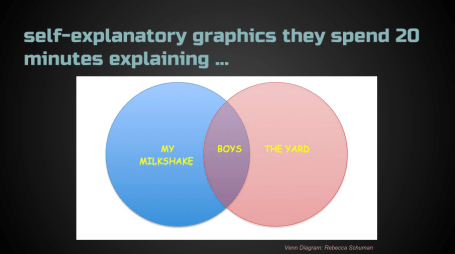
A clever and funny entry for our ongoing series on the use and abuse of PowerPoint. It’s aimed at classroom presentations but applies, a fortiori, to any professional meeting, including (especially?) academic conferences. I especially appreciate this:
If your audience can understand everything it needs to from your slide show only, . . . cut out about 50 percent of the slides and 90 percent of the text. . . . Your slide show by itself should be incomprehensible. Because, to paraphrase Ludwig Wittgenstein, its most important part is what’s not on it. (I.e., you actually talking with people.)
I have a few quibbles, e.g., I generally avoid animations (having each point appear only as you mention it), but overall this is great advice, amusingly illustrated.
Temporary versus Permanent Behavioral Responses
| Peter Klein |
As a behavioral economics skeptic I was intrigued by a recent NBER paper on worker responses to a change in the employment contract. Rajshri Jayaraman, Debraj Ray, and Francis de Vericourt studied an Indian tea plantation that changed its employment contract to weaken pay-for-performance incentives and found, initially, a substantial increase in output, suggesting a “happy-is-productive” effect that would make the pop psychologists proud. “This large and contrarian response to a flattening of marginal incentives is at odds with the standard model, including one that incorporates dynamic incentives, and it can only be partly accounted for by higher supervisory effort. We conclude that the increase is a ‘behavioral’ response.”
Alas, the effect was only temporary, becoming entirely reversed within a few months:
In fact, an entirely standard model with no behavioral or dynamic features that we estimate off the pre-change data, fits the observations four months after the contract change remarkably well. While not an unequivocal indictment of the recent emphasis on “behavioral economics,” the findings suggest that non-standard responses may be ephemeral, especially in employment contexts in which the baseline relationship is delineated by financial considerations in the first place. From an empirical perspective, therefore, it is ideal to examine responses to a contract change over an substantial period of time.
This looks to me like a Hawthorne effect. Given that much of the empirical literature in behavioral social science uses relatively short time horizons, I wonder how many of the findings can be explained this way? How many key “behavioral” results are short-term responses to changing management practices, workplace conditions, the employment contract, etc., rather than indicators of something more substantial about human behavior and motivation?
CFP: Coase Memorial Issue of Man and the Economy
| Peter Klein |
An important announcement from Ning Wang, editor of Man and the Economy:
Man and the Economy
Call for Papers for a Special Issue in Memory of Ronald Coase“R. H. Coase: The Man and His Ideas”
Man and the Economy will devote a special issue (December 2014) to the life and ideas of Ronald Coase, the 1991 Nobel Laureate in Economics and Founding Editor of this journal. During his long academic life, Coase devoted himself to economics, which, in his view, should investigate how the real world economy works, with all its imperfections. Coase viewed and practiced economics as a social science, a study of man creating wealth in society through various institutional arrangements. To honor the memory of Coase, we welcome original research articles that extend and develop the Coasian economics, including empirical studies of the structure of production and exchange. We also welcome critical and constructive commentaries that clarify and elaborate the Coasian themes, from a law-and-economics/new institutional economics perspective, which include, but not limited to, topics on transaction costs, property rights, theories of the firm and China’s economic transformation. In addition, we also welcome personal reflections and reminiscences of Coase as a colleague, a teacher, an editor, and/or a friend.
Submissions must be made online via the Journal’s website: http://www.degruyter.com/view/j/me
Deadline for submissions is September 30, 2014.
What Are “Transaction Costs” Anyway?
| Peter Klein |
A friend complains that management and entrepreneurship scholarship is confused about the concept of transaction costs. Authors rarely give explicit definitions. They conflate search costs, bargaining costs, measurement costs, agency costs, enforcement costs, etc. No one distinguishes between Coase’s, Williamson’s, and North’s formulations. “Transaction costs seem to be whatever the author wants them to be to justify the argument.”
It’s a fair point, and it applies to economics (and other social sciences and professional fields) too. I remember being asked by a prominent economist, back when I was a PhD student writing under Williamson, why transaction costs “don’t simply go to zero in the long run.” Indeed, contemporary organizational economics mostly uses terms like “contracting costs,” and since 1991 Williamson has tended to use “maladaptation costs” (while retaining the term “transaction cost economics”).
When I teach transaction costs I typically assign Doug Allen’s excellent 2000 essay from the Encyclopedia of Law and Economics and Lee and Alexandra Benhams’ more recent survey from my Elgar Companion to Transaction Cost Economics (unfortunately gated). Doug, for example, usefully distinguishes between a “neoclassical approach,” in which transaction costs are the costs of exchanging well-defined property rights, and a “property-rights approach,” in which transaction costs are the costs of defining and enforcing property rights.
What other articles, chapters, and reviews would you suggest to help clarify the definition and best use of the “transaction costs”? Or should we avoid the term entirely in favor of narrower and more precise words and phrases?
Creativity and Age
 | Peter Klein |
A common myth is that successful technology companies are founded by people in their 20s (Scott Shane reports a median age of 39). Entrepreneurial creativity, in this particular sense, may peak at middle age.
We’ve previously noted interesting links between the literatures on artistic, scientific, and entrepreneurial creativity, organization, and success, with particular reference to recent work by David Galenson. A new survey paper by Benjamin Jones, E.J. Reedy, and Bruce Weinberg on age and scientific creativity is also relevant to this discussion. They discuss the widely accepted empirical finding that scientific creativity — measured by high-profile scientific contributions such as Nobel Prizes — tends to peak in middle age. They also review more recent research on variation in creativity life cycles across fields and over time. Jones, for example, has observed that the median age of Nobel laureates has increased over the 20th century, which he attributes to the rapid growth in the body of accumulated knowledge one must master before making a breakthrough scientific contribution (the “burden of knowledge” thesis). Could the same hold through for founders of technology companies?
Focused Firms and Conglomerates: Let a Thousand Flowers Bloom
| Peter Klein |
A renewed interest in conglomerates has brought forth a HBR blog post from Herman Vantrappen and Daniel Deneffe, “Don’t Write Off the (Western) Focused Firm Yet.” As they rightly point out, the choice between a focus and diversity “depends on the context in which the business operates. Specifically, focused firms fare better in countries where society expects and gets public accountability of both firms and governments, while conglomerates succeed in nations with high public accountability deficits.” I would put it slightly differently: the choice between focused, single-business firms and diversified, multi-business enterprises depends on the relative performance of internal and external capital and labor markets. The institutional environment — the legal system, regulatory practices, accounting rules — plays a huge rule here, but social norms, technology, and the competitive environment also affect the efficient margin between between intra-firm and inter-firm resource allocation.
The point is that all forms of organization have costs and benefits. There is no uniquely “optimal” degree of diversification or hierarchy or vertical integration or any other aspect of firm structure; the choice depends on the circumstances. Instead of favoring one particular organizational form we should be promoting an environment in which entrepreneurs can experiment with different approaches, with competition determining the right choice in each context. Let a thousand flowers bloom!
Update: From Joe Mahoney I learn that not only was Chairman Mao’s actual exhortation “Let a hundred flowers blossom,” but also he may have meant it sarcastically: “It is sometimes suggested that the initiative was a deliberate attempt to flush out dissidents by encouraging them to show themselves as critical of the regime.” My usage was of course sincere. :)
In the Journals
| Peter Klein |
Some interesting review issues and special collections are hot off the virtual presses. The Journal of Management has just released its annual review issue with a number of valuable papers, including this one of particular interest to the O&M crowd:
The Many Futures of Contracts: Moving Beyond Structure and Safeguarding to Coordination and Adaptation
Donald J. Schepker, Won-Yong Oh, Aleksey Martynov, and Laura PoppoIn this article, we review the literature on interfirm contracting in an effort to synthesize existing research and direct future scholarship. While transaction cost economics (TCE) is the most prominent perspective informing the “optimal governance” and “safeguarding” function of contracts, our review indicates other perspectives are necessary to understand how contracts are structured: relational capabilities (i.e., building cooperation, creating trust), firm capabilities, relational contracts, and the real option value of a contract. Our review also indicates that contract research is moving away from a narrow focus on contract structure and its safeguarding function toward a broader focus that also highlights adaptation and coordination. We end by noting the following research gaps: consequences of contracting, specifically outcome assessment; strategic options, decision rights, and the evolution of dynamic capabilities; contextual constraints of relational capabilities; contextual constraints of contracting capabilities; complements, substitutes, and bundles; and contract structure and social process.
The always-interesting Strategic Organization has also released a package of previously published papers as a virtual special issue titled “Whither Strategy?” I have a soft spot for anything using the word “whither,” but this is a great collection by any name. Check out the ToC:
- Advancing strategy and organization research in concert: Towards an integrated model? | Durand, R. 2012. Volume 10, Issue 3. pp.297-303
- The end of strategy? | Farjoun, M. 2007. Volume 5, Issue 3. pp.197-210
- Strategic organization: A field in search of micro-foundations | Felin, T., & Foss, N.J. 2005. Volume 3, Issue 4. pp.441-455
- The disintegration of strategic management: it’s time to consolidate our gains | Hambrick, D.C. 2004. Volume 2, Issue 1. pp.91-98
- Stylized facts, empirical research and theory development in management | Helfat, C.E. 2007. Volume 5, Issue 2. pp.185-192
- So you call that research?: mending methodological biases in strategy and organization departments of top business schools | Heugens, P., & Mol, M.J. 2005. Volume 3, Issue 1. pp.117-128
- Process thinking in strategic organization | Langley, A. 2007. Volume 5, Issue 3. pp.271-282
- The field of strategic management within the evolving science of strategic organization | Mahoney, J.T., & McGahan, A.M. 2007. Volume 5, Issue 1. pp.79-99
- Walking the walk as well as talking the talk: replication and the normal science paradigm in strategic management research | Mezias, S.J., & Regnier, M.O. 2007. Volume 5, Issue 3. pp.283-296
- Paradigm prison, or in praise of atheoretic research | Miller, D. 2007. Volume 5, Issue 2. pp.177-184
- The Strategy Research Initiative: Recognizing and encouraging high-quality research in strategy | Oxley, J.E., Rivkin, J.W., & Ryall, M.D. 2010. Volume 8, Issue 4. pp.377-386
- The brain as substitute for strategic organization | Powell, T.C., & Puccinelli, N.M. 2012. Volume 10, Issue 3. pp.207-214
- The cultural side of value creation | Ravasi, D., Rindova, V., & Dalpiaz, E. 2012. Volume 10, Issue 3. pp.231-239
- A sociological perspective on strategic organization | Ruef, M. 2003. Volume 1, Issue 2. pp.241-251
- Strategy-as-practice meets neo-institutional theory | Suddaby, R., Seidl, D., & Le, J.K. 2013. Volume 11, Issue 3. pp.329-344
- How to connect strategy research with braoder issues that matter? | Vaara, E., & Durand, R. 2012. Volume 10, Issue 3. pp.248-255
- Big Strategy/Small Strategy | Whittington, R. 2012. Volume 10, Issue 3. pp.263-268





 Organizations and Markets
Recent Comments