Author Archive
Andrew Gelman on Significance Testing
| Peter Klein |
A very insightful post on the McCloskey-Ziliak / Hoover-Siegler controversy, paradigmatic examples of signficance testing in economics, rational addiction, and other econometrics-related issues. An excellent discussion starter for a graduate course in research methods. Or your next dinner party.
Personal trivia: I’ve interviewed both Steve Ziliak and Mark Siegler for academic jobs. Both were deemed too smart to be a good fit.
Raising Rivals’ Costs
| Peter Klein |
Last spring, Microsoft supported bills in the New York and Connecticut legislatures to impose strict regulations on businesses that gather personal information online for marketing purposes. The bills would hurt Microsoft, too, given that it also wants to sell advertisements based on customer behavior. But the self-inflicted wound may be worth it for the damage it causes Google.
Thanks to Jesse Walker for finding the passage in Wired’s very interesting story on the political economy of digital competition, which is just as nasty as in “old economy” industries. And don’t even get me started on Apple’s threat to go nuclear on Palm.
Hayek on the Austrians
 | Peter Klein |
Those of you longing for a copy of my favorite volume in Hayek’s Collected Works, but unwilling to pay the hefty University of Chicago Press or Routledge price, can now get a handsome paperback edition for only $12, thanks to Liberty Press. The brilliant introduction and copious editor’s footnotes alone are worth the price!
Attacking Incentive Pay is the “Height of Irresponsibility”
| Peter Klein |
Imagine you’re a salesperson at a company. In order to create an incentive for you to bust your tail, the company negotiates with you a leveraged compensation plan under which you receive a relatively small base salary plus fairly generous commissions on the sales you close. Suppose you do a bang up job one year, but the company as a whole suffers a loss because of some poor decisions beyond your control (or because of developments in the macroeconomy, such as the bursting of an asset bubble facilitated by government-sponsored entities). Now imagine that the government perceives your company to be strategically important and therefore decides to subsidize it by, say, buying its preferred stock or extending it a loan. Would it be “the height of irresponsibility” for your employer to honor your legitimate compensation expectations and pay you the wages that you effectively earned under your implicit deal with the firm? And what would happen if your employer didn’t pay you what you legitimately expected? Wouldn’t you and the other successful salespeople at your company immediately bolt, leaving the company with a much less effective sales force?
I have little to add to Thom’s excellent post on Obama’s populist attack on bonuses except to note that the compensation system is just one element of a firm’s organizational architecture (along with the allocation of decision rights, systems of performance evaluation, and so on). The firm, as Holmström and Milgrom put it, is an incentive system, and the elements of this system interact in complex and nuanced ways. The idea that regulators can simply march in and dictate changes to one element or another, based on popular prejudice, without affecting the performance of the system, is typical of the hubris of the intellectual.
Facebook in the Classroom
| Peter Klein |
According a new survey, 76 percent of undergraduates here at the University of Missouri are on Facebook at least once a day, and they are more likely to get school-related information from Facebook than from email.
I’ve never used Facebook as an academic resource. If you have, could you share something about your experiences? For example, I could create Facebook Group pages for my courses and use them for announcements, discussion, chat, hosting course materials, etc. Facebook isn’t a substitute for Blackboard, or one of the other specialized teaching platforms, however; it lacks testing and grading features, doesn’t automatically import membership lists from enrollment data, isn’t supported by university IT people, etc. How can Facebook and Blackboard be used effectively as complements?
Stimulus Haiku

 | Peter Klein |
From the great Bob Higgs:
Billions come bursting
From huge hydrants of money
I am stimulatedCredit freeze thaws now
Fed heats pipes until they steam
Winter is lovelyConsumers feel fine
Ready to mortgage their souls
John Maynard Keynes smilesSaving’s so passe
Capital stock may be assumed
Let K be capitalGiant debt you bet
Chinese will serve fine dinner
Children cannot voteLike rose in springtime
Welfare state blossoms anew
Laughter heard in hell
Feel free to try your hand in the comments section below. See also Bob’s reflections on the Inauguration.
Update: See also Morgan Reynolds’s bailout version of “I Fought the Law.”
Chapman on the US Economy
| Peter Klein |
My colleague, coauthor on several forthcoming projects, and former PhD student John Chapman was on Hugh Hewitt’s show last night, talking about the US economy. Like me John blames the Fed, not hedge funds and derivatives markets, for the housing bubble and crash. John’s investment advice: “Short the dollar and prepare for the 1970s.” Listen here (John comes on around 25:10).
The Hot Hand
| Peter Klein |
Watching UNC beat Clemson in basketball last week — Clemson has lost all 54 games it has played in Chapel Hill, the longest such streak in the nation — I was reminded of the behavioral economics literature on the “hot hand” (Gilovich, Vallone and Tversky, 1985; Camerer, 1989; Brown and Sauer, 1993), a version of the gambler’s fallacy in which people put too much weight on past results in predicting future performance. There is debate about hot-hand effects in sports, where the behavior of players and teams (unlike that of dice or roulette wheels) can certainly be affected by knowledge about past contests. If you’re on a team that has lost every game to a particular opponent, how can you not get nervous down the stretch? But such effects are hard to distinguish, empirically, from random error.
I haven’t seen much on hot-hand effects at the level of the firm, though there is a healthy literature on autocorrelation of stock returns (see Boudoukh, Richardson, and Whitelaw, 1994, for one survey). The business press often describes a firm being on a “hot streak” following a string of successful products or performance results (think Apple, Pixar, Google, etc.). If above-normal performance is anomalous, then investing in such firms is a mistake. If a firm’s hot hand reflects superior resources, strategies, market positioning, etc., and these advantages persist, then its hot hand may be real.
PS: When I taught at Georgia I used to know a great Clemson joke. Originally Clemson’s name was simply “Clem,” but it was decided that “Clem University” didn’t sound very distinguished, so they added “s” for chivalry, “o” for honor, and “n” for knowledge.
Update (2 February): Brian McCann notes that, including last night’s game, the NFC has won twelve consecutive Super Bowl coin tosses.
“Beta Culture” and Opportunity Cost
| Peter Klein |
 I enjoyed this rant on “beta culture” — the trend toward earlier and earlier releases of hardware and software, before many bugs are worked out — but wish the author understood the concepts of opportunity cost and marginal analysis. I used to assign Gene Callahan’s classic “Those Damned Bugs!” in my introductory classes to explain these concepts. Would it be nice if new products worked perfectly right out of the box? Sure. Is perfection worth the wait? Probably not. That isn’t to say that all new products are launched on the right side of the temporal benefit-cost margin — the BlackBerry Storm might qualify as alpha, not beta — but using the problems of some new products to crusade against early release more generally misses the mark.
New Leoni Collection: Law, Liberty, and the Competitive Market
| Peter Klein |
Transaction Publishers and the Instituto Bruno Leoni have just published a new collection of essays by Bruno Leoni, Law, Liberty, and the Competitive Market, edited by Carlo Lottieri. The essays elaborate on Leoni’s distinction between law and legislation, and the analogy between the latter and centralized economic planning, themes introduced in his best-known book, Freedom and the Law. Richard Epstein provides an informative introduction.
Disaster Socialism
| Peter Klein |
As I noted elsewhere yesterday, the “stimulus” bill making its way through Congress is a fine illustration of the Higgs effect, the tendency of government to expand massively in response to “crises,” real or imagined. Naomi Klein’s “Disaster Capitalism” thesis is exactly backward: “disasters” are inevitably followed by huge increases in the public sector at the expense of the private. Anyway, if you have any doubt that the current legislation has precious little to do with economic stimulus, consider the details of the House’s proposed $825 billion package, which includes:
- $1 billion for Amtrak
- $2 billion for child-care subsidies
- $50 million for the National Endowment for the Arts
- $400 million for global-warming research
- $2.4 billion for carbon-capture demonstration projects
- $650 million for digital TV conversion coupons
- $8 billion for renewable energy funding
- $6 billion for mass transit
- $600 million for the federal government to buy new cars
- $7 billion for modernizing federal buildings and facilities (including $150 million for the Smithsonian)
- $252 billion is for income-transfer payments ($81 billion for Medicaid, $36 billion for expanded unemployment benefits, $20 billion for food stamps, and $83 billion for the earned income credit for people who don’t pay income tax)
- $66 billion for education
Now I should state, for the record, that unlike other critics of this particular stimulus package, I don’t favor government “stimulus” packages of any kind. I’m not a Keynesian, after all.
Department of Irony, Cass Sunstein Edition
| Peter Klein |
Harvard’s Cass Sunstein has been tapped by Obama to head the Federal Office of Information and Regulatory Affairs (to be “regulation czar,” in the vernacular). One of his main tasks, presumably, will be to sell the new financial-market and related regulations accompanying the “stimulus” bill. I hope Sunstein will re-read his recent working paper with Richard Zeckhauser, “Overreaction to Fearsome Risks”:
Fearsome risks are those that stimulate strong emotional responses. Such risks, which usually involve high consequences, tend to have low probabilities, since life today is no longer nasty, brutish and short. In the face of a low-probability fearsome risk, people often exaggerate the benefits of preventive, risk-reducing, or ameliorative measures. In both personal life and politics, the result is damaging overreactions to risks. We offer evidence for the phenomenon of probability neglect, failing to distinguish between high and low-probability risks. Action bias is a likely result.
Cass, will you please explain “action bias” to the President and Congresssional leaders before they completely restructure the US economy in response to the current economic downturn?
The Heath Brothers on Incentives
| Peter Klein |
Dan and Chip Heath worry that incentive plans backfire because of focusing illusion — managers place too much weight on a single variable in the incentive contract, ignoring the likely side effects. I don’t disagree that this is possible but Chip and Dan seem to be knocking down a pretty feeble straw man. The drawbacks of single-variable, quantitative incentive schemes are well known in the organizational design literature, spawning oodles of studies of multi-tasking, the use of multiple performance measures, the benefits and costs of subjective evaluation criteria, and the like. (There’s a nice overview in BSZ chapter 16.)
The Economics and Sociology of Stonehenge
| Peter Klein |
 Recent research on Stonehenge recognizes that its construction was not just a massive technological undertaking, but a huge organizational challenge as well. Here’s a recent item from American Scientist (via 3quarks):
Although many people might straightforwardly conclude that an undertaking on the scale of Stonehenge must have been an expression of concentrated power within Neolithic society, the claim cannot be conceded without thinking about the long processes of inspiration, discussion, mobilization of labor and periodic reenergizing of all those involved that must have accompanied such enterprises and indeed made them possible. The challenge for archaeologists can slide from simple detection of the presence of power to analysis of the ways in which social preeminence could be asserted and maintained for what was all too often just a brief interval.
So research into the ways in which monuments “worked” is crucial. How did people approach and move around these great assemblies of earth, timber and stone? Did they do so freely, or were they directed? What did interventions in nature on this scale signify, and what meanings could be projected by the materials used in their construction? How were tradition and innovation respectively regarded? Leaders or would-be leaders must have had tricky paths to negotiate.
I’m waiting for the pop-management book, Leadership Lessons from the Stonehenge Builders.
Introducing Guest Blogger Mike Sykuta
| Peter Klein |
I’m delighted to introduce my friend and colleague Mike Sykuta as our newest guest blogger. Mike is Director of the Contracting and Organizations Research Institute (CORI) here at the University of Missouri. Mike and CORI played a big role in attracting me to Missouri in 2002 and we’ve worked closely together on many projects since then.
Mike got his Ph.D. in economics at Washington University in St. Louis and identifies with the Coase and North branch of the new institutional economics. (He is sympathetic to Williamsonian TCE but has not yet drunk the Kool-Aid.) Mike is co-editor of SSRN’s NIE Abstracting Journals, along with Mary Shirley, and is involved with ISNIE and ESNIE. He works on contracting, corporate governance, and the political economy of regulation. He teaches an MBA/MS-level course on the economics of transactions and contracting, doctoral seminars on firm and industry organization, and the capstone undergraduate strategy course in the agribusiness management program. Mike is almost as much a Luddite as Nicolai — he acquired his first mobile phone just a short while ago — and I’m glad he’s finally decided to give some 21st-century technology a try. Welcome, Mike!
Sociology Beats Economics — Again!
| Peter Klein |
This was only the beginning. Now I learn from this paper, summarized by Henry Farrell (who supplies the graph below), that economists rank dead last among social scientists in RateMyProfessors.com’s “hot or not” ranking system. Sociologists are right up there near the top. How can this be?
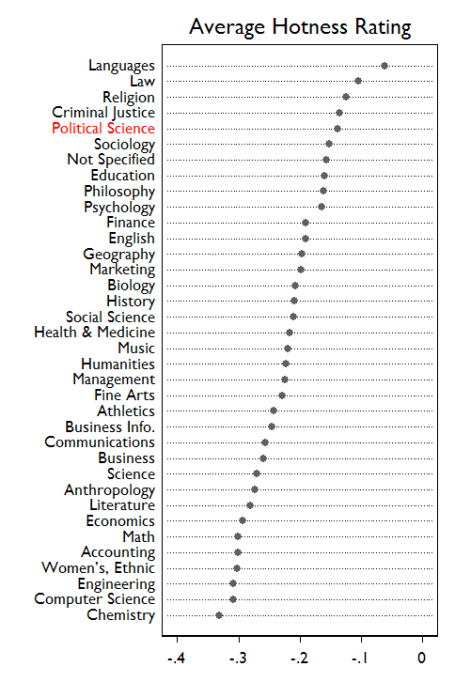
As Henry points out, all the academic disciplines have “hotness quotients” below zero, meaning more likely “not” than “hot.” I’m tempted to ask commentators to supply their favorite counter-examples, but would prefer not to encourage lawsuits.
Technological Change
| Peter Klein |
 You Macophiles may get a kick out of Larry Magid’s 1984 LA Times review of the original Mac (now celebrating its 25th anniversary). Packed with 128K RAM, a 400K floppy drive, a 9-inch monitor, and something called a “mouse,” it wowed the critics from the get-go. Magid was particularly impressed with the MacWrite software, which “can vary the size and style of your type on the screen and on paper. . . . You can vary the type size from 9 point (about the size used in most newspapers) to 72 point headlines. You can also change your type style, selecting an Old English font or one of the more common type styles. Your type can be in bold, italic, underline or even shadow print.” Wow!
Magid doesn’t say anything about speed, which concerned me the first time I saw one in person (yes, back in 1984; I’m that old). The old IBM-compatible PCs running command-line MS-DOS were much faster for basic word processing, database, and spreadsheet applications than the pretty WYSIWYG design popularized on the Mac.
Keynesian Economics in Four Paragraphs
Courtesy of Robert Barro:
[A]ssume that the multiplier was 1.0. In this case, an increase by one unit in government purchases and, thereby, in the aggregate demand for goods would lead to an increase by one unit in real gross domestic product (GDP). Thus, the added public goods are essentially free to society. If the government buys another airplane or bridge, the economy’s total output expands by enough to create the airplane or bridge without requiring a cut in anyone’s consumption or investment.
The explanation for this magic is that idle resources — unemployed labor and capital — are put to work to produce the added goods and services.
If the multiplier is greater than 1.0, as is apparently assumed by Team Obama, the process is even more wonderful. In this case, real GDP rises by more than the increase in government purchases. Thus, in addition to the free airplane or bridge, we also have more goods and services left over to raise private consumption or investment. In this scenario, the added government spending is a good idea even if the bridge goes to nowhere, or if public employees are just filling useless holes. Of course, if this mechanism is genuine, one might ask why the government should stop with only $1 trillion of added purchases.
What’s the flaw? The theory (a simple Keynesian macroeconomic model) implicitly assumes that the government is better than the private market at marshaling idle resources to produce useful stuff. Unemployed labor and capital can be utilized at essentially zero social cost, but the private market is somehow unable to figure any of this out. In other words, there is something wrong with the price system.
Barro thinks a multipler of zero is a more plausible baseline assumption. Of course, if GDP is adjusted for quality, the multipler is most likely negative, as resource allocation is directed by government officials, not consumer demands. In prior work Barro has estimated wartime multiplers of 0.8, but this seems high based on Robert Higgs’s important work [1, 2]. More important, there the Austrian point that resources are heterogeneous, and the additional goods and services financed by government spending will tend to be in the “wrong” place in the economy’s intertemporal structure of production. Keynes rejected the idea of capital heterogeneity, so this problem was lost on him.
That Great Klein (1996) Paper
| Peter Klein |
No, not this one. I’m talking about Ben Klein’s 1996 Economic Inquiry paper, “Why Would Hold-Ups Occur: The Self-Enforcing Range of Contractual Relationships.” It’s from a special issue honoring Armen Alchian, the entire contents of which are worth reading. Klein’s paper extends the Klein, Crawford, and Alchian (1978) model by explaining why, in equilibrium, holdups can occur, even if parties are farsighted. The basic story — that parties deliberately leave “gaps” in their contracts because the marginal costs of filling in the gaps exceed the marginal benefits — is closer in spirit to neoclassical economics than is Williamson’s Carnegie-style appeal to bounded rationality. Writes Klein:
[In an uncertain world where complete contractual specification is costly, transactors use incomplete contracts that deliberately do not take account of every contingency. As a result, transactors knowingly leave themselves open to the possibility of hold-ups.
The costs associated with contractual specification that lead transactors to use incomplete and imperfect contracts involve much more than the narrow transaction costs of writing down responses to additional contingencies. In addition to these extra “ink costs,” complete contractual specification entails wasteful search and negotiation costs associated with discovering and negotiating prespecified contractual responses to all potential contingencies. Because most future events can be accommodated at lower cost after the relevant information is revealed, much of this activity involves largely redistributive rent dissipation with little or no allocative benefit. Transactors are merely attempting to obtain an informational advantage over their transacting partners, hoping to place themselves in a position where they will be more likely to collect on (and less likely to pay for) hold-ups. Therefore, rather than attempting to determine all of the many events that might occur during the life of a contractual relationship and writing a prespecified response to each, the gains from exchange are increased by the use of incomplete contracts.
Transactors also use incomplete contracts because writing something down to be enforced by the court creates rigidity. Since contract terms are necessarily imperfect, once something is written down transactors can engage in a hold-up by rigidly enforcing these imperfect contract terms, even if the literal terms are contrary to the intent of the contracting parties (p. 447). (more…)
Robert Burns and Adam Smith
 | Peter Klein |
I’m sure you’re all busy this week preparing your Burns Supper. I’ll be celebrating on Sunday, of course, the 250th anniversary of Burns’s birth (this Burns, not this one). To honor the occasion Gavin Kennedy has written about the influence on Burns of Adam Smith, whose Theory of Moral Sentiments Burns knew well. Reflecting on the famous lines from Burns’s “Poem About a Louse” — O wad some Pow’r the giftie gie us / To see oursels as ithers see us! — Gavin notes that
Burns’s poem is a way into Smith’s “impartial spectator.” Both men would have agreed that “to see oursels as ithers see us” expresses their different perspectives; Burns, pessimistically, reminding us of human frailty and its consequences, and Smith, optimistically, mapping how humans develop and maintain their moral senses. Smith, contrary to the poet’s assertion, says we do have the power “to see oursels as ithers see us” and he explains how. We have this power, if we wish to use it, from what we may crudely describe as akin to a conscience (though it was much more) in a weak resistance to self-deceit.
Smith is explicit and his stance inspired Burns’s verse:
. . . self-deceit, this fatal weakness of mankind, is the source of half the disorders of human life. If we saw ourselves in the light in which others see us, or in which they would see us if they knew all, a reformation would generally be unavoidable. We could not otherwise endure the sight. (TMS III.4.6)





 Organizations and Markets
Recent Comments