Author Archive
It Was Only a Matter of Time . . .
| Peter Klein |
. . . before someone blamed the financial crisis on agency theory. Sure enough, Raymond Fisman and Rakesh Khurana trace the source of the current mess not to expansionary monetary policy, or lax underwriting standards, or implicit (now explicit) government guarantees against market discipline, or the Basel Committee, or a host of other policy and institutional failures, but to business schools, and the critics’ favorite bête noire, the concept of shareholder wealth maximization.
[B]usiness schools [promote] a particular brand of free-market ideology — squarely focused on shareholder maximization theories — that forms the staple fare of MBA and executive education courses today. . . .
In the world views that underlie modern business education, the market always “gets prices right” and “managers” are merely agents for shareholders. An individual’s worth can be reduced to one’s worth in the market.
If I get $100 million in compensation, the thinking goes, it is because ‘I deserve it.’ There is no discussion of the role of circumstance, luck or market failure. It is the type of thinking that has resulted in literally hundreds of billions of dollars being transferred away from organizational resources and into the personal bank accounts of CEOs, and is now bringing capitalism to its knees.
So, teaching future managers how the price system works, how managerial behavior effects shareholder wealth, how marginal productivity affects wages, and the like is equivalent to encouraging managers to lie, cheat, and steal! I suppose it would be better to teach that water runs uphill, that central planning is more efficient than free markets, and that men are angels. Perhaps we should cover socially responsible statistics and accounting too.
Sumantra Ghoshal famously blamed transaction cost economics and agency theory for much of the world’s ills, including the Enron affair. At least Ghoshal offered some arguments. Fisman and Khurana can’t be bothered. (HT: Ben Asa Rast.)
My New Office Poster
| Peter Klein |
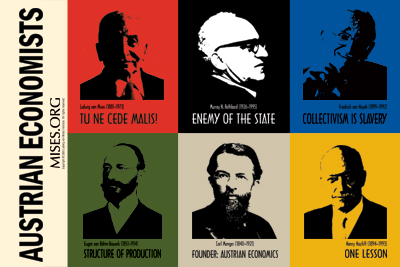
Cool, very cool. With these guys staring down at me I am sure to increase my productivity. That’s Mises, Rothbard, Hayek, Böhm-Bawerk, Menger, and Hazlitt, in case you can’t make out the captions (or, embarrassingly, don’t recognize the mug shots.) Sadly it doesn’t include Nicolai Foss, but you can’t have everything. Thank you, Santa! You can get yours here.
More New Blogs of Interest
| Peter Klein |
- Experiential Knowledge, by Alexandre Padilla
- Economic Policy Review, by a group of Harvard MBA students
- A Financial Economist’s Ramblings, by Wayne Marr
Christmas Links
 | Peter Klein |
Rotman’s Roger Martin explains the challenges faced by Santa in the Knowledge Economy:
While he may have an indisputable track record of effectiveness, Santa is clearly an industrial-age leader. He is going to need to change his leadership style dramatically to prosper in the knowledge economy. His focus on the physical characteristics of his workers — e.g. Rudolph’s red nose — is “old world.” He just has to learn how to value and reward the brains and accumulated knowledge of his elves and reindeers for his enterprise to prosper in the new economy.
The problem with satire, however, is that some people don’t quite get the joke. Consider, for example, this book on leadership, the contents of which can be summarized thusly:
1. Build a wonderful workshop!
- Make the MISSION the MAIN THING
- Focus on your PEOPLE as well as your purpose
- Let VALUES be your guide
2. Choose your reindeer wisely!
- Hire TOUGH so you can manage EASY
- PROMOTE the right ones….for the right reasons
- Go for the DIVERSITY advantage
3. Make a list and check it twice!
- PLAN your work
- WORK your plan
- Make the MOST of what you have
4. Listen to the Elves!
- OPEN your ears to participation
- PAY ATTENTION to how you’re perceived
- Walk awhile in THEIR shoes (more…)
Pomo Alert: New Management Journal Special Issues
| Peter Klein |
We haven’t raised the pomo periscope for a while, but two recent management journal special issues call for its return. The June 2008 issue of the Scandinavian Journal of Management contains a symposium on “Recreating/Recontextualising Entrepreneurship,” which includes such articles as “Accidental Ventures — A Materialist Reading of Opportunity and Entrepreneurial Potential” and “Transduction and Entrepreneurship: A Biophilosophical Image of the Entrepreneur.” Then there’s the new issue of ephemera, with the theme “University, Failed” and articles like “Institutionalizing Critique: A Problem of Critical Management Studies,” “Epistemic Convenience,” “I Wanted to Be an Academic, Not a ‘Creative’: Notes on Universities and the New Capitalism, and “We Are All Workers: A Class Analysis of University Labour Strikes.” Hoo-boy.
Guilds and Innovation
| Peter Klein |
Most economic and management historians see the guild system as partly responsible for the stagnation of the medieval European economy. A new book, Guilds, Innovation and the European Economy, 1400-1800 (S. R. Epstein and Maarten Prak, eds., Cambridge, 2008) offers a revisionist view, challenging the stereotype of guilds as “moribund rent-seekers whose habitual reaction to technical innovation was resistance and rejection.” The reality is more complex, says reviewer Christine MacLeod:
What emerges from this exceptionally coherent volume is not only the complexity of this institution, whose history spans more than half a millennium and a myriad of particular trades and local circumstances, but also the persistent tensions to which it was subjected, both internally from individualistic and capitalist challenges to its collective ethos and externally from the exigencies of nation states. Moreover, it adds another spur to the demanding search for innovation in the workshop and on the construction site, rather than in the too easily accessed and counted records of the patent office.
The Failure of the Journalists, Part II
| Peter Klein |
Another aspect of journalists’ remarkably credulous and fatuous attitude towards policymakers is their view that rhetoric, not substance, is what matters. Hence the constant references to the Bush Administration’s “dedication to free-market principles,” its “aversion to regulation,” its “belief in letting markets work by themselves.” This is of course sheer balderdash and piffle, virtually the reverse of the truth. Bush and Paulson and Greenspan and their clique are “free marketeers” in the same way (to borrow from A. J. Jacobs) that Olive Garden is an Italian restaurant. They adopt the language, and some of the form, of market advocacy without any of the content. The Bush Administration was already, before the “financial crisis,” the most economically interventionist since LBJ; it now ranks with Hoover and FDR as the most aggressively anti-market in US history. Greenspan and Bernanke expanded the money supply like none before; Bush and Cheney borrowed and spent trillions to finance overseas adventures; the Federal Register added pages at a record-setting pace; now the banking and automobile industries have become GSEs. Lassiez-faire, indeed! (BTW can anyone name a specific act of “deregulation” that contributed to the financial crisis? Gramm-Leach-Bliley? No way. And GLB was under Clinton, as was the infamous WGFM. What specific regulations, e.g. on hedge funds or mortgage-backed securities or executive compensation, did the Bush Administration oppose?)
And yet, there was Juan Williams on yesterday’s Diane Rehm show explaining, matter-of-factly, how Bush and Paulson had allowed their “free-market ideology” and “resistance to regulation” to “commitment to the idea that the market works itself” to lead the nation into ruin. Williams may be a good news reporter, but he has the political-economy understanding of a fifth-grader. Does it ever occur to these “watchdogs” to investigate what government officials actually do, rather than simply repeat what they say?
Indigenous Entrepreneurship in Rural China
| Peter Klein |
A very interesting article in the McKinsey Quarterly by MIT’s Yasheng Huang: “Private Ownership: The Real Source of China’s Economic Miracle.” The key to China’s recent economic is not state-led capitalism (call it “Bush-Bernanke-Paulson capitalism”) but private property and financial-market liberalization, leading to a burst of indigenous rural entrepreneurship. Writes Huang:
Big cities like Beijing, Shanghai, and Shenzhen are routinely extolled in the Western press as vibrant growth centers. China’s rural areas, if mentioned at all, typically figure as impoverished backwaters. But a close analysis of the economic data reveals that these breathless descriptions of China’s modern city skylines have it exactly backward: in fact, the economy was most dynamic in rural China, while heavy-handed government intervention has stifled entrepreneurialism and ownership in the urban centers.
Particularly interesting is Huang’s account of why so many Western economists fail to understand this. (more…)
Good to Great: Neither Good nor Great
| Peter Klein |
I’m not a fan of “guru” books like In Search of Excellence, Built to Last, and Good to Great, for reasons well documented by Phil Rosenzweig in his excellent Halo Effect. These books suffer from ad hoc generalization, sampling on the dependent variable, and a host of related methodological and expository flaws. If Rosenszweig’s critique is startling, then two articles from the November 2008 Academy of Management Perspectives on Jim Collins’s Good to Great — perhaps the leading guru book of our time — are devastating. Here is Bruce Resnick and Timothy Smunt:
With sales of more than 4.5 million copies, Good to Great by Jim Collins provides an inspiring message about how a few major companies became great. His simple but powerful framework for creating a strategy any organization can use to go from goodness to greatness is certainly compelling. However, was Collins truly able to identify 11 great companies? Or was the list of great companies he generated merely the result of applying an arbitrary screening filter to the list of Fortune 500 companies? To test the durability of his greatness filter, we conducted a financial analysis on each of the 11 companies over subsequent periods. We found that only one of the 11 companies continues to exhibit superior stock market performance according to Collins’ measure, and that none do so when measured according to a metric based on modern portfolio theory. We conclude that Collins did not find 11 great companies as defined by the set of parameters he claimed are associated with greatness, or, at least, that greatness is not sustainable. (more…)
EJPE Now Available
| Peter Klein |
The Erasmus Journal for Philosophy and Economics has put out its first issue, which you can read online here. Highlights include several articles and reviews about methodology, an interview with Uskali Mäki, and a review of Donald MacKenzie’s An Engine, Not a Camera, much beloved in certain circles. (Via Dan D’Amico.)
Mainstream Journalism, RIP
| Peter Klein |
Last week’s WSJ carried an op-ed from SEC Chair Christopher Cox, “We Need a Bailout Exit Strategy.” The op-ed was nothing special (mostly defending the SEC, of course, though there was a nice Hayekian line about “decentralized decision-making, in which millions of independent economic actors make judgments using their own money, [resulting] in the wisest allocation of scarce resources across our complex society”). What caught my eye was the headline, which suggests a connection between the bailout and the Iraq war, a connection I’ve been meaning to write about.
Remember how journalists felt deceived by the Bush Administration about the war? President Bush said that Saddam Hussein was a “grave and growing threat,” and the media repeated this line. Colin Powell showed pictures of the mobile weapons trailers and the New York Times reprinted them with enthusiasm. When the Administration’s claims proved false, the mea culpas began. Judith Miller resigned in disgrace. Never again, the media cried, will we be used as house propaganda organs. And yet, once the financial crisis began, the exact pattern was repeated. Bernanke and Paulson say there’s a “credit freeze,” that the financial sector is on the verge of collapse, that they alone know what to do — so that’s what the newspapers print. No time to investigate, to interview anyone outside the government, to hold these claims up to any critical scrutiny. If high officials say credit markets are frozen, that only “bold action” from the Treasury, the Fed, and Congress can prevent total meltdown, then that’s the way it is. Virtually every news report on the crisis followed the official script. It’s as if the financial reporters from the Times, the WSJ, the Washington Post, CNN, etc. were embedded with the Treasury. News reports have been little more than government press conferences. Shame, journalists, shame!
Why Oh Why, as Brad DeLong would say, can’t we have a press corps that investigates, rather than simply repeating what the government asserts?
Bygrave on the State of Entrepreneurship Research
| Peter Klein |
William Bygrave surveys the field and concludes that it’s “dominated by quantitative research driven almost exclusively by statistical analysis with SPSS and that qualitative research is seldom published in the leading entrepreneurship journals. He regrets that it is almost impossible to get purely empirical paper published in the leading journal. He pleads with journal editors and their review boards to become less narrow minded and much more pluralistic.”
Bygrave’s assessment is valuable but I think limited by its focus on the “traditional” entrepreneurship journals (e.g., JBV, ETP, SBE). Newer journals such as the SEJ and, more important, the entrepreneurship research that increasingly appears in the top mainstream strategy, organization, and economics journals tends to have a different, and more varied, character.
Ability and Specialization Among Economic Researchers
| Peter Klein |
Forgive the navel-gazing, but some of you may enjoy Todd Kendall’s paper in the December 2008 issue of MDE, “Ability and Specialization Among Economic Researchers,” which looks at the relationship between a researcher’s human capital and the scope of his activities. The sample consists of academic economists at top-50 US universities. Kendall shows that economists from more prestigious PhD programs tend to publish in more general journals, controlling for quality, and to list more JEL subject codes per paper. The quality control is important because the most prestigious journals (as in most fields) are also the most general. But the sample includes prestigious specialty journals and lower-tier general journals.
Naturally I’m tempted to ask for the raw data so I can analyze some sub-samples containing people I know personally. But perhaps it’s better not to go there. I do plan to defend myself against charges of being “eclectic” or “unfocused” by referring to this study and calling myself a “distinguished generalist.” At least it avoids Rothbard’s Law.
Spulber’s Separation Theory of the Firm
| Peter Klein |
Dan Spulber’s new paper, “Discovering the Role of the Firm: The Separation Criterion and Corporate Law,” defines the firm “as a transaction institution [in which] the consumption objectives of the institution’s owners can be separated from the objectives of the institution itself.”
The separation criterion provides a bright line distinction between firms and other types of transaction institutions. Firms under this criterion include profit-maximizing sole proprietorships, corporations, and limited-liability partnerships. Institutions that are not classified as firms include contracts, clubs, workers’ cooperatives, buyers’ cooperatives, merchants associations, basic partnerships, government enterprises, and government sponsored enterprises. The separation theory of the firm yields insights into corporate law that extend and complement the standard contractarian approach. The separation theory of the firm places emphasis on shareholder property rights and corporate governance.
The separation approach, Spulber argues, suggests that the corporate governance literature may pay too much attention to agency costs while downplaying the benefits of delegation. The paper builds on Spulber’s earlier work on intermediation and develops themes in his forthcoming book on the firm. Worth a look.
Rizzo and Whitman on the New Paternalism
| Peter Klein |
Mario Rizzo and Glenn Whitman offer a Hayekian critique of Richard Thaler and Cass Sunstein in their new paper, “The Knowledge Problem of New Paternalism.” From the abstract:
The “new paternalism” is a set of policy prescriptions based on recent findings in behavioral economics whose purpose is to help individuals overcome a wide variety of behavior and cognitive biases. According to its proponents, it does not aim at replacing the preferences of individuals with those of the paternalist but rather to uncover the “true” preferences of individuals, that is, the preferences they would have if they had perfect knowledge, unlimited cognitive abilities and no lack of willpower.
The purpose of this Article is to show that new paternalist policies founder on the shoals of a profound knowledge problem revealed in Friedrich Hayek’s famous critique of central planning. Feasible policies require not only accurate scientific knowledge but also accurate knowledge of “the particular circumstances of time and place” that constitute the local and personal knowledge of individuals. This knowledge is not accessible by paternalists.
See also this exchange between Rizzo and Thaler in last year’s WSJ.
More on the Mythical Credit Crunch
| Peter Klein |
The mainstream media finally picks up the meme. From a Reuters story (via Jeff):
* Overall U.S. bank lending is at its highest level ever and has grown during the current financial crisies.
* U.S. commercial bank lending is at record highs and growing particularly fast since May 2007.
* Corporate bond issuance has declined but increased commercial lending has compensated for this.
As for the interbank market, [a new report] says:
* lending hit its highest level ever in September 2008 and remained high in October and that overall interbank lending is up 22 percent since the start of the financial crisis, taken to be mid-2007.
* The cost of interbank lending, as measured by the interest rates banks charge each other for lending overnight Fed funds, dropped to its lowest level ever in early November and remains at very low levels. . . .
[C]onsumer credit . . . was at a record high in September, the latest date for publicly available data. Local government bond issuance had continued at similar levels to those before the credit crisis, while bank lending for real estate reached a record level in October 2008. . . .
All of [this] drove the Celent report to conclude that the U.S. and other governments may be throwing good money after bad for want of a better idea of what is really happening. “Just like a doctor contemplating an obviously sick and suffering patient, a massive surgical intervention based on a misdiagnosis can only worsen the patient’s condition.”
As usual, you read it here first.
Supply and Demand
| Peter Klein |
 You may have seen this ad that is currently making the rounds. It’s good for a chuckle, and also raises a serious point. Current discussion of the US automakers’ problems focuses almost entirely on the supply side: high labor costs, poor management, lack of innovation. The demand side is largely ignored — there’s talk about the distribution of demand for US products between large and small vehicles, but the overall demand for US cars and trucks, regardless of type, seems to be taken as fixed. But what if consumers change their preferences, not toward “small cars,” but toward non-US products? What, then, is the appropriate policy response?
Bailout proponents seem to believe that US cars “really are” as good as, say Japanese cars, but somehow consumers have been tricked into preferring cars from Japan. As usual, bailout proponents have no argument or evidence whatsoever for this belief, but no matter. A normal person might think consumers are fully entitled to buy, and refuse to buy, whatever brands they like. In today’s corporate-statist economy, however, consumer demand cannot be allowed to influence the allocation of resources.
Thirteen Ways of Looking at a Burrito
| Peter Klein |
I
On twenty pasty faces,
The only thing in common
Was burrito breath.II
I had three dollars,
Like a street person
Who panhandles three hours per burrito.V
I can’t decide between them.
The pleasure of obsession,
Or the pleasure of abandon.
The burrito in the mouth
Or the throat.VIII
I think clever phrases
And bipartisan, utopian ideas;
But I think, somehow,
That the burrito is more useful
than what I think.
Selected stanzas from Klipschutz’s “Thirteen Ways of Looking at a Burrito,” a parody of the famous Wallace Stevens poem “Thirteen Ways of Looking at a Blackbird.” Why am I blogging this? Because several years ago my wife and I picked up a print of the Klipschutz poem at the City Lights Bookstore in San Francisco. It spent years in a closet, rolled in a tube, but we finally got it mounted and framed, and I hung it in the dining room yesterday. Who says we aren’t haute culture here at O&M?
Directions for a Troubled Discipline: Strategy Research, Teaching, and Practice
| Peter Klein |
That’s the title of a symposium in the new issue of the Journal of Management Inquiry, edited by Michael Lounsbury and Paul Hirsch.
Debates about relevance versus rigor in management research have only grown in intensity over the past decade (e.g., Pfeffer, 2008). The following dialog highlights how these concerns have become manifest in the field of strategy, in which there has been disquiet in some circles about the dominance of abstract theorization and a movement toward a re-engagement with practice and practitioners (e.g., Jarzabkowski, 2005; Kaplan, 2003; Whittington, 2006; Whittington et. al., 2003). After a brief introduction by Jarzabkowski and Whittington that situates the dialog, Bower’s article “The Teaching of Strategy: From General Manager to Analyst and Back Again?” defends the importance of a practitioner focus by highlighting the historical role of process research in the early development of the business policy field and the case-oriented teaching tradition at the Harvard Business School. In contradistinction, Grant’s article on “Why Strategy Teaching Should be Theory Based” emphasizes the importance of economic theory in both strategy teaching in research. Finally, in “A Strategy-as-Practice Approach to Strategy Research and Education,” Jarzabkowski and Whittington conclude with an argument hat aims to forge a truce between these often rhetorically opposed positions. They argue that a strategy-as-practice perspective can usefully bridge the divide between research and practice without sacrificing either rigor or relevance.
This issue of JMI also includes a 25-year retrospective on DiMaggio and Powell’s famous “Iron Cage Revisited” paper, for you institutional isomorphism types out there (we know who you are).
Interesting Blogs
| Peter Klein |
- Urban and Regional Studies, by Pedro Marquez
- Beerkens’ Blog, by Eric Beerkens
- Estzer’s Blog, by Eszter Hargittai
- Terminal Degree, by a funny music professor





 Organizations and Markets

Recent Comments