Author Archive
Off to Boot Camp
 | Peter Klein |
I’ll be in Utah this week for the Society for Entrepreneurship Scholars conference, also known as “Manuscript Boot Camp.” It’s a sort of cross between a regular academic conference and a professional development workshop, with an interesting and unusual format. The conference is organized around a set of competitively selected working papers written by PhD students and junior faculty, who will be paired with a rotating series of senior scholars for one-on-one mentoring sessions designed to improve the quality of the papers for publication. These sessions, combined with plenary roundtables and lots of informal interaction, should make for a fun and professionally valuable event, for all concerned. I wish more workshops were organized this way.
The set of senior scholar-mentors includes many of the biggest names in entrepreneurship and strategy research, people like Rajshree Agarwal, David Deeds, Greg Dess, Jeff Dyer, Bill Hesterly, Bob Hoskisson, Jeff Reuer, Harry Sapienza, Bill Schulze, Dave Whetten, and your humble correspondent. More important, the participant list includes several bloggers — me and orgtheory’s Teppo Felin among the mentors, Brian McCann of Management R&D and former O&M guest blogger Chihmao Hsieh among the mentees — so expect good during- and post-conference reporting in the blogosphere.
My only concern, expressed to co-organizer Bill Shulze yesterday, is fitting that many egos into a single room. His solution: “free beer.”
My Favorite Student Questions
| Peter Klein |
Everybody loves the classics. This one, which I received today, is one of my favorites:
I can’t be in class tomorrow. Will I miss anything important?
What are your favorites? (If you’re not an educational professional, you can still play by listing favorite questions received from colleagues, subordinates, etc.)
Nixon Quote of the Week
| Peter Klein |
In case you missed it, a few days ago the Nixon Library released a new batch of tapes from December 1972. My favorite Nixon exhortation, issued to Kissinger on 14 December:
“Never forget,” Nixon tells national security adviser Henry Kissinger in a taped Oval Office conversation revealed Tuesday. “The press is the enemy. The establishment is the enemy. The professors are the enemy.
“Professors are the enemy,” he repeated. “Write that on a blackboard 100 times and never forget it.”
You can listen to the recordings here. Remember, it ain’t paranoia if they really are out to get you.
Have Economists Sold Out?
| Peter Klein |
I’ve complained that, in the current crisis, economists are being ignored. Oliver Hart and Luigi Zingales, two economists I very much admire, argued in Wednesday’s WSJ that the problem is, rather, that economists have sold out:
This year will be remembered not just for one of the worst financial crises in American history, but also as the moment when economists abandoned their principles. There used to be a consensus that selective intervention in the economy was bad. In the last 12 months this belief has been shattered.
Practically every day the government launches a massively expensive new initiative to solve the problems that the last day’s initiative did not. It is hard to discern any principles behind these actions. The lack of a coherent strategy has increased uncertainty and undermined the public’s perception of the government’s competence and trustworthiness.
Now, Hart and Zingales imply, but don’t demonstrate, that these selective interventions are supported by the majority of economists. I think most economists oppose them, but I don’t have systematic evidence either. Still, their point is well taken. To the extent that the lay public associates the moves by Bernanke, Paulson, etc. as representing some kind of professional consensus, the reputation of economics as a scientific discipline will be forever destroyed.
Incidentally, I don’t mind Hart and Zingales’s key counter-proposal that government “should intervene only when there is a clearly identified market failure,” because I think that condition is basically impossible to meet.
Macroeconomics Quote of the Day
| Peter Klein |
From Gary North (thanks to Dennis Lubahn):
Ben Bernanke . . . spent his career studying Milton Friedman’s now-dominant 1963 interpretation of the failure of Federal Reserve Policy, 1930-33, in not reversing the Great Depression. The FED did not inflate, Friedman said. This was in contrast to Murray Rothbard’s 1963 interpretation of the same era. He argued that the FED did inflate, 1924-29, which created the boom that busted in 1929. Had Bernanke studied Murray Rothbard’s 1963 book on Federal Reserve policy as the cause of the Great Depression, he might have had a very different career, perhaps teaching in a community college in North Dakota.
Of course, Rothbard’s approach to addressing the current crisis would be exactly the opposite of what has been done so far: stop inflating, allow interest rates to rise, encourage saving and capital accumulation, allow bankrupt financial and industrial firms to fail, etc. But we are all Keynesians now, right?
The Almost-Convergence of Mises, Parsons, and Popper
| Peter Klein |
O&M dabbles in economics, sociology, and the history and methodology of science so Rafe Champion’s new paper, “Mises, Parsons, and Popper: Comparison and Contrast of Praxeology, the Action Frame of Reference, and Situational Analysis,” may be of interest. Here’s the abstract:
During the 1930s three lines of thought converged on a common model of explanation in economics and the human sciences. Working in Europe, Ludwig von Mises of the Austrian school developed what he called “praxeology” to explore the sciences of human action. In the United States, Talcott Parsons, under the influence of Marshall, Pareto, Durkheim and Weber, offered the “action frame of reference” and in Australasia (in exile from Austria) Karl Popper elaborated “situational analysis”. Common features of the three models are methodological individualism, rejection of instrumentalism in favour of the search for real explanatory theories, and the use of a rationality principle to link the ends and means of action. General acceptance of the common features of these models would have significantly altered the criteria for theory development and appraisal in economics and the other social sciences. In the event, the three lines of thought did not merge to create a critical mass that might have made a difference in the scientific community at large. Their potential synergy has yet to be explored and there is scope for a synthesis of their most robust features with some modifications to each, especially to correct the views of Mises and Parsons on the methods that are effective in the natural sciences. A strange feature of the situation is that the three principals and their followers have, up to date, almost completely refrained from public comment or discussion of the work of the other two parties.
Comments are welcome here or at Rafe’s site.
Some Basic Finance Theory
| Peter Klein |
Sorry to sound like a broken record,* but journalists keep babbling about the “reduction in credit” as if it’s necessarily a bad thing. They don’t know any basic finance theory, which says that in well-functioning capital markets, positive NPV projects are funded and negative NPV projects aren’t. The talking heads think that the total number of projects funded, or the total amount of funding, independent of quality, measures the health of the financial system (and more is always better). They point out that consumers are finding it more difficult to get mortgages, that credit-card issuers are lowering borrowing limits, that firms are facing a higher cost of capital. (Of course, as we’ve pointed out before [1, 2], wild claims about credit markets being “frozen” are preposterous.) But changes in the allocation of credit are inefficient only if previous credit arrangements were somehow optimal. What if mortgages were too easy to get, credit-card limits too high, capital costs too low? A reduction in aggregate borrowing may be an improvement. Aggregate data aren’t helpful here.
For example, on the Diane Rehm show yeseterday two “experts” were talking about the proposed auto-industry bailout, when a wise caller raised this question: if the Big Three can return to profitability after receiving these government loans, then why wouldn’t private lenders be eager to make the loans? The pundits agreed that this was a good question but responded, matter-of-factly, that of course that can’t happen because credit markets have “completely shut down.” Rubbish!
* Readers under 30: ask your parents or grandparents what this expression means. It’s sort of like a corrupted mp3 file.
Outsourcing of Legal Services
| Peter Klein |
Interesting footnote to this recent discussion between me and Gordon Smith on the organizational structure of law firms. Last week the WSJ ran an item, “With Times Tight, Even Lawyers Get Outsourced,” profiling a subsidiary of India’s Pangea3 LLC that performs routine legal services for foreign (mainly US) clients. According to Forrester, quoted in the story, 35,000 US legal jobs will be moved offshore by 2010 and 79,000 by 2015.
The New World Order
| Peter Klein |
Jim Surowiecki at the New Yorker:
When news broke that Timothy Geithner was Barack Obama’s pick for Secretary of the Treasury, the stock market jumped more than six per cent in the space of an hour. Obviously, this was a good thing, but there was also something weird about the spectacle of the Street’s once fearless free marketeers exulting over a government appointment, as if they were nomenklatura members cheering a new Politburo chief. It showed just how central a few government officials have become to the well-being not just of the markets but of the economy as a whole. For better or worse, we now live in a world in which the Treasury Secretary controls hundreds of billions of dollars in spending and shapes the fate of some of the nation’s biggest companies. That’s quite a job to ask someone to do.
I think Surowiecki overstates the newness of all this — government has been heavily involved in running Wall Street since at least the 1930s, and I don’t know how many of the Street’s big players were ever “fearless free marketeers” — but the point is well taken.
Organizational Economics versus Strategy
| Peter Klein |
Brayden has a nice post at our good-twin blog on the differences between organization theory and strategy research. Writing from the perspective of an organizational sociologist, Brayden argues that organization theory is a higher-status, “purer” discipline, but that strategy research asks better questions and is providing more insight into organizations than organization theory.
I think much of Brayden’s analysis carries over to economics as well. Organizational economics (referring to people like Tirole, Hart, Gibbons, Holmström, Baker, Zingales, Aghion, Garicano, Bolton, etc.) has a much higher status than the kind of work published in the Strategic Management Journal or the strategy papers in Organization Science, the Academy of Management Review, or Management Science. (If by “strategy” we mean simply game theory, then strategy research would have the same status as organizational economics.) The explanation is simple: economic theory is a high-status discipline while sociology and applied economics, sociology, and psychology are not. A prominent economist who does some work that could be considered strategy once told me, when asked about SMJ, that its authors “ask good questions, but don’t know how to answer them.” He said it with a knowing smile and a slight shake of the head, the way a Southerner might say “bless their hearts.” Still, one would have to admit that some terrific work has come out of the strategy journals in recent years, particularly (ahem) as economics has become a more foundational discipline in that field.
Neuroscientist Sam Wang on Crackberry Addiction
 | Peter Klein |
Email in small does is productivity enhancing but in large doses it is not productivity enhancing and can even slow down productivity. You don’t even notice because you’re just busy getting those little drops of dopamine. There’s a disconnect between the perceived reward and actual reward.
From an interview in Fast Company. I too suffer from the disease. I never thought of incoming messages as little drops of dopamine, but it makes sense.
Government and the Corporation
| Peter Klein |
What is the net effect of government intervention on firm size, scope, complexity, and ownership? Roderick Long thinks government intervention makes firms larger and more hierarchical than they would otherwise be, and that a pure market economy would be dominated by small firms like worker-owned cooperatives. I think the net effect of government intervention on firm characteristics is ambiguous, because there are so many interventions affecting different types of firms. Here’s some back-and-forth between Roderick and me: his original essay on Cato Unbound, my comment on Mises.org, his reply, and my rejoinder.
Update: See also Caplan.
Pay For Performance, Robert Rubin Edition
| Peter Klein |
Remember, it’s not how much you pay, but how. Today’s WSJ profile of Robert Rubin provides some interesting numbers. Citigroup losses over the last year: $20 billion. US government bailout money going to Citigroup in the last month: $45 billion. Rubin’s compensation since becoming senior counselor and a director at Citigroup in 1999: $115 million. Naturally, Rubin says Citi’s near bankruptcy has nothing to do with his leadership. Critics say he encouraged the firm to increase its risk taking in 2004 and 2005. Ah well, another former Golden Boy brought down to earth. Thank goodness something positive is coming out of this mess.
Consider this today’s friendly reminder that corporate welfare is a bipartisan scam.
Update: See also Larry Ribstein.
Some Interesting Working Papers
| Peter Klein |
- Jennifer Arlen and Eric Talley, “Experimental Law and Economics”
This chapter provides a framework for assessing the contributions of experiments in Law and Economics. We identify criteria for determining the validity of an experiment and find that these criteria depend upon both the purpose of the experiment and the theory of behavior implicated by the experiment. While all experiments must satisfy the standard experimental desiderata of control, falsifiability of theory, internal consistency, external consistency and replicability, the question of whether an experiment also must be “contextually attentive” — in the sense of matching the real world choice being studied — depends on the underlying theory of decision-making being tested or implicated by the experiment.
- Matthew J. Holian, “Optimal Decentralization in Corporations and Federations”
Oates’ Theorem and the M-form Hypothesis are both organizational theories of decentralization, though they deal with different types of organizations. This brief note describes how the two theories complement one another, through both verbal description and mathematical models. The result is a simple but comprehensive account of the delegation problem.
- Abhijit V. Banerjee, Esther Duflo, “The Experimental Approach to Development Economics”
Randomized experiments have become a popular tool in development economics research, and have been the subject of a number of criticisms. This paper reviews the recent literature, and discusses the strengths and limitations of this approach in theory and in practice. We argue that the main virtue of randomized experiments is that, due to the close collaboration between researchers and implementers, they allow the estimation of parameters that it would not otherwise be possible to evaluate. We discuss the concerns that have been raised regarding experiments, and generally conclude that while they are real, they are often not specific to experiments. We conclude by discussing the relationship between theory and experiments.
Identification versus Importance
| Peter Klein |
At a recent workshop the subject of econometric identification came up. Identification is of course the major issue of our day among mainstream empirical economists. Some have described the dissertation process as the “search for a good instrument.” Instrumental-variables estimators have their critics, of course, but these critics are in the minority.
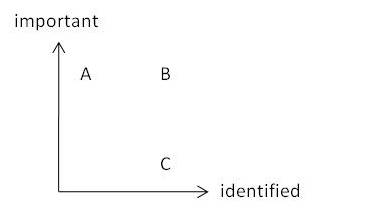
One of the workshop participants, a regular attendee at NBER events, summarized the consensus view among the elites of the profession with the following diagram:

A research problem can be important, and it can be well identified. The ideal problem is one in quadrant B, both important and identified. However, a problem in quadrant C is much more likely to be published in a top journal than a problem in quadrant A.
What does this say about the economics profession?
Hayek Speaks on Inflation and Unemployment
| Peter Klein |
Kudos to Jeff Tucker for unearthing this 1975 interview from Meet the Press. Notes Jeff:
The line of questioning he endures is hilariously naive and idiotic. We think we have a Keynesian problem now; it’s clear that these people really believe that policy makers can manipulate the economy like a machine, trading off unemployment for inflation and back again, with no trouble.
John Cochran suggests another Hayek appearance from 1975, this one a lecture at the University of Colorado (provided by Fred Glahe). Here are a few more from the Mises.org audio archive. And see also the new book.
Christina Romer to Head CEA
| Peter Klein |
 Obama has named Christy Romer, one of my old professors, to head the Council of Economic Advisers. She’s smart, organized, a great communicator; I expect her to be highly effective. She is a moderate Keynesian, of the New Keynesian variety, best known for her revisionist work challenging the postwar Keynesian consensus view that activist monetary and fiscal policy has lessened the severity of the business cycle compared to the bad old laissez-faire days. See, for example, “Is the Stabilization of the Postwar Economy a Figment of the Data?” AER, June 1986, and “Remeasuring Business Cycles,” JEH, September 1994. A recent Journal of Economic Perspectives piece and her entry on business cycles in the Concise Encyclopedia of Economics summarizes this work. Here is more. (Of course, doubts about the effectiveness of Keynesian stabilization policy have not dampened most macroeconomists’ enthusiasm for, well, Keynesian stabilization policy.)
I met Christy in my first year of graduate school when she co-taught, with Barry Eichengreen, my course in US economic history. I subsequently served for two semesters as her head TA in the large economics principles course (600 students, 16 TAs, one head TA, one professor — quite an operation). Berkeley had in those days a system in which the dissertation adviser (in my case, Oliver Williamson) does not serve on the dissertation proposal committee, and Christy kindly chaired the proposal committee for me, even though the topic (conglomerate diversification) was not in her general area. She is a great teacher and a great manager, careful, patient, and fair. Naturally my top choice for CEA chair would have been somone with views just like, um, mine, but of the realistic candidates Christy is an excellent choice.
What Do Boards Do and How Do They Do It?
| Peter Klein |
A new survey paper on Boards of Directors by Ben Hermalin and Mike Weisbach, updating their 2003 paper.
This paper is a survey of the literature on boards of directors, with an emphasis on research done subsequent to the Hermalin and Weisbach (2003) survey. The two questions most asked about boards are what determines their makeup and what determines their actions? These questions are fundamentally intertwined, which complicates the study of boards due to the joint endogeneity of makeup and actions. A focus of this survey is on how the literature, theoretical as well as empirically, deals – or on occasions fails to deal – with this complication. We suggest that many studies of boards can best be interpreted as joint statements about both the director-selection process and the effect of board composition on board actions and firm performance.
Don’t let James Walsh see this!
Write Like Toni Morrison
| Peter Klein |
Remember the Universal Translator? Peter Wood, in like manner, provides a useful guide to translating regular English prose into the style of Nobel-prizewinning author Toni Morrison, probably the most frequently assigned writer on US college campuses. The basic rules:
- Misuse common phrases
- Embrace inconsistency
- Omit words to create more forceful expression
- Mix up parts of speech
- Chop in self-conscious micro-sentences
He provides some wonderful examples. For instance, this office memo:
Just to remind you, I will be out of the office Tuesday to meet with our supplier, Acme Explosives. Please finish your work on the 2Q budget and let the account rep know that Mr. Coyote’s order will be shipped Thursday.
becomes
The reminding can’t wait the hurry of it. I explain. I know you know of Tuesday, I and Acme Explosives is soon together meet. You can please work, perhaps, the budget’s second quarter, and knowledge the account rep of Mr. Coyote’s Thursday shipment.
Wood also reminds us that Morrison is “the undisputed master of wandering verb tenses” and that she “knows how deftly to insert evocative foreign terms.”
But it is the anachronistic little details that are Morrison’s signature. My favorite occurs late in the book: “Ice-coated starlings clung to branches drooping with snow.” This is the 1690s, two centuries before the eccentric bird lover Eugene Schiffelin introduced starlings to the U.S. by releasing sixty of them in Central Park.
Schiffelin had no idea how the birds would proliferate, crowd out native species, and form enormous squawking, twittering, whistling flocks that seem to fill up whole forests. Starlings seem to propagate as fast as clichés and to descend like clouds of effusive blurbs on overpraised books.
Education Quote of the Day
| Peter Klein |
There is a settled mediocrity in American college teaching, surpassed here and there by talented and energetic individuals, but seldom disturbed in its languorous self-satisfaction. On most campuses, mediocrity can rightly pride itself on being a whole lot better than the conspicuous dreadfulness of a handful of professors who dedicate themselves variously to the nine muses of bad teaching: Boredom, Mumbling, Disorganization, Confusion, Forgetfulness, Stridency, PowerPoint, Textbook, and Vacuity.
That’s from Peter Wood, whose subject is actually the division of labor at many large US universities between tenured/tenure-track faculty, who do research and teach small classes to graduate and advanced undergraduate students, and the specialized, non-tenured teaching specialists who handle the bulk of the undergraduate instruction, assisted by a “small army” of graduate and undergraduate TAs. Wood points out, rightly IMHO, that one day the universities may decide that the prestige and grant dollars and other bennies generated by the research faculty isn’t worth their high salaries, perhaps choosing to go the University of Phoenix route instead.





 Organizations and Markets

Recent Comments