Author Archive
New Kauffman Entrepreneurship Blog
| Peter Klein |
The Kauffman Foundation’s Tim Kane and Bob Litan have a new blog, Growthology, focusing on the links between entrepreneurship and economic growth. Early posts focus on Schumpeter and Jane Jacobs, a good sign.
Reflecting on blogs’ advantages over traditional media, Kane notes the critical role of disaggregation. “A better way to think of this is personalized aggregation, something that can be done digitally with ease. . . . What is under siege is the business of mass-market aggregated news. I do not know if it can survive, but I do know that -– as a blogger -– I have its ink on my hands.” Amen to that.
Best Seminar Title You’ll Read Today
| Peter Klein |
It’s “Manure Entrepreneurs: Turning Brown to Green,” the theme for today’s Breimyer Seminar here at the University of Missouri. I promise, it won’t be just the same old . . . you know.
Incidentally, the seminar series is named for Harold F. Breimyer, a prominent agricultural economist of the last century. A friend described him to me this way:
He was an original New Deal agricultural economist who was absolutely and positively convinced of the inability of farmers and ranchers to compete without government because of their “obvious” lack of market power. His main issue was who will “control” agriculture. This conviction was so deep-seated that he could not appreciate or comprehend other perspectives. We corresponded in the late 1970s and it was as if we were from different planets. Promoting free-market agriculture, I was to him either a fool or a tool, or both.
Great Moments in Laziness
 | Peter Klein |
Some people are calculator nerds. For the lazy nerd, however, the real action is in remote controls. Did you know the first commercially available TV remote came out in 1950? Check out this history of the remote, and don’t miss the slideshow.
But, really, how much fun is channel surfing with only four channels?
The Klein Doctrine
| Peter Klein |
That’s the title of Johan Norberg’s new report ripping Cousin Naomi’s The Shock Doctrine: The Rise of Disaster Capitalism. Great subtitle: “The Rise of Disaster Polemics.” Here’s Norberg: “Klein’s analysis is hopelessly flawed at virtually every level. . . . Klein’s historical examples also fall apart under scrutiny. . . . Klein’s broader empirical claims fare no better.” Indeed, an embarrassment for Kleins everywhere. (HT: Steve Horwitz)
Update from Per Bylund: “This guy will publish a whole book on Naomi Klein later this year, published by Timbro (in Swedish only), called Naomi Klein’s Nudity Shock: Exclusive Exposure: Everything on the Empress’ New Clothes (my [quick] translation).”
Bonus libertarian material: Former guest blogger David Gordon has a nice takedown of Thaler and Sunstein’s Nudge, their defense of “libertarian paternalism.” See also this exchange between Thaler and Mario Rizzo.
Tom Ulen is Blogging
| Peter Klein |
Tom Ulen, Swanlund Chair and Director of the Illinois Program in Law and Economics at the University of Illinois College of Law, is online at the Law & Econ Prof Blog. Tom’s textbook (with Robert Cooter), Law and Economics, is now in its fifth edition and continues to be a fine introduction to the L&E literature.
I was going to write “Welcome to the blogosphere!” until I discovered that he’s been doing this longer than we have.
Me on Benkler
| Peter Klein |
Here is my review of Yochai Benkler’s The Wealth of Networks: How Social Production Transforms Markets and Freedom (Yale University Press, 2006). It will appear in the Fall 2008 issue of The Independent Review. Benkler has written a fine book, though I have some reservations, as explained in the review.
Interdisciplinary Degree Programs
| Peter Klein |
ANAKIN: How do you know the ways of the Force?
PALPATINE: My mentor taught me everything about the Force . . . even the nature of the dark side.
One of the great things about being Oliver Williamson’s PhD student is that he encouraged us to read widely outside our core discipline. His “Economics of Institutions” course included materials from political science, business history, cognitive science, and even . . . sociology! So while my primary training was in economics, I was exposed to some of the best thinkers in the “contiguous disciplines.” I even know about the dark side.
Nonetheless, I was enrolled in a traditional degree program and was credentialed in an established discipline (economics). Recently I’ve been talking to colleagues in several departments about the possibility of creating a truly interdisciplinary social-science degree program, one that would train students in two or more disciplines organized around core subject areas like organizational studies, entrepreneurship, regional development, and the like. This sort of curriculum has obvious potential advantages in fostering intellectual breadth, developing critical thinking skills, and encouraging relevance and accessibility beyond a handful of specialists. On the other hand, there are many potential hazards. The training may be broad but not deep; opportunities for narrow, technical advances may be missed; students may struggle to find academic placements; and so on.
I’d like to hear from readers who have experience with, or informed opinions on, such interdisciplinary programs. The best-known is probably Chicago’s Committee on Social Thought, which included T. S. Eliot, F. A. Hayek, Allan Bloom, Saul Bellow, Hannah Arendt, and Leo Strauss on its faculty and produced outstanding graduates such as Ralph Raico and Ronald Hamowy. Arizona State’s School of Global Studies is a more recent example. Vanderbilt recently started a PhD program in law and economics. What are some other programs I should be studying?
Edinburgh Business School to Buy Adam Smith’s House
| Peter Klein |
How would you like to take economics classes in Adam Smith’s house? Edinburgh Business School students will have the pleasure after the school completes its purchase of Panmure House, Adam Smith’s home from 1788 to 1790. Smith was born in nearby Kirkaldy and spent much of his academic career in Glasgow, but lived in Edinburgh on several occasions and was a prominent member of Edinburgh society.
Some commentators find it ironic that the house’s current owner, Edinburgh’s City Council, is selling to the university rather than accept a higher, competing bid from a private citizen. So much for the free market! But, as a careful reading of Smith reveals, Smith was hardly an advocate for unrestricted laissez-faire, supporting substantial public expenditures on infrastructure and education as well as the legal system and national defense (see David Gordon and Gavin Kennedy).
Remember Books?
| Peter Klein |
 Before multimedia, blog entries, and PowerPoint, people expressed their ideas in books. Appreciating books requires a longer-than-average attention span, a love of the tactile (no Kindles, please!), and a comfy chair. Anyway, if you’re into that whole Retro thing, there’s an official conference series on the Book. The sixth annual meeting is coming up this fall. From the conference blurb:
In the context of today’s rapid developments in information technologies, the book is indeed an old medium of expression. Do the new media (the internet, multimedia texts and new delivery formats) represent a threat or an opportunity? What is the book’s future as a creature of and conduit for human creativity?
This Conference will address the provocative suggestion that, rather than being eclipsed by the new media, the book will thrive as a cultural and commercial artifact. More than this, the information architecture of the book, embodying as it does thousands of years’ experience with recorded knowledge, may well prove critical to the success of the new media.
These crazy bibliophiles even have their own journal!
A Coasian Approach to Beating Google
| Peter Klein |
The always-interesting and provocative Mark Cuban (yes, him) suggests a “Coasian” strategy, based on side payments, for beating Google in the search-engine wars. If I understand correctly, the strategy works like this. Websites have the option (through robots.txt protocols) to prevent their inclusion in search engine databases. At some price, popular websites would presumably be willing to block Google’s spiders. Once word gets around that Google’s database no longer includes these sites, consumers would start to use alternative search engines. Doing this wouldn’t be cheap, but Cuban points out that that upstart search provider wouldn’t need the whole internet to play along, just the top sites, the ones at the left side of Chris Anderson’s long tail. It might cost, say, $1 billion, but the upstart would recover that $1 billion pretty quickly.
One problem Cuban doesn’t consider is that this kind of fragmentation in search-engine space would presumably reduce the value of search, cutting the revenue stream that Google is presently gobbling up. But the upstart might be better off with a larger slice of a smaller pie.
A more fundamental problem is that Google would presumably bid to get the top sites back. Do the search engines bid away all the rents, such that the returns from search accrue entirely to the top sites (as in the old Demsetz-Posner franchise-bidding model)? Or is the process more like a common-values auction with uncertainty and hence subject to the winner’s curse?
Manne on Ideology and the Law-and-Economics Movement
| Peter Klein |
Josh Wright has written a thoughtful and informative series on the future of law and economics (1, 2, 3, 4). Key issues include the increasing formalism of L&E scholarship, the place of L&E within law schools (as opposed to economics departments), and the influence of L&E on legal practice and public policy.
The latest entry focuses on a response to Josh by Henry Manne, the founder of the modern law-and-economics movement (and, I might add, a regular reader of O&M). Manne argues that ideology, more than genuine scientific disagreement, explains the often-hostile reaction to L&E within the legal establishment, a theme we’ve explored in several posts (1, 2, 3, 4, 5).
I think that the major issues are now, as they were fifty years ago, mainly ideological, and I believe that the causes forcing L&E out of the law schools today are the very same ones that operated to prevent my getting better jobs in the 1960s and for most senior law professors to think that what I was advocating was sheer nonsense, “to the right of Genghis Kahn,” as they used to be so stupidly amused at repeating ad nauseum. They were protecting their intellectual investment in skills and ideology against the threat of a new paradigm in which they could not share the rents, and I do believe that that is exactly what is still happening. While you and I see enormous social benefits from a legal system based on the idea of property rights and their protection, all they see is less role for the government and themselves. Perhaps this acts at an unconscious level, but it unmistakably is at work whatever the source of the peculiar leftist ideology of most academics.
What I am saying is that it is impossible to separate completely a discussion of the role of L&E in legal education from the ideological aspects of the subject. I honestly believe that at some level the turn of L&E to econometrics and empirical work is a flight from the implications of a thoroughgoing Alchianesque kind of economics. Perhaps that is even more clear with the current popularity of Behavioral Economics, and of late I even notice in the literature a somewhat open attack on the very idea of freedom of contract. I do not think these developments are accidental or random; I believe that they are inherent in the very structure of modern universities and law schools.
I Almost Didn’t Write this Blog Entry
| Peter Klein |
I mean, what’s the rush? But here it is, a pointer to Slate’s special issue on procrastination. Don’t put off reading it. Or do, if you want.
Take (Over) My Firm, Please!
| Peter Klein |
To paraphrase Groucho Marx, would you want to take over a firm that wants you to take it over? Most corporate bidders don’t. From Derek Oler and Kevin Smith:
We investigate 401 firms that publicly advertise a desire to be acquired (“take-me-over” or TMO firms) from 1990 to 2006. Over this period the TMO “wave” lags about one year behind the acquisition wave. Most TMO firms show evidence of high debt levels as well as fundamental underperformance relative to industry peers. Although most TMO firms enjoy positive announcement period returns, they significantly underperform in the year following their TMO announcement, and most do not receive a takeover offer. Greater proportionate ownership of the firm by dedicated institutional investors is associated with greater likelihood of the firm avoiding bankruptcy, but not with greater likelihood of the firm being acquired. These results suggest that the TMO announcement is a significant signal of bad news that is not fully anticipated by the market. However, the TMO announcement does increase the odds of the firm actually receiving a takeover offer.
The paper is titled “The Characteristics and Fate of ‘Take Me Over’ Firms.”
I tell you, I’ve been looking for an opportunity to reference Henny Youngman and Groucho Marx in the same post for years!
Turgot and What Might Have Been
| Peter Klein |
As a Francophile and Turgot enthusiast I direct you to Frédéric Sautet’s remarks on today’s anniversary of Turgot’s dismissal by the French crown:
May 12, 1776 was one of the saddest days for France. It was the day Louis XVI removed A.R.J. Turgot from office. Turgot was the Minister of Finance of France, the greatest French economist of the 18th century, and a key figure of the French enlightenment (he was a close friend of Condorcet, and Voltaire came to his rescue). He had a great sense of duty, freedom, and civilization. Turgot was too successful, so to speak, in his economic reforms and in the fiscal discipline he imposed on the finances of the French Crown. He fell because he wanted to go too far in the removal of confiscatory taxes (la taille and la corvée), the deregulation of commerce and industry, and the abolition of privileges many guilds and others possessed at the time (e.g. les droits féodaux). Turgot is perhaps the greatest reformer the world has ever seen. If Louis XVI had trusted his Minister of Finance to the end, it is likely that the French Revolution would not have taken place.
Note that Turgot even had his own castle. Ricardo was almost certainly wealthier, though. Böhm-Bawerk was also a fine Minister of Finance.
Politically Incorrect Company Logos
| Peter Klein |
 One of my favorite local restaurants sits next to a Sherwin-Williams paint store. When leaving the restaurant I always pause to gaze upon the Sherwin-Williams logo. A paint can dumping red ooze over the planet’s surface — you can’t get more politically incorrect than that! There’s even a tagline, “Cover the Earth,” in case you miss the point. In today’s environmentally sensitive age this logo is the Anti-Green. It screams: synthetic, industrial, man-made, unnatural. I love it.
I imagine there’s a lot of pressure on the company to reject the logo, but Sherwin-Williams soldiers on. There’s a brief description, charmingly apologetic, on the “Green Initiatives” page of the company website. “Created in the late 1800s, the logo’s purpose was to represent the company’s desire to help beautify and protect the buildings of the world. It was a symbol of a young company’s enthusiasm, idealism and hope regarding its future and the possibility for achievement that hovered on the nation’s horizon.” In other words, that was a different age, please forgive us. Today it’s simply “a figurative emblem signifying quality, integrity and service.” And no more oily residue!
What other firms have politically incorrect logos? Marlboro of course ditched the Marlboro man long ago. Joe Camel made it to 1997 before being ushered into retirement. Robertson’s kept Golly on its marmalade jars until 2001. Oh, and check out this funny set of politically incorrect ads of yesteryear (Santa smoking Chesterfields, a husband spanking his wife for serving the wrong coffee, a group of servicemen being warned “You can’t beat the Axis if you get VD”).
How People Find Us
| Peter Klein |
Like other blogs, O&M gets most of its new readers through links from other blogs and websites. But people also find us by searching. Our software shows us what search terms lead people here, and I recently looked up the most popular search terms from our 24 months of existence. Here’s the list.
- agency theory
- organizations and markets
- market based management
- corruption in organizations
- concept map
- organization and markets
- life in hell
- history of marketing
- strategic entrepreneurship journal
- swot model
- nicolai foss
- history of accounting
- theories of profit
- unusual business ideas
- market-based management
- queen bee syndrome
- peter klein
- pareto criterion
- management theory
- management theories
Obviously there’s something wrong with the order of items #11 and #17, but otherwise the software seems to work pretty well. . . .
Toyota the Innovator
| Peter Klein |
Jim Surowiecki’s latest New Yorker column focuses on Toyota and makes several important points about innovation.
- Process innovation is at least as important as, though less visible than, product innovation.
- Innovation can be an incremental process in which “the goal is not to make huge, sudden leaps but, rather, to make things better on a daily basis.”
- Process innovations often bubble up from the bottom, rather than the top, of the hierarchy.
- Cumulative, bottom-up, process innovation is really hard to imitate. “[T]he fundamental ethos of kaizen — slow and steady improvement — runs counter to the way that most companies think about change. Corporations hope that the right concept will turn things around overnight. This is what you might call the crash-diet approach: starve yourself for a few days and you’ll be thin for life. The Toyota approach is more like a regular, sustained diet — less immediately dramatic but, as everyone knows, much harder to sustain.”
These points are well known in the innovation literature but Surowiecki’s succinct and elegant presentation is well worth a read, even by specialists.
See also Steve Postrel’s earlier post on Toyota.
Hayek on Intellectuals
| Peter Klein |
It’s Hayek-Klein Day, and bloggers are sharing their favorite Hayek quotes (Boudreaux, Horwitz). Here’s one of mine:
The typical intellectual . . . need not possess special knowledge of anything in particular, nor need he even be particularly intelligent, to perform his role as intermediary in the spreading of ideas. What qualifies him for his job is the wide range of subjects on which he can readily talk and write, and a position or habits through which he becomes acquainted with new ideas sooner than those to whom he addresses himself.
That’s from “The Intellectuals and Socialism,” published in 1949. (See this for an elaboration of Hayek’s argument.) Substitute “blogger” for “intellectual” and the passage could have been written today!
Wharton Private Equity Review
| Peter Klein |
A special report from Knowledge@Wharton:
While the credit crunch has put a damper on headline-grabbing large buyouts, private equity firms have found other ways to discover value in the current market. In this special report, produced in cooperation with the Wharton Private Equity Club, Knowledge@Wharton looks at how funds are adapting to changes in the credit environment, what opportunities exist in the developed markets of Europe and Japan, and the ways that proposed changes in taxation may affect the industry. Also included is a roundtable discussion on setting up a first-time fund in the current market, as well as an interview with David Rubenstein, co-founder and managing director of The Carlyle Group.
Get the report here. For more on private equity see the proceedings from last fall’s AEI conference.
Incidentally, I used Jensen’s “Eclipse of the Public Corporation” in my strategy class this semester amd continue to be impressed with Jensen’s insight and prescience in that piece, now nearly twenty years old. Still an excellent introduction to the organizational economics of private equity.
Top Business Gurus
| Peter Klein |
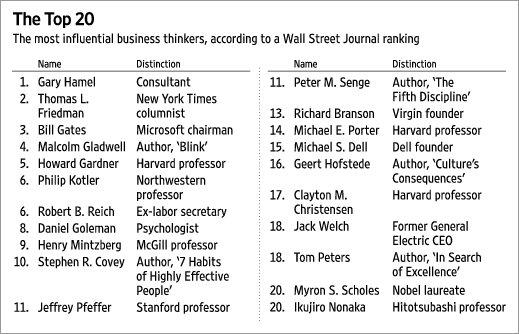
Did you catch the list of Top Business Gurus in Monday’s WSJ? Based on Google, Lexis-Nexis, and academic citation indexes, it puts Gary Hamel at the top, followed by Tom Friedman, Bill Gates, Malcolm Gladwell, and Howard Gardner. Our own Jeff Pfeffer checks in at #11. Click the picture below for the entire list. Hamel, Stephen Covey, Michael Porter, Clayton Christensen, and Tom Peters are obvious candidates for Guru Status, though the ranking algorithm produces some unlikely results too, such as Robert Reich and Myron Scholes.





 Organizations and Markets


Recent Comments