Posts filed under ‘Austrian Economics’
Keynes-Hayek again!
| Peter Lewin |
I am not sure if this book has already been review on this blog space — I haven’t seen it. Similarly, I haven’t seen any other reviews, so these are my fresh impressions. The book is Keynes Hayek: The Clash that Defined Modern Economics by Nicholas Wapshott (W. W. Norton: 2011).
With the growing interest in Hayek as the antidote to the resuscitated Keynes, this book is timely providing for the reader lively insight into the life and times of these two key individuals. In terms of the details of the lives of Keynes and Hayek the book appears to be well researched. I learned a few things from it — interesting details about events and personalities. On Keynes particularly one gains a sense of the power of the man and how a whole generation of economists at the LSE and Cambridge were won over by his revolutionary vision. Though Wapshott provides a lot of material on Hayek, I could not fight the impression that it was Keynes who captured his interest (and admiration?) most. Hayek is presented in all of his aspects, including the not so wholesome ones. The picture of Keynes seems less forthcoming, or differently spun to cast a more favorable light. But maybe that is just me and my biases.
When it comes to the economics, however, the case is much clearer. Wapshott is very weak on this part of the story, especially when it comes to Austrian economics. He is able to do a fairly good job of Keynesianism, again positively spun — including the story of multiplier. It adds to the plausibility of Keynes’s appeal. But when it comes to explaining the essence of Hayek’s opposition, his treatment is very inadequate at best and complete wrong at worst. Like Keynes himself, Wapshott does not understand capital theory and the time structure of production. So he gets the story of the business cycle wrong. He simply parrots in a formulaic way the ingredients of Hayek’s case. His treatment of Mises is almost a caricature. He does not understand the nature of the Austrian turn from classical economics and has some misleading things to say about the concept of “value.” Likewise he does not understand the differences and similarities between the economics of the Austrians and the Monetarists and invents bogus differences. I found this part of the book frustrating.
So, the question in my mind is: do I recommend this book to my macro/money students? I think I probably will, with suitable warnings, just because it is such a vital and interesting story.
The Sorry State of Economic Journalism
| Peter Klein |
Matthew Yglesias has found a killer argument against the Austrian theory of the business cycle:
[T]he Austrian story of investment booms and busts doesn’t actually explain recessions and unemployment. Spending patterns shift all the time without sparking a recession. People stop buying BlackBerrys and they buy iPhones instead. Or people stop buying boot-cut jeans and buy skinny jeans instead. Across sectors, maybe people go see fewer movies and with the money they save they eat out at nicer restaurants. A business that curtails its investment spending should have extra money to pay out as dividends. Or if they want to horde the cash, it sits in a bank for someone else to lend out.
I once heard a lecture by the sociologist Steven Goldberg about his work on male social dominance, expressed in his books The Inevitability of Patriarchy (1974) and Why Men Rule (1993). I remember him saying that whenever he presents his dominance thesis, someone invariably raises the objection, with a smug and self-satisfied expression, “What about Indira Gandhi?” or “What about Margaret Thatcher?” He went on (I’m paraphrasing): “Right. . . . Like I’m going to devote three years of my life to researching and writing a book called The Inevitability of Patriarchy, and someone’s going to say ‘What about Indira Gandhi,’ and I’m going to slap my forehead and say, ‘Oh, crap, why I didn’t think of that!'” Goldberg was a funny guy, with a great Brooklyn accent too. (His books point out that Gandhi-led India and Thatcher-led Britain were male-dominated societies, particularly in matters of state.)
This is the centennial year of Mises’s Theory of Money and Credit, published in German in 1912, the book that first presented the “Austrian” theory of business cycles. No doubt Yglesias is unaware that in the hundred years since, there have been dozens of books, hundreds of research papers, more than a few Ph.D. dissertations, and even one Nobel prize analyzing, developing, critiquing, and extending this theory. (Yglesias mistakenly attributes Hayek’s Nobel prize to his work on tacit knowledge, when in fact the prize was given for business-cycle theory.) And yet, these thousands of hours of scholarship can be blithely tossed aside because — wouldn’t you know it — people change their spending habits all the time, and it doesn’t cause a business cycle! Slap to the forehead. Why didn’t we think of that? Curse you, Matt Yglesias! (more…)
Disaggregation
| Peter Klein |
The idea that mainstream macroeconomic thinking focuses at too high a level of aggregation is a frequent complaint on this blog (e.g., here, here, here, and here). Our recent Strategic Organization paper hammers home this point. The level of aggregation is of course a fundamental difference between Keynesian and Austrian theorizing about economic fluctuations. But Keynesian economists don’t seem to recognize this.
The other day I posted a snarky blog entry at The Beacon, responding to a Krugman smear of Hayek (yawn). Today Mario Rizzo pens a more thoughtful response, emphasizing exactly this level-of-analysis issue:
I think the real issue is this. Hayek’s approach attacks, root-and-branch, the macroeconomic way of thinking. It is not simply a challenge to a particular theory of the determinants of mass unemployment, inflation, business cycles and the like. Hayek is not accepting the rules of the game or the parameters of the sub-discipline of modern macroeconomics. Hayek does not want to argue that the government expenditure multiplier is 0.5 instead of 2.0, for example. He does not want to discuss just how much fiscal stimulus should be undertaken and what form it should assume.
In short, he does not want to focus on aggregate spending and aggregate consequences. Hayek’s approach says: Let us pierce the veil of aggregates and look at the distortive effects on relative prices and relative output produced by boom-time credit expansions. Let us look at the distortive effects that booms leave us as we work our way through a recession. Let us concentrate on sustainable lines of expenditure both during the boom and during the road out from the bust.
Rafe Champion at Missouri
| Peter Klein |
 It’s been fun hosting Australian writer (and frequent O&M commenter) Rafe Champion at Missouri the last couple of days. Rafe spoke to the economists about the philosophy of science (handout here), and to the graduate philosophy seminar of my colleague André Ariew on current research topics in the philosophy of biology. We’ve had many talks about Hayek, Mises, Popper, Parsons, and our mutual friend Bill Bartley, among others. Rafe blogs at Catallaxy Files and the Critical Rationalist blog, and his website The Rathouse contains a treasure-trove of writings by, and commentary on, the most important twentieth-century philosophers of science.
Rationalistic Hubris and Opportunistic Behavior
| Peter Lewin |
The October 2011 issue of the Journal of Economic Behavior & Organization is a special issue on the work of James Buchanan, guest edited by Pete Boettke, arising out of a recent FFSO conference. In addition to Boettke, the contributors are Kliemt, Marciano, Munger, Leeson, G. Vanberg, Voigt, Horwitz, Besley, Coyne, and Horn on a variety of topics. Amartya Sen and Elinor Ostrom contributed short appreciations. This issue is full of good stuff on a variety of topics.
I focus here on the lead article by Pete Boettke somewhat clumsily entitled, “Teaching Economics, Appreciating Spontaneous Order, and Economics as a Public Science.” For my part, this article alone makes the issue worthwhile getting. Boettke presents an overview of the many facets of Buchanan’s work (and as they developed over his career) helpfully connecting and contrasting it with Hayek. Some of these ideas are directly relevant to the organization and management context.
At the risk of distorting oversimplification, we may say that whereas Hayek concentrated on the problem of rationalistic hubris, Buchanan concentrated on the problem of opportunistic behavior. Both are inevitable and related problems of social systems, and each of their works thus complements the other. In a nutshell, each is an in-depth protracted examination of the knowledge problem and the incentive problem, respectively.
As points of emphasis in their respective works, Hayek concentrated on the limits on man’s knowledge at the abstract level, and the contextual nature of the knowledge residing in the economy at the concrete level, while Buchanan stressed the institutional/organizational logic of politics and the systemic incentives that different rule environments generate. In both, however, the central message of same players, different rules, produce different games is seen throughout their work in comparative political economy. To Hayek the puzzle was how to limit the rationalistic hubris of men, to Buchanan the puzzle was how to limit the opportunistic impulse of men. Both found hope in what they called a “generality norm” embedded in a constitutional contract — no law shall be passed, or rule established which privileges one group of individuals in society.
Hayek uses an evolutionary approach and Buchanan a “veil of ignorance” contractarian approach. But both are surely applicable to organizations of all types.
Entrepreneurial Paradoxes and Simulations
| Peter Lewin |
Back from the SEA meetings in Washington DC, the venue for our annual SDAE conference and membership meeting. At the annual banquet we honored Leonard Liggio for his contribution to the teaching of Austrian economics. Dick Wagner gave the presidential address. Both received a standing ovation.
The panels were well attended and, from what I could tell, the quality very high. I presented my paper on Entrepreneurial Paradoxes (which has been around for a while). Young Bak Choi commented on it and presented an interesting paper on the role of entrepreneurship in economic development and development policy. David Harper and Anthony Endres presented a paper on another variation on the theme of heterogeneous capital and its structure. Perhaps most interesting was a paper by a strategic management Ph.D candidate at York University, Mohammad Keyhani (co-authored with Moren Lévesque), on “The Role of Entrepreneurship in the Market Process: A Simulation Study of The Equilibrating and Disequilibrating Effects of Opportunity Creation and Discovery.” Randy Holcombe commented. Interesting that the issue of equilibration is considered important enough to investigate with simulations. But it raises some important questions. My own current view, having spent a lifetime contemplating the issue, is that we are no nearer an answer than we ever were, and that perhaps the more important distinction is between entrepreneurial actions that add value and those that do not.
Next year’s meetings will be in New Orleans. The president-elect of the SDAE is Larry White. He will be putting together the panels. So if you have an interest in presenting a paper, discussing one, or chairing a panel, let him know (lwhite11@gmu.edu).
SDAE Conference
| Peter Lewin |
This coming weekend in Washington DC, the Society for the Development of Austrian Economics will hold its annual meeting and membership dinner. This year it is honoring Leonard Liggio for his contributions to the teaching and dissemination of Austrian Economics (through his dedication to the cause of classical liberalism) over many decades. A scholarship fund in Leornard’s honor will be established from the donations — the Leonard Liggio Fellowship Fund to enable graduate students to attend the full SEA/SDAE meetings each year at reduced cost. The Earhart Foundation and Liberty Fund are major sponsors. Table sponsors include the Cato Institute, the Institute for Humane Studies, the Review of Austrian Economics, the Mercatus Institute, the Atlas Economic Research Foundation and the Koch Foundation. See here for information on the panels organized by the SDAE. I will report on the event upon my return. (I promise for next year to ensure at least one panel dedicated to management themes.)
Returning to Our Austrian Roots
| Peter Klein |
Here’s me lecturing last week at the Austrian Academy of Sciences in Vienna, in the very room where Carl Menger and Eugen von Böhm-Bawerk defended their Habilitation theses. It was a pretty amazing experience.

The room is a bit fancier than your average lecture hall:

My co-bloggers couldn’t make it but, on a tour of Austrian economics sites of interest, I snapped this picture of the former Green Anchor restaurant, where Mises and his students repaired after Mises’s university seminar. Notice the street name!

Of Categories and Killers
| Peter Lewin |
A recent issue of the Review of Austrian Economics (edited by Virgil Storr) honors the contributions of Don Lavoie who died at a very young age in 2001. It contains contributions by Storr, Boettke and Prychitko, Klamer, Chamlee-Wright, Horwitz, Lewis, and High. In addition, published for the first time is a seminal article by Lavoie on the interpretive turn in economics.
Lavoie was an audacious pioneer. Like many such pioneers he was ahead of his time. The newly re-emergent Austrian school was not ready for him — did not understand what he was about. Most of them either ignored Lavoie’s products (and those of his collaborators at the Program on Social and Organizational Learning — a center he co-founded with Jack High), or else marginalized him. To the latter his preoccupation with late Continental Philosophy and hermeneutics was seen as a real threat to doing social science. His young, loyal and creative collaborators were caught in the crossfire. After his death the furor simply died down.
With the publication of this issue it is possible to gain a fresh perspective (something Lavoie’s hermeneutics might have predicted). For me it is a case of “distance lends enchantment to the view.” I confess I was in the group who neglected his work for lack of sufficient understanding of its significance.
For management and industrial organization types Lavoie’s work is highly relevant. There is a growing appreciation of the connection between language, communication, meaning, action, purpose and organization — about which Lavoie’s approach has much to say, not to mention his prescient contributions on culture, modularity, and computer science. For those wishing to benefit from his work, unless you have an interest in the epistemology of Continental philosophers, I would suggest concentrating on the contributions that have to do with information, knowledge, computing, and organization. (more…)
AoM Slides
| Peter Klein |
Thanks to Peter L. for his report on the “Austrian Economics and Entrepreneurship Studies” PDW at the Academy of Management conference. Here, for your viewing pleasure, are the slides: my opening remarks on the origins and development of the Austrian school, Henrik’s discussion of Israel Kirzner and his influence on entrepreneurship scholarship, and Todd’s presentation on Ludwig Lachmann’s unique approach. Enjoy!
Peter Lewin Interview
| Peter Klein |
Adrián Ravier has put together a nice collection of Spanish-language interviews with economists of the Austrian school (volume 1, volume 2). The leading modern figures are all included: Mises, Hayek, Machlup, Lachmann, Rothbard, Kirzner, fellow travelers such as Buchanan and Shackle, and contemporary Austrians such as Garrison, Block, Hoppe, Higgs, Ebeling, Salerno, Boettke, and more.
Guest blogger Peter Lewin’s interview is coming out in a third volume, to be published later this year, and Adrián has given me permission to post the English version here. You’ll find Peter’s intellectual odyssey very interesting!
(I am also featured in the collection, via translation of an old interview from 1995. Those were the days!)
Entrepreneurial Studies and Applied Economics at the AOM 2011
| Peter Lewin|
Back from the AOM 2011 meetings in San Antonio, it is worth adding a few words on the Professional Development Workshop (PDW) on Austrian Economics organized by the Henrik Berglund, Todd Chiles, and our own Peter Klein. Also there were Roggl Koppl and Maria Minniti.
I, for one, found the session extremely enjoyable and worthwhile. I am not good at estimating numbers, but I believe there were in excess of fifty people there of diverse backgrounds — all shapes and sizes. The one thing they had in common was an interest in Austrian economics as applied to entrepreneurship. Some appeared to know more about it than others, but they all seemed to be genuinely curious. Very encouraging for those of us laboring for many years on behalf of the Austrian School.
Henrik began with a nice introduction, which he later followed up with a discussion of Kirzner on entrepreneurship. Peter Klein was first up with a masterful overview of Austrian Economics for newcomers, and Todd finished up with an interesting account of Lachmann’s work drawing on his recent work. We then split into spontaneously organized small groups to discuss various topics leading to suggested research topics. The group I was in arrived at the topic “The Anatomy of Disequilibrium Order.”
As I suggest to Peter K, this might be a manifestation of a development many of us have anticipated — in a nutshell, the bifurcation of the discipline of economics. While the mainstream has moved on to ever more narrowly technical and precisely irrelevant scholarly activities, those wishing to do real economics (economics that matters for the real world) are drawn to other closely related fields. I see this developing into a kind of “applied economics.”
AOM 2011
| Peter Klein |
The Academy of Management conference in San Antonio is in full swing, with lots of interesting activities for O&Mers. Friday I co-facilitated the theory workshop for the Entrepreneurship Division Doctoral Consortium (slides here), and Peter Lewin and I participated yesterday in a great Professional Development Workshop on the role of Austrian economics in entrepreneurship research. Today O&M friend Joe Mahoney will receive the Irwin Outstanding Educator Award. And there are paper sessions, roundtables, keynotes, and other events dealing with organizational design, entrepreneurship, strategy, innovation, regulation, and other topics near and dear to our collective hearts. A good time is being had by all!
Rogoff on Leverage
| Peter Klein |
An important point from Ken Rogoff:
Many commentators have argued that fiscal stimulus has largely failed not because it was misguided, but because it was not large enough to fight a “Great Recession.” But, in a “Great Contraction,” problem number one is too much debt. If governments that retain strong credit ratings are to spend scarce resources effectively, the most effective approach is to catalyze debt workouts and reductions.
For example, governments could facilitate the write-down of mortgages in exchange for a share of any future home-price appreciation. An analogous approach can be done for countries. For example, rich countries’ voters in Europe could perhaps be persuaded to engage in a much larger bailout for Greece (one that is actually big enough to work), in exchange for higher payments in ten to fifteen years if Greek growth outperforms.
I don’t agree with all of the discussion, for example Rogoff’s call for price inflation to mitigate the burden on debtors, but this is a big advance over the vulgar Keynesianism that passes for analysis at the New York Times. (See also Peter L.’s post on Rumelt.) The main point is that a recession like the present one is structural, and has nothing do with shibboleths like “insufficient aggregate demand.” I wish Rogoff (here or in his important book with Carmen Reinhart) talked about credit expansion as the source of structural, sectoral imbalances that generate macroeconomic crises.
The Menger Sponge
| Lasse Lien |
Earlier the investigative arm of O&M (with only limited hacking of phones and bribing of police officers) discovered the sensational news that Peter is named after a bottle with no inside and no outside, the endlessly fascinating Klein bottle. Apparently this sort of thing is quite common in Austrian circles. We can now reveal that Menger is named after a sponge, the Menger sponge, which is described in greater detail here.
(Actually the Menger Sponge is named after Karl the mathematician, son of Carl.)
A Capital Approach
| Peter Lewin |
My thanks to Peter Klein (we have to be careful now to indicate which Peter is being addressed :-) ) and to O&M for this wonderful opportunity to participate in this forum. Though I have commented infrequently I have followed its musings with interest and profit. I am delighted to be here.
Perhaps, for my opening post, I might just mention a few areas of my past and current research that might be of interest.
- As part of the Routledge series on the Foundations of the Market Economy I wrote a book entitled Capital in Disequilibrium which was published in 1999. It is still available, but it is very expensive ($200) — certainly not worth that price! Routledge recently released their copyright to me exclusively and I have just got through revising the book for a second edition to be published very soon by the Mises Institute. I had hoped to have some copies available at the upcoming AOM meetings in San Antonio, but this seems very unlikely now. Still, it will be easily available on their website and an open source version will also be there. The price of the book will be $15 I believe. Based on inquiries I have received, this will be welcome news for a few interested scholars.
- I have made very few changes to the book — mainly stylistic improvements and corrections — but I have added a few references to relevant work that appeared after the first edition. For those who don’t know the work, it is basically an evaluative survey of capital theory Austrian-style. Capital theory has often been feared or avoided by economics students, never mind other interested scholars. I hoped and still hope that this book will provide them a comprehensive, sophisticated, yet accessible course in the subject. Of course, the amazing thing is the timing. The relevance of capital theory has, all of a sudden, burst upon the field of management and organization studies. Having discovered and digested Schumpeter and Kirzner, management scholars have now, in turn, discovered Lachmann. How delightful it is for me to see Lachmann’s insights being applied in this kaleidic, digital world. I know this would have pleased him beyond words. (A real paradox of sorts, because I cannot imagine he would ever have mastered the technology for his own personal use :-) ).
- Regarding the book, of course the material is at least twelve years old. Yet, those wishing to understand the recent work using concepts like radical subjectivism, capital heterogeneity, capital complementarity and subsititutability, etc. would probably find it useful — and need not pay attention to the every page. Chapters 2 and 3 seem to me particularly important for an understanding of the concept of equilibrium and disequilibrium about which so much confusion is evident in the literature. Chapter 9, and less so Chapter 10, address specifically the question of capital combinations in business organizations. The final part of the book is about human capital and creates a bridge between the work of Lachmann and Gary Becker. (more…)
AoM PDW on Austrian Economics
| Peter Klein |
 Four years ago I helped organize an Academy of Management pre-conference workshop on Austrian economics featuring Nicolai, me, Joe Mahoney, Yasemin Kor, Dick Langlois, and Elaine Mosakowski. It was well attended and very well received and we are doing something similar this year. Henrik Berglund, Todd Chiles, Steffen Korsgaard, and I have put together a Professional Development Workshop (PDW) on “Austrian Economics and Entrepreneurship Research.” Full details below. The conference home page is here. Hope to see many O&Mers at the workshop!
Austrian Economics and Entrepreneurship Research
Please join us Saturday, August 13, from 12:30 to 2:30pm in the San Antonio Convention Center, Room 212A, for a PDW on the Austrian school of economics and its implications for entrepreneurship studies (Program Session #281).
The Austrian school is increasingly well-known in the entrepreneurship field and is typically associated with Joseph Schumpeter’s idea of “creative destruction” and Israel Kirzner’s concept of “entrepreneurial alertness.” But Austrian economics features a number of additional themes, constructs, and emphases — resource heterogeneity, subjectivity of beliefs and expectations, processes of organizational emergence under complexity, and more — that are particularly relevant to research in entrepreneurship, organization, and strategy. Austrian economics is also receiving increasing attention in the broader economics and policy communities, as witnessed by the revival of interest in Austrian business cycle theory as an explanation for the financial crisis and subsequent economic downturn.
This PDW features a panel discussion and interactive table discussions designed to explore Austrian themes in greater detail and examine their applications to research in entrepreneurship and related areas of management studies. The organizers also hope to encourage and help develop the growing community of management scholars interested in the Austrian school.
The program begins with an introduction and overview by session organizers Henrik Berglund (Chalmers University of Technology), Todd Chiles (University of Missouri), Peter Klein (University of Missouri), and Steffen Korsgaard (Aarhus University), followed by breakout sessions organized around particular themes such as alertness and opportunity discovery, heterogeneity of the entrepreneurial imagination, resource heterogeneity and Austrian capital theory, entrepreneurship and equilibration, entrepreneurship and punctuated disequilibrium. Other distinctively Austrian (e.g., opportunities and action, the role of individuals, the individual-opportunity nexus, the market process, methodological individualism) and related (e.g., effectuation and bricolage) ideas will also figure prominently in the discussions.
The groups will then reassemble to share findings and results with the larger group. Ample time will be allowed for informal discussion and networking.
Please contact Henrik Berglund (henrik.berglund@chalmers.se) with any questions.
New Issue of Business History Review
| Peter Klein |
The March 2011 issue of Business History Review, just now online, contains several excellent papers, including “The Origin and Development of Markets: A Business History Perspective” by Mark Casson and John Lee, “Economics, History, and Causation” by Randall Morck and Bernard Yeung, “Globalization, Development, and History in the Work of Edith Penrose” by Christos Pitelis, and “Economic Theory and the Rise of Big Business in America, 1870–1910” by Jack High.
Morck and Yeung take the (perhaps surprising, almost Misesian) position that “[i]nstrumental variables can lose value with repeated use because of an econometric tragedy of the commons: each successful use of an instrument creates an additional latent variable problem for all other uses of that instrument,” and that “[e]conomists should therefore”consider historians’ approach to inferring causality from detailed context, the plausibility of alternative narratives, external consistency, and recognition that free will makes human decisions intrinsically exogenous.”
High notes that “by 1910, the entrepreneur was an important figure in American economics. He appeared regularly in textbooks written by American economists and his influence in the economy, especially in large firms, was generally recognized.” Entrepreneurship at that time was not about startups, but coordination more generally: J. R. Commons called the entrepreneur “the speculating, progressive, organizing, inventive, economizing agent of industry.”
2011 Spengler Prize
| Peter Klein |
Congratulations to Robert Leonard for winning the 2011 Joseph J. Spengler Prize for the best book in the history of economics for Von Neumann, Morgenstern and the Creation of Game Theory: From Chess to Social Science 1900-1960 (Cambridge University Press, 2010). I’ve only skimmed the book but it looks exceptionally well done. Required reading for O&Mers interested in intellectual history, methodology, Austrian economics, strategy, and/or game theory. . . . (That’s pretty much all of you.)
Competitive Advantage, Network Advantage, and Vienna
| Peter Klein |
At last week’s ACAC Joel Baum gave a very interesting presentation (ppt) on the institutional and intellectual histories of two important strands in management thought, the literature on competitive advantage and the literature on network advantage. These two strands developed largely in isolation but, as it turns out, can both trace important parts of their development to the University of Vienna and the Austrian school of economics. Check out the genealogies below, captured from Joel’s slides. First, two diagrams on the origins of the competitive advantage approach (click to enlarge):
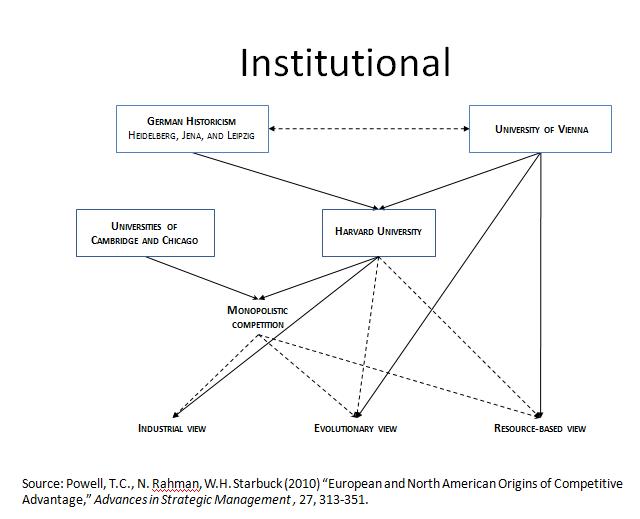

Now, two on the origins of network advantage theory: (more…)





 Organizations and Markets
Recent Comments