Posts filed under ‘Austrian Economics’
Study this Summer with Klein
 | Peter Klein |
I’m participating in a distance-learning experiment this summer — no, not Bootsy Collins’s Funk University, but the Mises Academy, a new Mises Institute service offering short, non-degree courses to university students, management professionals, and the general public. Everything’s online — lectures, readings, discussions, assignments. I’m teaching “Entrepreneurship in the Capitalist Economy,” a course based on my favorite book (as Mankiw would put it). The course runs for 9 weeks from 7 June to 7 August and costs a mere $255 — that’s less than one or two of Nicolai’s books!
The course is pitched at the undergraduate/MBA level, with no formal prerequisites except intellectual curiosity, a good work ethic, and a sense of humor. Perhaps I’ll offer special extra-credit assignments for O&M readers. . . .
Drop me a line if you have any questions. I’d love to have you join me on this journey!
Add to: Facebook | Digg | Del.icio.us | Stumbleupon | Reddit | Blinklist | Twitter | Technorati
Intro to The Capitalist and the Entrepreneur
| Peter Klein |
Here’s a nicely formatted HTML version of the introduction to The Capitalist and the Entrepreneur. I’d apologize for the self-promotion but, well, isn’t that the whole point of blogging?
(PS: Those of you who like to run your transactions through Amazon can get the book here. Not sure about a Kindle edition but I’m told an epub version will be available soon.)
Add to: Facebook | Digg | Del.icio.us | Stumbleupon | Reddit | Blinklist | Twitter | Technorati
This Makes Me Think of Hayek’s Sensory Order
| Peter Klein |
From Wired:
Karl Popper, the great philosopher of science, once divided the world into two categories: clocks and clouds. Clocks are neat, orderly systems that can be solved through reduction; clouds are an epistemic mess, “highly irregular, disorderly, and more or less unpredictable.” The mistake of modern science is to pretend that everything is a clock, which is why we get seduced again and again by the false promises of brain scanners and gene sequencers. We want to believe we will understand nature if we find the exact right tool to cut its joints. But that approach is doomed to failure. We live in a universe not of clocks but of clouds.
Add to: Facebook | Digg | Del.icio.us | Stumbleupon | Reddit | Blinklist | Twitter | Technorati
Scribd Version of Book
| Peter Klein |
I just learned I can embed the full document right here in a blog entry. Very cool!
Add to: Facebook | Digg | Del.icio.us | Stumbleupon | Reddit | Blinklist | Twitter | Technorati
The Capitalist and The Entrepreneur: Available Now!
| Peter Klein |
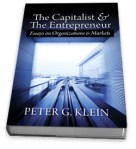 My new book, The Capitalist and the Entrepreneur: Essays on Organizations and Markets (Mises Institute, 2010), is now available. For a limited time, you can get it for just $15 — a bargain at half the price! Actually, the resource-constrained among you can read the Full Monty here, free of charge. A PDF version is also available. A promotional essay appears today on Mises.org.
The editorial and production staff did a terrific job, and I’m thrilled with the volume’s look and feel. The contents aren’t bad either!
Order two or more and I will personally send you a set of Ginsu knives.
Add to: Facebook | Digg | Del.icio.us | Stumbleupon | Reddit | Blinklist | Twitter | Technorati
Readings for Hayek-Klein Day
| Peter Klein |
Here are some readings to help you celebrate tomorrow’s Hayek-Klein Day:

- Klein’s Biography of Hayek
- Hayek and Entrepreneurship
- Austrian Economics and Strategic Management
- The Use of Knowledge in Firms
- Austrian Economics and the Transaction Cost Approach
- Rothbard and Hayek
- Hayek versus Hayek
Add to: Facebook | Digg | Del.icio.us | Stumbleupon | Reddit | Blinklist | Twitter | Technorati
A Hayekian Story About Taxis
| Peter Klein |
No, not taxis, but taxis. You know the old story about colleges placing paved footpaths along the paths already worn down by students, relying on “spontaneous order” to select the best routes across campus? Here’s a similar story involving New York City taxicabs. This New York Times infographic tracks taxi traffic and pick-up/drop-off locations across Manhattan throughout a typical week. You can see where traffic clusters during the weekly commute, on Saturday night, and so on. If the city were going to improve certain roads, build taxi stands, re-time traffic signals, and the like, these data could allow for a sort of Hayekian solution. (Via Cliff Kuang, who provides interesting commentary as usual, including this link to a similar San Francisco project.)
Add to: Facebook | Digg | Del.icio.us | Stumbleupon | Reddit | Blinklist | Twitter | Technorati
Lachmannian Entrepreneurship
| Dick Langlois |
The new issue of Organization Studies carries an article by John Mathews called “Lachmannian Insights into Strategic Entrepreneurship: Resources, Activities, and Routines in a Disequilibrium World.” Here’s the abstract.
Recent contributions to the organizational literature see the radical subjectivist and disequilibrium framework of Ludwig Lachmann as providing a suitable foundation for strategic entrepreneurial studies, in that his approach seeks independence from conventional equilibrium-based reasoning. In a Lachmannian spirit, this article suggests that strategizing can fruitfully be viewed as choices made by the entrepreneur in terms of the organization’s constituent resources, activities and routines together with their recombinations and complexifications. Cast in a general, disequilibrium setting, the strategic goals that guide the organizational entrepreneur’s strategizing can be formulated in terms of the construction and capture of resource complementarities, the pursuit of increasing returns through activities reconfiguration, and the generation of learning and dynamic capabilities through reconfiguration of routines. Once formulated in this way, the strategizing issues may be seen to make sense not just in the comparative static and imperfect equilibrium frameworks within which they have hitherto been posed, but in a more general dynamic and disequilibrium setting that corresponds to the real conditions in which firms are required to make entrepreneurial decisions. The simplified framework offers some hope for overcoming the balkanization of management scholarship that is so widely deplored.
Add to: Facebook | Digg | Del.icio.us | Stumbleupon | Reddit | Blinklist | Twitter | Technorati
Mannepalooza at Austrian Scholars Conference
| Peter Klein |
Tune in here at 3:45 EST today for a live broadcast of the ASC session, “The Contributions of Henry G. Manne,” organized by yours truly. Panelists include me, Alexandre Padilla, Richard Vedder, Thomas DiLorenzo, and Henry Manne. And buy your copy of the Collected Works.
Update: audio files are now available: Klein, Padilla, Vedder, DiLorenzo, Manne.
Mises Quote of the Day
| Peter Klein |
Nothing can be known about such matters as inflation, economic crises, unemployment, unionism, protectionism, taxation, economic controls, and all similar issues, that does not involve and presuppose economic analysis. All the arguments advanced in favor of or against the market economy and its opposites, interventionism or socialism (communism), are of an economic character. A man who talks about these problems without having acquainted himself with the fundamental ideas of economic theory is simply a babbler who repeats parrotlike what he has picked up incidentally from other fellows who are not better informed than he himself.
This is from Mises’s introduction to the 1959 edition of Böhm-Bawerk’s massive 3-volume set, Capital and Interest. Mises gives some further admonitions: “A man not perfectly familiar with all the ideas advanced in these three volumes has no claim whatever to the appellation of an economist.” This is, shall we say, a minority view. And my personal favorite: “A citizen who casts his ballot without having studied to the best of his abilities as much economics as he can fails in his civic duties. He neglects using in the appropriate way the power that his citizenship has conferred upon him in giving him the right to vote.”
Those lacking time to study Capital and Interest in its entirety may enjoy this new edition of Böhm-Bawerk’s essay “Control or Economic Law,” which is more easily digested.
I, Taco
| Peter Klein |
Some California design students tracked the ingredients in their favorite local taco and came up with this cool image.

Of course, it’s supposed to show us the horror of all those food miles, but what I see is the miracle of the market.
Price Level Shocks, uhm, Screwed Up Relative Prices, and Organization
| Craig Pirrong |
Peter’s post on the relation between inflation, vertical integration, and markets brings a couple of other thoughts to mind.
First, and most importantly, the number and characteristics of markets are endogenous too, and respond to changes in the amount of uncertainty in the environment, including the amount of uncertainty resulting from monetary shocks that (in Sherwin Rosen’s unforgettable in-class phrase) “f*ck up relative prices.” In particular, the number and variety of futures markets depends on the amount of uncertainty. The big boom in the creation of futures markets in the 1970s corresponds with, and was arguably caused by, the coincident inflation of that period, and the associated volatility in relative prices.
Second, although Peter’s point, and previous research, focuses on the implications of inflation on organizational choices and market vs. firm choices, in the current environment it is worthwhile pondering the implications of deflation. Certainly we have more research on the effect of inflation on the variability of relative prices due to our more recent inflationary experiences, and this was a major source of concern about inflation among Austrians, but the current situation makes it worthwhile to consider the effects of deflation on the pricing system, and firms’ responses to that.
Perhaps an examination of Japanese experience since 1990 would be worth some in-depth analysis.
Personally I am torn as to whether inflation or deflation is the greater risk in the near to medium term. The huge monetary overhang in the US and around the world (resulting from quantitative easing and other extraordinary monetary policies), and the inability of the Fed to commit credibly to drain reserves from the system when money demand picks up make me believe that it will be hard to avoid a burst of inflation. But all current indicators point to flat or declining prices.
It is hard to see things ending in a Goldilocks moment — just right. Thus, it is likely that that there will be a shock to prices generally, arguably a large one, and that this will disrupt relative prices for a variety of reasons. (Including, notably, the very likely case where these price level shocks lead to government policy interventions that distort relative prices.)
Thus, Peter’s research program may be rejuvenated, courtesy of the Fed, ECB, the Chinese Central Bank, etc. It is indeed an ill wind that blows nobody any good.
New Issue of QJAE
| Peter Klein |
The new issue of the Quarterly Journal of Austrian Economics (volume 12, no. 3) has several papers of likely interest to O&Mers. For instance:
Jack High, “Entrepreneurship and Economic Growth: The Theory of Emergent Institutions”
This paper enlarges Menger’s theory of the origins of money by making explicit the role of entrepreneurship in the theory and by extending the theory to market institutions other than money. Drawing on the research of anthropologists, archaeologists, and historians, the paper considers the origins of three institutions that underlie economic growth — the division of labor, monetary accounting, and private property. Menger’s generalized theory of the origins of institutions is used to interpret each of these institutions.
Laurent A.H. Carnis, “The Economic Theory of Bureaucracy: Insights from the Niskanian Model and the Misesian Approach”
Governmental interventions in the economy take numerous forms, and they require the existence of a public authority, a bureaucracy, to implement them. This article proposes an analysis of the origins and the dynamics of bureaucracy, and discusses means of escaping bureaucracy’s disadvantages. I will proceed by means of a comparison between the theories of Niskanen and Mises, two impressive and very representative works from the Public Choice School and the Austrian School of economics. Although Mises and Niskanen share a common analysis of the defect of bureaucratic management, there are strong disagreements between the two authors about the reasons for the existence of bureaus and about their functioning and their deficiencies. Inevitably, the means proposed by Niskanen and Mises for escaping the disadvantages of bureaucracy are different and cannot be reconciled.
Comparative Institutional Analysis and the New Paternalism
| Peter Klein |
Comparative institutional analysis — defined as the assessment of feasible organizational or policy alternatives — is at the heart of the new institutional economics. Most economists and management scholars recognize, at least implicitly, that individuals and organizations don’t think, act, and choose with reference to some kind of global optimum, but are always evaluating trade-offs among imperfect alternatives. Yet, when it comes to public policy, even trained economists and strategy scholars easily lapse into Nirvana mode. Recent examples discussed her at O&M include the debate over Fed independence, the role of financial regulators more generally, and the “soft” or “libertarian” paternalism favored by Obama’s man Cass Sunstein, among others.
The new paternalism literature suggests that private actors suffer from biases and cognitive limitations such as lack of willpower or self-control, status quo bias, optimism bias, and susceptibility to framing effects leading them to make decisions that are inconsistent with their own preferences. By making marginal changes to the options available to market participants (“nudges”), the private benefits and costs of various actions, and the informational environment in which choices are made, market participants can be led to make “better” choices without reliance on heavy-handed, top-down regulation. The problem, of course, is that this literature virtually ignores the cognitive and behavioral limitations affecting policymakers. Incentive problems are an obvious example, along with the “slippery-slope” problem: the vulnerability of new paternalist proposals “to slippery slopes that can lead from modest paternalism to more extensive paternalism” (Rizzo and Whitman, 2009, p. 667).
Mario Rizzo and Glen Whitman’s have written an excellent set of papers on the new paternalism, the latest of which focuses on the knowledge problem, and how dispersed, tacit knowledge about preferences and constraints limits policymakers’ ability to plan paternalist policies that actually make people better off. The paper is here, and Mario blogs about it here. Highly recommended!
Brad’s Bloviations, Part #2,235
| Peter Klein |
Brad DeLong accuses non-Keynesians (Austrians, Chicagoites, and other sensible people) of “los[ing] themselves amidst their early-nineteenth century books, one hundred and seventy years behind the state of the art in economics,” just because they think public spending and deficits might be crowding out private-market activity, making it difficult — impossible, actually — to come up with meaningful estimates of “jobs saved” by stimulus spending. If you can get past Brad’s adolescent writing style (anyone citing Bastiat, for example, is “a truly clueless idiot”), you find that he is indeed very “progressive” in his thinking — he’s made it all the way to 1950. Brad, like most Keynesians, is stuck in the C + I + G world of undergraduate macro. His argument is that the stimulus can’t be crowding out private-sector jobs because (a) wages aren’t rising (implying that stimulus-funded workers aren’t being bid away from other potential opportunities) and (b) T-bill prices aren’t falling (suggesting that private employers aren’t competing with the Feds for credit).
Leave aside for the moment that Brad has no idea what wages and bond prices would be in the absence of stimulus. The key problem with Brad’s argument, noted by Russ Roberts, is its reliance on crude macroeconomic aggregates. As pointed out here many times, heterogeneity matters. Sensible economists care not about the aggregate unemployment rate, but the effect of stimulus activity on individual labor markets. Stimulus affects the composition of employment, not just its level. (more…)
Stuck on the Methodological Hamster Wheel
| Craig Pirrong |
I’ve read John Cassidy’s New Yorker article (not available online) in which he described his journey to the freshwater provinces in his attempt to see whether the financial crisis had caused Chicago economists to reject their reactionary views. (With one exception, the answer is blessedly “no.”) I’ve also read his paean to Pigou in the WSJ. So I pretty much knew what to expect when I picked up his How Markets Fail. Let’s say I wasn’t disappointed, in the sense that my very low expectations were met.
The book is a very conventional, Stiglitz-esque critique of market economics and those who defend markets. The latter are always described with Homer-esque modifiers, just so you’ll know that they [we!] are retrograde knuckle draggers. (more…)
Ennen and Richter on Complementarity
| Nicolai Foss |
The notion of complementarity unites a number of the key concerns of this blog: It has been central in Austrian capital theory since Menger, it is key both in (sociological) organization theory (e.g., here) and in organizational economics (e.g., here), and it is of considerable relevance to the explanation of (sustained) performance difference (e.g., here). (In organizational economics and strategic management, complementarity is usually given the specific interpretation of “Edgeworth complementarity“). Complementarity has also helped to link some of these areas (e.g., here and here).
In a paper, “The Whole is More Than the Sum of Its Parts, Or Is It? A Review of the Empirical Literature on Complementarities in Organizations,” in the most recent issue of the Journal of Management, Edgar Ennen and Ansgar Richter of the European Business perform what is probably the first stocktaking of the complementarity literature. It is very well done and in many ways an eye-opener. Of particular interest is their separation of the literature in those that take an “interaction approach,” focusing on specific interaction effects among specific (typically few) elements (e.g., of organization structure) and those that take a “systems approach” and consider the performance outcomes of entire sets of multiple elements. (My own work with Keld Laursen on complementarity falls in the latter category). Here is the abstract:
The concept of complementarity denotes the beneficial interplay of the elements of a system where the presence of one element increases the value of others. However, the conceptual work on complementarities to date has not progressed sufficiently to constitute a theory that would offer specific predictions regarding the nature of the elements that form complementary relationships or the conditions for their emergence. To advance our understanding of complementarities, the authors provide a synoptic review of the empirical studies on this concept in leading journals in management, economics, and related disciplines over the period 1988-2008. The authors find that whether a study provides evidence of complementarities in organizations is at least partially driven by its investigative approach. On the basis of the findings, the authors argue that complementarities are most likely to materialize among multiple, heterogeneous factors in complex systems. Therefore, the absence of complementary relationships between a limited set of individual factors may not negate the possibility of complementarities, but rather point to the need for including further systems-specific factors in the analysis. The authors conclude by providing directions for future theoretical and empirical research and outlining managerial implications of the work.
Deja Vu?
| Craig Pirrong |
Writing near to the event, in Capitalism, Socialism, and Democracy, Schumpeter argued that policy shocks, and policy uncertainty generally, lengthened the Great Depression:
The subnormal recovery to 1935, the subnormal prosperity to 1937 and the slump after that are easily accounted for by the difficulties incident to a new fiscal policy, the new labor legislation and a general change in the attitude of government to private enterprise all of which can, in a sense to be defined later, be distinguished from the working of the productive apparatus as such.
Since misunderstandings at this point would be especially undesirable, I wish to emphasize that the last sentence does not in itself imply either an adverse criticism of the New Deal policies or the proposition — which I do believe to be true but which I do not need right now — that policies of that type are in the long run incompatible with the effective working of the system of private enterprise. All I mean to imply is that so extensive and rapid a change in the social scene naturally affects productive performance for a time, and so much the most ardent New Dealer must and also can admit. I for one do not see how it would otherwise be possible for the fact that this country which had the best chance of recovering quickly was precisely the one to experience the most unsatisfactory recovery. [Emphasis in original]
Some of the specifics are different (e.g., health care legislation vs. labor legislation) but the overall thrust of Schumpeter’s analysis of the 1930s is quite applicable today. An “extensive and rapid change in the social scene” is currently in progress, and like Schumpeter, I believe that “policies of [the] type [being considered] are in the long run incompatible with the effective working of the system of private enterprise.” And even if you don’t buy into that, as Schumpeter notes, just the massive rise in uncertainty associated with this policy ferment is sufficient to impede measured economic performance because it is rational for businesses and individuals to delay investment and hiring decisions until the uncertainty is resolved.
Murray N. Rothbard
| Peter Klein |
Jeff Tucker reminds me that Murray Rothbard passed away 15 years ago today. I remember the moment when I heard the news, from Parth Shah at a restaurant in DC, where we were attending the American Economic Association meeting. (This was before smartphones, Twitter, and the like, and news traveled more slowly.) I was stunned — Rothbard was not yet 70 — but my wife reminded us that he hadn’t looked well when we saw him the last time, the previous summer at the Mises Institute instructional conference in Claremont. (He died of congestive heart failure.) Check out the photo montage at Jeff’s post — see if you can identify younger versions of Ralph Raico, Roger Garrison, Bill Evers, George Reisman, Leonard Liggio, and others.
I consider Rothbard one of the great theorists of the twentieth century, and think his contributions to technical economics are greatly undervalued, even by many of his Austrian-school admirers. My own work has been heavily influenced by Rothbard (one of my most-cited papers is basically a gloss on a Rothbardian idea). Joe Salerno and I are working on a price-theory text (based on our lecture series) that builds heavily on Rothbard’s analysis in Man, Economy, and State. We hope it contributes to renewed interest in mundane Austrian economics.
Happy Keynesian New Year
| Craig Pirrong |
Keynes and Hayek were major adversaries in the 1930s, but it is interesting to note that they shared some important ideas in common, but drew diametrically opposed conclusions from them.
In particular, Hayek, and the Austrians generally, believed in radical uncertainty, in the sense that individual economic agents had too little information about the world to assess probabilities of states of the world, or even to identify the possible states. Keynes similarly believed in the inability of individuals to evaluate investments in a rigorous quantitative way. Keynes concluded that this made investors subject to radical shifts in sentiment and “animal spirits” that could cause an autonomous collapse in investment. (more…)





 Organizations and Markets

Recent Comments