Posts filed under ‘Austrian Economics’
The Age of Constructivism
| Craig Pirrong |
I am reading Vernon Smith’s Rationality in Economics. I highly, highly recommend it. Largely a homage to Hayek, it explores the implications of Hayek’s distinction between constructivist rationality and what Smith relabels ecological rationality. It contains a wealth of methodological and substantive insights. Smith is knowledgeable and thoughtful. He is almost John Stuart Mill-like in his even handed and fair characterizations of competing views, even those he disagrees with. He integrates experimental economics, game theory, institutional economics, neoclassical economics, neurology, and much, much more.
What fascinates Smith is the ineffable process by which an ecologically rational order emerges from the actions of myriad imperfectly informed and incompletely rational (in the constructivist sense) individuals. This process — a sort of economic transubstantiation — is the most fascinating economic mystery. It is also, alas, one that has received far too little attention from economists whose formal tools permit them to analyze (constructively) equilibrium, but which are virtually powerless to analyze the process of getting there; the proverbial drunks looking for their keys under the lamppost.
We live in an era of constructivism regnant. In health care and finance, especially, constructivist schemes will reshape for better or worse — and almost certainly worse — vast swathes of the American economy. What’s more troubling still, this is constructivism refracted through the flawed lens of politics and public choice. Appreciation of the emergent order, the ecologically rational, is sadly rare. Vernon Smith appreciates it, deeply, with an almost religious sense of awe. Read his book and you will appreciate it too.
Keynesian Anti-Economics
 | Peter Klein |
A reader objected to my recent portrayal of Keynes as a crank, as a man who never really studied economics or took it very seriously. Note that I never denied Keynes’s intellect, his great skill as a rhetorician, or his personal charm. But Keynesian economics is, in a sense, non-economics or even anti-economics, in that it ignores or contradicts many basic lessons about the allocation of scarce resources among competing ends. Mario Rizzo feels the same way:
Keynesianism is not concerned with the allocation of resources and related niceties. One can see this is the policy prescriptions of the stimulators. Just get people back to work. If a market is depressed: Prop it up. Labor, other resource-owners and entrepreneurs need to stop worrying about searching for the appropriate use of resources. Bankers have to stop fretting about to whom they should lend. They should abandon their ultra-restraint. Those who are holding money should invest; they should buy bonds. No need to worry about inflation because the potential output of “stuff” (however it is allocated across industries) is above the actual less-than-full-employment output.
Where did my microeconomics go?
Keynes and his followers proudly trumpeted his framework as a re-do of standard economics (what he called “classical,” though Keynes was not well versed in the history of economic thought). Standard economics is OK during periods of “full employment” (another aggregate concept, of course), but not in the “general” case, in which case the Keynesian magic comes into play. Credit expansion, according to Keynes, performs the “miracle . . . of turning a stone into bread.” As Mises noted, “Great Britain has indeed traveled a long way to this statement from Hume’s and Mill’s views on miracles.”
Sidak and Teece on Dynamic Competition
| Peter Klein |
A “neo-Schumpeterian” framework for antitrust analysis that favors dynamic competition over static competition would put less weight on market share and concentration in the assessment of market power and more weight on assessing potential competition and enterprise-level capabilities. By embedding recent developments in evolutionary economics, the behavioral theory of the firm, and strategic management into antitrust analysis, one can develop a more robust framework for antitrust economics.
Via Truth on the Market (where my colleague Mike Sykuta has joined the blogging team). On a related note, see Jesús Huerta De Soto’s Theory of Dynamic Efficiency. It was a pleasure meeting De Soto at last week’s fantastic Mises conference in Salamanca, where he spoke on dynamic efficiency (based on the book’s first chapter). You have to love medieval university towns. We held our meetings in the Convent of San Esteban, including breakfast in the room where Christopher Columbus reportedly waited to hear if Queen Isabella would finance his little expedition West.
Williamson and the Austrians
 | Peter Klein |
My short piece on Williamsonian transaction cost economics and its relationship to the Austrian approach is up on Mises.org.
The Pretense of Bernanke’s Knowledge
| Peter Klein |
Chairman Bernanke, in his own words:
July 2005: “[U]nquestionably, housing prices are up quite a bit; I think it’s important to note that fundamentals are also very strong. We’ve got a growing economy, jobs, incomes. We’ve got very low mortgage rates. We’ve got demographics supporting housing growth. We’ve got restricted supply in some places. So it’s certainly understandable that prices would go up some. I don’t know whether prices are exactly where they should be, but I think it’s fair to say that much of what’s happened is supported by the strength of the economy.”
July 2005: “[Recession is] a pretty unlikely possibility. We’ve never had a decline in house prices on a nationwide basis. So what I think is more likely is that house prices will slow, maybe stabilize: might slow consumption spending a bit. I don’t think it’s going to drive the economy too far from its full employment path, though.”
February 2007: “Our assessment is that there’s not much indication at this point that subprime mortgage issues have spread into the broader mortgage market, which still seems to be healthy. And the lending side of that still seems to be healthy.”
July 2007: “The pace of home sales seems likely to remain sluggish for a time, partly as a result of some tightening in lending standards, and the recent increase in mortgage interest rates. Sales should ultimately be supported by growth in income and employment, as well as by mortgage rates that, despite the recent increase, remain fairly low relative to historical norms. . . . Overall, the U.S. economy seems likely to expand at a moderate pace over the second half of 2007, with growth then strengthening a bit in 2008 to a rate close to the economy’s underlying trend.”
July 2009: “Overall, the Federal Reserve has many effective tools to tighten monetary policy when the economic outlook requires us to do so. As my colleagues and I have stated, however, economic conditions are not likely to warrant tighter monetary policy for an extended period. We will calibrate the timing and pace of any future tightening, together with the mix of tools to best foster our dual objectives of maximum employment and price stability.”
Navigating a Process of Integrating Co-Authors’ Diverse Mental Models
| Russ Coff |
Not long ago, Peter mentioned his heavily downloaded SEJ article (with Nicolai, Yasemin, and Joe). They argue that entrepreneurial teams have a greater potential for competitive advantage than individuals if positive team dynamics allow them to draw upon members’ diverse mental models.
My related working paper unpacks positive team dynamics across the variance generation and selection stages of creativity. In a nutshell, the required group mood differs markedly between the two stages and many teams are unable to navigate the divide.
Ironically, this paper has, itself, been a journey to meld co-authors’ diverse mental models. (more…)
Another Nanosecond of Fame
| Dick Langlois |
Warm thanks to Art Diamond for his very nice review on eh.net of my book The Dynamics of Industrial Capitalism: Schumpeter, Chandler and the New Economy. I am most pleased that Art recognizes the book to be primarily theory, albeit with much discussion of economic history and economic ideas.
Short Piece on Probability Theory
| Peter Klein |
“Risk, Uncertainty, and Economic Organization” is my contribution to the Hoppe Festschrift. I got the topic idea from some blogger guy. My chapter focuses, as the title suggests, on Knightian uncertainty. Hoppe places Knight, along with Ludwig von Mises, squarely in the frequentist camp (typically associated with Ludwig’s brother Richard). I tend to agree with Hoppe although, as I discuss in the paper, there are many interpretations of Knight, and some commentators argue that subjective (Bayesian) probability theory renders untenable the Knightian distinction between insurable risk and true uncertainty (see, for example, Dick’s 1982 paper).
Ultimately, however, I don’t think the approach to the firm promoted on this blog depends on a particular interpretation of Knight. The central claim is that judgment represents a kind of decision-making that cannot be traded on the market, and that therefore requires the entrepreneur exercising such judgment to establish a firm (more specifically, to take ownership of capital resources). To put it differently, ownership of assets implies a kind of ultimate responsibility that the owner cannot delegate. I think one can be agnostic about exactly why judgment isn’t tradable — it could be a form of asymmetric information, rather than ontological differences between types of knowledge — and still buy the basic Knight-Mises-Foss-Klein approach to the firm.
Will Macroeconomists Solve the Crisis?
| Benito Arruñada |
One may doubt it after observing that Ben Bernanke was one of those believing in the Great Moderation — the claim that macroeconomic volatility had been reduced. Macroeconomic policymaking seems to be as unsafe as firefighting: extinguishing small fires creates the conditions for hell. Shouldn’t macroeconomists learn something from forest management? (For a start: “Fire Must Be Ally in Forest Management.”) Of course, if coupled with an acid-suppressing pill, they could even dare to read Hayek’s “Pretence of Knowledge.”
The Professional Strategy of the Early Austrian Economists
| Peter Klein |
O&M, like other niche academic blogs, deals occasionally with the history and sociology of this or that school of economic or management thought. We think often about professional strategy — how to promote our ideas, how to secure financial and institutional support, how to recruit students and fellow-travelers (“groupies,” according to Nicolai), what competing and complementary movements and schools of thought (not to mention rival blogs) are up to, and so on.
Given our close association with the Austrian school, you might be surprised to learn that the founding Austrians were not at all “strategic” in this sense. They held strongly to the view that truth wins out in the long run, so there is no need to build formal institutions or establish a “movement.” This comes out in a passage from Mises’s recently released Memoirs (a new translation of his earlier Notes and Recollections):
It is necessary to correct the misunderstandings that can be called forth by using the expression “Austrian School.” Neither Menger nor Böhm-Bawerk wanted to found a school in the sense customarily used in university circles. They never attempted to turn young students into blind disciples, nor did they, in turn, provide these same students with professorships. They knew that through books and an academic course of instruction they could promote an understanding suited to dealing with economic problems, thus rendering an important service to society. They understood, however, that they could not rear economists. As pioneers and creative thinkers, they recognized that one cannot arrange for scientific progress, nor breed innovation according to plan. They never attempted to propagandize their theories. Truth would prevail of its own accord when man possessed the faculties necessary to perceive it. Using impertinent means to cause people to pay lip service to a teaching was of no use if they lacked the ability to grasp its substance and significance. (more…)
Austrian Theory of the Firm Bleg
| Peter Klein |
This post is for devotees and fellow-travelers of the Austrian school. As some of you know I maintain an online bibliography of articles and books dealing with applications of Austrian economics to the theory of the firm (and strategic management more generally). Happily, this literature has grown dramatically in the last few years. Sadly, I have not had time to update the bibliography on a consistent basis. So, please send me your suggested additions and corrections (ideally with URLs). Self-nominations are welcome!
Mises and Hayek in Progress in Human Geography
| Nicolai Foss |
It is surprising, even bizarre, to see Mises and Hayek, as well as other luminaries of 20th-century classical liberalism, being extensively cited, quoted, and discussed in one of the leading geography journals, Progress in Human Geography (here is the wiki on the field of “human geography”), specifically in the form of the printed version of an invited lecture by Jamie Peck. (more…)
Remembering Hayek
| Peter Klein |
In honor of today’s special day several writers have written personal reminisces of F. A. Hayek. Here are two by David Gordon and Mario Rizzo. (And here’s a 2003 remembrance from Ronald Hamowy.) The boys at orgtheory will get a kick out of the Merton reference in Gordon’s post.
Here’s an indirect Hayek reference that will amuse one or two of you. I was reading emails on my BlackBerry this afternoon while walking through the St. Louis airport and came across this passage, sent by a friend, from Terry Eagleton’s new book:
Because there is no necessity about the cosmos, we cannot deduce the laws which govern it from a priori principles, but need instead to look at how it actually works. This is the task of science. There is thus a curious connection between the doctrine of creation out of nothing and the career of Richard Dawkins. Without God, Dawkins would be out of a job. It is thus particularly churlish of him to call the existence of his employer into question.
Right after reading this, and pondering the word “cosmos,” I look up and see that I’m walking under a big sign, “Taxis.”
Cheer Up With the Depression Bundle
| Peter Klein |
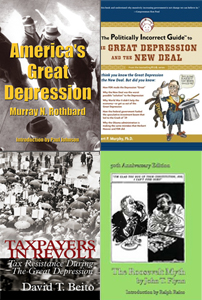 Sorry, couldn’t resist the headline. But check it out: Murray Rothbard’s America’s Great Depression, Bob Murphy’s Politically Incorrect Guide to the Great Depression and the New Deal, Dave Beito’s Taxpayers in Revolt, and John T. Flynn’s Roosevelt Myth, all for $49! That’s quite an uplifting deal.
More great news: Contra Keynes and Cambridge, vol. 9 of Hayek’s Collected Works, is now out in paperback from Liberty Fund, and just $14.50.
New Online Books
| Peter Klein |
Thanks to the Mises Institute, the Institute of Economic Affairs, the Library of Economics and Liberty, and other organizations, great works in social science continue to appear in free online editions. Some of the newest include:
- Carl Menger’s Investigations into the Method of the Social Sciences (1883), which features the famous section (book 3, chapter 2) on unintended consequences;
- Larry White’s Free Banking in Britain (1984); and
- Hayek’s Individualism and Economic Order (1948), which contains the classic essays “Economics and Knowledge,” “The Use of Knowledge in Society,” and “The Meaning of Competition,” among others.
Relative Prices Matter
| Peter Klein |
Hate to keep flogging a dead horse, and perhaps preaching to the choir, but the point can’t be made often enough: relative prices matter. The childish Keynesianism of people like DeLong and Krugman, like Bernanke and Geithner, understands only aggregate concepts like “national output,” “employment,” and “the price level.” A consistent theme of this blog’s rants is that resources are heterogeneous (1, 2) and, consequently, relative prices must be free to adjust to changes in demand, technology, market conditions, and so on. When government policy generates an artificial boom in a particular market, such as housing — drawing resources away from other parts of the economy — the key to recovery is to let resources flow out of that market and back to the sectors of the economy where those resources belong (i.e., to match the pattern of consumer demands). It’s quite simple: home prices should be falling, interest rates should be rising, savings rates should be going up, and debt levels should be going down. The Administration’s policies, like that of the last Administration, are designed to achieve exactly the opposite. Why? Because relative prices don’t matter, the allocation of resources across activities doesn’t matter, all that matters is to keep any sector from shrinking, any prices from falling, any firms from failing, any consumers from reducing their consumption. A child thinks only about what he can see. The unseen doesn’t exist.
Here are some excellent posts on the subject. Craig Pirrong notes that Sherwin Rosen had a colorful way of emphasizing relative price effects. Mario Rizzo (1, 2) points to data on the housing market and the Fed’s continuing attempt to keep resources from flowing out of this bloated sector. And here’s a snippet from Israel Kirzner’s short book on Mises explaining that insolvent financial institutions should be liquidated, not rescued. Good reading for grown-ups.
Management Theory and the Current Crisis
| Peter Klein |
 Here is a short piece by Nicolai and me written for a general audience, “Management Theory Is Not to Blame.” We discuss the role of resource heterogeneity in management theory and critique the vulgar Keynesianism that dominates mainstream commentary on the crisis. The graphic with the shovel alone is worth the click. Comments welcome here or at the Mises blog.
Austrian Economics and Strategic Management
| Nicolai Foss |
In terms of direct influence, the impact of Austrian economics (AE) on strategic management is fairly limited (e.g., Jacobson, 1992; Young et al., 1996; Foss et al., 2008). Different kinds of industrial economics, namely the SCP approach, the Chicago-UCLA school, and game theoretical industrial economics, have clearly been stronger influences. However, the points of contact and even overlap between the mainstream of strategic management and AE are many, and AE has the potential to contribute to the further development of the field. (more…)
High-Tech Austrians
| Peter Klein |
Austrian economists are social and cultural conservatives who bury their noses in thousand-page tomes, favor bow ties and vests, and gaze longingly toward Old Vienna, right? Guess again! These guys are on the cutting edge. To wit:
- You can follow the (in-progress) Austrian Scholars Conference on Twitter and watch the plenary sessions online.
- Both volumes of Murray Rothbard’s Austrian Perspective on the History of Economic Thought are now available as free e-books (1, 2).
- There are a bunch of Austrian economics groups on Facebook; this is the largest.
Why They Heart Keynes
| Peter Klein |
Luigi Zingales offers Straight Talk on Keynes (via Casey Mulligan):
Keynesianism has conquered the hearts and minds of politicians and ordinary people alike because it provides a theoretical justification for irresponsible behavior. Medical science has established that one or two glasses of wine per day are good for your long-term health, but no doctor would recommend a recovering alcoholic to follow this prescription. Unfortunately, Keynesian economists do exactly this. They tell politicians, who are addicted to spending our money, that government expenditures are good. And they tell consumers, who are affected by severe spending problems, that consuming is good, while saving is bad. In medicine, such behaviour would get you expelled from the medical profession; in economics, it gives you a job in Washington.
Three comments: First, the “hangover” metaphor, while not exactly accurate, is an effective way to communicate the basics of the Mises-Hayek malinvestment theory of the business cycle. Use it! Second, Zingales’s description applies equally well to the 1930s and 1940s, when the Keynesian consensus emerged. It’s important to remember that massive deficit spending to “cure” the Depression began with Hoover and Roosevelt in the early 1930s, long before the General Theory appeared. Keynes’s book did not propose a new direction for economic policy; it provided an allegedly scientific rationale for policies already in place, policies government officials were eager to defend and protect. (The use of expansionary fiscal and monetary policy to increase output had long been derided by serious economists as nonsense, as the domain of “monetary cranks” and other snake-oil salesmen).
Third, the Keynesian delusion afflicts not only policymakers, but professional economists as well. I’ve long suspected that the appeal of Keynes to people like Krugman and DeLong is ultimately based on aesthetic, not scientific, grounds. Deep in their hearts, they just don’t like private property, markets, and individual choice. They don’t think ordinary people are capable of making wise decisions and think they, the elites, should be in charge. They resent the fact that most people don’t want their lives controlled by liberal intellectuals. Technical arguments about the effectiveness of monetary and fiscal policy, the relationship between aggregate demand and output, the experience of the 1930s, and the like are really beside the point. For Keynesian economists, the belief that markets are naturally unstable in the absence of government planning is a matter of faith.





 Organizations and Markets
Recent Comments