Posts filed under ‘Bailout / Financial Crisis’
On the Border*
| Craig Pirrong |
This is my inaugural post as guest blogger here at O&M. I am grateful for the opportunity.
In his very gracious introduction, Peter Klein noted that my research is at the border of finance and industrial organization. Quite true (and indeed, “borderer” is a good description of me overall.)
That border is very, very busy today. Indeed, so much is happening there that it is difficult to keep up. In the aftermath of the financial crisis, Congress and regulators are beavering away on laws and regulations that will completely reshape the organization and regulation of financial markets, and especially of the area of particular interest to me — derivatives.
I anticipate that many of my O&M blog posts will explore these issues, but I’ll start with something very topical. Senator Chris Dodd just yesterday heaved up a 1,136-page proposed financial regulation bill, and one proposal that is attracting considerable attention is his plan to consolidate banking regulators. Dodd is not alone in thinking along these lines. Even before the financial crisis, there were myriad proposals to consolidate various regulators, such as the Securities and Exchange Commission and the Commodity Futures Trading Commission. These have only gained in popularity in light of the crisis.
In the modern financial markets, firms are big and complex, and operate in many markets (defined geographically, or by product). It is difficult to fit a big financial firm into any box. A Goldman Sachs deals in the securities markets and the derivatives markets. So it doesn’t fit comfortably in a securities box, or a derivatives box, so in the current system for regulatory purposes the firm is split into pieces, some of which are put into the securities box and others into the derivatives box (and there are many other boxes too for a big firm like Goldman).
This leads to potential for conflicting regulations, jurisdictional disputes, regulatory arbitrage, and other problems. So, the Dodd proposal — and most of the other consolidation proposals — advocate creating really big boxes, and in the extreme, one big box that regulates everything a financial firm does.
The problems of the seen are well known (though arguably exaggerated). What concerns me are the largely unexamined problems of the as-yet-unseen big-box alternative. (more…)
Cochrane on Krugman
| Peter Klein |
John Cochrane tackles Paul Krugman’s infamous essay (via Casey Mulligan). My own view of the crisis (and of macroeconomics) is different from Cochrane’s, but his skewering of Krugman is delightful, and there are many nuggets of wisdom. A few snippets:
Crying “bubble” is empty unless you have an operational procedure for identifying bubbles, distinguishing them from rationally low risk premiums, and not crying wolf too many years in a row. . . . This difficulty is no surprise. It’s the central prediction of free-market economics, as crystallized by Hayek, that no academic, bureaucrat or regulator will ever be able to fully explain market price movements. Nobody knows what “fundamental” value is. If anyone could tell what the price of tomatoes should be, let alone the price of Microsoft stock, communism and central planning would have worked. . . .
[T]he economist’s job is not to “explain” market fluctuations after the fact, to give a pleasant story on the evening news about why markets went up or down. Markets up? “A wave of positive sentiment.” Markets went down? “Irrational pessimism.” ( “The risk premium must have increased” is just as empty.) Our ancestors could do that. Really, is that an improvement on “Zeus had a fight with Apollo?” . . . (more…)
The Hodgson Petition
| Peter Klein |
Several friends and colleagues urged me to sign Geoff Hodgson’s petition on the financial crisis, but I declined. I agree with Krugman that economists have tended to mistake mathematical beauty for truth, but think this has little to do with the financial crisis. As discussed in previous posts, I view the financial crisis and recession as the (predicable!) result of government failure — massive credit expansion by the central bank, mortgage-lending rules and policies designed to inflate the housing market, a state-sponsored cartel of securities-rating agencies — not market failure resulting from unrealistic behavioral assumptions.
I respect many of the signatories to the petition, but statements like this (from Krugman), at the heart of the petition, are preposterous:
[Economists] turned a blind eye to the limitations of human rationality that often lead to bubbles and busts; to the problems of institutions that run amok; to the imperfections of markets — especially financial markets — that can cause the economy’s operating system to undergo sudden, unpredictable crashes; and to the dangers created when regulators don’t believe in regulation. . . . When it comes to the all-too-human problem of recessions and depressions, economists need to abandon the neat but wrong solution of assuming that everyone is rational and markets work perfectly.
“Regulators who don’t believe in regulation?” Paul, what color is the sky on your planet (1, 2, 3)? Notably absent from the petition’s list of villains is the Fed, Fannie and Freddie, the Treasury, or indeed anyone remotely connected with a government body.
Keep in mind it was Krugman himself who wrote in 2002: “To fight this recession the Fed needs more than a snapback; it needs soaring household spending to offset moribund business investment. And to do that . . . Greenspan needs to create a housing bubble to replace the Nasdaq bubble.” St. Alan followed Krugman’s advice to the letter, and here we are today.
John Gray on the Greenspan-Bernanke Economy
| Peter Klein |
From Gray’s April 2009 NYRB review of Margaret Atwood’s Payback: Debt and the Shadow Side of Wealth:
Concepts of debt figure centrally in Western religion, while the notion that debt is something to be avoided, or incurred with caution, has long been important in Western capitalism. Without institutions facilitating borrowing, capitalism would not have developed to the degree that it has; but the belief that debt could be dangerous was until recently also an important part of capitalism. It is only lately, Atwood notes, that debt has been celebrated as positively benign, “a thing we’ve come to feel is indispensable to our collective buoyancy.” From being a necessary tool in productive enterprise, debt came to be viewed as an instrument of wealth creation. Using cheap credit, hedge funds and investment banks were able to multiply their profits, while society at large — including some in its poorest groups — came to see taking on large amounts of debt as a way of building up capital. Now that this structure of debt is unwinding, older ideas may be on their way back: “We seem to be entering a period in which debt has passed through its most recent harmless and fashionable period, and is reverting to being sinful.”
Latest news from Washington: “The Federal Reserve said Wednesday that it would keep short-term interest rates near zero for the foreseeable future, even though the central bank acknowledged that the economy was recovering from its long downturn.”
Bankrupt Bankruptcy
| Glenn MacDonald |
The US bankruptcy process is designed to be an orderly way to preserve any value that is left in the bankrupt business, and treat the creditors fairly and consistent with their contractual rights. This process has been honed through use and generally functions highly effectively. The point of preserving value is obvious enough. Fair treatment of creditors is not about fairness per se, but rather about investor investor protection generally, i.e., in the US, to promote efficient credit markets, investors are generally well protected, including in bankruptcies. The recent GM bankruptcy is an interesting case of how this process can be made to fail, mainly through rushing the process and dictating its outcome rather than by letting the process do what it was designed to do.
Specifically, much value was wasted. For example, among car aficionados, there are few brands more revered than the Pontiac GTO; this persists despite the weak offering brought out in 2004. Where is the GTO? On the scrap heap with the rest of Pontiac. A more deliberate bankruptcy would have preserved this value, e.g., by folding parts of Pontiac into Chevrolet. Second, GM’s creditors rightly claimed they were wronged by allowing the sale of all good GM assets to the new GM, owned mostly by the government and the UAW, and denying them the rights to argue their case to the bankrupcy court. They correctly argue they were robbed.
Who are the main beneficiaries of this mess? To the extent that despite the poor reorganization, GM is actually worth something, obviously the Federal government and the UAW benefit from the treatment of creditors. But more importantly, this is terrific for GM’s competitors, who have much to gain from GM’s remaining value being wasted through a weak product line, politically driven lack of cost reduction as inefficient facilities are retained, etc.
What’s Wrong Here?
| Lasse Lien |
A rich tourist came to a small town in the middle of the financial crisis. He went into the local hotel, placed a 200-dollar bill on the counter and went upstairs to check out what kind of rooms the hotel had to offer. In the meantime the hotel manager grabbed the bill, walked over to the butcher and used the bill to pay his debt. The butcher then took the bill to the cattle farmer and paid his debt to him. Next, the cattle farmer took the bill to the cattle feed supplier and paid his debt there. The cattle feed supplier then paid his debt to the local prostitute. The local prostitute brought the bill back to the hotel and paid her debt to the hotel manager. The hotel manager put the bill back on the counter. Then the rich tourist returns down the stairs and proclaims that he didn’t like the any of the rooms. He grabs the bill and leaves the city. A pity, but more importantly, the town was now debt free and optimism was back.
Source unknown. HT: Tore Hillestad.
A Hopeful Sign
| Peter Klein |
At least one major US bank is advertising the fact that it refused TARP funds. Bernanke and Co. must be unhappy, as they insisted that all large banks take the money to avoid tainting those that actually needed it. Wouldn’t it be great if the largest bailout recipients became tarred as Welfare Bums (just as people call G.M. “Government Motors”)? (HT to Lisa Fairfax.)
The irony in all this is that government intervention in financial markets is usually justified by claims about asymmetric information: consumers can’t distinguish reliable from unreliable banks, insurers can’t tell healthy from unhealthy people, and so on, leading to a rash of adverse-selection problems that market mechanisms cannot solve. Actually the reverse is true: low-quality but politically connected financial institutions rely on government intervention to enforce a pooling equilibrium, preventing the market signaling and screening that would otherwise take place.
Solution to a Credit Bubble? More Credit
| Peter Klein |
As noted before (1, 2, 3), policymakers (and some economists) seem immune to the argument that the credit bubble may have been caused by, you know, too much credit, and that encouraging people to increase their debt levels even more might not be the optimal policy response.
Bill Shughart, a very good economist, notes some disturbing parallels between the monetary and regulatory policies that led to the housing crisis and the US government’s “cars for clunkers” program. Whatever its effect on improving air quality (marginal) or stimulating aggregate demand (barf), one consequence is that people who would not otherwise have taken out a new car loan will do so, increasing total and average leverage in the economy. Will banks be pressured to extend new-car credit to “subprime” borrowers? Well, if all you care about is total lending, this is a good thing.
Organizations, Markets, and Health Care Reform
| Russ Coff |
Amidst the fierce debate about the U.S. health care system is a raving lack of clarity. At the core, is whether organizations and markets fail to produce an optimal solution. Even the most neoclassical of economists these days acknowledge that market externalities exist and that these should be the focus of government intervention. Unfortunately, I don’t feel that the debate has been rigorous or well-informed in defining the market failure or why a government run system would be superior.
Liberal Economist Paul Krugman explains why markets fail summarizing Kenneth Arrow’s arguments (here). Basically, the third-party payee system and the information asymmetries render comparison shopping ineffective (and hence competition fails to yield an optimal solution).
Indeed, there is a good bit of inefficiency in the current U.S. system. A recent NY Times article notes that health care costs the average U.S. household $6,500 more each year than other comparable wealthy nations. Unfortunately, looking at many of the important outcomes, it appears that consumers are not getting much for their money on many dimensions (e.g., chronic disease outcomes). So it should be possible to lower costs and improve outcomes. Of course, this ignores the question of whether costs are higher to subsidize R&D that ultimately spills over into other countries.
Unfortunately, the article continues to point out how the reform efforts seem to ignore this low-hanging fruit. (more…)
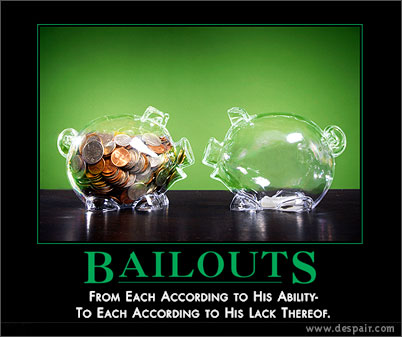
Federal Reserve “Independence”
| Peter Klein |
I was invited to sign the Open Letter in support of Fed independence but, like Jerry O’Driscoll, Bob Higgs, and Larry White, I don’t support the cause. Follow the links above for detailed arguments. For my part:
1. The Open Letter focuses exclusively on monetary policy, as if the Fed’s Congressional critics like Ron Paul just want to know how the Federal Funds Rate is set. But the Fed conducts not only monetary policy, but fiscal policy as well, especially during the last 18 months. If the Fed can buy and hold any assets it likes, if it works hand-in-hand with the White House and the Treasury to coordinate trillion-dollar bailouts, isn’t it reasonable to have some oversight? (And don’t forget bank supervision. Even the Fed’s defenders recognize a need to separate its monetary-policy and bank-supervision roles. But as long as the Fed continues as a bank regulator, shouldn’t someone should be watching the watchmen?)
2. The Open Letter itself is poorly crafted, full of unsubstantiated assertions and misleading statements. There’s no argument there, as Higgs emphasizes. Actually, neither the time-series or cross-sectional evidence suggests any correlation between central-bank independence (whatever that means) and economic performance.
3. More generally, the Fed is a central planning agency, and it performs about as well as every central planning agency in history. Have we learned nothing from the huge literature on comparative economic systems? “Independence,” in this context, simply means the absence of external constraint. There are no performance incentives and no monitoring or governance. There is no feedback or selection mechanism. There is no outside evaluation (outside the blogosphere). Why on earth would we expect an organization operating in that environment to improve social welfare? Is this institution run by men, or gods?
Rizzo on “Methodological Exclusivism”
| Peter Klein |
Great anecdotes on contemporary social-science methodology in Mario Rizzo’s post, “The Failure of Macroeconomics” (including the comments). Young economist to senior scholar: “All that is in Adam Smith.” Senior scholar: “Maybe — but until my theory it was not science.” Deepak Lal asks distinguished colleague what should be done about the current crisis. Reply: “I do not consider that an intellectually respectable question.” My own beloved dissertation adviser indulged my quirkier interests, but stated plainly: “Methodology is a swamp.” And of course there’s the famous Ed Leamer analogy.
Here’s Mario’s take:
This is the great problem with economics today: methodological exclusivism (or in my more intemperate moments I call it “methodological fascism”).A young person goes to graduate school. He or she is filled with the excitement of ideas. Today, in particular, some may come with a great desire to understand what has happened in the real world of the bailouts, recessions, stimulus, and so forth. And then academic reality hits.
Formal modeling, axiomatic foundations, tractability, technical power, and topological studies. Shall I get an MA in mathematics? Do I need to take a third semester of macro-econometrics? . . .
It seems pretty clear that what we have is a collective insecurity. If we open the floodgates to methodological inquiry, or even worse, to methodological pluralism, we shall become like political science, or God forefend, like sociology. So let’s keep those with disruptive instincts out of the profession. If this is not possible, then let’s at least keep them out of the good schools.
If you’re feeling subversive, you can browse our methodology/theory of science archive for more forbidden thoughts. (more…)
Goldman Sachs, Best in the Business
| Peter Klein |
 The business of political capitalism, that is. Like Enron, Goldman operates primarily in the nebulous world of public-private interaction. It is the US’s most politically powerful financial firm, skilled at navigating the byzantine regulations governing the virtually nationalized US financial sector. Goldman’s eye-popping $3.4 billion second-quarter earnings shouldn’t surprise anyone; as Craig Pirrong notes, these earnings reflect good old-fashioned moral hazard, with Goldman exploiting its too-big-to-fail status by taking on huge amounts of risk:
Goldman knows it is too big to fail. How does it know this? Well, the government bailed out AIG not so much for AIG’s sake, but for the sake of big AIG counterparties — most notably Goldman. Moreover, given the conventional wisdom that the government’s primary error in the financial crisis was its failure to bail out Lehman — a piker compared to Goldman — it doesn’t take a rocket scientist to figure out that it won’t repeat that mistake in the future, and let Goldman go down. So Goldman knows it can get bigger, and take more risk. It is the classic heads Goldman wins, tails the sucker taxpayer eats the loss gambit. If nobody steps in to rein in the firm, it will continue to add risk, thereby enhancing the value of the Treasury put hiding in the equity entry on its balance sheet.
Somebody should be stepping in — but nobody is. Why not? Partly, no doubt, it is Goldman’s political heft. It is likely too that important policy makers don’t want to crack down on a major source of risk capital to the markets in the fear that this would impede a recovery. Even though in reality, that risk capital is your money and mine, with the exception that we have no chance of capturing the upside, and are left with a good chunk of the downside. This is a piece with the hair-of-the-dog strategy being pursued by Treasury and the Fed.
Rajshree Agarwal on the US Government’s Response to the Financial Crisis
| Peter Klein |
Nice interview with Rajshree Agarwal on the US government’s response to the financial crisis. “Has It Helped?” Rajshree’s answer in brief: No.
Sid Winter and Alice Rivlin on the Current Crisis
| Nicolai Foss |
Sidney G. Winter is a towering figure in management research, essentially being the current thought leader in the strategic management field as it pertains to issues of capabilities, routines, knowledge assets, etc. Most of his work in strategic management is founded on his earlier work in evolutionary economics (notably this seminal volume). Winter is married to Alice Rivlin, a long-time critic of Reagan-era economic policies and a high-ranking bureaucrat under Johnson and Clinton.
Here is Winter and Rivlin on “fixing the global financial system.” Winter thinks that business schools are partly to blame, but is not very concrete in his critique (at least he doesn’t blame agency theory). And here is Winter answering the question, “Is capitalism dead?” Note his comments about “people on the extreme right.” Neither Winter nor Rivlin leave much doubt about where they stand politically.
UPDATE: There is more Winter on YouTube: “Inflation or Deflation,” “Economic Cassandras,” and “The Price of Oil.” They are all very recent and done under the auspices of the Australian School of Business.
And Meet the New Bud Fox
| Peter Klein |
Further to my Wall Street post: There’s another scene in which we learn that Bud Fox, the twenty-something broker played by Charlie Sheen, will be made CEO of Blue Star Airlines during its reorganization if Gordon Gekko’s hostile takeover is successful. We’re supposed to laugh at the absurdity of a baby-faced kid with an Ivy League education but no knowledge of airplanes or management running an airline. But when the federal government does it, it’s all good. (HT: Randy.)
You Go, Gordon Gekko!
| Peter Klein |
Several folks in my part of the blogosphere have noted John Hasnas’s terrific op-ed in yesterday’s WSJ, “The ‘Unseen’ Deserve Empathy, Too.” Hasnas invokes the great Bastiat to counter President Obama’s call for judges who have compassion, empathy, and understanding of “people’s hopes and struggles.” As Hasnas points out, judges should consider the effects of legal rulings not only on the parties before the bar, but also on the “unseen” whose lives will be affected:
One can have compassion for workers who lose their jobs when a plant closes. They can be seen. One cannot have compassion for unknown persons in other industries who do not receive job offers when a compassionate government subsidizes an unprofitable plant. The potential employees not hired are unseen. . . .
The law consists of abstract rules because we know that, as human beings, judges are unable to foresee all of the long-term consequences of their decisions and may be unduly influenced by the immediate, visible effects of these decisions. The rules of law are designed in part to strike the proper balance between the interests of those who are seen and those who are not seen. The purpose of the rules is to enable judges to resist the emotionally engaging temptation to relieve the plight of those they can see and empathize with, even when doing so would be unfair to those they cannot see.
 This was on my mind when, channel surfing last night, I came across Oliver Stone’s 1987 classic “Wall Street,” which I haven’t seen in its entirety in years. To my surprise (perhaps not yours), I found myself rooting for Michael Douglas’s Gordon Gekko, the corporate raider who serves as the movie’s arch-villain. The main sub-plot revolves around Gekko’s attempted buyout of Blue Star Airlines. Bud thinks the buyout can save the struggling airline, where his father still works, and helps convince the pilots’ and flight attendants’ unions to Gekko’s move. Later, Bud discovers Gekko is really planning to break up the company and sell off the pieces and Bud feels betrayed, leading to a climactic confrontation. (The film feels remarkably fresh, despite the glowing green CRT screens and brick-sized cellular phones, and Douglas’s performance is dazzling.) (more…)
Ferguson on Financial History and the Crash
| Dick Langlois |
I too loved the Ferguson piece in the New York Times. More sound bites: “In the months ahead,” he predicts, “the world will reverberate to the sound of stable doors being shut long after the horses have bolted, and history suggests that many of the new measures will do more harm than good. The classic example is the legislation passed during the British South-Sea Bubble to restrict the formation of joint-stock companies. The so-called Bubble Act of 1720 remained a needless handicap on the British economy for more than a century.”
Deregulation and the Financial Crisis
| Peter Klein |
Niall Ferguson joins Charles Calomiris, Jerry O’Driscoll, Arnold Kling, and many others in questioning the supposed link between “deregulation” and the financial crisis. As Ferguson emphasizes, the timing is all wrong; there is no time-series correlation between specific patterns of regulation and deregulation and particular financial or economic outcomes. The relaxation of Glass-Steagall restrictions on universal banking is an oft-cited example, but, as these writers point out, no one has offered any specific mechanism by which universal banking contributed to the problem (indeed, the opposite is likely to be true). The “laissez-faire caused the crisis” meme may be pithy, but is there any systematic theoretical or empirical evidence for it?
Ferguson has the best line (suggested by Luke): “It is indeed impressive how rapidly the economists who failed to predict this crisis . . . have been able to produce such a satisfying story about its origins.”
Cheer Up With the Depression Bundle
| Peter Klein |
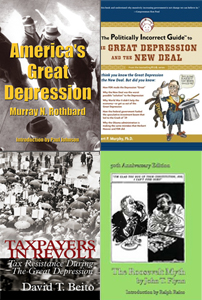 Sorry, couldn’t resist the headline. But check it out: Murray Rothbard’s America’s Great Depression, Bob Murphy’s Politically Incorrect Guide to the Great Depression and the New Deal, Dave Beito’s Taxpayers in Revolt, and John T. Flynn’s Roosevelt Myth, all for $49! That’s quite an uplifting deal.
More great news: Contra Keynes and Cambridge, vol. 9 of Hayek’s Collected Works, is now out in paperback from Liberty Fund, and just $14.50.





 Organizations and Markets
Recent Comments