Posts filed under ‘Bailout / Financial Crisis’
The Ethics of Bankruptcy
| Peter Klein |
I like this 2003 HBR piece from Joe Bower and Stuart Gilson on bankruptcy. Substitute “Chrysler” and “foreign auto makers” for “WorldCom” and “competing telecom firms” and you’ll get the idea:
WorldCom’s bankruptcy, however, highlights an important, potentially very large social cost of the U.S. bankruptcy system. Competing telecom firms, which have played by the accounting rules and have used more prudent financing, now find themselves — once again — at a competitive disadvantage relative to the company. Unlike WorldCom, these firms had to stay current on their debt and service their lease obligations. They did not get to write down their assets and debt, nor have they been able to reduce taxes by claiming that their profits never existed.
Is this fair? Do the benefits of the system outweigh its costs? The system works well to protect assets and employees, to be sure. But are WorldCom’s assets and employees really the ones that should be protected? What about those of more efficient firms? In capital-intensive industries like petrochemicals, steel, telecoms, and airlines, doesn’t bankruptcy law make it harder for efficient companies to drive inefficient assets out of business? In the majority of bankruptcy cases in these industries, the top managers are gone, but old capacity returns to the market with an improved balance sheet. This can easily prolong a period of industrywide overcapacity as well as unfairly disadvantage competitors.
Their focus is bankruptcy resulting from corporate fraud, but the question applies equally well, in my view, to bankruptcy resulting from managerial incompetence.
BTW, for a primer on bankruptcy, Michelle White’s 1989 Journal of Economic Perspectives paper, “The Corporate Bankruptcy Decision,” is a good place to start.
Macroeconomic Policy Quote of the Day
| Peter Klein |
Mike Rozeff makes the Hayekian point that is probably obvious to the O&M community, but virtually absent from public debate:
Bernanke is just a man. He is fallible. We learned this week that he pressured Bank of America into absorbing Merrill Lynch. In doing this, he pressured the leader of Bank of America into withholding critical information from his shareholders about Merrill Lynch losses. Technically, he can be charged with conspiracy to defraud. The loans he had the FED make to AIG look far from wise. A number of his other actions are highly questionable in making various kinds of loans to questionable borrowers.
I am saying that Bernanke doesn’t actually know what he’s doing. But I am using him only as an example. He’s not special. The more important point is that no one knows how to do fiscal and monetary policy, and they never have and never will. No one. For that reason alone, which is a narrowly practical one, no one should have those powers.
One Part of the Financial Sector Is Still Growing
| Peter Klein |
Courtesy of EconomPicData:
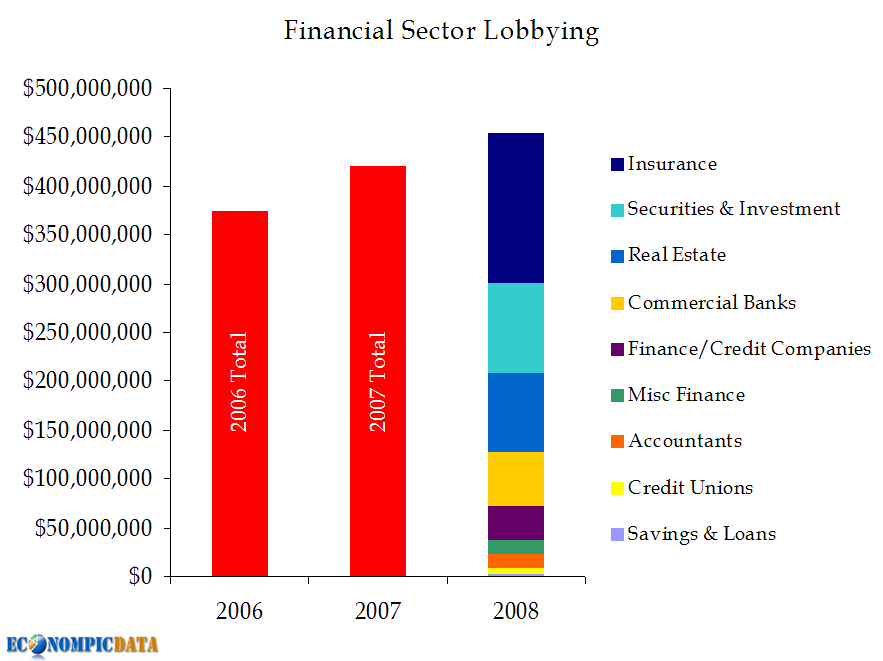
It takes money to make money, you know.
Macroeconomics Quote of the Day
| Peter Klein |
From Kenneth Boulding’s review essay on Samuelson’s Foundations, published in the JPE in 1948:
[I]t is a question of acute importance for economics as to why the macroeconomics predictions of the mathematical economists have been on the whole less successful than the hunches of the mathematically unwashed. The answer seems to be that when we write, for instance, “let i, Y, and I stand, respectively, for the interest rate, income, and investment,” we stand committed to the assumption that the internal structures of these aggregates or averages are not important for the problem in hand. In fact, of course, they may be very important, and no amount of subsequent mathematical analysis of the variables can overcome the fatal defect of their heterogeneity.
More on heterogeneity in macroeconomics here.
Best NCAA Championship Game Headline
| Peter Klein |
From the New York Daily News: “No bailouts for Michigan State in NCAA final loss.”
I have to admit, as an auto-industry-bailout opponent, I was getting a little tired of the “Michigan State basketball brings a ray of sunshine to struggling Detroit” storyline. Sheesh. Oh, did I mention that I’m also a rabid UNC basketball fan?
 (I’m really happy for Carolina star Tyler Hansbrough, with whom I feel a close connection. Tyler’s a Missourian who went to UNC; I did my undergraduate work at UNC and now live in Missouri. My former next-door neighbors are from Tyler’s home town of Poplar Bluff, MO. My wife taught Tyler’s older brother Greg here at Mizzou. And, like Tyler, I have some pretty sweet post-up moves . . . NOT!)
Today, SNL or the Onion, Tomorrow . . . ?
| Peter Klein |
From the opening sketch of last weekend’s Saturday Night Live:
My administration intends to do to every industry in this country, exactly what we are doing to the automakers. Every company will be vetted for fiscal soundness. Those judged best able to compete in the global economy will be offered a governmental subsidy. The others will be asked to cease operations at once. Hopefully, they will do so voluntarily, if not, they will be shut down by force.

Thanks to Gary Peters for the pointer.
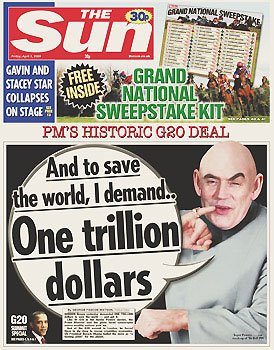
If Only the US Media Were as Clever as their British Counterparts
| Peter Klein |
Today’s cover of the Sun (via Per):
South Park’s Less-Famous Metaphor
| Dick Langlois |
 One of my students sent me this link to a recent South Park episode, which not only effectively skewers the bailout but also has its own take on the nature and meaning of “the market.” A mini-Fable of the Bees for modern times.
Relative Prices Matter
| Peter Klein |
Hate to keep flogging a dead horse, and perhaps preaching to the choir, but the point can’t be made often enough: relative prices matter. The childish Keynesianism of people like DeLong and Krugman, like Bernanke and Geithner, understands only aggregate concepts like “national output,” “employment,” and “the price level.” A consistent theme of this blog’s rants is that resources are heterogeneous (1, 2) and, consequently, relative prices must be free to adjust to changes in demand, technology, market conditions, and so on. When government policy generates an artificial boom in a particular market, such as housing — drawing resources away from other parts of the economy — the key to recovery is to let resources flow out of that market and back to the sectors of the economy where those resources belong (i.e., to match the pattern of consumer demands). It’s quite simple: home prices should be falling, interest rates should be rising, savings rates should be going up, and debt levels should be going down. The Administration’s policies, like that of the last Administration, are designed to achieve exactly the opposite. Why? Because relative prices don’t matter, the allocation of resources across activities doesn’t matter, all that matters is to keep any sector from shrinking, any prices from falling, any firms from failing, any consumers from reducing their consumption. A child thinks only about what he can see. The unseen doesn’t exist.
Here are some excellent posts on the subject. Craig Pirrong notes that Sherwin Rosen had a colorful way of emphasizing relative price effects. Mario Rizzo (1, 2) points to data on the housing market and the Fed’s continuing attempt to keep resources from flowing out of this bloated sector. And here’s a snippet from Israel Kirzner’s short book on Mises explaining that insolvent financial institutions should be liquidated, not rescued. Good reading for grown-ups.
Another Attack on Outrageous Bonuses
| Mike Sykuta |
For the second time in a week, the Obama Administration attacked what it referred to as “outrageous” bonuses paid during a time of economic struggle for so many Americans. The announcement came as a reaction to Walmart’s announcement that the Arkansas-based retailer paid almost $1 billion in bonuses to its employees. Adding in profit-sharing, 401K contributions, and employee discounts, the total giveaway is closer to $2 billion, according to company officials.
The White House reacted strongly to such “corporate largess” less than a week after reports that bailout target AIG paid millions in bonuses to its employees. “At a time when so many Americans are losing their homes and unable to put food on their tables, it is unconscionable that a retailer that has benefited so much from consumers should be paying out such astronomical sums in bonuses to its employees. To make matters worse, we understand these bonuses were not even contractually obligated, as in the AIG case,” stated White House spokesman Robert Gibbs. “Obviously Walmart’s ‘Every Day Low Prices’ are not as low as they should be.” Congressional Democrats said they are considering legislation to tax Walmart employees’ bonus payments and to force the retailer to lower its prices further. (more…)
Thoughts on AIG
| Peter Klein |
Nothing has annoyed me more in the last 24 hours than the constant parade of angry, self-righteous, and ill-informed denunciations of AIG coming from Capitol Hill and the mainstream media. No one, of course, likes the thought of a failing, taxpayer-supported firm paying large bonuses to executives. But let’s talk some common sense here.
- The main lesson is that AIG should never, ever have been bailed out with taxpayer dollars. I said that at the beginning, and I stand by it even more today. AIG should have declared bankruptcy. Under bankruptcy there are well-established, orderly procedures for winding down a firm, distributing the remaining assets among the various legal claimants, and so on. Injecting taxpayer money without any serious thought about the implications of government subsidy and/or ownership for management and governance is just plain dumb. Naturally, that’s what Congress and the last President — people who know exactly zilch about what companies do and how they are run — did.
- Performance-based pay is a complicated subject. There are dozens, if not hundreds, of theoretical and empirical studies on the effects of performance-based pay on company performance, the benefits and costs of various compensation formulas, and the like. As Jensen and Murphy wrote back in 1990, “It’s Not How Much You Pay, But How.” Of course, the people screaming the loudest right now haven’t a clue about any of this. (more…)
Management Theory and the Current Crisis
| Peter Klein |
 Here is a short piece by Nicolai and me written for a general audience, “Management Theory Is Not to Blame.” We discuss the role of resource heterogeneity in management theory and critique the vulgar Keynesianism that dominates mainstream commentary on the crisis. The graphic with the shovel alone is worth the click. Comments welcome here or at the Mises blog.
Passing the Hat for Jon Stewart’s Mother
| David Gerard |
No doubt you have all seen or at least heard of the bloodletting of CNBC’s Jim Cramer at the hands of Jon Stewart. Stewart took Cramer to task for the financial “journalists'” role as cheerleaders rather than as investigative reporters leading up to the financial meltdown.
What seems to be lost in the discussion is the fate of Mr. Stewart’s poor mother.
Mr. Stewart: My mother is 75. And she bought into the idea that long-term investing is the way to go. And guess what?
Mr. Cramer: It didn’t work.
Although I think it is a bit premature to malign the viability of equities and long term investing, I found it even more distressing was that Mr. Stewart’s mother doesn’t seem to have access to any competent financial advice. I would hope that the host of a popular television show would have sufficient financial resources to hook his mother up with a financial planner. Or, she might have stayed in-house and asked her son who is the “head of U.S. Markets and Global Technology at NYSE Euronext.”
Well, I am willing to help out by imparting a bit of my investment knowledge (actually, all my investment knowledge) that I picked up in graduate school to the cause.
(1) It’s tough to beat the market. Most funds don’t beat a simple index fund, so buy a simple index fund.
(2) Stocks tend to be more volatile than bonds. There is a bigger upside, yes, but there is also a bigger potential downside. As you hit your golden years, consider rebalancing to reduce your portfolio risk.
If you have any further questions, please consult the comments.
The Adults Are In Charge
| David Gerard |
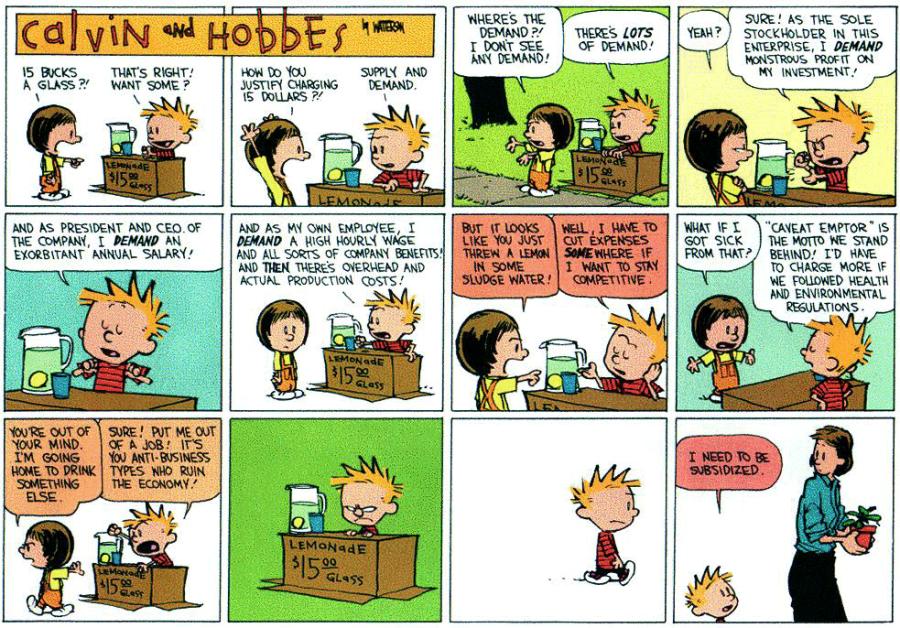 A common refrain heralding the arrival of a new Administration is that “the adults are in charge now.” The expression came to mind when I saw that this classic Calvin and Hobbes strip was making the internet rounds.
I certainly don’t envy the adults these days.
What Does a Trillion Dollars Look Like?
| Peter Klein |
As they say, trillion is the new billion, where bailouts and government debt are concerned (1, 2). Just how much is a trillion dollars anyway? Here it is in pictures (via MGK).
Skidelsky on Keynes and Hayek
| Peter Klein |
Keynes biographer Robert Skidelsky delivered the Manhattan Institute’s 2006 Hayek Lecture on Keynes and Hayek. The lecture will be broadcast this Sunday, 1 March 2009, 3:00 EST, on C-Span 2’s Book TV series. It will presumably appear later on C-Span’s YouTube channel. (Thanks to Warren for the pointer.)
Top 3 Boundary Implications
| Lasse Lien |
Top 3 lists are popular, the financial crisis is a hot topic, and this is Organizations and Markets. Combine all three and you get my top 3 list of implications of the financial crisis/recession for firm boundaries:
1. Increased horizontal specialization (de-diversification)
2. Increased vertical specialization
3. Increased concentration (increased size)
Is this roughly right? If not, provide us with your own list.
An Obamanable Housing Plan
| Peter Klein |
So, let me get this straight. We’re in a major recession triggered by a collapse in the housing market, itself the inevitable result of government policies, led by Fannie Mae and Freddie Mac, to get the wrong loans to the wrong people so they could buy the wrong houses. The Obama Administration’s remedy is not to let Fannie and Freddie die a long-overdue and merciful death, but to prop them up, to give them additional powers, and to subsidize private mortgage lenders who extend yet more credit to more borrowers who can’t pay it back, thus making what might have been a temporary misallocation of the housing stock into a permanent one. Brilliant!
I am bewildered. But, more than that, I am angry. I can’t count how many news accounts I’ve seen about the poor, struggling homeowners who can’t make the monthly mortgage payment, are about to be foreclosed, and risk losing the family home, yard, white picket fence, and piece of the American Dream. But I haven’t heard one word about the poor, struggling renters, the ones who scrimped and saved and put money away each month towards a down payment, who kept the credit cards paid off, stayed out of trouble, and lived modestly, and thought that maybe, just maybe, the fall in housing prices meant that they, finally, could afford a house — maybe one of those foreclosed units down the street. These people are Bastiat’s unseen. For them, Obama’s housing plan is a giant slap in the face. To hell with the prudent. Party on, profligate! Now that’s what I call moral hazard.
Update: Here it is in pictures (from EconomiPicData via Wayne Marr).
Demand for Commodities Is Not Demand for Labor
| Peter Klein |
Minnesota engineering professor David Levinson (via Mankiw), on the “shovel-ready” criterion for stimulus spending:
In the 1930s, when you were literally building with shovels, that might have made sense. That was largely unskilled labor. Today, it’s blue collar, but it’s not unskilled. . . . The guy brushing the asphalt back and forth is unskilled, but the guy operating the steamroller isn’t. And there’s an assumption out there that construction workers are interchangeable between residential and highway projects. But a carpenter isn’t a whole lot of help in building a road.
Modern Keynesian economics, which retains the Master’s belief in homogeneous labor and capital and his focus on macroeconomic aggregates, treats a worker as a worker as a worker. Lending and spending — on anything, it doesn’t matter what — brings idle resources into gainful use. Notes Hayek:
John Stuart Mill’s profound insight that demand for commodities is not demand for labor, which Leslie Stephen could in 1878 still describe as the doctrine whose “complete apprehension is, perhaps, the best test of a sound economist,” remained for Keynes an incomprehensible absurdity (Collected Works, vol. 9., p. 249).
And here’s Craig Pirrong:
There is no such thing as “aggregate output.” There are many industries, many goods, many sectors, all of which rely on specialized resources that are not readily redeployable among them. Directing — via coercion — spending to one sector or another is likely to worsen resource misallocations, rather than mitigate them. I find it particularly bizarre that some of the stimulus appears to be directed at supporting industries and sectors that resources should leave (e.g., construction, automobiles). We almost certainly built too many houses (due to perverse monetary policy, as John Taylor explains it), so resources should leave that business. Why stimulate it?





 Organizations and Markets

Recent Comments