Posts filed under ‘Bailout / Financial Crisis’
Karl’s Revenge
 | Peter Klein |
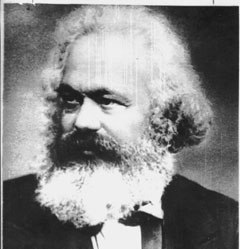
I closed my first post on the bailout mess with “Capitalism, requiescat in pace.” Here’s Martin Masse with the details. (Thanks to Mark Thornton.)
Mankiw: Defer to the Philosopher-Kings
| Peter Klein |
One of the most disappointing economist responses to the proposed bailout is Greg Mankiw’s. While not exactly endorsing the Paulson-Bernanke plan itself, Greg supports the process through which it emerged. His argument, essentially, is this: Paulson and Bernanke are very smart and have access to better information than the rest of us, so we should stop complaining and go along with whatever they propose.
I find this stunningly naive, for four reasons:
1. It ignores differences in theoretical frameworks or models. No doubt Karl Marx, John Maynard Keynes, Oskar Lange, Paul Samuelson, and Joseph Stiglitz were or are highly intelligent people. Do we have to accept all their policy conclusions? Surely intelligent specialists can come to different conclusions not only because they have access to different information (the Friedmanite view), but because they have different understandings of how the world works. (This is especially true when long-run, rule-utilitarian consequences are at stake.)
2. It ignores the distinction between theoretical and applied economics. Even if people agree on theoretical questions, they may disagree on the application of theory to specific historical situations, which is a matter of judgment, not intelligence.
3. It ignores private interests. Paulson and Bernanke are not disinterested, Platonic philosopher-kings pursing the common good. Presumably they are pursuing private interests, just like every other political actor. Has Greg never heard of public choice?
4. It ignores concerns other than economic efficiency. Economists, like everyone else, have normative opinions. Some may oppose the bailout not on utilitarian grounds, but because they think giving taxpayer dollars to failing enterprises is immoral, regardless of possible contagion effects.
A New Hope
| Peter Klein |
 Finally, encouraging signs of resistance to the Paulson-Bernanke Corporate Welfare Act of 2008. Naturally, the commentators at our favorite sites at our favorite sites listed in the “Links” section below and to the right have been been against the bailouts from the beginning, but now mainstream scholars and analysts are getting into the act. I don’t mean complaints from members of Congress or The Candidates that the recent and proposed bailouts don’t go far enough (e.g., homeowners should get bailed out too) or that the Paulson-Bernanke proposal doesn’t include enough new regulations. Rather, I’m talking about sensible analysis by prominent, mainstream economists and other experts explaining that a market economy in which profits are private while losses are socialized is, well, not a market economy at all but a socialist or corporate-fascist state. See, for example, statements by Luigi Zingales, John Cochrane, and Richard Epstein, among others. Maybe the Empire can be defeated after all. (Apologies to Seth MacFarlane for modding his image.)
Update: Casey Mulligan is also quite good.
Request for Urgent Confidential Business Relationship
| Peter Klein |
Perhaps you found this in your inbox today. But, really, is it any sillier than the real thing?
From: Minister of the Treasury Paulson
Subject: REQUEST FOR URGENT CONFIDENTIAL BUSINESS RELATIONSHIPDear American:
I need to ask you to support an urgent secret business relationship with a transfer of funds of great magnitude.
I am Ministry of the Treasury of the Republic of America. My country has had crisis that has caused the need for large transfer of funds of 800 billion dollars US. If you would assist me in this transfer, it would be most profitable to you.
I am working with Mr. Phil Gram, lobbyist for UBS, who will be my replacement as Ministry of the Treasury in January. As a Senator, you may know him as the leader of the American banking deregulation movement in the 1990s. This transactin is 100% safe.
This is a matter of great urgency. We need a blank check. We need the funds as quickly as possible. We cannot directly transfer these funds in the names of our close friends because we are constantly under surveillance. My family lawyer advised me that I should look for a reliable and trustworthy person who will act as a next of kin so the funds can be transferred.
Please reply with all of your bank account, IRA and college fund account numbers and those of your children and grandchildren to wallstreetbailout@treasury.gov so that we may transfer your commission for this transaction. After I receive that information, I will respond with detailed information about safeguards that will be used to protect the funds.
Yours Faithfully Minister of Treasury Paulson
Of course, the word “deregulation” above should be “change in regulation.”
See also: All Your Banks Are Belong to US (via Anthony).
The Financial Crisis
| Peter Klein |
A regular reader asks why we haven’t written much on the US financial crisis. What, he asks, do organizational economics, strategic management, Austrian economics, entrepreneurship theory, and the new institutional economics say about the events of recent weeks?
I can’t speak for Nicolai, Dick, and Lasse, but I personally have avoided talking about it because, well, I’m too depressed — not so much about the crisis itself, which I view as a necessary corrective to two decades of potentially ruinous malinvestment, but about the political reaction to it. I agree with Larry White that the general level of discourse not just among laypeople but also among the political and financial elites, top journalists, and academics, has been shockingly vapid and vacuous, even by the usual standards. Listening to government officials, pundits, and analysts analyzing the crisis is like listening to my son’s first-grade class discussing the finer points of postmodern French literature. It was too much deregulation! (Huh?) The free market broke down yet again, just like in the 1930s! Market failure! Thank goodness the government is “stepping in”! Excuse me while I blow my groceries.
My view, in brief, is that the current crisis is the predictable result of a massive credit bubble that began under Greenspan in the 1990s and spilled over into the housing market, following the general outlines of the boom-bust cycle described by the Austrians, along with moral hazard encouraged by the financial “safety net” and the implicit (and, increasingly explicit) guarantees of the “too-big-to-fail” mentality. Of course, the US government’s reaction — spending taxpayer money like candy to bail out favored groups and institutions — can only exacerbate the problem. You can do your own Googling like this or this to find informed commentary. I have little to add but will highlight a few favorite comments: (more…)
Moral Hazard, For Real
| Peter Klein |
I suppose I posted a whimsical item about moral hazard because I was too angry to write anything about the Financial Irresponsiblity Bailout and Reward Act of 2008, the moral-hazard story of the decade. Buy more house than you can afford? Sign a mortgage contract you can’t understand? Invest in risky mortgage-backed securities that lose money? Run your financial institution into the ground? Don’t worry, the hapless US taxpayer will pick up the tab!
I have nothing but contempt in my heart for all who asked for, drafted, and voted for this odious piece of legislation. If there were any doubt that the US is, in many ways, a socialist economy, this massive socialization of financial-market risk should put such doubts to rest. Capitalism, requiescat in pace.





 Organizations and Markets


Recent Comments