Posts filed under ‘Business/Economic History’
Technology and Firm Size and Organization
| Peter Klein |
As a New Economy skeptic (1, 2, 3, 4) I worry about sweeping claims that information technology has rendered obsolete the large, vertically integrated, publicly held corporation and its managerial hierarchy. Such claims suffer from two problems: First, they tend to be thinly documented — evidence on the economy-wide distribution of organizational forms is largely fragmentary and anecdotal. Second, they usually exaggerate what’s new about those changes that we can document. As I wrote in my review of Yochai Benkler’s The Wealth of Networks:
Benkler proposes social production as an alternative to the traditional organizational modes of “market” and “hierarchy,” to use Oliver Williamson’s terminology. Indeed, open-source production differs in important ways from spot-market interaction and production within the private firm. But here, as elsewhere, Benkler tends to overstate the novelty of social production. Firms, for example, have long employed internal markets, delegated decision rights throughout the organization, formed themselves into networks, clusters, and alliances, and otherwise taken advantage of openness and collaboration. There exists a variety of organizational forms that proliferate within the matrix of private property rights. Peer production is not new; the relevant question concerns the magnitude of the changes.
Here, the book suffers from a problem common to others in this genre. Benkler provides a wealth of anecdotes to illustrate the revolutionary nature of the new economy but little information on magnitudes. How new? How large? How much? Cooperative, social production itself is hardly novel, as any reader of “I, Pencil,” can attest. Before the web page, there was the pamphlet; before the Internet, the telegraph; before the Yahoo directory, the phone book; before the personal computer, electric service, the refrigerator, the washing machine, the telephone, and the VCR. In short, such breathlessly touted phenomena as network effects, the rapid diffusion of technological innovation, and highly valued intangible assets are not really really new. (Tom Standage’s history of the telegraph and its own revolutionary impact, The Victorian Internet [New York: Walker & Company, 1998], is well worth reading in this regard.)
A new paper by Giovanni Dosi, Alfonso Gambardella, Marco Grazzi, and Luigi Orsenigo, “Technological Revolutions and the Evolution of Industrial Structures: Assessing the Impact of New Technologies upon the Size and Boundaries of Firms,” looks at the empirical evidence more systematically and concludes that the effect of information technology on firm size and organization is real, but modest: (more…)
Business History Bleg: British Trading Houses
| Peter Klein |
I’m advising a PhD student in sociology (yes, it’s true) who’s studying the rise of British commercial influence in the Far East. He’s particularly interested in Jardine Matheson & Company, a Hong Kong trading company founded in 1832 that grew quickly into a pre-modern industrial conglomerate. Can anyone recommend references on the organization and strategy of 19th-century trading firms, their political, social, and cultural activities and influence, and their role in trade and economic growth more broadly?
Notes from DRUID
| Dick Langlois |
I am in Copenhagen for the DRUID 25th Celebration Conference, which finished up yesterday. It’s called the 25th Celebration because it’s the 25th DRUID conference -– there have been generally two a year since the organization started in 1995. This conference represents a transition for DRUID, which has grown considerably over the years. One indication of transition is that the old scientific advisory board, of which I had been a member since 1996, has been dissolved and a new one reconstituted. The new board is made up of a number of smart and interesting people, but it tends more toward management and economic geography and away from the theory of the firm and industry as represented by the likes of Bo Carlson, Brian Loasby, and George Richardson (and me). It was perhaps fitting that Brian was asked to press the button that touched off the fireworks over the harbor after last night’s conference dinner.
Some highlights.
Steven Klepper presented the first keynote, a further development of his long-term research program on industry structure and the birth and death of firms. (I missed the very beginning of the talk because I was having breakfast with Nicolai; fortunately, the paper is available here.) What Klepper does is essentially top-flight quantitative economic history. In this paper he takes on the conventional wisdom (A) that Silicon Valley is unique because of the rate of spinoffs it engendered and (B) that universities are crucial to the spinoff process. It turns out that the early auto industry in Detroit and the early tire industry in Akron had almost identical spinoff patterns, both sans university. (In fact, there were more spinoffs than in Silicon Valley.) In Klepper’s account -– notably different from most accounts –- clusters arise when new profit opportunities get seized by defection of key personnel rather than through internal diversification. In all cases, the cluster tend to consist of successful spinoffs from already successful firms. Genuine new entrants and spinoffs from less-successful firms seldom prosper. Defections have to do in large part with the dysfunctionality of the parent company, involving a problem either with expectations (as when the soon-to-be defectors couldn’t convince management of the value of their ideas) or of incentives (read: inadequate stock options). There is an interesting connection here with the Penrose/Chandler theory of the growth of the firm. Penrose seems to assume, and Chandler more than assumes, that firms always build internal capabilities and then use their excess resources to diversify internally into profitable related areas. Klepper shows that those opportunities often result in the formation of new firms. (more…)
The New Comparative Economic History
| Peter Klein |
That’s the title and subject of a Festschrift for Jeffrey G. Williamson, edited by Timothy Hatton, Kevin O’Rourke, and Alan Taylor and published last year by MIT Press. Reviewer Dan Bogart describes the field thusly: “In a nutshell, this line of research analyzes the sources of economic growth, the importance of institutions, and the impact of globalization by making comparisons between actual economies. An illuminating contrast is made with early cliometrics, which addressed questions by constructing counterfactuals with the help of theory and calibration. ” As such, the new comparative economic history is a closely related to, though not identical with, the new institutional economic history associated with Douglass North, Barry Weingast, Avner Greif, and others mentioned frequently on these pages. The NCEH takes institutions seriously but does not give them quite as much weight as NIE historians in explaining economic performance.
Sudha R. Shenoy (1943-2008)
| Peter Klein |
I’m saddened to report the death yesterday of Sudha Shenoy, the distinguished Australian economic historian and important contributor to the “Austrian revival” of the 1970s. Her father, the eminent Indian economist B. R. Shenoy, was a student at the London School of Economics in the 1930s when Hayek gave his famous “Prices and Production” lectures and both father and daughter were deeply influenced by Hayek. Sudha too studied at the LSE and eventually took a position at the University of Newcastle, where she taught until her retirement in 2004. Sudha was writing a book on Hayek and would have given a week-long lecture series on Hayek at the Mises Institute this fall. Here is a 2003 interview, here are some audios and videos, and here are some materials collected by Google Scholar. Some obituaries and personal remembrances are here, here, and here.
Suhda was a regular reader and occasional commentator here at O&M. You can get a sense of her erudition from this blog post, one of our most popular, which was basically a cut-and-paste job from one of her emails.
Suhda was a quiet, kind, and gentle person. This may be hard for our younger American readers to comprehend but she didn’t know how to drive. I once had the pleasure of chauffeuring her around Auburn, Alabama at an Austrian Scholars Conference. Spending time with her was a real treat.
Allen Nevins Dissertation Award
| Peter Klein |
I received an email the other day from the Economic History Association soliciting nominations for its dissertation prizes, the Allan Nevins Prize for best dissertation in U.S. or Canadian economic history and the Alexander Gerschenkron Prize for the best dissertation in the economic history of, you know, what our textbooks call ROW (the Rest of the World). This brought to mind a couple of personal connections:
1. Last year’s Nevins prize went to a University of Missouri student, Mark Geiger, who wrote on grassroots financing of the US Civil War.
2. My dad got his PhD in history at Columbia in the 1950s and, while teaching there as a lecturer, worked in Nevins’ office. Dad told an interviewer:
Allan Nevins had retired, but I was allowed by him to use a desk in his office. He had an office twice the size as this, which was filled with books from ceiling to floor and piled high. And if you were at Columbia you were immediately well known, you know. A newspaper or journal would call me up or a publisher, “Would you review this book for us?” And I wouldn’t know anything about it, “Yes Sir,” and I’d look on Nevins’ shelf and find three books on the subject. (Laughter)
Being at Columbia and around Nevins at that time was a great launching pad for an academic career. Dad, holding the rank of lecturer (lower than assistant professor), was invited to interview for the department head position at Long Island University, which he was offered and accepted. The job came with tenure and the rank of full professor. Dad’s the only person I’ve known to be a tenured full professor without ever having been an assistant or associate prof.!
This Month in Business History
| Peter Klein |
Business history highlights for June, courtesy of Friends of Business History News:
June 1, 1495 — Friar John Cor records the first known batch of Scotch whiskey in the Exchequer Rolls of Scotland.
June 4, 1896 — Henry Ford drives his first automobile through Detroit streets.
June 9, 1790 — The Philadelphia Spelling Book becomes the first work registered under the federal copyright act (U.S. District Court of Pennsylvania).
June 15, 1851 — Jacob Fussell of Baltimore, Maryland sets up first ice cream factory.
June 26, 1848 — The first U.S. pure food law is enacted, banning the importation of adulterated drugs.
June 30, 1893 — The blue-white Excelsior diamond (995 metric carats) is discovered at the De Beers mine in Jagersfontein, South Africa. Until the discovery of the Cullinan in 1905, it was the world’s largest known uncut diamond.
Are Brand Names a Modern Phenomenon?
| Peter Klein |
Not at all, says Gary Richardson, in a new NBER paper, “Brand Names Before the Industrial Revolution.” Branding has long been the target of largely uncomprehending critique from the likes of Veblen, Galbraith and sociologists such as Daniel Bell but its role in maintaining quality and reliability and securing contractual performance is now generally understood. Importantly, shows Gary (my former grad-school classmate), the use of seller-specific markers was widespread even before the Industrial Revolution and played an important role in facilitating the emergence of long-distance trade:
In medieval Europe, manufacturers sold durable goods to anonymous consumers in distant markets, this essay argues, by making products with conspicuous characteristics. Examples of these unique, observable traits included cloth of distinctive colors, fabric with unmistakable weaves, and pewter that resonated at a particular pitch. These attributes identified merchandise because consumers could observe them readily, but counterfeiters could copy them only at great cost, if at all. Conspicuous characteristics fulfilled many of the functions that patents, trademarks, and brand names do today. The words that referred to products with conspicuous characteristics served as brand names in the Middle Ages. Data drawn from an array of industries corroborates this conjecture. The abundance of evidence suggests that conspicuous characteristics played a key role in the expansion of manufacturing before the Industrial Revolution.
See also Gary’s EH.Net Encyclopedia entry on guilds.
Accounting and Modern Management
| Peter Klein |
In assessing the role of accountants during the industrial revolution, historians generally have been guided by Sidney Pollard’s interpretation expressed in The Genesis of Modern Management (1965). Pollard contended that early industrial accounting exhibited a marked confusion between capital and revenues. This confusion suggested to him that early industrialists were more concerned with calculating and extracting interest on their investments rather than maximizing their rate of return. Thus, Pollard concluded, these early entrepreneurs apparently lacked the true profit motive possessed by modern capitalists.
David Oldroyd’s book seeks to test these contentions by subjecting the financial accounts of three northern [coal] estates to detailed analysis in four specific areas: the performance of contracts, investment planning, labor management, and managerial behavior. . . .
The result is a discussion of early industrial entrepreneurship that is both revealing and nuanced. For example, Oldroyd shows that an extensive network of contracts regulated the exploitation of the Durham and Northumberland coalfield. These contracts covered a myriad of circumstances involved in both the underground mining and aboveground transportation of minerals. A typical enterprise might need to contract the leasing or subcontracting of a mine, aboveground “wayleaves” to transport coal across neighboring properties, the shipment of coal to London or other ports, and the off-loading of coal at the point of sale. In all of these areas, accounting records carefully quantified not only total production and transport, but very often unit costs as well. Oldroyd therefore concludes that, contrary to Pollard, accounting was an essential and extremely adaptable tool promoting economic efficiency during this era.
This is from James Jaffe’s EH.Net review of David Oldroyd’s Estates, Enterprise and Investment at the Dawn of the Industrial Revolution (Ashgate, 2007). Interesting fodder for business historians and specialists in contracting and organization. And here are some previous posts on accounting (1, 2, 3, 4, 5, 6).
Economics and the Rule of Law
| Peter Klein |
This week’s Economist features a summary of recent economic controversies about the rule of law (thanks to Fabio Chaddad for the pointer). There is near-universal consensus among specialists in economic history and economic growth that the legal rules — and institutions more generally — “matter,” though the precise mechanisms are in dispute, and aspects of the institutional environment such as the quality of legal rules are difficult to measure consistently across societies and over time. We’ve touched on the closely related “legal origins” debate before. As with that controversy, the arguments in this one have become more subtle and complex in the last decade. As the Economist notes:
[A]s an economic concept the rule of law has had a turbulent history. It emerged almost abruptly during the 1990s from the dual collapses of Asian currencies and former Soviet economies. For a short time, it seemed to provide the answer to problems of development from Azerbaijan to Zimbabwe, until some well-directed criticism dimmed its star. Since then it has re-established itself as a central concept in understanding how countries grow rich — but not as the panacea it once looked like.
The Economist piece focuses on the distinction between “thick” and “thin” understandings of the rule of law. (more…)
Fed Intervention Policy
| Steve Phelan |
Greg Mankiw reports that Myron Scholes has a novel idea to fix the credit crisis – rather than simply guaranteeing to underwrite asset losses (as they have with the JP Morgan/Bear Stearns ) Scholes proposes that the Fed takes senior equity and debt positions in a distressed bank thereby improving the capital adequacy ratio, and thus preventing a credit freeze which would damage the real economy. I like it – what do YOU think?
Debt Bites Back
| Steve Phelan |
A nice cartoon presentation of the debt crisis by the Wasington Post that you might want to use in your classes.
Two questions:
1) Is the story essentially correct or is it overly damning?
2) What are the organizational implications of this story – for institution and policy building?
We can only assume that all sorts of “corrective” measures will be planned and taken in the immediate future. I believe we should be getting involved in the debate by honing our theoretical position. We are watching economic history in the making.
Big Think in Management Research
| Peter Klein |
Greg Clark’s A Farewell to Alms has received a lot of attention in the econo-blogosphere. I haven’t read the book and don’t have much to say about it but you can read as much as you like from Cowen, McCloskey, DeLong, Caplan, Kling, and others. One of the most interesting reviews, to me, is this one by Robert Margo of Boston University. Margo admires the book but dislikes this genre, what he calls “Big Think.”
“Big Think” refers to the genre of economic history that asks The Big Question. Why England and not China? Do institutions “matter” or is it something else, or many things? Why is the United States rich and Bolivia poor?
Reviewers should be upfront about their ex ante biases. Here is one of mine: I do not care for Big Think. The Big Question per se is not the problem — in economics, there is nothing more important. For me, the problem with Big Think is that it is inherently Too Big. One cannot hope to answer The Big Question by tackling it head on. One must break The Big Question into a great many very tiny precisely posed questions, and get the answers to them right. In economic history we are still _very_ far from completing this task even for a country whose economic history is as well-worn as the United States. Big Think is a Big Distraction from our true purpose in life. (more…)
Wages and Currency: Visualizing Wage Payments
| Peter Klein |
That’s the title of a virtual exhibition hosted by the International Institute of Social History in the Netherlands. Jan Lucassen has collected data and images showing the connection between coin circulation and wage payments throughout history, particularly for societies about which we know little of labor patterns and wage rates. “As far as wages are paid in currency, in particular in coin, specific patterns of denominations produced and used in space and time may provide insights into the importance of wage labour in those societies.”
Numismatists may also wish to pre-order George Selgin’s forthcoming Good Money: Birmingham Button Makers, the Royal Mint, and the Beginnings of Modern Coinage, 1775-1821, a chapter of which you can read here. Two other Selgin papers on private coinage are here and here. As you can see, Selgin’s work has improved considerably since he quit doing stuff like this.
Medieval Business Schools
| Peter Klein |
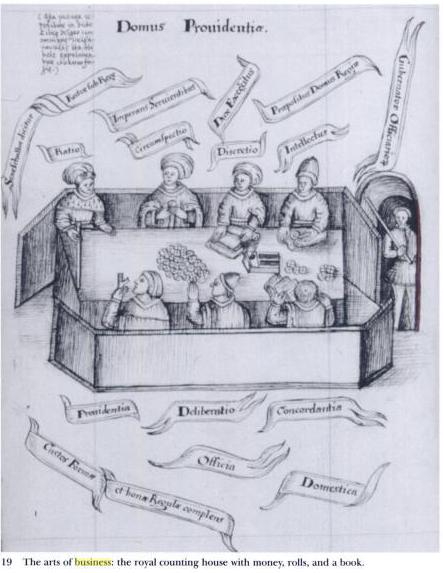
Contrary to popular belief, formal education in medieval times was not restricted to the clergy and the very wealthy. Nor was theology the most popular subject. Independent schools, unaffiliated with any particular religious body or royal institution and staffed by lay people, were common, and even taught business administration (writing letters, drafting contracts, keeping the books).
So says Nicholas Orme in Medieval Schools: From Roman Britain to Renaissance England (Yale, 2006). (Thanks to Tom Woods for the pointer.) In Britain, grammar schools were often supported by wealthy patrons and were open to students of modest means. Notes Orme:
Most [English] schoolmasters were probably broad rather than specialized teachers, catering for a wide range of needs, so it is not surprising that a brand of practical teacher emerged by the fourteenth century (at latest), offering more focused instruction for careers in trade and administration. Such instruction might include “dictamen” (the art of writing letters), the methods of drafting deeds and charters, the composition of court rolls and other legal record, and the keeping of financial accounts. Since documents of these kinds were often written in French between 1200 and 1400, the practical teachers came to teach French too.
This illustration, from p. 69 of the book, depicts such a class. How did they do it without PowerPoint?
The Early History of Silicon Valley
| Peter Klein |
Most historical accounts of Silicon Valley start in the 1970s or later. Christophe Lecuyer’s Making Silicon Valley: Innovation and the Growth of High Tech, 1930-1970, reminds us that the seeds of the first modern high-tech cluster were planted much earlier. Fairchild is central to the story, of course, but so is Eitel-McCullough (Eimac) in the 1930s and 1940s, Litton in the 1940s and 1950s, and Varian in the 1960s (them, not him). Lecuyer, writes reviewer Glenn Bugos,
seeks to define Silicon Valley as an industrial district, akin to the Marshallian industrial districts that economic historians have begun to explore. Also, he integrates into his story the many extant, divergent strands of Silicon Valley historiography. Into his manufacturing-driven narrative, we see the trends other historians have emphasized — military funding, the shake-out following the McNamara consolidation, the role of Stanford University in generating expertise, and the importance of workplace culture.
ECHO
| Peter Klein |
Check out ECHO (Exploring and Collecting History Online), a portal to several thousand websites dealing with the history of science, technology, and industry.
Call for Papers: Honoring the Life and Works of Alfred Chandler
| Peter Klein |
Shawn Carraher and John Humphreys are editing a special issue of the Journal of Management History devoted to the life and work of the late Alfred D. Chandler, Jr. (1918-2007). Submissions are due 7 April 2008. Details below the fold. (more…)
Immigration and the Housing Bubble
| Steve Phelan |
Brad De Long’s analysis of the current financial crisis published in the Taipei Times on 01/01/08 received some attention in the blogosphere yesterday. For a crisis resulting in a sustained fall in asset values, he recommends either 1) nationalizing the debt or 2) inflating the price of nominal assets. As I was reading the article (and another on the fact that an 3 million excess housing units were created in the boom above long term trends) it occurred to me that a third path might be available — increased immigration. (more…)
My Pet Peeve
| Steve Phelan |
One of my pet peeves is when academics assume that people in industry are a little “dim.” For instance,
It would be churlish to point out that the fact that one should be extremely leery of arguments that diversification radically improves the safety of bond investments was well known back by Edgar L. Smith and others back in 1923.
This quote from Brad De Long here.
I’m not picking on Brad because it happens quite a bit in my experience. The “oh my gosh, we academics have known since 1923 that diversification of bonds does not reduce systematic risk that much, you dumbasses.”
Contrast this view with the fact that the brightest minds in a generation have been taking jobs on Wall Street. So the smartest people are the biggest dumbasses???
In these matters, I prefer to assume plausible deniability. Reducing systematic risk by combining geographically diversified BBB bonds sounds just plausible enough to avoid litigation for fraud and/or negligence. Now that’s smart!





 Organizations and Markets
Recent Comments