Posts filed under ‘Business/Economic History’
ICC Special Issue on Alfred Chandler
| Dick Langlois |
The most recent number of Industrial and Corporate Change is a special issue: Management Innovation-Essays in the Spirit of Alfred D. Chandler, Jr. Guest editors are Bill Lazonick and David Teece. Some interesting articles and definitely many interesting contributors. Yours truly was not involved — indeed, I didn’t learn about it until the table of contents appeared in my inbox. But I am cited in at least four of the papers. Indeed, the paper by Susan Helper and Mari Sako, both of whom I admire greatly, spends considerable time comparing my argument with Chandler’s. For the most part, I don’t disagree with their assessment except in respect of spin (more on which in a moment); but at one point they make an assertion that had me scratching my head.
Some argue that as a central tendency, the buffering and coordination functions of management are devolving to the mechanisms of modularity and the market — informational decomposition, flexibility, and risk spreading (Langlois, 2003: 377). In contrast, in Chandler’s world, “Increased specialization must, almost by definition, call for more carefully planned coordination if the volume of output demanded by the mass market is to be achieved” (Chandler, 1977: 490). The disagreement lies in different assumptions made. Langlois assumes that thickness of the market is exogenously given or that it is already established, while Chandler assumes that the mass market is something that has to be developed. Chandler’s view seems more correct here. (Helper and Sako 2010, p. 420)
Hello? One can argue that I have spent most of my career making precisely the point they attribute to Chandler: it’s the basis of the theory of dynamic transaction costs. Neither markets nor firms snap into existence but evolve slowly and — as I often quote Brian Loasby as pointing out — both require managerial coordination. (more…)
Mundaneum: The Google of 1910
| Peter Klein |
Fascinating article by Molly Springfield in Triple Canopy on the Mundaneum, an effort by two Belgian lawyers to collect and classify all the world’s information, using notecards and an innovative filing system. Information scientist Paul Otlet “was the first to imagine all the world’s knowledge as one vast ‘web,’ connected by ‘links’ and accessed remotely through desktop screens, and because of this he can be seen as the kooky grandfather of the Internet.” Unfortunately, the analog technology of the early twentieth century was not up to the task. (Here’s the wiki on the Mundaneum, which incidentally might make a good title for my next book.)

See also: The Victorian Internet by Tom Standage.
Jobs Of Yesteryear: Obsolete Occupations
| Peter Klein |
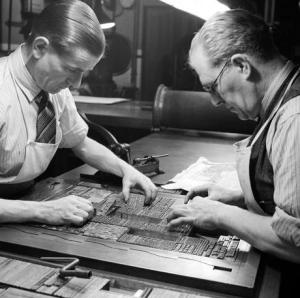
A fascinating pictorial from NPR on jobs made obsolete by technological innovation. Great illustrations of the labor-market side of creative destruction. (Planet Money via Russ Roberts.)
The Best and the Brightest
| Dick Langlois |
I read Peter’s post about paternalism — and the limits of smart people in government — just after I read about the death of Carl Kaysen, long-time MIT economist and one-time Kennedy advisor. Obituaries praise Kaysen for his role as a policy intellectual of great scope, especially in the area of nuclear non-proliferation. But they either fail to mention, or mention with considerable approval, Kaysen’s pivotal role in the famous 1954 United Shoe Machinery case. Kaysen’s view of the case, and of the role of economic analysis in antitrust, is a key example of what Williamson calls the “inhospitality tradition” — that any kind of contract we don’t understand must therefore be anticompetitive. In the eyes of many present-day economists, Kaysen is implicated in having destroyed the American shoe machinery industry and with it the American shoe industry. (The post-mortem is by Masten and Snyder.) Not exactly McNamara in Vietnam, but worth mentioning amid the hagiography of Kaysen, not to mention the reawakened culture of elitist decision-making in Washington.
New Issue of ICC
| Dick Langlois |
A new issue of Industrial and Corporate Change is out (TOC here) with a bunch of interesting articles. Prominent among them is a well-researched and nicely written piece by Pierre Desrochers that argues a politically unpopular view about corporations and the environment. Free speech in action?
Corporations Are People Too
| Craig Pirrong |
Legally, in some respects, anyways. That was a key issue in the recent Supreme Court decision re McCain-Feingold (see Dick’s post). I don’t have a lot to say about the specifics of the decision, as campaign finance law is way too arcane for me. Suffice it to say that I am inherently skeptical about any regulation regarding elections designed by incumbent politicians. People yammer about conflicts of interest all the time, but there’s a colossal one for you.
I just wanted to make a quick point about a debate between Stevens and Scalia carried out in the opinion and the dissent. Stevens noted that the Founders were deeply skeptical of corporations. Indeed so. Scalia noted that there are so many corporations today. Also true. The interesting question is how we got from A (Stevens) to B (Scalia).
The story is told in the North, Wallis and Weingast natural-state book Violence and Social Orders I’ve blogged about several times over at Streetwise Professor, mostly in the context of Russia. The relevant chapter is primarily based on John Wallis’s work. The basic story is that hostility to corporations — reflected very well in Adam Smith’s Wealth of Nations — was due to the fact that historically, English corporations were created by the crown, and were essentially very profitable favors provided to the politically connected. They were, in NWW terms, part of the “closed order” of the natural state, in which access to certain contracting forms was limited to a select powerful few. This animus towards corporations was inherited in the United States, but in the early years of the 19th century, state legislatures confronting issues associated with the financing of new infrastructure turned the corporate form into a prop of an open-order system in which this contracting form was made available to all. Rather than limit the right of incorporation to an elite, they made it available to everybody. The system changed from one in which legislatures had to grant every incorporation, to one in which pretty much anybody could incorporate if they met a set of general, universally applicable requirements. Hence, the proliferation of corporations. (more…)
Call for Applications: “International Business in Historical Perspective: The Emergence of Global Entrepreneurship”
| Peter Klein |
The Henley Business School at the University of Reading and the Institute for Economic and Social History at the Georg August University of Göttingen are organizing a Conference/Summer School on “International Business in Historical Perspective: The Emergence of Global Entrepreneurship,” 19-20 March (conference) and 21-25 March (summer school) 2010. Details here. “During the combined conference and summer school, scholars and students will explore the concept of entrepreneurship applied to historical examples in an international context. Topics include, for instance, the performance of multinationals in foreign markets, immigrant entrepreneurship, international family firms, and the institutional framework in which entrepreneurial decisions were made.”
The Division of Labor, 1886
| Peter Klein |
Another interesting passage from Graham Robb’s The Discovery of France:
Every [French] town and village was a living encyclopedia of crafts and trades. In 1886, most of the eight hundred and twenty-four inhabitants of Saint-Étienne-d’Orthe, on a low hill near the river Adour, were farmers and their dependents. Of the active population of two hundred and eleven, sixty-two had another trade: there were thirty-three seamstresses and weavers, six carpenters, five fishermen, four innkeepers, three cobblers, two shepherds, two blacksmiths, two millers, two masons, one baker, one rempailleur (upholsterer or chair-bottomer), and one witch (potentially useful in the absence of a doctor), but no butcher and no storekeeper other than two grocers. In addition to the local industries and the services provided by itinerant traders (see p. 146), most places also had snake collectors, rat catchers with trained ferrets, and mole catchers who either set traps or lay in wait with a spade. There were rebilhous, who called out the hours of the night, “cinderellas,” who collected and sold ashes used for laundering clothes, men called tétaïres, who performed the function of a breast pump by sucking mothers’ breasts to start the flow of milk, and all the other specialists that the census listed under “trades unknown” and “without trade,” which usually meant gypsies, prostitutes, and beggars (p. 99).
This book is filled with economics. Here’s a passage about repeated games:
Deceit was a particular specialty of pedlars from the Auvergne. A single piece of cloth could be made to last a whole season if it was sold with the promise that a tailor would come the next day and make up the clothes for nothing. The tailor would arrive, measure the customer, take the cloth, and never return. The drawback was that a dishonest salesman had to cover vast areas compared to a pedlar who earned the trust of his clientele (p. 150).
New Book: The Invention of Enterprise
| Peter Klein |
I’m putting this one on my Amazon wish list: The Invention of Enterprise:
Entrepreneurship from Ancient Mesopotamia to Modern Times, edited by David Landes, Joel Mokyr, and Will Baumol (Princeton, 2010). Check out the Table of Contents — an all-star lineup of entrepreneurship scholars and economic and business historians.
A Tale of Two Papers, or, Humpty Dumpty Writes About Exchanges
| Craig Pirrong |
The American Economic Association/American Finance Association Meetings are just about over. I made a quick trip there to comment on a paper. Upon returning home, I downloaded a couple of the papers presented that seemed of interest. Good call on one, bad call on the other.
The bad one is “Centralized versus Over The Counter Markets” by Viral Acharya of LBS and NYU, and Alberto Bisin of NYU. Although the motivation of the paper is admirable, the execution is execrable, and is representative of a lot of what is wrong in the profession.
The motivation is to compare the efficiencies of alternative ways of organizing derivatives trades: centralized exchanges and over-the-counter (OTC) markets. Great. Big question. I’ve written a lot about it, and would be very interested in seeing other takes thoughtful on the subject.
The paper concludes that organized exchanges are (constrained) first best efficient, and more efficient than OTC markets. A quick review of the paper makes it clear, however, that they’ve rigged the game to produce that result. (more…)
Studying Entrepreneurs
| Peter Klein |
Great opening from Robert Whaples’s EH.Net review of T.J. Stiles, The First Tycoon: The Epic Life of Cornelius Vanderbilt (Knopf, 2009):
Economists have always had a hard time dealing with entrepreneurs — as individuals and in the aggregate. We sort of know what entrepreneurship is and that it can have a profound impact on economic performance, but it’s usually just too difficult to model and measure. What we do not understand, we simply ignore and leave to others. After all, we are firm believers in comparative advantage and studying entrepreneurship — even if it is economically important — doesn’t seem to be our comparative advantage. In the view of most economic historians, it is the rules of the game — the incentives and the institutions — that really matter, not the players. American economic history has been cast as the story of millions of diligent and clever beavers working away and transforming the landscape. Take one of them away and nothing of great importance will really change. (In fact, most of us seem to believe that if you take away an entire technological complex, like the railroads, little of much importance would really change.)
Why, then, should economic historians study the careers of entrepreneurs? Not all of us should. But for some, the study of entrepreneurs will illuminate the past and the present — and put life into our cliometric narrative.
Joe Salerno has a valuable treatment of this problem in his 2008 paper “The Entrepreneur: Real and Imagined.”
The Onion on Industrialization
| Peter Klein |
At year-end the Onion is featuring “Top Ten Stories of the Last 4.5 Billion Years” and some are O&M-themed. A look at child labor is cute, if uninformed (some of them little buggers actually worked before the Industrial Revolution, believe it or not). And I liked these person-on-the-street reflections on Henry Ford:
Ethel Smith, Auto Worker: “It’s satisfying to know I’m helping to build an industry and a future for my grandchildren and great-grandchildren right here in Detroit.”
Walter Booker, Craftsman: “It’s about time. I’ve had enough of those mind-numbingly boring jobs where you have to do different things all day.”
And don’t miss “Four Or Five Guys Pretty Much Carry Whole Renaissance”: “Our research indicates that da Vinci, Michelangelo, Shakespeare, and Galileo basically hoisted the entire intellectual transformation of mankind onto their shoulders while everyone else just sat around being superstitious nimrods.”
Boeing and the Higgs Effect
| Peter Klein |
In their calls for greatly expanding the Federal Reserve System’s and Treasury Department’s roles in the economy, Chairman Bernanke, Secretaries Paulson and Geithner, and their academic enablers have repeatedly emphasized the temporary nature of these “emergency” measures. “History is full of examples in which the policy responses to financial crises have been slow and inadequate, often resulting ultimately in greater economic damage and increased fiscal costs. In this episode, by contrast, policymakers in the United States and around the globe responded with speed and force to arrest a rapidly deteriorating and dangerous situation,” said Bernanke in September. Yeah, no kidding. But, we are assured, the basic structure of our “free-enterprise” system remains soundly in place.
 However, as Bob Higgs has taught us, “temporary,” “emergency” government measures are never that. Indeed, virtually all the major, permanent expansions of US government in the twentieth-century resulted from supposedly temporary measures adapted during war, recession, or some other “crisis,” real or imaginary. Cousin Naomi’s “disaster capitalism” thesis is exactly backward: it is socialism, or interventionism, that thrives during the crisis, and Washington, DC never looks back. I mean, does anyone seriously believe that the Fed will deny, or give back, the authority to purchase whatever financial assets it wishes at some future date when it deems the crisis officially “over”? Will the Treasury credibly commit never again to purchase equity or guarantee debt or otherwise protect some major industrial or financial firm after the economy returns to “normal”? Not a chance. Everything the authorities have done in the last two years to deal with this “emergency” will become part of the federal government’s permanent tool kit.
Today’s WSJ has a good example of Higgs’s ratchet effect, a front-pager on Boeing’s dependence on export loan guarantees from the Export-Import Bank, a federal government agency created in — you guessed it — 1934, as a temporary agency to deal with the Great Depression. “No company has deeper relations with Ex-Im Bank than Chicago-based Boeing. Without Ex-Im, aviation officials say, Boeing this year could have been forced to slash production, endangering hundreds of U.S. suppliers, thousands of skilled American jobs and billions of dollars in export contracts.” Bank official Bob Morin is described as “Ex-Im Bank’s rainmaker. His Boeing deals accounted for almost 40% of the bank’s $21 billion in business last year. To help Boeing through the credit crunch, his team has spent the past year developing government-backed bonds that promise to raise billions.” So, a massive industrial-planning apparatus, supposedly born during a temporary crisis, lives on as the lifeblood of a huge, politically connected US company.
Thank goodness all that money flowing to Goldman Sachs is only temporary!
Update: Here’s a short Higgs piece from 2000 on the Ex-Im Bank, appropriately titled “Unmitigated Mercantilism.”
The WSJ on Vertical Integration
| Peter Klein |
It’s not as bad as this 2006 piece from Slate, but Monday’s WSJ front-pager, “Companies More Prone to Go ‘Vertical,'” is underwhelming at best. It shares a few interesting anecdotes about recent vertical mergers, but falls flat on two major grounds. First, like the Slate piece, it assumes that the advances in IT over the last few decades led to some sort of tectonic shift away from vertical integration, against which firms are now reacting by “rediscovering” the benefits of vertical coordination. Actually there’s little evidence for such a shift. Second, and more important, the article doesn’t bother to mention any theories about what vertical integration is and does. There are vague references to commodity-price volatility and the need to “control” the supply chain, but no recognition that risk-management and control over inputs can be achieved through contract as well as integration. Given that one of this year’s Nobel Laureates won the prize for his work on precisely this problem, you’d think some reference to transaction costs might be appropriate. Old Media, R.I.P.
Peter Bernstein Interview
| Peter Klein |
Speaking of Peters, the McKinsey Quarterly site has a video interview with the late Peter Bernstein on risk. Bernstein was a deep thinker and an excellent writer. I once found myself on a plane next to an investment banker who was reading Bernstein’s Against the Gods. I mentioned that I too was a fan, and he told me he re-read the book at least once each year, out of professional obligation.
Masters of Finance
| Peter Klein |
The American Finance Association has assembled a terrific set of video interviews and lectures with eminent financial economists including Markowitz, Sharpe, Samuelson, Merton, Scholes, Arrow, Fama, and Myers. (HT: Fama/French.)
What Does the Rule of Law Variable Measure?
| Peter Klein |
Bill Easterly poses this question, referring to his NYU colleague Kevin Davis’s work on law and development. Davis has several papers criticizing economists’ use of rule-of-law variables in development research (1, 2, 3). As summarized by Easterly:
Kevin points out that two current measures of “rule of law” used by economists in “institutions cause development” econometric research are by their own description a mixture of some characteristics of the legal system with a long list of non-legalistic factors such as “popular observance of the law,” “a very high crime rate or if the law is routinely ignored without effective sanction (for example, widespread illegal strikes),” “losses and costs of crime,” “corruption in banking,” “crime,” “theft and crime,” “crime and theft as obstacles to business,” “extent of tax evasion,” “costs of organized crime for business” and “kidnapping of foreigners.” Showing that this mishmash is correlated with achieving development tells you what exactly? Hire bodyguards for foreigners?
What if “institutions” are yet another item in the long list of panaceas offered by development economists that don’t actually help anyone develop?
Easterly opens with a clever example of a legal rule that doesn’t make sense outside an informal, non-rule context. But overall I think he’s a little unfair to the development and financial economists working in this area, many of whom are sensitive to these problems but are doing the best they can with the data available. It’s true, however, that much of the early work, particularly in the LLSV tradition, conflated de jure and de facto rules (particularly in over-emphasizing differences between common-law and civil-law countries). Benito Arruñada’s critique of the Doing Business Project is also informative in this regard.
Greif’s Response to Rowley
| Peter Klein |
Avner Greif has written a response to Charles Rowley’s odd claim that Greif “denied Janet Landa her full intellectual property rights with respect to her contributions to the economic analysis of trust and identity.” Public Choice, which published Rowley’s critique, will run the reply. Avner kindly sent me an advance copy and gave me permission to post it here. Full text below the jump.
My $0.02: This is a very effective reply, pointing out that Landa’s and Greif’s explanations for trust are quite different (one based on preferences, the other on beliefs). Avner, perhaps wisely, steers clear of the general epistemological problem: How do you know if scholar A has cited predecessor B “enough”? Expecting A to show he hasn’t unfairly neglected B is asking A to prove a negative. Ultimately, the whole exercise seems petty to me. B’s defenders should focus on elevating B’s reputation, not complaining about A, C, and D’s failure to show the love.
The Curious Commentary on the Citation Practices of Avner Greif
By Avner Greif
August 2009
Forthcoming at Public Choice
Abstract: Rowley (2009) failed, among other faults, to recognize the substantive distinction between the lines of research pursued by Professor Landa and myself. Its claim that I have “expropriated” (p. 276) intellectual property rights from Professor Landa by insufficiently citing her works is vacuous. (more…)
Another Nanosecond of Fame
| Dick Langlois |
Warm thanks to Art Diamond for his very nice review on eh.net of my book The Dynamics of Industrial Capitalism: Schumpeter, Chandler and the New Economy. I am most pleased that Art recognizes the book to be primarily theory, albeit with much discussion of economic history and economic ideas.
Scandals and Financial Panics in Historical Perspective
| Peter Klein |
The Spring 2009 issue of Business History Review focuses on scandals and panics. Here’s the TOC. Follow the link for abstracts and ordering information.
A SPECIAL ISSUE ON SCANDALS AND PANICS
With an introduction by guest-editor Per H. HansenNaomi R. Lamoreaux: “Scylla or Charybdis? Historical Reflections on Two Basic Problems of Corporate Governance”
Thomas Max Safley: “Business Failure and Civil Scandal in Early Modern Europe”
Richard Sylla, Robert E. Wright, and David J. Cowen: “Alexander Hamilton, Central Banker: Crisis Management during the U.S. Financial Panic of 1792”
Eric Hilt: “Rogue Finance: The Life and Fire Insurance Company and the Panic of 1826”
Edward J. Balleisen: “Private Cops on the Fraud Beat: The Limits of American Business Self-Regulation, 1895-1932”





 Organizations and Markets
Recent Comments