Posts filed under ‘Business/Economic History’
Lamoreaux and Sokoloff’s Financing Innovation in the United States
| Peter Klein |
Nice EH.Net review by Charles Calomiris of Naomi Lamoreaux and Sokoloff’s edited volume Financing Innovation in the United States: 1870 to the Present (MIT Press, 2007).
Anyone interested in the organization of innovation, and the nexus between finance and the organization and process of innovation, must read this book. All of the chapters are original, scholarly, and packed with insightful gems (truly a font of inspiration for Ph.D. students), and the analysis manages to be both sophisticated (theoretically and statistically) and accessible to a broad audience. While the volume is too rich to boil down to a single theme, the editors’ introduction does point to a common thread that runs through many of the essays: “… perhaps the most striking aspect of the record of innovation over American economic history is the flexibility that technologically creative entrepreneurs have exhibited in adjusting their business and career plans so as to obtain financing for, and extract returns from, their projects.”
Doug North Line of the Day
| Peter Klein |
From Bob Margo’s EH.Net review of North, Wallis, and Weingast’s Violence and Social Orders: A Conceptual Framework for Interpreting Recorded Human History:
In my book people are iconic if I can summarize their life’s work in ten words or less. North takes two: “Institutions matter.”
He adds: “The opposite perspective — viewed in isolation most institutions don’t matter much, being Harberger triangles and small ones at that — has its fans in modern economics. But North has convinced the majority of economic historians, a goodly share of world’s development wonks, and the Nobel Prize Committee that he’s right.”
Update: Art Carden beat me to this.
Capitalism’s Challenges: Cycles of Expropriation
| Benito Arruñada |
Following up my previous entry on cycles of statism, I ask next: How important are cycles of expropriation? Consider, for example, how Bolivia has nationalized foreign oil firms every 34 years. In the most recent round, the nationalizing decree read:
Consider that Bolivia was the first country on the Continent to nationalize ts hydrocarbons, in 1937 with Standard Oil Co, a heroic measure, and done again in 1969 with Gulf Oil, leading the present generation to carry on the third and definitive nationalization. (Supreme Decree 28701, Evo Morales, President, May 2006).
In an experiment with Marco Casari we find similar patterns under more “democratic” circumstances. You may download the paper here.
Does Capitalism Suffer Cycles of Statism?
| Benito Arruñada |
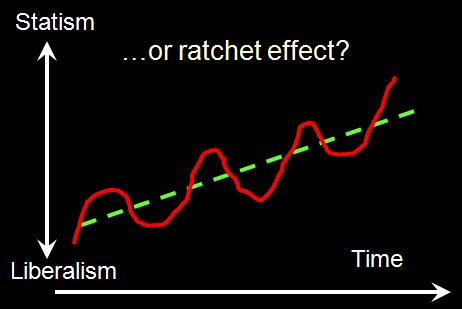
Does the current expansion of the State reverse a previous reduction, to be reduced once again in the future? Or, alternatively, is there a sort of ratchet effect, with a trend towards greater statism disguised by cycles along such increasing trend?
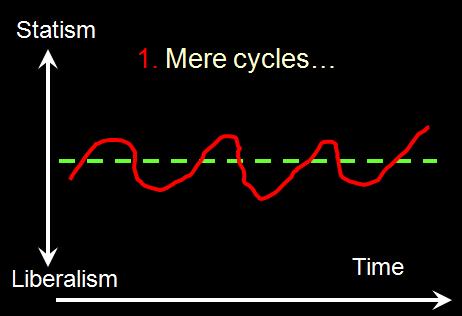 I am inclined to think that cycling has not taken place around a stationary average but around an increasing tendency (see the figures). But perhaps a better way of facing these questions would be to disaggregate in different dimensions. For instance, in several papers with Veneta Andonova we argue that freedom
  of contract has been in decline for more than a century in Western Law, both in civil- and common-law countries. Something similar could probably be said about trade, but in the opposite direction. However, in both freedom of contract and trade, it might be the case that exchange opportunities have expanded mainly as a result of technological change (e.g., cheaper transportation and communications), whatever the legal constraints. In terms of research, how could these trends be measured?
These thoughts were triggered by a timely and extremely suggestive paper by Witold J. Henisz presented at the Workshop on “Manufacturing Markets” organized last week in Villa Finaly, Florence, by Eric Brousseau and Jean-Michel Glachant. My next few blogs will address other aspects of Henisz’s views on the broader challenges facing capitalism.
Peter L. Bernstein (1919-2009)
| Peter Klein |
I was saddened to learn (from Kenneth Anderson) that Peter L. Bernstein, author of Against the Gods: The Remarkable Story of Risk and other popular works, died June 5. Bernstein was a terrific writer and a clear and provocative thinker with a gift for making difficult concepts accessible. I was greatly influenced by an earlier book, Capital Ideas: The Improbable Origins of Modern Wall Street, which I came across in graduate school while searching for a dissertation topic. Bertstein’s characterization of the brokerage industry in the 1960s and early 1970s, before the deregulation of brokerage fees — an Old Boys Club, lacking competition and innovation — inspired me to examine the role of corporate internal capital markets in replicating the resource-allocation function normally performed by external capital markets, and how the growth and development of financial markets following liberalization contributed to the end of the conglomerate period.
Here are obituaries in the WSJ and NYT and here is Bernstein’s wiki.
The Industrious Revolution
| Peter Klein |
Hans-Joachim Voth calls Jan de Vries’s new book on household behavior during the early modern period “staggeringly erudite, insightful, stimulating, and on all the main points, convincing.” The book, The Industrious Revolution: Consumer Behavior and the Household Economy, 1650 to the Present (Cambridge, 2008) builds on de Vries’s earlier concept of an Industrious Revolution, the two centuries before the Industrial Revolution in which consumers increased their production of marketable goods, largely at the expense of leisure time. “The industrious revolution was a household-level change with important demand-side features that preceded the Industrial Revolution, a supply-side phenomenon” (De Vries, 1994). Adds Voth:
The sheer amount of hard work that went into every aspect of these chapters is hard to convey. Surveying the rise of consumer items through the prism of probate inventories shows the author confidently mastering the abundant historical literature in four or five languages. De Vries’ reconstruction of Europeans’ increasing consumption of “colonial luxuries” — sugar, tea, and coffee — alone is going to be useful for all scholars working in the area.
This book may be of interest not only to economic and business historians, but also to management scholars in marketing and consumer behavior.
Ferguson on Financial History and the Crash
| Dick Langlois |
I too loved the Ferguson piece in the New York Times. More sound bites: “In the months ahead,” he predicts, “the world will reverberate to the sound of stable doors being shut long after the horses have bolted, and history suggests that many of the new measures will do more harm than good. The classic example is the legislation passed during the British South-Sea Bubble to restrict the formation of joint-stock companies. The so-called Bubble Act of 1720 remained a needless handicap on the British economy for more than a century.”
Deregulation and the Financial Crisis
| Peter Klein |
Niall Ferguson joins Charles Calomiris, Jerry O’Driscoll, Arnold Kling, and many others in questioning the supposed link between “deregulation” and the financial crisis. As Ferguson emphasizes, the timing is all wrong; there is no time-series correlation between specific patterns of regulation and deregulation and particular financial or economic outcomes. The relaxation of Glass-Steagall restrictions on universal banking is an oft-cited example, but, as these writers point out, no one has offered any specific mechanism by which universal banking contributed to the problem (indeed, the opposite is likely to be true). The “laissez-faire caused the crisis” meme may be pithy, but is there any systematic theoretical or empirical evidence for it?
Ferguson has the best line (suggested by Luke): “It is indeed impressive how rapidly the economists who failed to predict this crisis . . . have been able to produce such a satisfying story about its origins.”
My “No New Economy” Slides
| Peter Klein |
Here, for the curious, are my slides from this morning’s talk at the Law and Economics of Innovation conference, titled “Does the New Economy Need a New Economics?” (Short answer: no.) This will eventually morph into a paper so comments are most welcome (and thanks to those who have already helped). I’m looking forward to Susan Athey’s keynote later today.
Cheer Up With the Depression Bundle
| Peter Klein |
 Sorry, couldn’t resist the headline. But check it out: Murray Rothbard’s America’s Great Depression, Bob Murphy’s Politically Incorrect Guide to the Great Depression and the New Deal, Dave Beito’s Taxpayers in Revolt, and John T. Flynn’s Roosevelt Myth, all for $49! That’s quite an uplifting deal.
More great news: Contra Keynes and Cambridge, vol. 9 of Hayek’s Collected Works, is now out in paperback from Liberty Fund, and just $14.50.
Open Innovation: Not So New
| Peter Klein |
The new issue of the always-interesting Industrial and Corporate Change features a paper by the always-interesting David Mowery, “Plus Ca Change: Industrial R&D in the Third Industrial Revolution.” Picking up this blog’s theme that Very Little Is New Under the Sun (OK, not explicitly), Mowery argues that the much-touted New Econonmy concept of “open innovation” is not, in fact, completely new, but an incremental change from previous R&D practices:
The structure of industrial R&D has undergone considerable change since 1985, particularly in the United States. But rather than creating an entirely novel system, this restructuring has revived important elements of the industrial research system of the United States in the late 19th and early 20th centuries. In particular, many of the elements of the Open Innovation approach to R&D management are visible in this earlier period. This article surveys the development of industrial R&D in the United States during the postwar period. In addition to emphasizing continuity rather than discontinuity, this discussion of the development of US industrial R&D during the Third Industrial Revolution stresses the extent to which industrial R&D in the United States, no less than in other nations, is embedded in a broader institutional context. My discussion also highlights the extent to which its development has been characterized by considerable path dependency.
New Online Books
| Peter Klein |
Thanks to the Mises Institute, the Institute of Economic Affairs, the Library of Economics and Liberty, and other organizations, great works in social science continue to appear in free online editions. Some of the newest include:
- Carl Menger’s Investigations into the Method of the Social Sciences (1883), which features the famous section (book 3, chapter 2) on unintended consequences;
- Larry White’s Free Banking in Britain (1984); and
- Hayek’s Individualism and Economic Order (1948), which contains the classic essays “Economics and Knowledge,” “The Use of Knowledge in Society,” and “The Meaning of Competition,” among others.
Dutch Treat
 | Peter Klein |
There’s only two things I hate in this world. People who are intolerant of other people’s cultures, and the Dutch. — Nigel Powers
Karel Davids’s new book, The Rise and Decline of Dutch Technological Leadership: Technology, Economy, and Culture in the Netherlands, 1350–1800 (Brill, 2008), provides an interesting look at knowledge flows within and between regions, an important idea in the modern literatures on economic geography and regional innovation. Writes EH.Net reviewer William TeBrake:
According to Davids, the northern Netherlands, the territory encompassed by the Dutch Republic, was the technological leader during much of the seventeenth and eighteenth centuries, before relinquishing that role to England by 1800, and in the process of explicating the rise and fall of Dutch technological leadership, he has called into question a number of commonplace assumptions found in the historiography of the period in question. . . .
One of the most interesting features of his study is the attention he pays to the truly remarkable concentration during the seventeenth and eighteenth centuries of literally hundreds of industries powered by windmills in the Zaan district, just across the IJ/harbor from Amsterdam, forcing the reader to reconsider how revolutionary the English Industrial Revolution really was. Further, there are several important areas in which he has significantly revised current understanding of the course of technology, economy, and society during the late-medieval and early-modern periods. . . . [For example], Davids makes clear that technological leadership in the Dutch Republic was much less tied to economic advancement than is usually assumed. Indeed, the Republic’s technological leadership began to peak only when the economy of the Dutch Republic already had begun to decline, during the late seventeenth century, and such leadership continued for another century thereafter, before giving way to England only after 1780. Finally, Davids makes a compelling case for locating the causes of technological leadership (and its decline) not only in market forces but also in institutional and cultural conditions, including the relative openness or secrecy of economic, cultural, and political life.
Railway Gauges and Path Dependency
| Dick Langlois |
 You’ve all read the viral email asserting that the railroad gauge we have today — and, in some versions, the size of the space shuttle fuel tanks, which had to be transported by rail — is a direct result of the wheel gauge of Roman chariots. Not surprisingly, the real story is more complex, and many gauges coexisted (and to some extent continue to coexist) in the U.S. and around the world. My former colleague Doug Puffert tells this story in full detail in his new book, Tracks across Continents, which has just appeared from the University of Chicago Press. The book is a useful addition to the catalog of case studies of path-dependent technology.
The book came out of Doug’s thesis at Stanford, where he worked with Paul David and Brian Arthur. He was a visitor at UConn in the 1988-89 academic year. I can still remember his seminar presentations, which involved simulating the evolution of railways on a Macintosh of the era. (One thing you probably won’t learn in Doug’s official bio is that, before coming to UConn, he won a car on Wheel of Fortune. I always tell students about this when I teach the QWERTY story — a student of Paul David who really knew his letter frequencies.)
Watching the Growth of Walmart
| Peter Klein |
This animated map showing the US growth of Walmart from 1965 to 2007 proves the adage that a picture is worth a thousand words. Lots of other cool visualizations at FlowingData, like the Heavy Metal Band Names Flowchart. (Thanks to SKK.)
Blue Eagle Redux
| Peter Klein |
 Assuming this is not a joke, Obama has unveiled a new stimulus-plan logo. Projects funded by the American Recovery and Reinvestment Act — primarily roads and bridges, I presume — will sport this handsome emblem. It lacks the 1930s-era fascist style of the NRA’s Blue Eagle but is much in the same spirit. Will those who maintain these roads and bridges be fined for failing to display the logo? (Business owners without a Blue Eagle could be fined up to $500 — more than $8,000 in today’s dollars — and get six months in jail.) Will consumers be encouraged to bycott those without the colorful insignia?

 Jason Taylor and I have written that the Blue Eagle may be more important than economic historians have realized. In the early days of the NRA it seems to have played a strong cartel-enforcement role. Eventually business owners and consumers learned that NRA officials were not punishing cartel violations and the Blue Eagle began to disappear from store windows and newspaper advertisements. Our analysis is game-theoretic, but I’m sure our friends from that other discipline would proffer a different explanation based on institutional legitimacy and that stuff.
More on the Evolution of Accounting
| Peter Klein |
For some reason posts dealing with accounting are among our most popular. Perhaps this says something about the Nerd Quotient of the typical O&M reader. Anyway, if you liked the recent post about the evolution of accounting rules, you may enjoy this paper that looks at the problem more systematically.
Accounting is an Evolved Economic Institution
Gregory B. Waymire and Sudipta Basu
We consider accounting from an evolutionary perspective. Accounting encompasses the creation of transactional records, the summarization of records in t-accounts, and the preparation of audited financial statements. Accounting’s history spans at least 10,000 years dating back to the first human settlements in ancient Mesopotamia. Our focus is on the study of accounting history in three ways: providing useful thoughts experiments valuable to researchers interested in the development of modern practices, the use of historical data to test formal hypotheses about the origins of accounting practices, and the development of theories and related empirical evidence that explain accounting based on evolution and ecological rationality. Within this third area, we describe the basis for hypotheses and empirical analyses concerning six issues: (1) the emergence of recordkeeping, (2) the effect of double-entry bookkeeping on the scale and scope of economic organization, (3) the spontaneous emergence of norms of practice in accounting, (4) the impact of law, regulation, and taxation on accounting, (5) the demand for broad principles in evaluating accounting method choices, and (6) the relation between economic crises and major discontinuities in accounting practice.
Patent Pools and Innovation
| Dick Langlois |
In a (fairly) recent paper, which may soon see the light of day in volume from Cambridge University Press, I argued against Alfred Chandler’s analysis of RCA and the early American consumer electronics industry. In Inventing the Electronic Century (2001) Chandler holds that, by creating capabilities (notably central R&D capabilities), RCA was the fountainhead of innovation in that industry, at least until after World War II. I argue instead that, as a government-created patent pool, RCA in fact retarded innovation in what was actually a fairly modular industry. Recently, I came across a paper by two economists from Stanford called “Do Patent Pools Encourage Innovation? Evidence from the 19th-Century Sewing Machine Industry.” They provide quantitative evidence that an earlier patent pool (also) retarded innovation. Here is the abstract:
Regulators favor patent pools to encourage innovation in industries where overlapping patents and excessive litigation suppress innovation. With patent pools, member firms share patents freely with each other and offer one-stop licenses to outside firms. Thus patent pools are expected to promote innovation by reducing litigation risks for pool members and lowering transaction costs for outside firms. We examine this prediction at the example of the first patent pool in U.S. history, the Sewing Machine Combination (1856-1877). Our data confirm that pools reduce litigation risks for members and that pool members patent more in the years leading up to the pool. Pool members, however, patent less as soon as the pool is established and only resume patenting after the pool dissolves. We construct objective measures of performance to examine whether such changes reflect changes in strategic patenting or actual effects on innovation. Performance data suggest that innovation slowed as soon as the pool had been established and resumed only after the pool had been dissolved. Why might patent pools discourage innovation? Our data indicate that pools may discourage innovation by increasing litigation risks for outside firms and by diverting research by outside firms to inferior technologies.
This last point also held true in the case of RCA: as RCA controlled all of the key patents for the radio and licensed them only en bloc, there was no incentive for outsiders to create new products that would compete with only one or two of RCA’s technologies.
Viral Marketing
| Peter Klein |
My friend Tom Woods has written a new book, Meltdown, that explains the economic crisis from an “Austrian” perspective. Tom is a historian by training but has an excellent grasp of economic theory and policy (disclaimer: I consulted on the book). The book is aimed at the intelligent lay reader and was produced very quickly (Tom writes faster than I read) to take advantage of today’s unique educational moment. The book went on sale today.
Tom is promoting the book via the usual means (scholarly and popular websites and blogs, email lists, some TV and radio appearances) and some of his admirers have launched a viral marketing campaign, based at GetTomonTV.com. Can viral marketing work to promote a quasi-academic book? Will policy wonks, economic journalists, and concerned citizens blog, text, and twitter like Blair Witch groupies or Christian Bale fans? How does one promote books (and, for that matter, journal articles) in the Web 2.0 world? Most important, how do I use this knowledge to promote myself?
Symposium on Alfred Chandler
| Dick Langlois |
I just discovered that Business History Review published a special issue this summer in memory of Alfred Chandler. The papers are mostly short, hagiographic, and written by relatively big names — all as it should be. Tom McCraw mentions one detail I had never known: Chandler was dyslexic.





 Organizations and Markets
Recent Comments