Posts filed under ‘Classical Liberalism’
The Capitalist Kibbutz
| Peter Klein|
That’s how the Financial Times headlines this fascinating story about the transformation of many Israeli kibbutzim into partially privatized, profit-seeking, professionally managed entities that act in capital, product, and factor markets just like private firms. There are some similarities with the end of the socialist experiment in Russia: “‘The kibbutz was never isolated from society,’ says Shlomo Getz, the director of the Institute for Research of the Kibbutz at Haifa University. ‘There was a change in values in Israel, and a change in the standard of living. Many kibbutzniks now wanted to have the same things as their friends outside the kibbutz.”
The bottom line, from economist and former kibbutznik Omer Moav: “People respond to incentives. We are happy to work hard for our own quality of life, we like our independence. It is all about human nature — and a socialist system like the kibbutz does not fit human nature.” (Via BK Marcus.)
Happy Schumpeter Day
| Peter Klein |
Today’s the birthday of Joesph A. Schumpeter, one of the great theorists — and one of the great characters — in the history of economics. To celebrate, how about remembering some of the classic Schumpeter quotes:
“[Competitive] behavior . . . is the result of a piece of past history and . . . as an attempt by those firms to keep on their feet, on ground that is slipping away from under them.”
“The process of Creative Destruction is the essential fact about capitalism … it is not [price] competition which counts but the competition from . . . new technology . . . competition which strikes not at the margins of profits . . . of existing firms but at their foundations and their very lives.”
“Intellectuals are people who wield the power of the spoken and written word, and one of the touches that distinguishes them from other people who do the same is the absence of direct responsibility for practical affairs . . . .The critical attitude [arises] no less from the intellectual’s situation as an onlooker — in most cases, also an outsider — than from the fact that his main chance of asserting himself lies in his actual or potential nuisance value.”
“[C]apitalism, while economically stable, creates a mentality and a style of life incompatible with its own fundamental conditions. [It] will be changed, although not by economic necessity and probably even at some sacrifice of economic welfare, into an order of things which it will be merely a matter of taste and terminology to call Socialism or not.”
Update: Walter Grinder reminds me that it’s also Julian Simon’s birthday. Here’s a nice tribute from Steven Moore.
Brad’s Bloviations, Part #2,235
| Peter Klein |
Brad DeLong accuses non-Keynesians (Austrians, Chicagoites, and other sensible people) of “los[ing] themselves amidst their early-nineteenth century books, one hundred and seventy years behind the state of the art in economics,” just because they think public spending and deficits might be crowding out private-market activity, making it difficult — impossible, actually — to come up with meaningful estimates of “jobs saved” by stimulus spending. If you can get past Brad’s adolescent writing style (anyone citing Bastiat, for example, is “a truly clueless idiot”), you find that he is indeed very “progressive” in his thinking — he’s made it all the way to 1950. Brad, like most Keynesians, is stuck in the C + I + G world of undergraduate macro. His argument is that the stimulus can’t be crowding out private-sector jobs because (a) wages aren’t rising (implying that stimulus-funded workers aren’t being bid away from other potential opportunities) and (b) T-bill prices aren’t falling (suggesting that private employers aren’t competing with the Feds for credit).
Leave aside for the moment that Brad has no idea what wages and bond prices would be in the absence of stimulus. The key problem with Brad’s argument, noted by Russ Roberts, is its reliance on crude macroeconomic aggregates. As pointed out here many times, heterogeneity matters. Sensible economists care not about the aggregate unemployment rate, but the effect of stimulus activity on individual labor markets. Stimulus affects the composition of employment, not just its level. (more…)
Stuck on the Methodological Hamster Wheel
| Craig Pirrong |
I’ve read John Cassidy’s New Yorker article (not available online) in which he described his journey to the freshwater provinces in his attempt to see whether the financial crisis had caused Chicago economists to reject their reactionary views. (With one exception, the answer is blessedly “no.”) I’ve also read his paean to Pigou in the WSJ. So I pretty much knew what to expect when I picked up his How Markets Fail. Let’s say I wasn’t disappointed, in the sense that my very low expectations were met.
The book is a very conventional, Stiglitz-esque critique of market economics and those who defend markets. The latter are always described with Homer-esque modifiers, just so you’ll know that they [we!] are retrograde knuckle draggers. (more…)
Interview with a Randian CEO
| Peter Klein |
Today is Ayn Rand’s birthday, so in her honor we direct you to the December 2009 issue of Academy of Management Learning and Executive, which features an interview with BB&T Bank CEO John Allison, a follower of Rand. Access appears to be restricted to AoM members (manuscript version here, published version here). Sample:
After I went to work I began to read philosophy, in search for the answers to the big questions of life. I became interested in what I consider to be the great reason/reality based philosophers — Aristotle, Thomas Aquinas, John Locke, Thomas Jefferson and Ayn Rand.
That philosophical background combined with my own observations, which I call my inductions from life, together with my family upbringing, formed my philosophical framework as a young adult and executive. In 1993 or 1994 I read Objectivism: The Philosophy of Ayn Rand by Leonard Peikoff. This book really integrated everything for me. It enabled me to focus my thinking. By this time, I had been CEO of BB&T for a few years and we were in the midst of a merger of equals. It was very important that we have a clearly defined value system. Two large organizations with cultures that had some differences had to come together with a single value system. Peikoff’s book put everything together for me. We had some of the basics of a value system — honesty, integrity, traditional conservative business values, but we also held a number of contradictions. What Rand’s philosophy did for me was to provide a framework for how to integrate all the disparate pieces. I could see everything in a different way than I had seen before. Rand’s philosophy provided an ordering. It also clarified concepts. For example, people often mix up justice with mercy. From Rand I learned that justice requires that you reward those who contribute the most with the most, which implied that paternalism is unjust; failing to deal with non-performance is unjust. Also, rationality is the foundation for values, and rationality can not be compromised.
NB: BB&T has funded a number of professorships in the last few years.
Paging John Stuart Mill
| Dick Langlois |
I have been amused by the firestorm of outrage in the press over the Supreme Court’s recent mild affirmation of the free-speech rights of corporations. As many readers of this blog will probably appreciate, the point of a right to free speech is that it must apply even to speech, and to speakers, we don’t like. Many if not most angry commentators, like the writers of the Times editorial on the subject, don’t even bother to worry about the nature of rights. To the Times and many others, constitutional jurisprudence is a purely consequentialist exercise no different from legislation (which, sadly, may be often be true in practice). But other writers and organizations aghast at the Court’s decision have a thorny problem of argument, to the extent that they have themselves invoked the First Amendment in an effort to protect speech of which they approve (or, more generally, to protect specific sub-spheres of discourse in which they themselves participate). A case in point is People for the American Way, which has called for a constitutional amendment to outlaw corporate political speech (via William Saletan). “People For the American Way,” they write, “has been at the forefront of defense of free speech and the First Amendment for almost 30 years. We continue in that role today.” In order to square the circle, PFAM and like-minded pundits and Justices have to find a way to define corporate speech as not speech. The answer? Spending is not speech and corporations aren’t people. So: does this mean that it would be OK under this logic for the government, say, to decree that the New York Times must limit its editorial budget — limiting dollars not ideas, after all — because the Times is a corporation not an individual? Why should this logic not apply to the other Amendments as well? The Times should flat-out not have freedom of the press because it is a corporation; and the Roman Catholic Church should certainly not have freedom of religion.
My favorite line, from Justice Stevens (in dissent): “The Court’s blinkered and aphoristic approach to the First Amendment may well promote corporate power at the cost of the individual and collective self-expression the Amendment was meant to serve.” So freedom of speech is really a neoclassical or Benthamite exercise in which we aren’t trying to protect individual (let alone corporate) speech but are instead trying to maximize the total amount of self-expression in society.
In its recent obituary of Erich Segal, the Times cites the following cringe-inducing line, spoken by college-student protagonist Oliver Barrett IV, as a measure of the literary caliber of Segal’s novel Love Story: “Jenny, for Christ’s sake, how can I read John Stuart Mill when every single second I’m dying to make love to you?” This suggests that many a Justice, editorial writer, and pundit must have fallen prey to similar distractions in college. They certainly failed to read John Stuart Mill.
Endogenous Indoctrination
| Dick Langlois |
I have been wanting for some time to write about an interesting paper by Gilles St. Paul called “Endogenous Indoctrination.” (I wasn’t familiar with his work, but he seems to do interesting things, including this.) Here’s the abstract:
Much of the political economy analysis of reform focuses on the conflict of interest between groups that stand to gain or lose from the competing policy proposals. In reality, there is also a lot of disagreement about the working of the policy: in addition to conflicting interests, conflicting views play an important role. Those views are shaped in part by an educational bureaucracy. It is documented that the beliefs of that bureaucracy differ substantially from those of the broader constituency. I analyse a model where this effect originates in the self-selection of workers in the educational occupation, and is partly reinforced by the insulation of the educational profession from the real economy (an effect which had been discussed by Hayek). The bias makes it harder for the population to learn the true parameters of the economy if these are favourable to the market economy. Two parameters that govern this capacity to learn are social entropy and heritability. Social entropy defines how predictable one’s occupation is as a function of one’s beliefs. Heritability is the weight of the family’s beliefs in the determination of the priors of a new generation. Both heritability and social entropy reduce the bias and makes it easier to learn that the market economy is “good,” under the assumption that it is. Finally I argue that the capacity to learn from experience is itself affected by economic institutions. A society which does not trust markets is more likely to favour labour market rigidities that in turn reduces the exposure of individuals to the market economy, and thus their ability to learn from experience. This in turn reinforces the weight of the educational system in the formation of beliefs, thus validating the initial presumption against the market economy. This sustains an equilibrium where beliefs and institutions reinforce each other in slowing or preventing people from learning the correct underlying parameters.
I was catalyzed to write today because of a related article I recently saw in the Times, which enthuses giddily about a paper called “Why Are Professors Liberal?” by two sociologists called Fosse [N. B. not Foss] and Gross. The Times lauds the paper for its sophistication and use of the quantitative. (more…)
Josh Lerner on Public Policy Toward Entrepreneurship
| Peter Klein |
Speaking of public entrepreneurship, here’s an interview with Josh Lerner about his new book Boulevard of Broken Dreams: Why Public Efforts to Boost Entrepreneurship and Venture Capital Have Failed — and What to Do About It (Princeton, 2009). Excerpt:
There are two well-documented problems that can derail government programs to boost new venture activity. First, they can simply get it wrong: allocating funds and support in an inept or, even worse, a counterproductive manner. Decisions that seem plausible within the halls of a legislative body or a government bureaucracy can be wildly at odds with what entrepreneurs and their backers really need. . . .
Economists have also focused on a second problem, delineated in the theory of regulatory capture. These writings suggest that private and public sector entities will organize to capture direct and indirect subsidies that the public sector hands out. For instance, programs geared toward boosting nascent entrepreneurs may instead end up boosting cronies of the nation’s rulers or legislators. The annals of government venturing programs abound with examples of efforts that have been hijacked in such a manner.
Thanks to Ross Emmett for the tip.
Recession and Recovery: Six Fundamental Errors of the Current Orthodoxy
| Peter Klein |
A very good summary by Bob Higgs of “vulgar Keynesianism,” defined by Bob as the “pseudointellectual mishmash . . . that has passed for economic wisdom in this country for more than fifty years.” The key feature of VK is an emphasis on crude aggregates (“national income,” “the employment rate,” “the interest rate,” etc.) at the expense of relative prices, firm and industry effects, and cause and effect. Echoing one of this blog’s favorite themes, Bob highlights the VK economist’s inability to grasp the concept of capital structure, “the fine-grained patterns of specialization and interrelation among the countless specific forms of capital goods in which past saving and investment have become embodied. In [the VK] framework of analysis, it matters not whether firms invest in new telephones or new hydroelectric dams: capital is capital is capital.”
Update: See also David Henderson on aggregation.
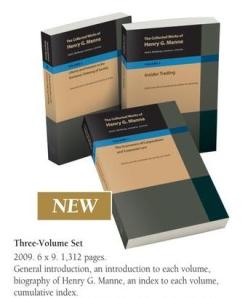
The Collected Works of Henry Manne
 | Peter Klein |
Via Geoff Manne, a description and ordering information for the new Collected Works of Henry Manne, produced by Liberty Fund. A great collection of scholarly articles, reviews, and shorter popular pieces divided into three volumes, “The Economics of Corporations and Corporate Law,” “Insider Trading,” and “Liberty and Freedom in the Economic Ordering of Society.” Order your copy today!
The Age of Constructivism
| Craig Pirrong |
I am reading Vernon Smith’s Rationality in Economics. I highly, highly recommend it. Largely a homage to Hayek, it explores the implications of Hayek’s distinction between constructivist rationality and what Smith relabels ecological rationality. It contains a wealth of methodological and substantive insights. Smith is knowledgeable and thoughtful. He is almost John Stuart Mill-like in his even handed and fair characterizations of competing views, even those he disagrees with. He integrates experimental economics, game theory, institutional economics, neoclassical economics, neurology, and much, much more.
What fascinates Smith is the ineffable process by which an ecologically rational order emerges from the actions of myriad imperfectly informed and incompletely rational (in the constructivist sense) individuals. This process — a sort of economic transubstantiation — is the most fascinating economic mystery. It is also, alas, one that has received far too little attention from economists whose formal tools permit them to analyze (constructively) equilibrium, but which are virtually powerless to analyze the process of getting there; the proverbial drunks looking for their keys under the lamppost.
We live in an era of constructivism regnant. In health care and finance, especially, constructivist schemes will reshape for better or worse — and almost certainly worse — vast swathes of the American economy. What’s more troubling still, this is constructivism refracted through the flawed lens of politics and public choice. Appreciation of the emergent order, the ecologically rational, is sadly rare. Vernon Smith appreciates it, deeply, with an almost religious sense of awe. Read his book and you will appreciate it too.
Ironies of Avatar
| Peter Klein |
I took the kids to see Avatar this weekend. From a technical standpoint, Jim Cameron’s film is remarkable, a breakthrough, as good as advertised. The alien world Pandora is stunningly realistic, detailed, convincing. The computer-generated characters look and move like real actors. The battle scenes are phenomenal.
But the storyline didn’t grab me. It’s a twist on that familiar Hollywood trope: evil, materialist, capitalist, militarist humans versus nature-loving, low-carbon-footprint, New Agey savages so noble they would have made Rousseau blush. The computer-generated landscapes are dazzlingly three-dimensional, but the characters, both human and alien, are cartoonish and one-dimensional (especially the Head Evil Capitalist, played here by Giovanni Ribisi, essentially reprising Paul Riser’s role from Cameron’s Aliens). The Pandorans are in their own way as clichéd as Peter Jackson’s much-derided Skull Islanders. I appreciate the film’s antiwar, anti-imperialist message, but really, the Earth First! propaganda is way, way over the top. And consider these ironies:
1. Avatar was written and directed by bazillionaire businessman Jim Cameron, is produced and distributed by giant corporation 20th-Century Fox, and will likely gross hundreds of million dollars. Naturally the film’s villain is — you guessed it — a giant corporation! Because, you know, businesspeople and money and corporations are evil and stuff.
2. The film was made possible by Cameron’s highly innovative, beyond-the-state-of-the-art, years-in-the-making technological innovations. Yet one of the film’s main themes is the evils of technology and capital accumulation and the beauty of live-for-today, pre-industrial society. The Pandorans literally worship their planet and don’t just hug their animals and tress, they physically bond with them through some mystical (and anatomically curious) process. The poor humans, one of the characters explains, have destroyed their own “Mother.” Blech.
Update: Peter Suderman beat me to it, calling Avatar
one of the stupidest major movies in recently memory, blithely peddling a message that its entire production process actually undermines. That Avatar’s melodramatic attacks on corporate interests and its defense of simple, natural living come packaged as one of the most expensive, and probably the most technically advanced, corporate films in history would seem to indicate that only quality bigger than the movie’s stupidity is its head-in-the-clouds hypocrisy. Cameron’s made a movie that he intends to be epic and awesome, but the only thing that’s awesome here is his total lack of self-awareness.
Stephan Kinsella sees a libertarian defense of property rights, and so do I, but for me that message was buried beneath the eco-propaganda. Had the earthlings homesteaded some piece of unoccupied Pandoran land, put it to productive use, and then the natives decided they needed the land or that its economic value belonged to “Mother Pandora,” is there any doubt what side Cameron would be on?
Robert Sugden
| Nicolai Foss |
I have become a huge fan of Robert Sugden, an economics Professor at the University of East Anglia and one of the most cited UK economists. Readers of this blog may know Sugden’s work from, for example, his excellent 1986 book, The Economics of Rights, Co-operation, and Welfare, as well as his papers on spontaneous order (e.g., here or here). Much of Sugden’s research lies in the zone of overlap between game theory (mainly experimental game theory and coordination games) and moral and political philosophy, and he is engaged in a constant dialogue with scholars in, or associated with, the classical-liberal tradition, such as Hume, Mill, and Hayek. He is the rare economist who, like Frank Knight, manages to publish in American Economic Review as well as in Ethics.
I am reading through Sugden’s recent publications and recommend the following as being of particular interest to the O&M readership:
- “Can Economics Be Founded on “Indisputable Facts of Experience”? Lionel Robbins and the Pioneers of Neoclassical Economics” — An attack on Robbins’ Essay that may also challenge followers of praxeology.
- “Fraternity: Why the Market Need Not Be a Morally Free Zone“(with Luigino Bruni) — Drawing on the work of a contemporary of Adam Smith, Antonio Genovesi, Sugden and Bruni criticize the idea (reflected in, e.g., Williamson’s distinction between “trust as calculative risk” and “trust proper”) that one can make a distinction between market relationships and genuinely social relationships. Market relationships also have elements of joint intentions for mutual assistance.
- The basis for the latter point can be found in “The Logic of Team Reasoning” which is a case for placing agency at the level of teams, specifically those teams that make use of team reasoning. The basic idea is that when team members reason in this way, they consider which combinations of actions will best promote the team objectives, and choose actions accordingly.
- If the above sounds at variance with classical liberalism (which I don’t think it necessarily is), check out Sugden’s criticism of Thaler and Sunstein (here) or his various critical discussions of the notion of “opportunity” in welfare economics (Sen, Cohen, Roemer) (e.g., here) which are all in the mainstream of classical-liberal thought.
Boeing and the Higgs Effect
| Peter Klein |
In their calls for greatly expanding the Federal Reserve System’s and Treasury Department’s roles in the economy, Chairman Bernanke, Secretaries Paulson and Geithner, and their academic enablers have repeatedly emphasized the temporary nature of these “emergency” measures. “History is full of examples in which the policy responses to financial crises have been slow and inadequate, often resulting ultimately in greater economic damage and increased fiscal costs. In this episode, by contrast, policymakers in the United States and around the globe responded with speed and force to arrest a rapidly deteriorating and dangerous situation,” said Bernanke in September. Yeah, no kidding. But, we are assured, the basic structure of our “free-enterprise” system remains soundly in place.
 However, as Bob Higgs has taught us, “temporary,” “emergency” government measures are never that. Indeed, virtually all the major, permanent expansions of US government in the twentieth-century resulted from supposedly temporary measures adapted during war, recession, or some other “crisis,” real or imaginary. Cousin Naomi’s “disaster capitalism” thesis is exactly backward: it is socialism, or interventionism, that thrives during the crisis, and Washington, DC never looks back. I mean, does anyone seriously believe that the Fed will deny, or give back, the authority to purchase whatever financial assets it wishes at some future date when it deems the crisis officially “over”? Will the Treasury credibly commit never again to purchase equity or guarantee debt or otherwise protect some major industrial or financial firm after the economy returns to “normal”? Not a chance. Everything the authorities have done in the last two years to deal with this “emergency” will become part of the federal government’s permanent tool kit.
Today’s WSJ has a good example of Higgs’s ratchet effect, a front-pager on Boeing’s dependence on export loan guarantees from the Export-Import Bank, a federal government agency created in — you guessed it — 1934, as a temporary agency to deal with the Great Depression. “No company has deeper relations with Ex-Im Bank than Chicago-based Boeing. Without Ex-Im, aviation officials say, Boeing this year could have been forced to slash production, endangering hundreds of U.S. suppliers, thousands of skilled American jobs and billions of dollars in export contracts.” Bank official Bob Morin is described as “Ex-Im Bank’s rainmaker. His Boeing deals accounted for almost 40% of the bank’s $21 billion in business last year. To help Boeing through the credit crunch, his team has spent the past year developing government-backed bonds that promise to raise billions.” So, a massive industrial-planning apparatus, supposedly born during a temporary crisis, lives on as the lifeblood of a huge, politically connected US company.
Thank goodness all that money flowing to Goldman Sachs is only temporary!
Update: Here’s a short Higgs piece from 2000 on the Ex-Im Bank, appropriately titled “Unmitigated Mercantilism.”
War, Taxes, and Doux Commerce
| Dick Langlois |
Uwe Reinhardt, a health economist at Princeton, is eminently familiar with the idea of moral hazard. In a recent blog in the New York Times, he applies the idea to war. “If the monetary and the blood cost of war are shifted mainly to citizens other than the elites who are empowered to declare war and decide how it is conducted,” he writes, “then that elite is more likely to embrace war and to spend on it.” (I’m sure others have said this before, though I’ll rely on my colleagues and readers to supply the cites. Bob Higgs?) Reinhardt points out that, rather than raise taxes to pay for war, Bush cut taxes after entering Afghanistan. This had the effect of hiding the cost and pushing the financing into deficit spending, which is less easy for voters to detect. Those of us of a certain age remember how Lyndon Johnson, with the acquiescence of the Fed, financed Vietnam (and his domestic programs) largely through inflation. Apparently, some in Congress are calling for a law that would require a tax surcharge whenever war is declared.
As I say, these ideas may already be familiar to O&M readers and may even have been touched on in previous posts. But the Reinhardt piece reminded me of an idea I’ve been playing with for a long time. There is a large literature on the doux commerce thesis (see especially Albert Hirschman): the idea that increasing trade and wealth (increasing capitalism, if you will) leads to less violent and warlike societies. Oversimplifying more than a bit, the idea is that increased wealth increases the opportunity cost of war and violence. Maybe this is already in Hirschman or elsewhere, but it seems to me, however, that there must be not just a substitution effect but also an income effect. Higher GDP increases the opportunity cost of war on average (even if, as Reinhardt points out, not necessarily for the elites). At the same time, however, a wealthier society is more able to buy more war, all other things equal. Someone with the wherewithal might try to see which effect is more important by using cross-country historical data sets in the Acemoglu-Johnson-Robinson vein. If you ever run into somebody doing that sort of thing, remember that you heard it here first.
Nirvana Fallacy Alert, #2,535 in a Series
| Peter Klein |
Another mistake in John Cassidy’s ditty on externalities is the claim that Pigou “was reacting against laissez faire — the hands-off approach to policy that free market economists, from Adam Smith onwards, had recommended. Such thinkers had tended to view the market economy as a perfectly balanced, self-regulating machine.” Forget that the British Classicals, Adam Smith in particular, were far from “hands-off” types. Note instead that Cassidy provides no textual evidence of unnamed “free-market economists” viewing the market system as a “perfectly balanced, self-regulating machine.” How could he, when no sensible economist ever wrote or thought such a thing? The free-market economists — actually, virtually all sound economists — have maintained that the market economy works remarkably well, given the limits of human knowledge, our devious character, the brutality of nature, and so on. Paris gets fed, as Bastiat noted, and that is a miracle. Government intervention into markets inevitably makes things worse, the economists argued, not because the market system is “perfect,” whatever that means, but because men are fallible, and giving coercive power to fallible men is — to borrow P. J. O’Rourke’s metaphor — like giving whiskey and car keys to teenage boys. Cassidy’s caricature shows how little he understands what free-market economics is actually all about.
The Fate of Famous Economists
| Peter Klein |
 Even very famous ones. The Dundee Courier (what, you don’t read it?) reports that Adam Smith’s gravestone, in the courtyard of Canongate Kirk in Edinburgh, is in bad shape: “Smith’s gravestone could be in danger of deterioration after years of exposure to the elements, vandalism and neglect” (HT: MGK). According to a spokesperson for the World Monument Fund, cemeteries in the central parts of cities like Edinburgh have become “unsafe environment[s] home to illicit activities.” Apparently David Hume’s grave, elsewhere in Edinburgh, is also threatened. How ironic that we put dead politicians in great cathedrals and mausoleums (and, while living, give them Nobel Prizes), while actual heroes are abandoned and forgotten.
The First Secretary of Agriculture
| Peter Klein |
 Mises.org has posted Frank Chodorov’s 1952 classic, “Joseph, Secretary of Agriculture”:
The dream plan worked wonders — for Pharaoh and his secretary of agriculture. . . . On the other hand, it is told how a delegation of Egyptians came to Joseph and declared: “Thou hast saved our lives: let us find favor in the sight of my lord, and we will be Pharaoh’s servants.” Showing that the proletariat had come to terms with collectivism (since that was the only way to get by in this world) and were content with whatever security the secretary would provide.
Joseph, however, had to make some concession to private property, perhaps to encourage more taxable production; he restored to some of the Egyptians the land he had taken from them in their adversity, on a rental basis. The rent? One-fifth of all the annual output. By this well-timed act of policy, informs historian Flavius Josephus, “Joseph established his own authority in Egypt and increased the standing revenue of all its succeeding monarchs.”
Though the succeeding monarchs and the succeeding commissars did well under the plan introduced by Joseph, it seems (according to later historians) that it put upon the proletarians a moral blight, so that when conquerors from other lands came to Egypt they met with little resistance; those who had nothing to lose had nothing to fight for, so that even the monarchs had to beg the invaders for administrative jobs. And lots of dust fell on the civilization of Pharaoh.
Chodorov goes on to describe the obvious analogy to twentieth-century agriculture policy. Of course, without farm programs, how would we have food?
Uncle Miltie on Economic Communication
| Peter Klein |
No, not Milton Friedman, but John Milton. See “Areopagitica: Milton’s Influence on Classical and Modern Political and Economic Thought” by Isaac M. Morehouse in the excellent new online journal Libertarian Papers. Says Morehouse:
Milton’s work has something to teach economists not only in its content but in its style and strategy. Milton did not restrict his theories on free speech to scholarly journals. Though his rhetorical style hardly seems accessible to the masses today, he intentionally wrote a short pamphlet with conscious allusions to popular sentiment in order to communicate rather complex ideas to the body politic. Economists who lament the lack of economic knowledge among the “man on the street” and the preponderance of antigrowth economic policy which result have much to learn from Milton. He wrote his work because he truly wanted change. For that reason, he made it accessible to the people whose hearts and minds he would have to win to see change come about. Modern economists would do well to more frequently attempt communication with more than a handful of scholars.
Along these lines I have to admit that I admire Paul Krugman, not because of the substance of arguments, which I find puerile and unformed, or his writing style, which is haughty and shrill, but because he tries to write for a popular audience, not just to his fellow specialists. (OK, actually, Krugman seems to have quit doing or writing about serious economic research, and doesn’t seem to have read a journal article in the last 15 years, but you get my point.)
Update: See also “Heroic Milton, Happy Birthday” from the NYRB.
Two Quotations on Profits
| Peter Klein |
Henry Hazlitt, from Economics in One Lesson:
In a free economy, in which wages, costs and prices are left to the free play of the competitive market, the prospect of profits decides what articles will be made, and in what quantities — and what articles will not be made at all. If there is no profit in making an article, it is a sign that the labor and capital devoted to its production are misdirected: the value of the resources that must be used up in making the article is greater than the value of the article itself.
One function of profits, in brief, is to guide and channel the factors of production so as to apportion the relative output of thousands of different commodities in accordance with demand. No bureaucrat, no matter how brilliant, can solve this problem arbitrarily. Free prices and free profits will maximize production and relieve shortages quicker than any other system. Arbitrarily fixed prices and arbitrarily limited profits can only prolong shortages and reduce production and employment.
The function of profits, finally, is to put constant and unremitting pressure on the head of every competitive business to introduce further economies and efficiencies, no matter to what stage these may already have been brought.
Barack Obama, from last week’s address on healthcare:
I’ve insisted that like any private insurance company, the public insurance option would have to be self-sufficient and rely on the premiums it collects. But by avoiding some of the overhead that gets eaten up at private companies by profits and excessive administrative costs and executive salaries, it could provide a good deal for consumers, and would also keep pressure on private insurers to keep their policies affordable and treat their customers better. . . .
So, (a) profits and executive salaries are part of (avoidable) overhead, and (b) government agencies have lower administrative costs than private firms. Who knew? (Thanks to Gary for the quote.)





 Organizations and Markets
Recent Comments