Posts filed under ‘Conferences’
Israel Strategy Conference
| Peter Klein |
This year’s Israel Strategy Conference has an impressive lineup, featuring Jay Barney on “The Missing Conversation in Strategic Management,” Mike Hitt on “Strategic Management: Taking Stock and Looking Forward,” Anita McGahan on “The Agenda for Strategic Management: Implications of the Economic Crisis,” and Harbir Singh on “Creating Competitive Advantage across Firm Boundaries.” There are also paper sessions, interactive sessions, and a doctoral consortium. Info at the link above.
CFP: International Perspectives on Corporate Governance
| Peter Klein |
Posted on behalf of Alex Padilla:
CALL FOR PAPERS
Journal of Private Enterprise &
Association for Private Enterprise EducationSymposium on Corporate Governance: International Perspectives
Guest Editors: Alexandre Padilla, Nishat Abbasi, and Pierre Garello
Metropolitan State College of Denver & University Paul CézanneAssociation for Private Enterprise Education International Conference
Las Vegas, Nevada, April 11-13, 2010The Journal of Private Enterprise in collaboration with the Association for Private Enterprise Education, The School of Business at the Metropolitan State College of Denver, and the Centre d’Analyse Economique of the Université Paul Cézanne invite you to submit a proposal to present a paper at the Association for Private Enterprise Education International Conference. Proposals are due by November 20th. We want to have two sessions: one addressing issues of Corporate Governance in the America and another one addressing issues of Corporate Governance in Europe, Asia, Africa. We welcome papers written from an accounting, economics, finance, historical, philosophical, and political science perspectives. (more…)
CFP: “Institutions in Economic Thought”
| Peter Klein |
That’s the theme for the next meeting of the Charles Gide Association for the Study of Economic Thought (ACGEPE), to be held at the University of Paris Panthéon-Sorbonne, 27-29 May 2010. Steve Medema, Malcolm Rutherford, and O&M friend Claude Ménard are the keynote speakers. Proposal deadline is 27 November. Details here.
The Limits of Antitrust Revisited
| Dick Langlois |
I also just returned from an interesting conference, this one at the Searle Center at Northwestern Law School. The topic was the 25th anniversary of Frank Easterbrook’s 1984 paper “The Limits of Antitrust.” Here’s the agenda. I don’t think the papers are all available online, but the plan is to publish them eventually.
Thursday, October 29th
Welcome and Introduction
Henry N. Butler, Executive Director, Searle Center on Law, Regulation and Economic Growth
Opening Remarks: “The Limits of Antitrust” and the Chicago School Tradition, George Priest, Yale Law School
Session One – Easterbrook on Errors, Fred S. McChesney, Class of 1967 James B. Haddad Professor of Law, Northwestern Law
Session Two – The Limits of Antitrust in the New Economy, Joshua D. Wright, George Mason University School of Law, and Geoffrey A. Manne, Lewis & Clark Law School and ICLE .
Dinner Keynote Address: Ronald A. Cass, Dean Emeritus, Boston University School of Law.
Friday, October 30th
Session Three – The Limits To Simplifying the Application of Current U.S. Antitrust Law, Richard S. Markovits, John B. Connally Chair, University of Texas at Austin, School of Law.
Session Four – Microsoft and the Limits of Antitrust, William H. Page, Marshall M. Criser Eminent Scholar, University of Florida, Levin College of Law.
Closing Remarks: Hon. Frank H. Easterbrook, United States Court of Appeals for the Seventh Circuit.
Wanted: Human Capital Research(ers)
| Russ Coff |
Human Capital Interest Group? First a self-serving announcement. I’m part of an effort to create a new SMS interest group on Human Capital & Competitive Advantage (HC&CA). I need to gauge interest and identify people who would want to be involved if the proposal moves forward. We need people who are interested in: 1) Program Chair or Associate Program Chair, 2) Launch Planning Committee, or 3) Friends of HC&CA (email list). Please nominate yourself or others here.
General Human Capital and Competitive Advantage. Now for the meat: Why I think human capital is such fertile ground. Strategy research tends to adopt very unrealistic assumptions about markets for human capital. As a result, shorthand like “firm-specific” human capital inaccurately reflects its strategic potential. (more…)
Will Mitchell’s Comments on Receiving the BPS Irwin Award
| Russ Coff |
A big congratulations to Will for winning this prestigious award. It is really something to hear a person’s students describe how their mentor has altered their lives. Many misty eyes in the room…
Embedded in Will’s comments after receiving the award was an observation that in many business settings, such as in developing countries, effective business decisions cannot be made using the risk-based tools (like NPV) that are so often taught in business schools. He argued that, in the face of Knightian uncertainty, these tools fail miserably.
So what would be a set of tools to address uncertainty? The closest that I teach would be scenario analysis and real options. Here, one still needs to estimate parameters like the volatility of the investment or probabilities of outcomes (for decision trees or binomial trees). Of course, the assumption that these parameters could be known still suggests reflect risk rather than uncertainty. However, I emphasize sensitivity analysis (such as simulations, etc.) on these parameters to address the fact that they cannot be known.
First, is this the best set of tools available for Knightian uncertainty?
Second, is Will right that these are left out of most strategy courses? Perhaps we need to re-think the curriculum a bit…
The History of England and the Future of the Archive
| Dick Langlois |
I just received a newsletter from our Humanities Institute announcing (among other things) a graduate student conference at Yale in February on “The Past’s Digital Presence: Database, Archive, and Knowledge Work in the Humanities.” Here are some of the suggested possible topics:
- The Future of the History of the Book
- Public Humanities
- Determining Irrelevance in the Archive
- Defining the Key-Word
- The Material Object in Archival Research
- Local Knowledge, Global Access
- Digital Afterlives
- Foucault, Derrida, and the Archive
- Database Access Across the Profession
- Mapping and Map-Based Platforms
- Interactive Research
I draw your attention to the fourth from the bottom. It reminds my childhood, which I spent in Catholic schools through twelfth grade: no matter how secular the topic, there had to be at least a perfunctory mention of religion. (We were even encouraged to inscribe JMJ, for Jesus, Mary, and Joseph, at the top of our papers, though as I recall only the girls actually did this.) In the humanities, there has to be some obeisance to Postmodernism, however irrelevant to the topic.
The newsletter also mentioned, and rightly praised, a fascinating article in the Harvard alumni magazine called “Who Killed the Men of England?” My Scandinavian colleagues may want to take particular note.
The Integration of Micro and Macroeconomics from a Historical Perspective
| Peter Klein |
That’s the title of a conference next week at the University of São Paulo featuring eminent economists and historians of economic thought such as Robert Gordon, Kevin Hoover, Wade Hands, and Phil Mirowski. According to the conference website the proceedings will be streamed live, so you can participate even if you can’t make it to São Paulo.
Videos from Entrepreneurship Research Exemplars Conference
| Peter Klein |
Dick blogged previously about the Entrepreneurship Research Exemplars Conference held at UConn in May. The conference organizers have uploaded videos of the keynote speeches by Howard Aldrich, Jay Barney, Mike Hitt, Duane Ireland, Patricia McDougall, and Venkat Venkataraman. You can also watch the editor/author panel sessions in which editors of AMJ, AMR, ET&P, JAP, JBV, JOM, JMS, Org Science, SEJ, and SMJ discuss publication strategies and authors of recently published papers talk about their experiences with writing and revision (Fabio, direct ’em here!). I especially like the SEJ session featuring Yasemin Kor’s discussion of this excellent paper, which I’m told is the most-downloaded paper on the SEJ website. Go figure.
Does Capitalism Suffer Cycles of Statism?
| Benito Arruñada |
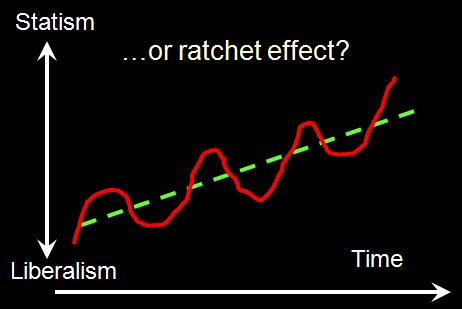
Does the current expansion of the State reverse a previous reduction, to be reduced once again in the future? Or, alternatively, is there a sort of ratchet effect, with a trend towards greater statism disguised by cycles along such increasing trend?
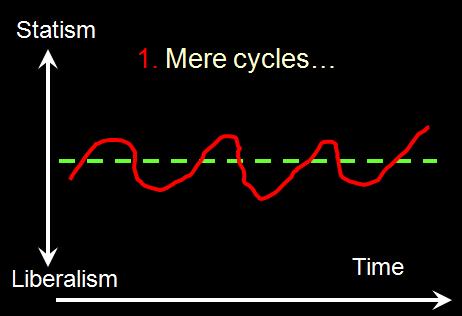 I am inclined to think that cycling has not taken place around a stationary average but around an increasing tendency (see the figures). But perhaps a better way of facing these questions would be to disaggregate in different dimensions. For instance, in several papers with Veneta Andonova we argue that freedom
  of contract has been in decline for more than a century in Western Law, both in civil- and common-law countries. Something similar could probably be said about trade, but in the opposite direction. However, in both freedom of contract and trade, it might be the case that exchange opportunities have expanded mainly as a result of technological change (e.g., cheaper transportation and communications), whatever the legal constraints. In terms of research, how could these trends be measured?
These thoughts were triggered by a timely and extremely suggestive paper by Witold J. Henisz presented at the Workshop on “Manufacturing Markets” organized last week in Villa Finaly, Florence, by Eric Brousseau and Jean-Michel Glachant. My next few blogs will address other aspects of Henisz’s views on the broader challenges facing capitalism.
Events @CBS
| Peter Klein |
I’ve just arrived in Copenhagen, where I’m spending a month as a visiting professor at the SMG. Copenhagen Business School has become one of the most intellectually exciting places in Europe. This week alone the school is hosting the DRUID summer conference which features people like Anita McGahan, Sid Winter, Will Mitchell, Russ Coff, Mike Ryall, and many others, along with a workshop on corporate governance with keynotes by Mark Roe, Randall Morck, Annette Poulsen, and Florencio Lopez-de-Silanes Molina. Of course these are only appetizers for the next week’s main course, the PhD seminar on The Theory of the Firm and Its Applications in Management Research conducted by Professors F. and K. Truly an embarrassment of riches!
2009 SES Boot Camp
| Peter Klein |
Just received the Call for Papers for the 2009 edition of the Society for Entrepreneurship Scholars Manuscript Boot Camp, this year at Johns Hopkins University right before the SMS Conference in October. I participated last year and had a terrific experience (OK, it was at a ski resort, but that has nothing to do with it). Submissions due 4 August 2009. Details below the fold. (more…)
Entrepreneurship Exemplars Conference
| Dick Langlois |
The Center for Entrepreneurship and Innovation at the UConn business school is sponsoring an “exemplars” conference in conjunction with the Entrepreneurship Division of the Academy of Management. The idea of the conference is to help young scholars by providing “exemplars” of good scholarship. Editors from the top management and entrepreneurship journals are here (including frequent O&M participant Joe Mahoney) to comment on these exemplar papers and provide advice.
The conference started last night with a keynote by Venkat Venkataraman and continues through Saturday. You can actually participate in the conference online: register here. I am about to wander over (physically, not electronically) to hear Jay Barney’s keynote at 10:50 EDT.
Research Workshop on Institutions and Organizations
| Peter Klein |
The IV Research Workshop on Institutions and Organizations takes place at Insper (formerly Ibmec) São Paulo 5-6 October 2009. Lee Alston and David Stark are keynoting. There are panels on “Judicial Norms and Development,” “New Theories of the Firm,” and “Social Capital and Organization.” There’s an open call for papers, with abstracts due 20 July.
I attended the 2007 version and enjoyed it very much.
ACAC Schedule
| Peter Klein |
 The Atlanta Competitive Advantage Conference begins tomorrow. The updated schedule, along with other logistical information, is here. You can also download many of the papers. Emory, Georgia Tech, and Georgia State Universities have co-hosted this event the past five years and it’s become one of the main events for research in strategy, organizational economics, entrepreneurship, and related fields.
My “No New Economy” Slides
| Peter Klein |
Here, for the curious, are my slides from this morning’s talk at the Law and Economics of Innovation conference, titled “Does the New Economy Need a New Economics?” (Short answer: no.) This will eventually morph into a paper so comments are most welcome (and thanks to those who have already helped). I’m looking forward to Susan Athey’s keynote later today.
Law and Economics of Innovation
| Peter Klein |
I’m speaking at this year’s edition of the Law and Economics of Innovation, organized by Geoff Manne and Josh Wright and co-sponsored by GMU Law and Microsoft. It’s May 7 in Arlington. Check out the slick conference website (and Geoff’s post at ToTM). If you don’t want to hear me, at least come for Susan Athey’s keynote. Tom Hazlett has the best paper subtitle: “Of Newtons, Blackberries, iPhones & G-Phones.” How many of you youngsters have heard of the Newton?
Program for Searle Center Conference, “The Economics and Law of the Entrepreneur”
| Peter Klein |
Here. I participated in last year’s conference and thought it was terrific. Old friend Henry Butler is doing a fine job making the Searle Center a major player in the entrepreneurship field.
The Economics of Prehistory
| Dick Langlois |
Greg Dow at Simon Fraser is organizing a conference this summer on “Early Economic Developments.”
This conference is a meeting for scholars interested in economic aspects of prehistoric events. The organizers welcome proposals for papers on topics at the boundaries among economics, archaeology, and anthropology. Topics can include economic prehistory, the economics of human biological evolution; pre-industrial economic history; and the evolution of economic, social, and political institutions.
Looks interesting. Abstract deadline is April 15, which I guess isn’t tax day in Canada.
Conference on Law and New Institutional Economics
| Peter Klein |
Vic Fleischer and Phil Weiser have organized a conference on Law and New Institutional Economics at the University of Colorado, 4-5 June 2009. Along with Lee Fennel, Mark Ramseyer, Henry Smith, and Eric Talley, Vic and Phil will facilitate discussion of classic (Demsetz 1967, Klein, Crawford, and Alchian, 1978) and contemporary papers dealing with property rights, contract design, behavioral finance, the teaching of NIE, and more. See the link for details.





 Organizations and Markets
Recent Comments