Posts filed under ‘Corporate Governance’
Manne on Fama and French
| Peter Klein |
An open letter to Gene Fama and Ken French from Henry Manne (also running today at Truth on the Market):
Dear Gene and Ken:
I must say that I was totally flabbergasted when I read your recent blog posting on insider trading. I know that your usual posts on investments, which I often cite to friends, are well-informed and empirically supported; your work over the years on these topics is important and influential — and rightly so. Unfortunately, in this post, you have deviated from your usual high quality. Anyone current on the topic of insider trading will recognize that you have been careless in your selection of anti-insider-trading arguments and that you omitted from your brief note the major part of the argument about insider trading: whether and how much it contributes to market efficiency. To say this is a strange omission coming from Fama and French would be an understatement.
Your first error is to assume that the insider trading debate is about informed trading only by “top management.” I suspect that this error may flow from my original argument for using insider trading to compensate for entrepreneurial services in a publicly held company, a matter you do not mention and which I will not pursue here except to note that “entrepreneurial services” does not equate to top management. Strangely no one seems to notice that most of the celebrated cases on the subject have not involved corporate personnel at all (a printer, a financial analyst, a lawyer, and Martha Stewart). (more…)
Scribd Version of Book
| Peter Klein |
I just learned I can embed the full document right here in a blog entry. Very cool!
Add to: Facebook | Digg | Del.icio.us | Stumbleupon | Reddit | Blinklist | Twitter | Technorati
The Capitalist and The Entrepreneur: Available Now!
| Peter Klein |
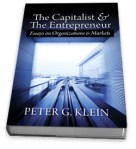 My new book, The Capitalist and the Entrepreneur: Essays on Organizations and Markets (Mises Institute, 2010), is now available. For a limited time, you can get it for just $15 — a bargain at half the price! Actually, the resource-constrained among you can read the Full Monty here, free of charge. A PDF version is also available. A promotional essay appears today on Mises.org.
The editorial and production staff did a terrific job, and I’m thrilled with the volume’s look and feel. The contents aren’t bad either!
Order two or more and I will personally send you a set of Ginsu knives.
Add to: Facebook | Digg | Del.icio.us | Stumbleupon | Reddit | Blinklist | Twitter | Technorati
Goldman in the Dock
| Craig Pirrong |
I have several reactions to the SEC’s fraud complaint against Goldman.
First, some of the more sensationalist reporting emphasizes that Goldman was short the RMBS structures that it was selling to its customers. (Yeah, it’s the NYT, basing its opinion on reporting by Wretched Gretchen Morgenson, so take it for what it’s worth–meaning not much.) Well, that’s true, but Goldman was also long. After all, it was the counterparty, the protection seller, to Paulson’s CDS. It then entered into offsetting transactions. Goldman was essentially a conduit of risk between other financial firms and Paulson. Note paragraph 66 of the complaint, which indicates that Goldman paid most of the $840 million it received on short positions in the Abacus deals to Paulson. Goldman claimed in its response to the government’s Wells Notice that it was actually long because it retained a slice of the risk; the protection it sold to Paulson was for a larger portion of the potential losses than covered by the protection it bought from ACA Capital. (more…)
A Real Hostage Model
| Peter Klein |
Forget Williamson (1983). Check out Randall Morck and Fan Yang’s analysis of the 19th-century banks Shanxi, China. These banks featured a dual-class equity structure and, to mitigate agency problems created by entrenched insiders, not only gave insiders few voting rights, but also allowed outsiders to enslave insiders’ wives and children and hold their relatives as hostages. As Morck and Yang observe, with dry humor: “Modern civil libertarians might question some of these governance innovations, but others provide lessons to modern corporations, regulators, and lawmakers.”
Add to: Facebook | Digg | Del.icio.us | Stumbleupon | Reddit | Blinklist | Twitter | Technorati
Posner on Institutions and Organizations, Round Two
| Peter Klein |
Remember the infamous Posner-Coase-Williamson exchange from JITE, 1993? Posner dismissed the New Institutional Economics as a derivative form of Posnerian law and economics, prompting unhappy replies from Coase and Williamson. Here’s Coase:
Posner [1993, 79] says that the first part of his paper describes “the conception of the field [the new institutional economics] held by Ronald Coase.” Reading this part of his paper recalled to my mind Horace Walpole’s opening remarks in his book on King Richard the Third: “So incompetent has the generality of historians been for the province that they have undertaken, that it is almost a question, whether, if the dead of past ages could revive, they would be able to reconnoitre the events of their own times, as transmitted to us by ignorance and misrepresentation” (Walpole [1768, 1]). I have only one foot through the door but should the final yank come before this piece is published, Horace Walpole’s words would apply exactly to Posner’s highly inaccurate account of my views.
Adds Williamson, wryly: “Richard Posner is a prolific writer and distinguished jurist. He is frequently asked to speak with wisdom and authority on many issues. Whether he hits the mark or misses varies with his depth of knowledge and understanding of those issues. . . . I content that Posner’s [1993] commentary mainly misses.”
Now Geoff Hodgson has produced a reboot: a long essay by Posner in the Journal of Institutional Economics titled “From the New Institutional Economics to Organization Economics: with Applications to Corporate Governance, Government Agencies, and Legal Institutions,” with replies from Jürgen Backhaus, Bruno Frey, Lin Ostrom, John Roberts, Tom Ulen, and several others (but not Coase or Williamson!). Posner focuses almost exclusively on the principal-agent problem, perhaps unaware that information, delegation, coordination, and adaptation are also important issues in organizational economics. His main conclusion seems to be that both private firms and public agencies are equally inefficient. Interesting reading, to be sure (and much better than Posner’s solipsistic essay on his conversion to Keynesianism, inexplicably published by the New Republic).
Mannepalooza at Austrian Scholars Conference
| Peter Klein |
Tune in here at 3:45 EST today for a live broadcast of the ASC session, “The Contributions of Henry G. Manne,” organized by yours truly. Panelists include me, Alexandre Padilla, Richard Vedder, Thomas DiLorenzo, and Henry Manne. And buy your copy of the Collected Works.
Update: audio files are now available: Klein, Padilla, Vedder, DiLorenzo, Manne.
Shareholder-Stakeholder Smackdown: Jensen, Freeman, Mintzberg, Khurana
| Peter Klein |
This looks like a fun event. Watch the Big Guys debate the future of the firm, management, and management education. It’s Fordham University’s W. Edwards Deming Memorial Conference, 11 May 2010 in New York City. Kudos to Mike Jensen for his willingness to walk into what will be, presumably, a line of fire. And remember, management theory is not to blame.
Org. Structure and Diversification
| Peter Klein |
The March 2010 issue of the Journal of Industrial Economics has just come out, and it features my paper with Marc Saidenberg, “Organizational Structure and the Diversification Discount: Evidence from Commercial Banking.” I’m quite happy with the paper, which went through many rounds of revision and consumed a great deal of time and energy. I blogged the details earlier. The published version is behind a firewall; if you can’t get through I’d be happy to mail you a copy.
Stuck on the Methodological Hamster Wheel
| Craig Pirrong |
I’ve read John Cassidy’s New Yorker article (not available online) in which he described his journey to the freshwater provinces in his attempt to see whether the financial crisis had caused Chicago economists to reject their reactionary views. (With one exception, the answer is blessedly “no.”) I’ve also read his paean to Pigou in the WSJ. So I pretty much knew what to expect when I picked up his How Markets Fail. Let’s say I wasn’t disappointed, in the sense that my very low expectations were met.
The book is a very conventional, Stiglitz-esque critique of market economics and those who defend markets. The latter are always described with Homer-esque modifiers, just so you’ll know that they [we!] are retrograde knuckle draggers. (more…)
Corporations Are People Too
| Craig Pirrong |
Legally, in some respects, anyways. That was a key issue in the recent Supreme Court decision re McCain-Feingold (see Dick’s post). I don’t have a lot to say about the specifics of the decision, as campaign finance law is way too arcane for me. Suffice it to say that I am inherently skeptical about any regulation regarding elections designed by incumbent politicians. People yammer about conflicts of interest all the time, but there’s a colossal one for you.
I just wanted to make a quick point about a debate between Stevens and Scalia carried out in the opinion and the dissent. Stevens noted that the Founders were deeply skeptical of corporations. Indeed so. Scalia noted that there are so many corporations today. Also true. The interesting question is how we got from A (Stevens) to B (Scalia).
The story is told in the North, Wallis and Weingast natural-state book Violence and Social Orders I’ve blogged about several times over at Streetwise Professor, mostly in the context of Russia. The relevant chapter is primarily based on John Wallis’s work. The basic story is that hostility to corporations — reflected very well in Adam Smith’s Wealth of Nations — was due to the fact that historically, English corporations were created by the crown, and were essentially very profitable favors provided to the politically connected. They were, in NWW terms, part of the “closed order” of the natural state, in which access to certain contracting forms was limited to a select powerful few. This animus towards corporations was inherited in the United States, but in the early years of the 19th century, state legislatures confronting issues associated with the financing of new infrastructure turned the corporate form into a prop of an open-order system in which this contracting form was made available to all. Rather than limit the right of incorporation to an elite, they made it available to everybody. The system changed from one in which legislatures had to grant every incorporation, to one in which pretty much anybody could incorporate if they met a set of general, universally applicable requirements. Hence, the proliferation of corporations. (more…)
The Collected Works of Henry Manne
 | Peter Klein |
Via Geoff Manne, a description and ordering information for the new Collected Works of Henry Manne, produced by Liberty Fund. A great collection of scholarly articles, reviews, and shorter popular pieces divided into three volumes, “The Economics of Corporations and Corporate Law,” “Insider Trading,” and “Liberty and Freedom in the Economic Ordering of Society.” Order your copy today!
Internal and External Corporate Governance
| Peter Klein |
Most of the corporate governance literature focuses on external mechanisms for limiting managerial discretion: competition in product and factor markets; discipline from banks, institutional investors, and other large capital suppliers; and, of course, the market for corporate control. Firms have access to internal control mechanisms as well — performance-based pay, internal audits, a strong Board, competition among the top-management team, adoption of the M-form structure, and so on — but these are usually considered weaker, less effective instruments.
Viral Acharya, Stewart Myers, and Raghu Rajan have a new theory paper, “The Internal Governance of Firms,” on internal control mechanisms, focusing on dividend policy as a means of satisfying both internal and external constituents. NBER version here, ungated version here, older SSRN version here. Abstract:
We develop a model of internal governance where the self-serving actions of top management are limited by the potential reaction of subordinates. Internal governance can mitigate agency problems and ensure that firms have substantial value, even with little or no external governance by investors. Internal governance works best when both top management and subordinates are important in generating cash flow. External governance, even if crude and uninformed, can complement internal governance and improve efficiency. This leads to a theory of investment and dividend policy, where dividends are paid by self-interested CEOs to maintain a balance between internal and external control. Our paper can explain why firms with limited external oversight, and firms in countries with poor external governance, can have substantial value.
The Lazy Manager Theory
| Peter Klein |
Good ideas from John Wilkins, who earned a PhD in (I think) evolutionary biology while working as a full-time manager (via Randy). Sample elements of the Lazy Manager Theory:
- Never do any piece of paperwork when the person who asked for it isn’t there and holding it when they make the request. If they don’t care enough to come see you, they probably don’t need it done. Also, you put faces to names and develop a good personal relationship with those who come to see you, so it’s win-win.
- If any piece of paper falls off your desk for any reason, throw it away. This is God’s way of telling you it is unimportant.
- Always sit on the left side of the table, at the far end from the secretary if you aren’t that person. This way when tasks are being handed out, you are less likely to be volunteered, as you are not in the immediate line of sight of either the chair or the secretary.
If you prefer meatier fare, try this paper from Philippe Aghion, John Van Reenen, and Luigi Zingales, “Innovation and Institutional Ownership,” which examines a version of the lazy-manager hypothesis:
We find that institutional ownership in publicly traded companies is associated with more innovation (measured by cite-weighted patents). To explore the mechanism through which this link arises, we build a model that nests the lazy-manager hypothesis with career-concerns, where institutional owners increase managerial incentives to innovate by reducing the career risk of risky projects. The data supports the career concerns model. First, whereas the lazy manager hypothesis predicts a substitution effect between institutional ownership and product market competition (and managerial entrenchment generally), the career-concern model allows for complementarity. Empirically, we reject substitution effects. Second, CEOs are less likely to be fired in the face of profit downturns when institutional ownership is higher. Finally, using instrumental variables, policy changes and disaggregating by type of owner we find that the effect of institutions on innovation does not appear to be due to endogenous selection.
Lynch ‘Em
| Craig Pirrong |
I’ve had several calls from reporters asking my opinion on the Lynch Amendment to Barney Frank’s derivatives-regulation bill. For some reason, Forrest Gump pops into my head every time that question is asked. You know, the part where he says “stupid is as stupid does.”
As I am sure you all know, the amendment, introduced by New Jersey representative Stephen Lynch, imposes restrictions on the ownership and control of the clearinghouses that the Frank bill will require the vast bulk of derivatives to be traded through. The amendment imposes similar restrictions on ownership of exchanges and swap execution facilities.
Specifically, the amendment defines a class of “restricted owners” that includes swap dealers and major swap participants, and limits the amount of a clearinghouse (or execution facility or exchange) that these restricted owners can own or control collectively to 20 percent. The justification for this limitation is to reduce conflicts of interest, the specific nature of which are not identified.
This represents yet another example of Congressional micromanagement of the organization and governance of financial institutions. In my view, it is incredibly wrong-headed. (more…)
Bebchuk-Weisbach Survey of Corporate Governance
| Peter Klein |
It’s the introduction to a special issue of the Review of Financial Studies:
The special issue features seven papers on corporate governance that were presented in a meeting of the NBER’s corporate governance project. Each of the papers represents state-of-the-art research in an important area of corporate governance research. For each of these areas, we discuss the importance of the area and the questions it focuses on, how the paper in the special issue makes a significant contribution to this area, and what we do and do not know about the area. We discuss in turn work on shareholders and shareholder activism, directors, executives and their compensation, controlling shareholders, comparative corporate governance, cross-border investments in global capital markets, and the political economy of corporate governance.
Here it is on the NBER site; I couldn’t find an ungated version.
Nirvana Is Just a Band
| Craig Pirrong |
Last week I wrote about one justification for exchange trading and clearing mandates in derivatives markets — the market power argument. This week I’ll examine another argument, and render a similarly skeptical verdict.
In a chapter of Restoring Financial Stability, Viral Acharya, Rob Engle, Steve Figlewski, Anthony Lynch and Marti Subrahmanyam argue that bilateral transactions in OTC derivatives markets involve an externality. Their argument is not stated that clearly, but FWIW here it is verbatim:
[A]ll OTC contracts . . . feature collateral or margin requirements, wherein counterparties post a deposit whose aim is to minimize counterparty risk. The deposit is marked to market daily, based on fluctuations in the value of the underlying contract and the creditworthiness of the counterparties . . . . The difficulty, however, is that such collateral arrangements are negotiated on a bilateral basis. Parties in each contract do not take full account of the fact that counterparty risk they are prepared to undertake in a contract also affects other players; indeed, they often cannot take account of this counterparty risk externality in an OTC setting, due to inadequate transparency about the counterparty’s positions and its interconnections with the rest of the market. While bilateral collateral arrangements do respond to worsening credit risk of a counterparty, such response is often tied to agency ratings, which are sluggish in capturing credit risk information and potentially inaccurate.
An externality means that some cost or benefit is not priced. By invoking the concept of externality Acharya et al (“AEFLS”) are asserting that something — a bad in this instance — isn’t priced. They are a very vague on just what this is, but here’s my interpretation of what they mean.
A firm that has already entered into financial contracts affects the risk exposure of its existing counterparties when it enters into new deals. A firm that has a large number of commitments outstanding can enter into additional contracts that substantially increase its riskiness, thereby harming the incumbent counterparties. The cost imposed on these incumbent counterparties isn’t, in this telling, priced. (more…)
On the Border*
| Craig Pirrong |
This is my inaugural post as guest blogger here at O&M. I am grateful for the opportunity.
In his very gracious introduction, Peter Klein noted that my research is at the border of finance and industrial organization. Quite true (and indeed, “borderer” is a good description of me overall.)
That border is very, very busy today. Indeed, so much is happening there that it is difficult to keep up. In the aftermath of the financial crisis, Congress and regulators are beavering away on laws and regulations that will completely reshape the organization and regulation of financial markets, and especially of the area of particular interest to me — derivatives.
I anticipate that many of my O&M blog posts will explore these issues, but I’ll start with something very topical. Senator Chris Dodd just yesterday heaved up a 1,136-page proposed financial regulation bill, and one proposal that is attracting considerable attention is his plan to consolidate banking regulators. Dodd is not alone in thinking along these lines. Even before the financial crisis, there were myriad proposals to consolidate various regulators, such as the Securities and Exchange Commission and the Commodity Futures Trading Commission. These have only gained in popularity in light of the crisis.
In the modern financial markets, firms are big and complex, and operate in many markets (defined geographically, or by product). It is difficult to fit a big financial firm into any box. A Goldman Sachs deals in the securities markets and the derivatives markets. So it doesn’t fit comfortably in a securities box, or a derivatives box, so in the current system for regulatory purposes the firm is split into pieces, some of which are put into the securities box and others into the derivatives box (and there are many other boxes too for a big firm like Goldman).
This leads to potential for conflicting regulations, jurisdictional disputes, regulatory arbitrage, and other problems. So, the Dodd proposal — and most of the other consolidation proposals — advocate creating really big boxes, and in the extreme, one big box that regulates everything a financial firm does.
The problems of the seen are well known (though arguably exaggerated). What concerns me are the largely unexamined problems of the as-yet-unseen big-box alternative. (more…)
CFP: International Perspectives on Corporate Governance
| Peter Klein |
Posted on behalf of Alex Padilla:
CALL FOR PAPERS
Journal of Private Enterprise &
Association for Private Enterprise EducationSymposium on Corporate Governance: International Perspectives
Guest Editors: Alexandre Padilla, Nishat Abbasi, and Pierre Garello
Metropolitan State College of Denver & University Paul CézanneAssociation for Private Enterprise Education International Conference
Las Vegas, Nevada, April 11-13, 2010The Journal of Private Enterprise in collaboration with the Association for Private Enterprise Education, The School of Business at the Metropolitan State College of Denver, and the Centre d’Analyse Economique of the Université Paul Cézanne invite you to submit a proposal to present a paper at the Association for Private Enterprise Education International Conference. Proposals are due by November 20th. We want to have two sessions: one addressing issues of Corporate Governance in the America and another one addressing issues of Corporate Governance in Europe, Asia, Africa. We welcome papers written from an accounting, economics, finance, historical, philosophical, and political science perspectives. (more…)
Need Examples of Subversive Behavior in M&A
| Russ Coff |
I just finished teaching a simulation exercise to BBA students on the politics of post-acquisition integration. I was surprised that students had a great deal of trouble believing that managers would be subversive even in that kind of setting. If there are specific examples of such subversive behavior that you know about, I’d appreciate it if you would post here or email them to me.
Here are some details about the exercise (and a Dilbert cartoon) in case anyone is interested. (more…)





 Organizations and Markets
Recent Comments