Posts filed under ‘Education’
Mirowski on Backhouse and Fontaine, eds., The History of the Social Sciences since 1945
| Peter Klein |
I enjoyed Philip Mirowski’s first book, though I find his more recent stuff increasingly tendentious and repetitive. Still, a Mirowski review of Backhouse and Fontaine, eds., The History of the Social Sciences since 1945 (Cambridge, 2010) is worth a read. Interesting bit on organizational structure:
The historical generalization overlooked by the editors is that “interdisciplinary” social science units shoehorned into postwar university structures almost uniformly failed, whereas those founded as freestanding think tanks, from RAND to American Enterprise Institute to Cato and the Manhattan Institute, all persevered and succeeded. This is true even for the odd case of Carnegie GSIA, which became the model for other business schools across the nation, but only upon dispensing with the original interdisciplinary structures initially promoted by Herbert Simon (himself then exiled to a Department of Psychology). The lesson may be that the postwar American research university could not sustain true interdisciplinarity in social science inquiry, but that military and corporate sponsors of the think tanks could manage it, but only by yoking it to a format that enforced unquestioned responsiveness to the whims of the funders.
A familiar point of course to students of entrepreneurship and innovation, and yet another reason to suspect that innovation in higher education is more likely to come from outsiders (e.g., the notorious for-profit institutions) than incumbents.
Teaching Analytical Writing
| Peter Klein |
More on academic writing: This paper by Wayne Schiess, “Legal Writing Is Not What It Should Be,” deals specifically with law students, but applies in many ways to academic writing more generally. Quoting from the introduction:
The writing required of students in high school and college is often what I call “self-expression writing” rather than expository writing. Self-expression writing tends to be writer-focused, not reader-focused.That is, self-expression writers focus primarily on expressing their own ideas. This is surely a necessary developmental step for improving writing skill, but it is two steps removed from the skill of analytical legal writing. Once high school and college writers move beyond self-expression, they usually produce writing that can be called “knowledge-telling” or conveying information.
But legal writing is not self-expression, and it is another step beyond knowledge telling. One author has referred to the skill of analytical legal writing as “knowledge transforming.” Thus, legal writing is a form of expository writing in which the focus should be on the reader‟s ability to understand. This is in contrast to self-expression writing, where clearly and effectively conveying information to the reader is secondary to expressing one’s self the way one desires. And it is in contrast to knowledge-telling, in which the primary purpose is conveying information, not analyzing a problem.
Of course, self-expression and knowledge-telling are necessary steps, as I’ve acknowledged. But I can report, based on anecdotal evidence, that some students get little training even in these two developmental steps. Some college curricula do not require much writing at all. For example, in my teaching of the required, first-year legal writing course, I often have students who studied science or engineering in college. Many of these students arrive at law school and tell me they have never written a paper in college.
The kind of writing required for good social science is also what Schiess calls “analytical writing,” and my sense is that few graduate students have any experience with or training in this kind of writing. How to teach it is another question. Schiess has several suggestions that are specific to law schools; how can they be applied to economics or sociology or business administration?
The Five Stages of Grading
| Peter Klein |
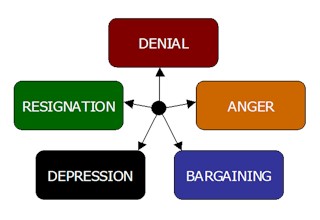
A nice complement to Daniel Solove’s classic guide to grading: “The Five Stages of Grading” at notthatkindofdoctor.com (via David Croson). “Everyone is familiar with Elisabeth Kübler-Ross and her stage model of coping with grief popularly known as the five stages of grief. What you may not know is that Kübler-Ross actually developed her theory as a graduate student, basing her conception of the process of loss on the experiences one goes through over a grading weekend.”
“The Meanest and Most Contemptible Persons in Society”*
| Scott Masten |
*That would be Peter, Dick, Lasse (I think), and me, but not Nicolai. (See below.)
I haven’t posted anything on higher education governance in a couple of weeks, so I guess it is about time. My excuse will be an Instapundit link to an opinion column titled “End Our ‘Multiuniversities’.”
The author, David Warren, complains that the “great majority of the universities — founded since the Second World War to bureaucratically process and credentialize a large part of the general population, as a matter of ‘right’ and regardless of their intellectual capacities — are in effect ‘community colleges’ or trade schools,” a condition that he attributes in the main to public funding. (Warren is writing from Canada but a related piece makes clear his reprobation is catholic.) I am broadly sympathetic with his lament, though I am less confident that public funding is the ultimate culprit. What I want to comment on, however, is his (possibly facetious) solution: (more…)
Secure Abjure Tenure
| Scott Masten |
Thanks to Peter, Nicolai, Dick, and Lasse for the invitation to guest blog and for the opportunity to sound off on current issues to a broader audience than just my LCD screen. [Thank you! — LCD Screen.]
A fairly recent example of such an issue was the discussion — anew — of proposals — anew — to abolish professorial tenure. Earlier this month, the New York Times Sunday Book Review ran an essay titled “The End of Tenure?” This was preceded by a July NYT “Room for Debate” forum on the question “What if College Tenure Dies?” and a proposal a week or so later by the American Bar Association to eliminate the term “tenure” from the ABA standards covering job security and academic freedom. A flurry of blog posts on the merits of tenure — many by law professors — ensued.
Leaving aside the details of the debate, an interesting pattern emerged in the “sides,” with more market-oriented (libertarian- or conservative-leaning) writers tending to be more critical, or at least skeptical of the merits, of tenure (see, for example, here and here; here; and here, compared, for instance, with this. The rule-proving exception is here). (more…)
Richard T. Ely’s Influence on Woodrow Wilson
| Peter Klein |
Researching and teaching sound economics during the Dark Era (i.e., the Keynesian Revival) can be frustrating and depressing. Keynesian doctrine has been refuted again and again; why won’t this zombie stay dead? What, more generally, is the role of economic education? Can we really transform hearts and minds through reason and dialogue? Or do students and scholars simply seek intellectual cover to justify what they already believe?
Hayek reports that he was originally a mild Fabian but was converted by laissez-faire by Mises’s 1922 book Socialism. Such conversion stories are rare, however, in either direction. With this in mind, I was intrigued by Gary Pecquet and Clifford Thies’s paper, “The Shaping of a Future President’s Economic Thought: Richard T. Ely and Woodrow Wilson at ‘The Hopkins'” (Independent Review, Fall 2010). Pecquet and Thies report that “Woodrow Wilson entered graduate studies at Johns Hopkins University as a classical liberal in his economic views but departed as a progressive. His fateful transformation had much to do with his apprenticeship with Richard T. Ely, who disparaged the laissez-faire policy prescriptions and deductive methodology of classical economics.” Worth a look for those interested in the impact of economic education on economic policy.
Upcoming Public Appearances
| Peter Klein |
It’s a slow news day, blogospherically speaking, so I thought I’d share information about some of my upcoming public appearances, for reasons that have nothing at all to do with self promotion:
“Entrepreneurship, Strategy, and the Financial Crisis: Lessons from the Austrian School”
Sherlock Hibbs Distinguished Lecture in Business and Economics
24 September 2010, 2:00-3:30pm
205 Cornell Hall, Trulaske College of Business
University of Missouri
“Entrepreneurship and the Financial Crisis”
27 September 2010, 7:00pm
N021 Business Complex
Michigan State University
“Getting Out the Word: Alternative Research, Teaching, and Outreach”
Mises Institute Supporters Summit
8-9 October 2010
Auburn, Ala.
Get Ready for the Slow-Conversation Movement
| Peter Klein |
Conversations today are constantly hijacked by digital fact-checkers. Every fact or statement, it seems, must be checked or augmented in real time with at-our-fingertips online information. We no longer trust each other to come up with good-enough facts or allow each other add colorful embellishment to our stories. Let me give a recent example to make my point. Over lunch the other day, I shared a story with my colleagues — the surreal experience of being accidently given a presidential suite at a Four Seasons Hotel. “This was an amazing room, probably 3000+ square feet with over-the-top appointments everywhere,” I said. No more than two minutes after making the statement, an associate checked on his BlackBerry the size of the presidential suite, correcting me that it was closer to 2000 square feet.
What happened to natural conversations, those based on what is already in our heads, unburdened by verfication? As the fast food movement has seen an opposing slow food movement take hold and shape, I predict we’ll soon see a similar desire for putting down for a moment all the “information enhancements” that come with mobile, digital-sparring tools.
That’s Anthony Tjan blogging at HBR. As someone who reads a lot of student papers — not to mention newspapers, magazines, and blogs — I tend to favor more fact checking, not less. But I see the point.
This is relevant for teaching and public speaking as well. I don’t record my classes, but I suspect that day is not far off (and some of my public talks are already preserved, for better or worse). Will professors be more rigid, overly cautious, less spontaneous, less natural, knowing that everything they say is ripe for verification, by current or future students (or administrators)? What is the appropriate balance between monitoring and governance and classroom spontaneity, ad hocery, and silliness?
In Defence of L’Ancien Regime
| Nicolai Foss |
It is sometimes instructive to reflect on the massive changes that the University has undergone since the Second World War. On the negative side, the advent of the mass university has very likely led to a dumbing down of the curriculum in many disciplines and a fall in the requirements for entry. It has paved the way for a powerful bureaucratic caste, and the “bureaucrat-professor” who is in the academic industry because of his specialized management skill, and not because of his wish to engage in scholarly pursuits and the training of the most intelligent persons in a given society. On the benefit side, many more people can now share in science and general learning, very likely contributing to economic growth.
As the universities are broadly speaking financed by the taxpayer, politicians and their henchmen in the ministeries of education, science, technology, etc. happily undertake to steer the universities. Thus, inspired by as-yet-largely-unvalidated claims of a general shift in the “mode of knowledge production,” university bureaucrats, managers, and politicians are calling for increased “inter-disciplinarity” and “relevance,” notably in the form of mobilizing multiple disciplines in the context of concrete problem-solving in “business” (the so-called “Mode II”). In the context of business schools, it seems almost de rigeur in certain quarters to deem business schools largely “irrelevant” (meanwhile, business happily employs the products of business schools, paying MBA and other graduates hefty salaries, presumably motivated by the high usefulness, indeed, “relevance,” of these graduates).
Contrast all this with universities not so many decades back. There are not many who stand up on behalf of l’ancien regime of universities. But here are two who do, one implicitly and the other one (much) more explicitly. (more…)
The Modern University
| Peter Klein |
[I]f you were starting a top university today, what would it look like? You would start by gathering the very best minds from around the world, from every discipline. Since we’re living in an age of abundant, not scarce, information, you’d curate the lectures carefully, with a focus on the new and original, rather than offer a course on every possible topic. You’d create a sustainable economic model by focusing on technological rather than physical infrastructure, and by getting people of means to pay for a specialized experience. You’d also construct a robust network so people could access resources whenever and from wherever they like, and you’d give them the tools to collaborate beyond the lecture hall. Why not fulfill the university’s millennium-old mission by sharing ideas as freely and as widely as possible?
What would this modern university look like? It certainly wouldn’t resemble Harvard or Swarthmore or Michigan or Texas A&M. It would look like TED, profiled in this month’s Fast Company. Or Wikiversity or the Mises Academy or some nonprofit or for-profit alternative we haven’t heard of yet.
See also: “Are Universities Worth It?”
Law School for Economists
| Peter Klein |
Via Josh Wright, here’s an announcement for the Levy Fellowship at George Mason University School of Law. It’s a program to support PhD economists (and ABDs) pursuing law degrees. These days, a JD and a PhD are pretty much required for an academic post at a good law school, so check it out if you’re interested in teaching. After all, the world clearly needs more economists and more lawyers. . . .
One-Size-Fits-All Higher Ed?
| Peter Klein |
Alternative title: “An Economist Tries Talking to an English Professor, and Gives Up.” Perhaps one of you wants to take up the mantle over at UD?
The point, which I’ve raised in previous posts (e.g., here and here), is that higher education isn’t one, well-defined thing, but a variety of things, and we should welcome experimentation, innovation, and — well — diversity. Blockquoting myself:
“Diversity” is the primary mantra of higher-education institutions. So why not have some diversity in organizational forms? “Education,” after all, is not a homogenous good. As with healthcare, one size doesn’t fit all. Shouldn’t we encourage entry, and applaud entrants who experiment with alternative curricula, teaching methods, incentive structures, sizes, and shapes? Let a thousand pedagogic flowers bloom, I say!
Add to: Facebook | Digg | Del.icio.us | Stumbleupon | Reddit | Blinklist | Twitter | Technorati
The Unbearable Hotness of Being
| Peter Klein |
 Does blogging reduce research productivity? Are we O&Mers worried about posting something we’ll later regret? Nah, we think blogging is good for us, professionally. But we have another problem, more difficult to remedy: we are hot. I mean smokin’ hot. Harrison Ford in the first Indiana Jones movie? Forget it. He looks like some dork philosopher compared to us. Colleagues and students — females, especially — don’t take us seriously. “We know why you got this job!” We get one-line student evaluations: “Yum.”
Apparently, this is a real problem for some faculty members, according to a recent Chronicle story. “[I]n academe, being hot has a downside: Professors who are considered too good-looking can be cast by their peers as lightweights, known less for their productivity than for their pulchritude.” As the article points out, students have been falling in love with their professors for years, but only now do they have a chance to express themselves, often anonymously, at sites like RateMyProfessor.com. One professor — an economist, no less! — got so annoyed with the leering after making a hot professor list that he moved out of town. “He found notes under his door asking ‘what it would take to lasso me.’ And female students coyly ask his advice on whether it’s OK to date professors once a class is over.” I feel for the guy, really I do.
One anonymous professor quoted in the article puts things in their proper perspective, however: “on a scale of hotness academics aren’t all that hot, relatively speaking, and to make a list of hot ones is thus, relatively laughable.”
Add to: Facebook | Digg | Del.icio.us | Stumbleupon | Reddit | Blinklist | Twitter | Technorati
Academy of Management Conference Open Thread
| Peter Klein |
 Much of the O&M extended family is heading home from Montréal, site of the Academy of Management Annual Meeting. I presented one paper, discussed several more, facilitated a research roundtable, and spoke at a doctoral student consortium. Then there are business meetings, editorial board pow-wows, and planning sessions. Plus the really important stuff: socializing, networking, exchanging gossip, and enjoying good food and drink. It was great to see so many O&M bloggers, former guest bloggers, regular and occasional commentators, lurkers, and secret admirers.
Several sessions dealt with pedagogy, data sharing, research collaboration, and other issues being transformed by the web/wiki/blog/tweet/Facebook revolution. There was even a session on academic blogging featuring some of our friends from That Other Site. Clearly the O&M community is on the cutting edge of organizational research, teaching, and policy.
What did you think of the conference? What were your favorite sessions, papers, discussions, and activities? What could be done to improve future conferences? (Believe it or not, many high-ranking AoM muckety-mucks are regular O&M readers, so now’s your chance to be heard!)
Add to: Facebook | Digg | Del.icio.us | Stumbleupon | Reddit | Blinklist | Twitter | Technorati
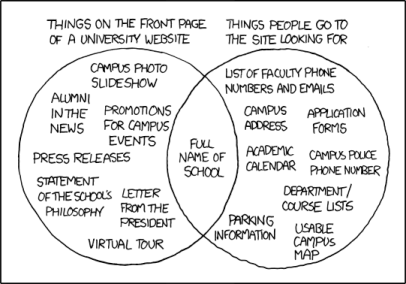
University Websites
| Peter Klein |
Add to: Facebook | Digg | Del.icio.us | Stumbleupon | Reddit | Blinklist | Twitter | Technorati
Misc Academic Links
| Peter Klein |
- Academia’s love-hate relationship with wikis.
- Deathbed witticisms from Voltaire, Hegel, and other interesting persons.
- Should research universities exploit the internal division of labor?
- Tips on academic job talks from Fabio’s valuable series.
Add to: Facebook | Digg | Del.icio.us | Stumbleupon | Reddit | Blinklist | Twitter | Technorati
Mises Quote of the Day
| Peter Klein |
From Human Action, chapter 15, section 11 (via JGL):
In order to succeed in business a man does not need a degree from a school of business administration. These schools train the subalterns for routine jobs. They certainly do not train entrepreneurs. An entrepreneur cannot be trained. A man becomes an entrepreneur in seizing an opportunity and filling the gap. No special education is required for such a display of keen judgment, foresight, and energy. The most successful businessmen were often uneducated when measured by the scholastic standards of the teaching profession. But they were equal to their social function of adjusting production to the most urgent demand. Because of these merits the consumers chose them for business leadership.
Add to: Facebook | Digg | Del.icio.us | Stumbleupon | Reddit | Blinklist | Twitter | Technorati
Too Much Research
| Peter Klein |
Bill McKelvey is one of the signatories to a controversial Chronicle piece that ran last month, “We Must Stop the Avalanche of Low-Quality Research.” The five authors, from a variety of academic disciplines, argue that “the amount of redundant, inconsequential, and outright poor research has swelled in recent decades, filling countless pages in journals and monographs.” As evidence they point to increases in the numbers of journals, journal pages, and authors and decreases in average citation rates.
[I]nstead of contributing to knowledge in various disciplines, the increasing number of low-cited publications only adds to the bulk of words and numbers to be reviewed. Even if read, many articles that are not cited by anyone would seem to contain little useful information. The avalanche of ignored research has a profoundly damaging effect on the enterprise as a whole. Not only does the uncited work itself require years of field and library or laboratory research. It also requires colleagues to read it and provide feedback, as well as reviewers to evaluate it formally for publication. Then, once it is published, it joins the multitudes of other, related publications that researchers must read and evaluate for relevance to their own work. Reviewer time and energy requirements multiply by the year. The impact strikes at the heart of academe.
I think this assessment is generally on target, in my own field at least. What percentage of the articles in your favorite scholarly journal do you read, let alone remember? How much of the research in your field really adds value? Of course, search tools make it easier to find relevant information, so I’m not sure the point about lit reviews is all that compelling. Still, it does seem increasingly difficult to sort wheat from chaff.
I’m less impressed with the authors’ proposed solutions — limiting the number of publications that can be considered for promotion and tenure, making greater use of impact factors, and enforce tighter page restrictions. These strike me as superficial fixes. The main problem is the vast increase in the scale and scope of the “scientific” enterprise itself, almost all of it due to public funding. There are simply too many universities and institutes, too many research faculty, too many granting agencies, too much research money. It’s a self-perpetuating process, almost exclusively driven by supply-side considerations (who on earth “demands” the output of most English departments?). Some of you will be shocked by the claim that there’s “too much” research money, particularly in today’s austere climate. But I mean too much relative to some social optimum, not too much relative to what university professors want.
Why would we expect this kind of system to produce high-quality research? Perhaps it’s a miracle that any good work gets done at all.
Add to: Facebook | Digg | Del.icio.us | Stumbleupon | Reddit | Blinklist | Twitter | Technorati
Speak Like a Philosophy Professor
| Peter Klein |
From Shrek the Third (text courtesy of IMDB):
Prince Charming: You! You can’t lie! So tell me puppet… where… is… Shrek?
Pinocchio: Uh. Hmm, well, uh, I don’t know where he’s not.
Prince Charming: You’re telling me you don’t know where Shrek is?
Pinocchio: It wouldn’t be inaccurate to assume that I couldn’t exactly not say that it is or isn’t almost partially incorrect.
Prince Charming: So you do know where he is!
Pinocchio: On the contrary. I’m possibly more or less not definitely rejecting the idea that in no way with any amount of uncertainty that I undeniably
Prince Charming: Stop it!
Pinocchio: …do or do not know where he shan’t probably be, if that indeed wasn’t where he isn’t. Even if he wasn’t at where I knew he was,
[Pigs and Gingerbread Man begin singing]
Pinocchio: That’d mean I’d really have to know where he wasn’t.
Add to: Facebook | Digg | Del.icio.us | Stumbleupon | Reddit | Blinklist | Twitter | Technorati
Isomorphism in Higher Education
| Peter Klein |
 Amitai Etzioni is upset that new firms are entering the higher-education market and offering — gasp! — a differentiated product. Worst of all, they operate on a for-profit basis! (“For-profit,” as left-leaning intellectuals know, is synonymous for “evil.”) Consider:
The education students receive at for-profit colleges bears little resemblance to the kind they would get at a true liberal arts college. Neither does it resemble the collegial image the for-profit colleges love to project. Professors at these schools often work on short contracts. There is no tenure. The executives make staggering salaries. Most students are taught online, often by poorly qualified professors who have very limited contact with the students. . . .
The schools’ stripped-down curricula and poor instruction often make for nearly worthless degrees. When students graduate from these colleges, many cannot find jobs — or at least not the kinds they were promised — and eventually, many of them default on their loans.
Of course, this in no way resembles the situation at traditional colleges and universities, at which all instructors are highly qualified, administrators make minimum wage, instructors spend lots of time with their students, and all students get exactly the jobs they were promised and pay their loans back immediately. (more…)





 Organizations and Markets
Recent Comments