Posts filed under ‘Education’
Duke LLM in Law and Entrepreneurship
| Peter Klein |
We mentioned before Vanderbilt’s PhD program in law and economics and Arizona’s program in law and entrepreneurship. Now Duke Law School is offering an LLM degree in law and entrepreneurship. “Open to an inaugural class of about 20 JD graduates, the curriculum will blend rigorous academic study relating to the legal, business, institutional, strategic, and public-policy frameworks and considerations that apply to entrepreneurs and innovation, with practice and research opportunities that allow each student to develop skills in representing clients.” Obviously, this is a program for lawyers, not for entrepreneurship scholars or management practitioners, but there may be lessons here for business schools and other academic units seeking to offer interdisciplinary programs in entrepreneurship studies. I particularly appreciate the Duke program’s broad, functional concept of the entrepreneur: “[T]he entrepreneurship LLM will not only be ideal for the entrepreneur, but also for those in large institutions and firms who operate with the spirit of an entrepreneur.”
Add to: Facebook | Digg | Del.icio.us | Stumbleupon | Reddit | Blinklist | Twitter | Technorati
IRB Flames
| Peter Klein |
Zachary Schrag’s excellent Institutional Review Blog highlights the discussion on a recent Chronicle post about IRBs. As you can imagine, most of the comments are from frustrated researchers who see the campus IRB as their enemy, not their ally. Sample: “At my current institution, humanities scholars are subject to an IRB that only makes sense for scientists collecting blood and doing life-threatening experiments on small children.” Zach points out that a few comments defend the local IRB, but these comments “are vaguer and less eloquent,” and “none tells a story of an IRB review that proved necessary.”
I suspect that some of this researcher frustration can be alleviated by recognizing that IRBs exist not to protect research subjects, but to protect the university. The IRB’s goal is to prevent the university from being sued or otherwise losing Federal funding. Protecting research subjects, improving research methods, and contributing to the growth of knowledge are incidental.
Add to: Facebook | Digg | Del.icio.us | Stumbleupon | Reddit | Blinklist | Twitter | Technorati
Outsourcing TAs?
| Peter Klein |
An interesting make-or-buy decision for colleges and universities. Best line, from Roosevelt University B-school dean Terry Friel: “Faculty have this opinion that grading is their job, . . . but then they’ll turn right around and give papers to graduate teaching assistants. . . . What’s the difference in grading work online and grading it online from India?”
Add to: Facebook | Digg | Del.icio.us | Stumbleupon | Reddit | Blinklist | Twitter | Technorati
Shareholder-Stakeholder Smackdown: Jensen, Freeman, Mintzberg, Khurana
| Peter Klein |
This looks like a fun event. Watch the Big Guys debate the future of the firm, management, and management education. It’s Fordham University’s W. Edwards Deming Memorial Conference, 11 May 2010 in New York City. Kudos to Mike Jensen for his willingness to walk into what will be, presumably, a line of fire. And remember, management theory is not to blame.
Mises Quote of the Day
| Peter Klein |
Nothing can be known about such matters as inflation, economic crises, unemployment, unionism, protectionism, taxation, economic controls, and all similar issues, that does not involve and presuppose economic analysis. All the arguments advanced in favor of or against the market economy and its opposites, interventionism or socialism (communism), are of an economic character. A man who talks about these problems without having acquainted himself with the fundamental ideas of economic theory is simply a babbler who repeats parrotlike what he has picked up incidentally from other fellows who are not better informed than he himself.
This is from Mises’s introduction to the 1959 edition of Böhm-Bawerk’s massive 3-volume set, Capital and Interest. Mises gives some further admonitions: “A man not perfectly familiar with all the ideas advanced in these three volumes has no claim whatever to the appellation of an economist.” This is, shall we say, a minority view. And my personal favorite: “A citizen who casts his ballot without having studied to the best of his abilities as much economics as he can fails in his civic duties. He neglects using in the appropriate way the power that his citizenship has conferred upon him in giving him the right to vote.”
Those lacking time to study Capital and Interest in its entirety may enjoy this new edition of Böhm-Bawerk’s essay “Control or Economic Law,” which is more easily digested.
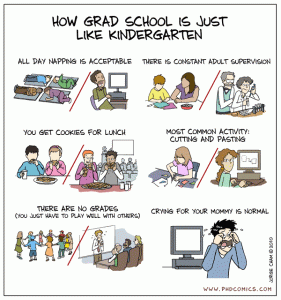
How Grad School Is Just Like Kindergarden
| Peter Klein |
Another gem from the PhD Comics guy (click to enlarge).
Quote of the Day: Bartley on the Marketplace of Ideas
| Peter Klein |
I happened to be looking today through Unfathomed Knowledge, Unmeasured Wealth by W. W. Bartley, III, who passed away shortly after this book was published. Bartley, a student and colleague of Karl Popper and the Founding Editor of The Collected Works of F. A. Hayek, was a brilliant and penetrating thinker whose work is not very well known outside of a few professional circles. Unfathomed Knowledge, a book about higher education (with the subtitle “On Universities and the Wealth of Nations”), was written for a general audience and is full of insights about the crazy business of academia. Here’s one passage:
Analogies have often been drawn between a free market in ideas and free markets in goods and services. Yet intellectuals tend to dislike such comparisons. They see the free market in ideas as something on a higher plane, qualitatively different from free markets in commodities and the like. Many of them indeed even hate the marketplace as traditionally conceived, and would want nothing to do, even analogically, with a free market in coal, housing, fish, or petroleum.
Take a few examples. Several scholars, including Edward Shils, of the University of Chicago, strongly protested the analogy when it was drawn by Michael Polanyi at the Congress for Cultural Freedom. One called Polanyi’s comparison between free markets in goods and in ideas “clever but questionable” in that a man who offers commodities in the free market “is not bound by anything” whereas in science one is bound to an objective method. Shils added that members of the scientific community, by contrast to businessmen and traders, act in accordance with overriding standards, a “common law” above and beyond individuals.
Such a position does not withstand examination. Someone offering commodities in a market — far from being “not bound by anything” — is governed by enforceable law relating to fraud, credit, contract and such like. The analogy does have limits, but of a different sort: in the marketplace of ideas, fraud, plagiarism, theft, false advertising (including false claims to expertise and the whole mystique of expertise), “conspiracies of silence,” casual slander and libel, breach of contract, deceit of all sorts are more common than in business — simply because there are few readily enforceable penalties against offenders, whereas “whistle-blowers” are severely punished. This is so especially in those areas (the humanities, social sciences, the arts — as opposed to the profitable fields) where the transaction costs of enforcing such things as property rights, priority claims, or even accurate report5ing usually outweigh the advantage in doing so, and where the transaction costs of trying to defend oneself against such things as slander are prohibitive.
Endogenous Indoctrination
| Dick Langlois |
I have been wanting for some time to write about an interesting paper by Gilles St. Paul called “Endogenous Indoctrination.” (I wasn’t familiar with his work, but he seems to do interesting things, including this.) Here’s the abstract:
Much of the political economy analysis of reform focuses on the conflict of interest between groups that stand to gain or lose from the competing policy proposals. In reality, there is also a lot of disagreement about the working of the policy: in addition to conflicting interests, conflicting views play an important role. Those views are shaped in part by an educational bureaucracy. It is documented that the beliefs of that bureaucracy differ substantially from those of the broader constituency. I analyse a model where this effect originates in the self-selection of workers in the educational occupation, and is partly reinforced by the insulation of the educational profession from the real economy (an effect which had been discussed by Hayek). The bias makes it harder for the population to learn the true parameters of the economy if these are favourable to the market economy. Two parameters that govern this capacity to learn are social entropy and heritability. Social entropy defines how predictable one’s occupation is as a function of one’s beliefs. Heritability is the weight of the family’s beliefs in the determination of the priors of a new generation. Both heritability and social entropy reduce the bias and makes it easier to learn that the market economy is “good,” under the assumption that it is. Finally I argue that the capacity to learn from experience is itself affected by economic institutions. A society which does not trust markets is more likely to favour labour market rigidities that in turn reduces the exposure of individuals to the market economy, and thus their ability to learn from experience. This in turn reinforces the weight of the educational system in the formation of beliefs, thus validating the initial presumption against the market economy. This sustains an equilibrium where beliefs and institutions reinforce each other in slowing or preventing people from learning the correct underlying parameters.
I was catalyzed to write today because of a related article I recently saw in the Times, which enthuses giddily about a paper called “Why Are Professors Liberal?” by two sociologists called Fosse [N. B. not Foss] and Gross. The Times lauds the paper for its sophistication and use of the quantitative. (more…)
The Virtual Firm
| Peter Klein |
If the proprietor has been to business school, it can never be smaller than two persons:

Bonus material, via Craig Newmark: the Boston Globe ponders “The End of the Office.” But it won’t happen, IMHO.
Is Grad School a Cult?
| Peter Klein |
 A Chronicle piece by a pseudonymous English professor, urging prospective humanities PhD students to consider alternative career paths, generated some buzz last week. I prefer the same writer’s 2004 article, “Is Graduate School a Cult?” (via Vedran Vuk). “For all its claims to the contrary, graduate education does not seem to enhance the mental freedom of many students, some of whom are psychologically damaged by the experience.” The writer focuses on the humanities, but the arguments could just as well apply to the social sciences. Check out this list of cult characteristics, and see if they sound familiar:
- Behavior control: “major time commitment required for indoctrination sessions and group rituals”; “need to ask permission for major decisions”; “need to report thoughts, feelings, and activities to superiors.”
- Information control: “access to non-cult sources of information minimized or discouraged (keep members so busy they don’t have time to think)” and “extensive use of cult-generated information (newsletters, magazines, journals, audio tapes, videotapes, etc.).”
- Thought control: “need to internalize the group’s doctrine as ‘Truth’ (black and white thinking; good vs. evil; us vs. them, inside vs. outside)” and “no critical questions about leader, doctrine, or policy seen as legitimate.”
- Emotional control: “excessive use of guilt (identity guilt: not living up to your potential; social guilt; historical guilt)”; “phobia indoctrination (irrational fears of ever leaving the group or even questioning the leader’s authority; cannot visualize a positive, fulfilled future without being in the group; shunning of leave takers; never a legitimate reason to leave”; and “from the group’s perspective, people who leave are ‘weak,’ ‘undisciplined.'”
Comments are open for everyone except University of Missouri graduate students.
Do Top Scholars Make the Best University Leaders?
| Peter Klein |
Yes, says Amanda Goodall here and here. Here’s a summary and here’s some commentary. Her argument is based on inside knowledge, the ability to set appropriate standards, signaling, and legitimacy. Signaling strikes me as the most plausible (non-academic administrators may not have knowledge or legitimacy but they can hire subordinates who do). I haven’t studied the work carefully, however. Kudos to Goodall for tackling an important subject.
Her Vox article singles out economist-administrators for special mention. They seem to be doing quite well, Larry Summers notwithstanding.
Things Professors Don’t Know
| Peter Klein |
Useful information for undergraduate instructors, provided by students, from the Chronicle (via Ross Emmett). Sample:
There is no need to put those “just for fun” optional readings on the syllabus. We will never read them. If I even see the word “optional” my eyes glaze over and I will go back to thinking of something pointless, like how many grapes I can possibly stick in my mouth without suffocating. There’s a better chance of me shimmying into class followed by a conga line of maroon pandas than actually reading your optional paper.
And this: “seeing you in a place outside of the academic setting is one of the most awkward moments ever. When you’re done with class everyday we like to think that you disappear, surfacing at random moments to check your email, and then slinking back into oblivion.” When you live in a small college town, as I do, and occasionally do crazy stuff like go out to eat or go to the movies, this can be a problem.
Incentives Matter, Football Helmet Edition
| Peter Klein |
Latest example of the Peltzman Effect, courtesy of the WSJ: “Is It Time to Retire the Football Helmet?” E.g.: “[W]hile [hard-shell] helmets reduced the chances of death on the field, they also created a sense of invulnerability that encouraged players to collide more forcefully and more often.” Economics teachers, if you’re tired of using the seat-belt example, or the one about airplane child-safety seats — or Dwight Lee’s slightly more risqué version — try this one instead.
Professorial Role Models
| Peter Klein |
Mine is of course Professor Kingsfield from “The Paper Chase”:
Best line: “Loud! Fill the classroom with your intelligence.”
My co-bloggers are of course warm-and-fuzzy types. Anybody have a clip of the scene from One True Thing where the Renee Zellweger character remembers visiting her father’s classroom as a child? “So, I guess this is the last class of the semester. Thank you for taking this journey with me.” (Students all stand up and applaud, shake his hand as he walks down the aisle, etc.) Then there’s the scene from Better Off Dead with the high-school math teacher played by Vincent Schiavelli. Classic!
Blogging About the Academic Job Market
| Peter Klein |
Political science profs don’t like it. The passage on job-market-rumor sites caught my eye in this Inside Higher Ed piece on the poli sci market (via Randy).
One change in the hiring process that is clearly frustrating to many graduate directors and search chairs is the popularity of Web sites devoted to the latest news and rumors about the status of searches. . . . Some in the audience said that they should try to discourage graduate students from frequenting the sites, given that postings are not only of questionable accuracy but are sometimes “hateful,” as one political scientist said. . . .
PoliSciGuy, one of the anonymous editors of Political Science Job Rumors, reached via e-mail, defended the site. He noted that his e-mail is on the site so he can respond to complaints about postings, and said that there is some moderation to remove certain posts. But he said that there is a strong demand for the information — even unverified information — from job seekers. “If we tighten things down too much, then a new board will spring up without moderation. So, we try to strike a balance between allowing enough free flow of information that this board remains the focal point for all political science rumors, and still being responsible about what we allow to remain posted.”
He also said that grad students know how to place the site’s information in perspective. “I’m not sure if graduate students actually rely on this message board, per se,” he said. “I think that they likely take it as one data point along with information they gain from other graduate students, advisers, and the rumor mill that has always existed at every conference bar.”
Exactly. There has always been a job-market rumor mill, in academia as in every other profession. Until now, this information has been restricted to faculty and students at elite schools, in particular specialized networks, who happen to know the guy who knows the guy. . . . Rumor-mill websites simply democratize this information. Yet another example of the great keepers of the democratic flame opposing something that looks like actual democracy.
Update: Maybe the hiring schools should just tweet their openings (HT: Cliff).
Bayes of Our Lives
| Peter Klein |
 I’ve already shared my Bayesian anecdote. On a more serious note, Andrew Gelman is asked (by Bill Harris) to recommend overviews of Bayesian methods for practitioners (analysts, managers). Andrew provides several helpful suggestions. Any others? Any recommendations for teaching Bayesian (or classical) statistics to MBAs, executives, even undergraduate business majors?
Wanted: Human Capital Research(ers)
| Russ Coff |
Human Capital Interest Group? First a self-serving announcement. I’m part of an effort to create a new SMS interest group on Human Capital & Competitive Advantage (HC&CA). I need to gauge interest and identify people who would want to be involved if the proposal moves forward. We need people who are interested in: 1) Program Chair or Associate Program Chair, 2) Launch Planning Committee, or 3) Friends of HC&CA (email list). Please nominate yourself or others here.
General Human Capital and Competitive Advantage. Now for the meat: Why I think human capital is such fertile ground. Strategy research tends to adopt very unrealistic assumptions about markets for human capital. As a result, shorthand like “firm-specific” human capital inaccurately reflects its strategic potential. (more…)
Chalk or Dry-Erase Markers?
| Peter Klein |
I just committed a rookie teacher faux pas: wearing a black shirt to class in a room equipped with old-fashioned chalk and chalkboards. I do PowerPoint, but use the boards to make additional points and to guide Socratic discussion. Now I look like Woody Allen in the cocaine scene from Annie Hall. O Whiteboard with Black Dry-Erase Markers, Where Art Thou?
Now, I’m sure some professors and teachers among our loyal readership will have strong opinions on the chalk-versus-dry-erase controversy. Chalk generates more dust than markers, but the dust is easily washable and gives that disheveled, absent-minded professor look that many of us crave (especially when combined with tweed and elbow patches). Dry-erase boards are usually cleaner, but the dust and stray markings can ruin your clothes and make you look like a tattoo-school drop-out. What do you think?
NB: My favorite example of an academic Extreme Makeover relates to this discussion. When I was in grad school Andrei Shleifer came out to give a seminar, sometime around 1989 or 1990. He had the quintessential professor look — tousled hair, shirttail hanging out, chalk marks everywhere. I’m pretty sure there were no transparencies or PowerPoint slides, just Three Equations and a Cloud of Dust. Several years later, in the mid-2000s, I saw him give the keynote address for the ISNIE annual conference. This was after the Late Unpleasantness in Russia. In the transition to public servant, Shleifer had been completely transformed, now sporting a fashionable haircut, perfectly tailored Armani suit, bright purple tie, and legible PowerPoint slides (not up to Teppo’s standard, but a big leap for Shleifer nonetheless). Quelle difference!
Even Stanley Fish . . .
| Peter Klein |
. . . recognizes that politicizing the basic English composition classes — one of the crowning achievements of literary and cultural postmodernism, the movement once championed by Fish himself — wasn’t such a good idea (via George Leef):
A few years ago, when I was grading papers for a graduate literature course, I became alarmed at the inability of my students to write a clean English sentence. They could manage for about six words and then, almost invariably, the syntax (and everything else) fell apart. I became even more alarmed when I remembered that these same students were instructors in the college’s composition program. What, I wondered, could possibly be going on in their courses?
I decided to find out, and asked to see the lesson plans of the 104 sections. I read them and found that only four emphasized training in the craft of writing. Although the other 100 sections fulfilled the composition requirement, instruction in composition was not their focus. Instead, the students spent much of their time discussing novels, movies, TV shows and essays on a variety of hot-button issues — racism, sexism, immigration, globalization. These artifacts and topics are surely worthy of serious study, but they should have received it in courses that bore their name, if only as a matter of truth-in-advertising.
As I learned more about the world of composition studies, I came to the conclusion that unless writing courses focus exclusively on writing they are a sham, and I advised administrators to insist that all courses listed as courses in composition teach grammar and rhetoric and nothing else. This advice was contemptuously dismissed by the composition establishment, and I was accused of being a reactionary who knew nothing about current trends in research.
Quelle ironie!





 Organizations and Markets
Recent Comments