Posts filed under ‘Education’
Discipline-Based Policy Advice
| Peter Klein |
As noted before, the economist long ago replaced the fortune teller as the most popular kind of policy adviser. The US, for example, has a Council of Economic Advisers but no Council of Anthropological Advisers or Council of Critical Literary Theorist Advisers (thank goodness). Now the sociologists want a piece of the action. And, as Rajshree Agarwal, Jay Barney, Nicolai, and I have argued, management scholars (a partially overlapping set with economists, it should be noted) may also have something to offer in understanding the current economic mess.
Here’s Richard Posner making a pitch for legal scholars: “with a few notable exceptions, such as Lucian Bebchuk, Edward Morrison, and Steven Schwarcz, academic lawyers (and Bebchuk and Morrison have Ph.Ds in economics, as well as law degrees) have not made a contribution to the understanding and resolution of the current economic crisis, even though it bristles with legal questions.” But he isn’t sure that academic legal training is currently very useful. Kenneth Anderson is more optimistic:
I think that legal academics will have much to contribute in the reform of finance in the remaking of institutions and markets with fewer panglossian assumptions about how they will find optimal solutions on their own, and with fewer panglossian assumptions that they will do so as a matter of natural necessity. But I also think, even more strongly, and will raise it in some subsequent posts, that lawyers will bring to the table an understanding of the unquantified risks and uncertainties that are written into financial contracts — derivatives, securitizations, etc. — that financial analysts, economists, many other non-lawyer actors, took for granted as not having any effect.
Who else wants a seat at the table?
Preaching from the Choir
| Dick Langlois |
It’s hard to top Bruce Kogut on the Daily Show. But by sheer coincidence I happened upon a video that offers a quite different perspective on corporate social responsibility.
Bruce Kogut on the Daily Show
| Peter Klein |
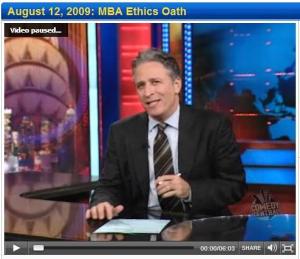
Nicolai Facebooked this the other day but neglected to share it with the wider blogosphere. The clip made me laugh out loud. Of course, I don’t agree with the premise, that business schools are responsible for the current crisis (and that the MBA Oath, which we discussed before, is the solution). But it’s still funny as Hades.
Times Are Tough
| Peter Klein |
At the University of Southern Mississippi, which is responding to the economic crisis by eliminating its economics department (Tomas Sjostrom via Sandeep Baliga). Even tenured faculty will go
Stanford dumped its Food Research Institute (where a good friend of mine was employed) about a decade ago, also terminating the contracts of tenured economists, though not in response to a particular external event (as far as know). I’m sure there are other examples. Thank goodness it wasn’t sociology!
Will Mitchell’s Comments on Receiving the BPS Irwin Award
| Russ Coff |
A big congratulations to Will for winning this prestigious award. It is really something to hear a person’s students describe how their mentor has altered their lives. Many misty eyes in the room…
Embedded in Will’s comments after receiving the award was an observation that in many business settings, such as in developing countries, effective business decisions cannot be made using the risk-based tools (like NPV) that are so often taught in business schools. He argued that, in the face of Knightian uncertainty, these tools fail miserably.
So what would be a set of tools to address uncertainty? The closest that I teach would be scenario analysis and real options. Here, one still needs to estimate parameters like the volatility of the investment or probabilities of outcomes (for decision trees or binomial trees). Of course, the assumption that these parameters could be known still suggests reflect risk rather than uncertainty. However, I emphasize sensitivity analysis (such as simulations, etc.) on these parameters to address the fact that they cannot be known.
First, is this the best set of tools available for Knightian uncertainty?
Second, is Will right that these are left out of most strategy courses? Perhaps we need to re-think the curriculum a bit…
Statistics Is Sexy
| Peter Klein |
So say Hal Varian, Erik Brynjolfsson, and Peter Orszag, among others quoted in this NY Times piece (via Laura M). “I keep saying that the sexy job in the next 10 years will be statisticians,” says Varian, who now toils away as chief economist at Google, though he’s not far from the hearts of most economics PhD students. Here’s Brynjolfsson: “We’re rapidly entering a world where everything can be monitored and measured. But the big problem is going to be the ability of humans to use, analyze, and make sense of the data.”
The article doesn’t actually say much about the substance of the “new” statistics, but the writer has in mind inductive, very-large-N, data-mining exercises (the kind of analysis not taught to social-science and business-administration graduate students, except perhaps some marketing and finance PhDs). Of course we still make our students take multiple semesters of classical statistics and econometrics.
Is This In the Training Manual for Academic Deans?
| Peter Klein |
Matilda, mother of King Henry II, advising her son on the business of royal patronage (quoted in Danny Danzinger and John Gillinghman, 1215: The Year of Magna Carta, London, Hodder and Stoughton, 2003, p. 178):
He should keep posts vacant for as long as possible, saving the revenues from them for himself, and keeping aspirants to them hanging on him hope. She supported this advice by an unkind parable: an unruly hawk, if meat is often shown it and then snatched away or hid, will become keener, more attentive, and more obedient.
 Speaking of deans, I happened to catch Indiana Jones and the Kingdom of the Cyrstal Skull the other day. The film, you probably know, takes place in the 1950s and centers on Indy’s confrontation with a group of Soviet treasure-hunters. Early in the film Indy loses his academic post because of suspected Communist sympathies. At the end, after defeating the bad guys (hope that’s not a spoiler), Indy not only gets his job back, but is made Associate Dean. That this is considered a reward shows how little anyone in Hollywood knows about university life!
The Five-Minute University
| Peter Klein |
This clip is making the rounds. How many of you Old Timers remember Father Guido Sarducci? Both economics and business get mentioned.
Kline Mystery Solved
| Peter Klein |
Thanks to Maureen Kline for solving the Peter Kline mystery:
Hi, just came across this post although it’s over a year old and you have surely solved the mystery by now; the “real” Peter Kline is my father, who currently lives in the Washington DC area (Silver Spring, MD). He started out as an English and Drama teacher in Washington area private schools, and co-founded Thornton Friends School in the 1970s. The school had a very innovative approach and great success, particularly in turning around “problem students.” Eventually he and his then-wife Nancy turned the school over to others to pursue other projects, and Dad has been “free-lancing” ever since, mainly training teachers in various school systems around the country, writing the books you mentioned, and doing extensive training within companies (Kodak, IDC and others).
Update: PK himself checks in with a comment to the original post.
Peter: If you get any of my letters from the Nobel Committee, will you please pass them on?
Does Economics Training Hinder Managers’ Ability?
| Benito Arruñada |
In a new paper with Xosé H. Vázquez we explore the consequences of using different behavioral assumptions in training managers on their future performance. We argue that training with an emphasis on the standard assumptions used in economics (rationality and self-interest) leads future managers to rely excessively on rational and explicit safeguarding, crowding out instinctive contractual heuristics and signaling a “bad” type to potential partners. In contrast, the behavioral assumptions used in management theories, because of their diverse, implicit, and even contradictory nature, do not conflict with the innate set of cooperative tools and may provide a good training ground for such tools.
We present tentative confirmatory evidence by examining how the weight given to behavioral assumptions in the core courses of the top 100 business schools influences the average salaries of their MBA graduates. Controlling for the average quality of their students and some other school characteristics, we find that average salaries are significantly higher at those schools whose core MBA courses contain a higher proportion of management courses as opposed to courses based on economics or technical disciplines. (more…)
How Active are Governments in the Morality Business?
| Benito Arruñada |
Brad Taylor doubts in his reaction to my previous post on organizations and markets in morality that:
The moral authority of the Church was anywhere near complete in even the most ardently Catholic societies. The Church claimed a monopoly on morality, and many people went along with it to a greater or lesser degree. This seems pretty close to what government does today. The state doesn’t simply create laws aimed at resolving the inevitable conflicts among people, but attempts to influence public opinion through various types of propaganda – telling people not to smoke or get drunk and dance, for example.
I would not claim that the Church enjoyed a monopoly, only that the production of morality was more organizational — i.e., it took place within organizations (the Church itself was divided in several organizations), was more centralized, and was made by specialized moralist experts (mainly, theologians and priests, but even with some specialization of priests between those who focused on taking care of parishes, preaching, and confessing). In contrast, I am inclined to think that morality is now produced more in the market: it is less centralized and is produced by generalists.
It is true, as Brad says, that governments play an increasing role, especially in many European countries where they (1) control most education, even introducing new mandatory courses on “Good Citizenship”; (2) run their own TV stations, with plenty of scope to manipulate its contents; and (3) are actively running advertising campaigns about everything from global warming to racism or the use of condoms.
However, there are many other powerful sources of morality that are purely market driven: e.g., Hollywood movies and commercial TV series; biologists, pop stars, and former politicians moonlighting as preachers for their favorite causes; reality shows; gossip media; and so on.
The Higher Education Bubble
| Peter Klein |
Will it be the next to burst? Yes, say Joseph Marr Cronin and Howard E. Horton. “Consumers who have questioned whether it is worth spending $1,000 a square foot for a home are now asking whether it is worth spending $1,000 a week to send their kids to college. There is a growing sense among the public that higher education might be overpriced and under-delivering.” Of course it is, which explains the unbridled hostility of the higher-ed establishment toward alternative organizational models. Adds Mark Taylor:
Make no mistake about it, education is big business and, like other big businesses, it is in big trouble. What people outside the education bubble don’t realize and people inside won’t admit is that many colleges and universities are in the same position that major banks and financial institutions are: their assets (endowments down 30-40 percent this year) are plummeting, their liabilities (debts) are growing, most of their costs are fixed and rising, and their income (return on investments, support from government and private donations, etc.) is falling.
These commentators do not, however, speculate on root causes. There’s no doubt the traditional model for producing higher education is grossly inefficient and that there’s been tremendous overinvestment in facilities and staff (malinvestment, in Austrian lingo) over many decades. But why, and why now? One hypothesis is that the democratization of higher education that began in the 1960s not only increased enrolments, but created a wedge between expectations of faculty (we’re here to create and disseminate knowledge and to challenge, engage, and enlighten our students — in the humanities, to teach them political slogans) and those of students (we’re here to party, find mates, and prepare for the job market). Another possibility is that political correctness has distorted the curriculum, creating large and well-funded departments in ethnic studies and postmodern literature with high overhead and few students, leaving insufficient resources for, and interest in, traditional subjects like math and history. What are some other hypotheses? (Thanks to Dennis Lubahn for the pointers.)
Organizations or Markets in Morality?
| Benito Arruñada |
Moral codes can be produced and enforced through markets or through organizations. In particular, Catholic theology can be interpreted as a paradigm of the organizational production of morality. In contrast, the dominant moral codes are now produced in something resembling more a market.
The organizational character of Catholicism comes from its centralized production and enforcement of the moral code by theologians and priests and the mediation role played by the Church between God and believers. The epitome of both features is the old institution of confession of sins, a cultural universal that reaches full sophistication — for good and for bad — within Catholicism. My forthcoming JSSR paper argues that confession was a strikingly organizational solution to the production and enforcement of morality, something that Western societies now do mostly through markets. (more…)
The MBA Oath
| Peter Klein |
As a manager, my purpose is to serve the greater good by bringing people and resources together to create value that no single individual can create alone. Therefore I will seek a course that enhances the value my enterprise can create for society over the long term. I recognize my decisions can have far-reaching consequences that affect the well-being of individuals inside and outside my enterprise, today and in the future. As I reconcile the interests of different constituencies, I will face choices that are not easy for me and others.
Therefore I promise:
- I will act with utmost integrity and pursue my work in an ethical manner.
- I will safeguard the interests of my shareholders, co-workers, customers and the society in which we operate.
- I will manage my enterprise in good faith, guarding against decisions and behavior that advance my own narrow ambitions but harm the enterprise and the societies it serves.
- I will understand and uphold, both in letter and in spirit, the laws and contracts governing my own conduct and that of my enterprise.
- I will take responsibility for my actions, and I will represent the performance and risks of my enterprise accurately and honestly.
- I will develop both myself and other managers under my supervision so that the profession continues to grow and contribute to the well-being of society.
- I will strive to create sustainable economic, social, and environmental prosperity worldwide.
- I will be accountable to my peers and they will be accountable to me for living by this oath.
This oath I make freely, and upon my honor.
This comes from a group of second-year Harvard MBAs and was featured in last Friday’s New York Times (HT: MGK). Here’s their blog. I eagerly await the analysis of the O&M commentariat.
Plowing Under Rural Sociology
| Peter Klein |
From Randy Westgren:
The aggie world, and to a lesser extent, the sociology world, is reacting to a decision by Washington State University to dissolve its Department of Community and Rural Sociology. There is a great deal of rancor developing about this type of budget-cutting strategy, as opposed to making everyone suffer equally. If one looks closely at the budget documents made public by WSU, the ag school is getting a smaller cut (5% teaching + 8% research) than many colleges, including the B-school (13%, 12 vacant positions). The budget plan can be found here. It looks like the Dean’s decision, rather than the CEO’s (The Dean is an agricultural economist).
I was stunned to see a comment to a piece written in Inside Higher Education on this battle from an engineering prof — well, not actually stunned, more like chagrined.
“As for the rural sociology department, while I can sympathize with their plight in Pullman I do not see the loss as intellectually serious. As a member of an engineering faculty at a major university for more than 25 years, I’ve known quite a few sociologists. Most of them publish little stories that are not much sounder empirically, and usually less interesting substantively, that a good fiction writer. With very few exceptions, sociologists I know and have known are mathophobes! The few who have some ability in math use it on their omnibus snapshots of human populations taken at widely spaced intervals and then try to figure out from those “data” what happened and why. Ridiculous! Continuous observation is probably not possible, but you need closely spaced observations that focus on the specific processes that are the point of your investigation! If you have continuous-time observations, you need calculus in order to analyze your data. If you have closely spaced discrete-time observations, you need something more than shotgun regressions to analyze your data. Most of what sociologists publish is a waste of time and money.”
Obviously, this scholar has not followed the closely reasoned defense of fuzzy, ill-defined concepts at orgtheory.net.
Teppo and Brayden, if you are watching, ask Dave Whetten about his take on the Chancellor of SUNY Albany who undertook a similar department-cutting strategy during the New York State budget difficulties of the late 1970s.
Missouri J-School Tastes the Apple
| Peter Klein |
Many colleges and universities require students to purchase a laptop with particular capabilities. Some schools are considering requiring Kindles or similar book readers. The University of Missouri School of Journalism, however, is going one better by mandating not just a particular type of device — in this case, a portable media player — but a particular brand. In a decision sure to warm Teppo’s heart, the school announced last week that incoming freshmen will be required to own an iPhone or iPod Touch. Not only are these high-end devices, for their class, but in the case of the phone a 2-year AT&T service contract is part of the package. The ostensible reason is to allow students to listen to recorded lectures and other multimedia presentations related to their coursework and projects.
If you think this places an unfair burden on students, given that they can listen to these materials on any personal computer and most portable music players, don’t worry: university officials immediately announced that the requirement won’t be enforced, but is merely a cynical ploy to let students add the cost of the fancy toy to their financial aid applications. No doubt makers of rival devices are delighted by the university’s move.
Skepticism and Greed
| Dick Langlois |
One of my University colleagues, who works in instructional technology, sent a few of us a post from a mailing list-blog at Stanford called Tomorrow’s Professor. The site has a lot of interesting stuff on teaching and the academy, which O&M readers may find interesting. But this particular post, reprinted from a blog at the Carnegie Foundation for the Advancement of Teaching, prompted me to send in a response. Here is what I said. (Take a look at the original post, but I think you can get the idea from my comment.)
I certainly endorse what I take to be the central idea of post 944 — that students of business and economics would benefit from a liberal education.
Having said that, however, let me also note that I think the post gets things exactly — and perhaps dangerously — backwards in many ways. It is a constant trope in the popular press that the idea of “free markets” is some kind of dogma among economists (and perhaps society more broadly). In fact, economists believe that markets exist only within institutional structures, and economics — even so-called free-market economics — is actually about getting the institutions right, not about letting people do whatever they want.
In my view, moreover, economists are the real skeptics in the academy. Despite his (marketing) claim to being a “rogue” economist, Steve Levitt of Freakonomics fame is actually a better model of what most economists do than is Ben Bernanke or Alan Greenspan. Unlike most other academics, economists are rewarded for taking skeptical and iconoclastic positions, at least when they can back those positions up with hard data and clear analysis.
By contrast, few people outside of economics departments or business schools have any understanding whatever about how and when — or even whether — individual action can lead to beneficial unintended consequences. Economics is actually counter-intuitive in many ways. Humans evolved in small bands of hunter-gatherers, and as a result our intuitions about how a large open society operates are often wrong or backwards.
For all these reasons, it seems to me odd to suggest that economists (and students of economics) are dogmatic and would be made more skeptical and thoughtful about the economy by studying other liberal fields. In my experience, it’s rather the opposite. (Which is not to say, of course, that students won’t benefit in many ways from studying other fields.)
The post itself is a case in point. It starts out in the right direction with a marvelous story from Keynes about the nature of the money supply. But then it goes on to talk about “greed” as the central issue, ending with a quote from Roosevelt that “heedless self-interest” is bad economics. In fact, however, it is pointing to “greed” that is unexamined dogma. Why exactly has the level of greed changed over time? Is that really an explanation of anything? In stark contrast, many professional economists (including such serious scholars of the crisis as John Taylor and Karl Case) would point out that the most fundamental cause of the crisis was the expansive monetary policy of the Fed, which pumped money into the system and caused an asset bubble. Our hunter-gatherer ancestors endowed us with intuitions about greedy individuals; but they didn’t leave us intuitions about how a fiat money system works in a huge economy of non-face-to-face exchange. That we have to learn in an economics course.
Diversity of Opinion at the University of Missouri
| Peter Klein |
Who says the modern US university doesn’t reflect the full diversity of American social, cultural, and political opinion? Sure, most of the faculty at my university are Birkenstock-wearing, tree-hugging, Prius-driving, union-loving, New-York-Review-of-Books reading ACLU supporters, but they also like to hear from the other side:
Chairperson of U.S. Communist Party to Speak on Campus
Sam Webb, the Chair of the Communist Party, USA, will be speaking on Tuesday April 28th at 7:00pm in Ellis Auditorium. The event is free and open to the public. Sam Webb’s speech will address the current role of/possibilities for the Communist Party, USA and other progressives in the current political climate, confronted as our country is with the economic crisis, environmental crises and two wars. Webb writes extensively on politics, economics, international affairs, and Marxism, and is the author of a number of theoretical pamphlets, including “Reflections on Socialism,” and “The Nature, Role and Work of the Communist Party,” both of which were published in English and Spanish.
Announcement sponsored by ORG — Organization Resource Group
Thanks to Per for noticing.
Missouri’s View of Charter Schools
| Peter Klein |
Missouri Democrat Chris Kelly, who represents my district in the state legislature, has introduced a bill rescinding a 2007 Missouri state board of education rule restricting the sale of public school buildings to charter schools. The 2007 rule prevents public school buildings from being sold to “charter schools, liquor stores, adult entertainment venues, distilleries, and landfills.”
IRBs Gone Wild
| Peter Klein |
We’ve noted before the strange behavior of university Institutional Review Boards. My own campus has a particularly prickly IRB, the result of an unpleasant incident a few years back involving the medical school. So, even social-science researchers must receive IRB training and have individual research projects — yes, every research project that involves “human subjects,” which includes research using secondary data — approved by the campus IRB.
My certification expired recently and I took an online test today to be re-certified. Some of you may find the questions interesting. Here is a selection. Keep in mind these are questions for an economist wishing to do research in economics and management, not for a pharmacologist or epidemiologist. (more…)





 Organizations and Markets
Recent Comments