Posts filed under ‘Education’
Shared Governance: Benefits and Costs
| Peter Klein |
Back in grad school I was regularly hectored by a fellow student about joining the Association of Graduate Student Employees (AGSE), our local collective-bargaining association. Despite his attempt to stigmatize me as a free rider, I never joined. I didn’t think I agreed with the organizations goals, and I was sure I didn’t want to be associated with AGSE’s parent organization, the United Auto Workers (go figure). One year there was even a strike, which I found silly (I scabbed).
This semester I’m getting repeated invitations to join the American Association of University Professors (AAUP). Again, I hesitate. Of course, as an American university professor, I’m happy to see more power, prestige, and perquisites go to American university professors (OK, specifically, to me). But the AAUP has a strange agenda. Its mission includes not only protecting academic freedom and defending the role of the university in public life, but also preserving shared governance. Having spent many years in university settings, I’m convinced that shared governance is grossly inefficient, at least most of the time. There can be benefits, of course, to offset these costs, as is the case with worker-owned cooperatives and other non-standard forms of organization. But one searches the AAUP’s website in vain for any analysis or evidence on shared governance. What are the benefits and costs, relative to other feasible organizational forms? Why should professors defend this peculiar institution? (more…)
A Picture Is Worth a Thousand Bullet Points
| Peter Klein |
An alert reader directs me to slide 241 of the slide pack for Dick Langlois’s Economics of Organization course. Click the image below for a look. Dick seems to be raising the point that Williamson’s TCE (as well as other theories of economic organization) pays insufficient attention to the processes by which firms reach their “optimal” organizational structures. TCE holds that firms try to minimize (or should minimize) the sum of production and transaction costs. But do firms actually do this? Do they make mistakes? Do they experiment and learn? Is the selection environment strong enough that inefficient organizational choices are quickly eliminated, or do inefficiencies persist? (The problem is particularly important for empirical literature on organizational form — see pp. 440-42 of this paper.) Or, can we assume, with Dr. Pangloss, that whatever is, is optimal?
 To illustrate the point, Dick includes a photo of Williamson giving a seminar, with some additional background art — an etching from Candide — added to the frame. If you’re not paying attention you might think the etching is part of the original. I give Dick points for cleverness, but my anonymous correspondent finds the illustration a bit too subliminal. What do you think?
Debt Bites Back
| Steve Phelan |
A nice cartoon presentation of the debt crisis by the Wasington Post that you might want to use in your classes.
Two questions:
1) Is the story essentially correct or is it overly damning?
2) What are the organizational implications of this story – for institution and policy building?
We can only assume that all sorts of “corrective” measures will be planned and taken in the immediate future. I believe we should be getting involved in the debate by honing our theoretical position. We are watching economic history in the making.
The Urban Toilet
| Peter Klein |
That’s the title of SCA 90.001, offered this semester at New York University’s Department of Social and Cultural Analysis. Professor Harvey Molotch’s syllabus, writes Ben McGrath in the New Yorker, “reads almost like a parody of Allan Bloom’s worst nightmare, bringing the jargon of gender and ethnic studies, city planning, and industrial design to bear on the most euphemized of subjects.” The reading list includes
- Jo-Anne Bichard, Julienne Hanson and Clara Greed, “Please Wash Your Hands.” The Senses and Society 2(3): 385-90.
- Barbara Penner, “A World of Unmentionable Suffering: Women’s Public Conveniences in Victorian London.” Journal of Design History 14 (2001): 35-52.
- Mitchell Duneier, “When You Gotta Go.” From Sidewalk.NY: Farrar Straus & Giroux, 1999.
- Lee Edelman, “Men’s Room,” in Joel Sanders, ed., Stud: Architectures of Masculinity. Princeton Papers on Architecture Series. New York: Princeton Architectural Press, 1996.
Apparently Clara Greed, of the World Toilet Organization, is a major player in the field. In class one day Molotch read aloud something by Greed about “the restroom revolution which is going on in the Far East.”
“Does she use the phrase ‘Far East’?” a young woman asked, sounding incredulous. “It’s really Western-centric, obviously.”
“O.K., so Clara stepped into that one, but she’s otherwise good on toilets,” Molotch said.
Thanks to Travis Kavulla for the pointer.
The SMG in EMR
| Nicolai Foss |
The latest issue of the European Management Review features an article (here, scroll down to “Project Report”), “Knowledge Governance in a Dynamic Global Context: the Center for Strategic Management and Globalization at the Copenhagen Business School,” which details the history of said Center (SMG). I happen to be the Director of the SMG. The article tells a rosy story of a talented cohort of CBS PhD students whose careers followed convergent paths, eventually leading to the establishment of the SMG, and raves about the ambitions and current accomplishments of the members of the Center. Oh, did I mention that I am the author of the article?
Impact of B-School Research
| Peter Klein |
The AACSB has released its Impact of Research Task Force Report. Key excerpt:
The Task Force believes that it is critical for business schools to find ways to continuously enhance the value and visibility of scholarship and research of all types — basic, applied, and pedagogical. Through its analysis, the Task Force has uncovered five issues that, if addressed by AACSB International, its member schools, and other organizations, could assist business schools to achieve their fullest potential from scholarship and research. First, current measures of intellectual contributions focus on inputs rather than outcomes. That is, the focus is on how faculty spend time (engagement in scholarship) and not on the value of outcomes produced (impact of scholarship on intended audiences). Second, business school and individual faculty incentives tend to create an overwhelming emphasis on discipline-based scholarship at the expense of contributions to practice and to pedagogical development. Third, the relationship between management research and teaching and the
mechanisms to support their interaction, especially when these functions are not always performed by the same people, are not well-understood. Fourth, there are inadequate channels for translating academic research to impact practice. Fifth, opportunities to support deeper, more continuous interaction between faculty and practicing managers on questions of relevance have not been fully developed.
The recommendations are fairly generic — require accredited schools to demonstrate the impact of faculty research, find ways to reward faculty for producing high-impact work, study more closely the links between scholarship, education, and practice, and so on. There’s less detail on exactly how impact should be measured, however. A few examples are given:
- number of practitioners or firms adopting new approach or developed practice
- awards by industry or professional associations
- adoptions and integration in curricula of schools
- sales of book
- number of regional/national/international presentations
- reviews in magazines (e.g., BusinessWeek, Forbes)
These are all fine, but it’s difficult to imagine criteria that can be applied consistently across disciplines, across types of research (basic versus applied), and so on.
Here is some commentary from Inside Higher Ed.
Medieval Business Schools
| Peter Klein |
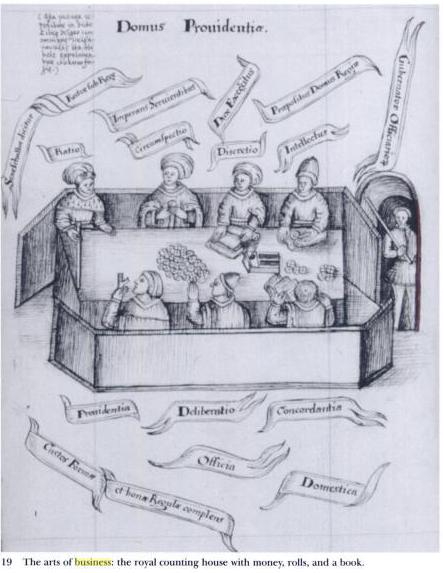
Contrary to popular belief, formal education in medieval times was not restricted to the clergy and the very wealthy. Nor was theology the most popular subject. Independent schools, unaffiliated with any particular religious body or royal institution and staffed by lay people, were common, and even taught business administration (writing letters, drafting contracts, keeping the books).
So says Nicholas Orme in Medieval Schools: From Roman Britain to Renaissance England (Yale, 2006). (Thanks to Tom Woods for the pointer.) In Britain, grammar schools were often supported by wealthy patrons and were open to students of modest means. Notes Orme:
Most [English] schoolmasters were probably broad rather than specialized teachers, catering for a wide range of needs, so it is not surprising that a brand of practical teacher emerged by the fourteenth century (at latest), offering more focused instruction for careers in trade and administration. Such instruction might include “dictamen” (the art of writing letters), the methods of drafting deeds and charters, the composition of court rolls and other legal record, and the keeping of financial accounts. Since documents of these kinds were often written in French between 1200 and 1400, the practical teachers came to teach French too.
This illustration, from p. 69 of the book, depicts such a class. How did they do it without PowerPoint?
CEOs as University Presidents
| Peter Klein |
I could have titled this post “University Presidents as CEOs,” focusing on the characteristics and responsibilities of university administrators. But I’m interested here in universities hiring former corporate CEOs, rather than career educators, as presidents. Gary Forsee, Sprint-Nextel CEO from 2005 to 2007, became my boss yesterday when he began his term as President of the University of Missouri System. Forsee’s selection last year raised hackles among some faculty because he holds only a bachelor’s degree and has no faculty or university administrator experience. (A greater concern, among some faculty, was the eagerness with which Sprint, under Forsee’s leadership, participated in the Bush Administration’s warrantless wiretapping program.) The University of Colorado is apparently in a similar situation, though with far greater controversy.
Does a university president need a PhD? Under the university-as-guild model, hiring a leader from outside the guild is unthinkable, akin to bringing in Richard Dawkins to head the Catholic Church, or hiring a guy who never played in the NBA to coach an NBA team (actually, that happened). On the other hand, if the university is just another service organization, then hiring leaders from outside makes perfect sense. (more…)
Economics of Higher Education: Sophism versus Virtue
| Peter Klein |
Donald R. Stabile’s new book Economics, Competition And Academia: An Intellectual History of Sophism versus Virtue (Elgar, 2007) contrasts the customer-oriented, for-profit model of education (which Stabile calls “sophism”) with the patronage-supported, non-market model (“virtue”). Stabile reminds us that the notion of higher education as a commercial enterprise was invented not by the University of Phoenix, but by the ancient Greeks. The Sophists believed in teaching practical subjects that students wanted to know, while Plato and Aristotle, wealthy aristocrats whose schools didn’t depend on student fees, favored the teaching of timeless truths independent of student demand. Reviewer Donald Frey thinks Stabile’s framework lacks precision; still, the book sounds like an interesting read.
Tyler Cowen’s In Praise of Commercial Culture, which traces the history of patronage (and, its modern-day equivalent, state funding) and market-based approaches in art, music, and literature, is worth consulting in this context. And don’t miss Paul Cantor’s lectures on commerce and culture, which you can listen to here.
The Stabile dust-jacket blurb is below the fold. (more…)
Dress for Success
| Peter Klein |
 The professorial dress code has long been an object of (gentle) ridicule. “This diagram explains why I’m an expert on money yet I dress like a flood victim,” says an economics professor in a recent Dilbert strip. I remember one from years back in which an older professor says to the younger, “Congratulations on making tenure! Here are your elbow patches.”
Erik Jensen argues that professors should, instead, conduct themselves in a professional manner, which includes professional dress. For men that means jackets and ties; for women, suits or modest, professional dresses. His proposed Uniform Uniform Code: “Faculty members shall, when on college grounds or on college business, dress in a way that would not embarrass their mothers, unless their mothers are under age 50 and are therefore likely to be immune to embarrassment from scruffy dressing, in which case faculty members shall dress in a way that would not embarrass my mother.”
When I started my career I wore a tie every day in class, but eventually quit. This semester I’m teaching a class at Olin, where ties are the norm (except among the economists, apparently), and am wearing one again. I’d really prefer a gown, however. And when did students quit bowing?
Choosing a Dissertation Topic
| Peter Klein |
 One of my PhD students sent me this (click to enlarge), from PhD Comics. Nothing as fancy as grad skool rulz, but a useful analysis nonetheless.
This Week’s Sign of the Apocalypse: Naming-Rights Edition
| Peter Klein |
You want your name associated with a university but can’t afford to fund a building, classroom, or endowed professorship. Not to worry, there are other options:
It’s an offer the University of Colorado couldn’t flush away: A Boulder venture capitalist paid $25,000 for the naming rights to a bathroom in the Boulder campus’ ATLAS building.
And so it is that the second-floor men’s bathroom in the high-tech hub now has Brad Feld’s name on it and a plaque with some words of wisdom from the donor: “The best ideas often come at inconvenient times. Don’t ever close your mind to them.” . . .
“I just wanted a plaque outside of the men’s room to inspire people as they walk in to do their business,” Feld said.
Perhaps this should be our next continuing series.
Why Business Ignores the Business Schools
| Peter Klein |
That’s the title of Michael Skapinker’s essay in the Financial Times (via Kenneth Amaeshi), which focuses on academic research in business administration (not teaching). Unlike their counterparts in law, medicine, and engineering, Skapinker argues, B-school professors focus almost exclusively on impressing their peers, leading to work that is too abstract, jargon-filled, and theoretical to interest practitioners. He blames not only the usual publish-or-perish incentives, but also the fact that “[w]ithin the university world, business schools suffer from a long-standing inferiority complex.” B-school faculty “prefer to adorn their work with scholarly tables, statistics and jargon because it makes them feel like real academics.” Ouch.
Interesting discussion fodder, and Skapinker is surely right that some research in management suffers from scientistic pretensions (perhaps less so in finance and accounting). I do think Skapinker overstates the close relationship between research and practice in medicine. (Try asking your family physician about something you read in the New England Journal of Medicine, or ask for a confidence interval on the point estimate you’re given about the likelihood drug X will cure your condition Y.)
Economists on Interdisciplinarity
| Peter Klein |
I missed the ASSA/AEA session “What Should Be the Core of Graduate Economics?” featuring Susan Athey, Ed Gleaser, Bo Honoré, Blake Lebaron, Derek Neal, and Michael Woodford but there is a write-up in the Chronicle (gated, though a free version is temporarily available here). Gleaser offers perhaps the most interesting comment for the O&M crowd:
“We actually shouldn’t be thinking narrowly in terms of first-year economics.” . . . “We should be thinking about first-year social science. The whole division between economics, sociology, and political science feels like a hangover from the 19th century. So many of the people in our profession are working on problems that have traditionally been seen as part of sociology or political science.
“We should probably be rethinking from the ground up all of the social sciences,” Mr. Glaeser continued. “A more attractive model might be a first-year course sequence that trains a social scientist to work on anything, rather than having separate first-year economics, sociology, and political science course work. But maybe that’s a discussion for a different panel.”
My guess is that such a first-year sequence would have two much economics-based sociology, economics-based political science, and the like to satisfy our friends at orgtheory.net. But it is an intriguing possibility. (more…)
Why Study the Humanities?
| Peter Klein |
Stanley Fish (not one of my favorites) channels G. H. Hardy:
To the question “of what use are the humanities?”, the only honest answer is none whatsoever. And it is an answer that brings honor to its subject. Justification, after all, confers value on an activity from a perspective outside its performance. An activity that cannot be justified is an activity that refuses to regard itself as instrumental to some larger good. The humanities are their own good.
What about the social sciences? Certainly they purport to be”useful,” in a way that the humanities do not. Scholars of business administration hope their research improves business practice. Economists maintain that sound public policy requires the economist’s unique understanding of complex social phenomena. (more…)
EU Research Productivity
| Steve Phelan |
Interesting post over at Vox EU on EU Research Productivity. Basically a recent study examines the ISI List of Highly Cited Researchers (HCRs) by country,
the United States gets the lion’s share with 66% of the total number of HCRs, while the EU17 (EU15 plus Norway and Switzerland) has 22.3%.
They then use an econometric model to estimate the effects of R&D expenditure as % of GDP, GDP per capita, Anglo-Saxon academic institutions, and the proportion of English speakers.
Raising R&D to 3% of GDP was predicted to increase EU share to only 28%. Interestingly, university governance reforms were predicted to increase performance the most (by an additional 9%).
The article is very vague about the supposed institutional benefits conferred by the US/UK academic system that generate the higher performance. If this result is true, then what is the reason? Is it more efficient incentives such as an up-or-out promotion based on top tier publications? Is it better PhD training? Is it higher rewards for top performers?
That being said, is the “the list of highly cited researchers on ISI” an appropriate dependent variable to measure comparative research performance? Is it biased towards US researchers? Note that English proficiency only explained 3-4% of the performance gap.
New Challenges for Business Educators
| Peter Klein |
Tuesday’s WSJ ran an interview with Daphne Atkinson, vice president for industry relations at the Graduate Management Admission Council (the organization that owns and administers the GMAT and provides various recruiting services for business schools). The interviews focuses on the challenges schools face in attracting and educating the newest generation of MBA students (the so-called Millennials). A few passages caught my eye:
[The current generation has] the sense that it is either irrelevant or meaningless to “pay dues.” It can be disappointing to find out that you won’t be president of the company in two years. Millennials want their dream job as early as possible. But entry-level jobs are seldom dream jobs, although they may be at dream companies or in dream industries.
Could the current emphasis on entrepreneurship, creativity, and the like — we are all entrepreneurial and creative, we just have to discover and nurture our inner entrepreneur — be partly responsible? (more…)
This Week’s Sign of the Apocalypse
| Peter Klein |
The University of Chicago’s Graduate School of Business now requires prospective students to submit a PowerPoint presentation as part of their applications (via Cliff). “We wanted to have a freeform space for students to be able to say what they think is important, not always having the school run that dialogue,” says Rose Martinelli, associate dean for student recruitment and admissions. “To me this is just four pieces of blank paper. You do what you want. It can be a presentation. It can be poetry. It can be anything.” I suppose requiring a written essay, in English prose and following conventional rules of grammar and style, would be unduly confining.
According to Dean Martinelli, as reported in the Washington Post, students “won’t be judged on the quality of their slides. Rather the slides are an outlet for judging the kind of creativity the business world needs.” Adds second-year MBA student Michael Avidan: “If there’s one foundation of business, it’s innovation, and this is your chance to elevate yourself and show you can do something innovative.” Huh?
Pros and Cons of Academic Blogging
| Peter Klein |
Scott Eric Kaufman, a PhD candidate in English literature who blogs at Acephalous, says academic blogging connects scholarship to the wider world:
There’s no reason our community needs to consist solely of people we knew in grad school. Why not write for people who don’t already how you think about everything? Why not force yourself to articulate your points in such a way that strangers could come to know your thought as intimately as your friends from grad school do?
The informal publishing mechanisms available online can facilitate such communication so long as bloggers write for an audience informally. Senior faculty might continue to orient their scholarly production to the four people whose scholarly journals don’t pile up in the corner of the living room, slowly buried beneath unpaid bills and unread New Yorkers. Whether they know it or not, bloggers write for an audience larger than the search committees we hope to impress. They have already started eye-balling the rest of the world, asking themselves how they can communicate with it without seeming to pander to it.
But the signal-to-noise ratio is very low, counters Adam Kotsko, a PhD student in theology: (more…)
Integrity and the Academy: Are Academicians in a Position to Preach About Social Responsibility?
| David Hoopes |
Do college faculty — generally untrained in ethics (except for philosophy professors, etc.) — have any business teaching social responsibility and ethics? This question comes from my most recent post.
I interviewed for a job at the Army War College a few years back. I was fortunate enough to hear a high-ranking general speak to the students (mostly lt. colonels). One of things he said is that he stayed in the armed services because of the high integrity of its members. I know in some corners this will be scoffed at. However, I think there is no small amount of truth to this.
I thought, “Cannot say that about academia.” Why so cynical? There are many things one could complain about. There are more passive-aggressive people in the academy than most other place. Academics seem especially prone to speaking with a forked tongue.
The clearest example I can think of is the tenure process. Certainly the tenure process can bring the worst out in people. Beyond that, it is amazing how sexually biased the tenure process seems to be. It is especially amazing to see how entrenched the “old boy” network is among men who fancy themselves liberal or progressive.
I have no proof that the tenure process is sexually biased. Nevertheless, in management it certainly seems easy to think of women getting left out of the loop. Thus, fewer social interactions, fewer coauthored papers, less mentoring. Now part of this may have to do with where I have worked: schools that have had multiple discrimination and harassment charges brought against them.
Yet, I don’t think this is limited to management departments. It’s pretty strange that an institution that fancies itself as being so progressive is so backwards when it comes to mentoring and networking women through the old (or young) boys clubs.
Here is a link that offers some evidence. I found the stuff at the bottom of the page most useful.





 Organizations and Markets
Recent Comments