Posts filed under ‘Entrepreneurship’
Mahoney and Pitelis Talk Public Entrepreneurship
| Peter Klein |
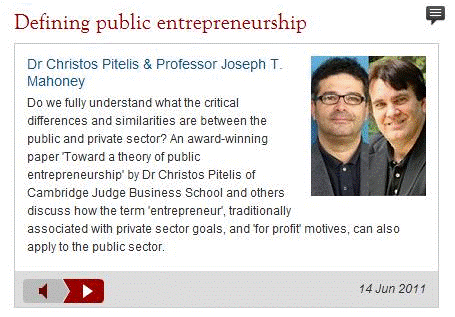
Here’s a podcast with my colleagues and good friends Joe Mahoney and Christos Pitelis on public entrepreneurship, part of an ongoing research project on public-private boundaries. Check it out!
Upcoming Conferences
| Peter Klein |
- ISNIE, 16-18 June in Palo Alto. Registrations are closed but latecomers could try lobbying the Treasurer to accept a late payment — never mind, that’s me, don’t bother.
- “Open Source, Innovation, and New Organizational Forms,” 1 August in Johannesburg. “This first IPEG conference intends to explore new theoretical and empirical advances in open source organization: the interest is not just on voluntary Open Source Software production and its potential innovation implications, but also on such related ‘open source’ phenomena as collective invention, online collaboration (e.g., Wikipedia), online social networking (e.g., Facebook), open innovation, open science, open source biology, and open standards.” The conference website is not live as of this posting, but organizer Giampaolo Garzarelli can provide details. O&M’s Dick Langlois is a keynote speaker. 500-word abstracts are due 24 June.
- “Achieving Coexistence of Biotech, Conventional & Organic Foods in the Marketplace,” 26-28 October in Vancouver. Speakers include FAO Deputy Director General Ann Tutweiler and Canadian Ag Minister Gerry Ritz. Coexistence conferences have been held every other year since 2003; the first 3 conferences came out of EU Commission efforts, the next was in Australia, and this one is the first to be held in North America. A co-organizer tells me “we hope to bring a more ‘practical’ view of coexistence than is commonly held in Europe.”
Miscellaneous Links
| Peter Klein |
- A public service from our good-twin site: What makes a good review?
- History matters? “[T]he descendants of societies that traditionally practiced plough agriculture, today have lower rates of female participation in the workplace, in politics, and in entrepreneurial activities, as well as a greater prevalence of attitudes favoring gender inequality.”
- Another review of The Invention of Enterprise, by frequent O&M commenter Michael Marotta.
- Regression to the mean? A McKinsey report (via Russ) illustrates the difficulty of long-run supra-normal growth: “a startling 44 percent of all companies that grew at rates faster than 15 percent from 1994 to 1997 were growing at rates lower than 5 percent ten years later.”
- Another attempt to model the evolution of cooperation — this time by Acemoglu and Jackson.
Henry Manne on Entrepreneurship
| Peter Klein |
Important new paper by Henry Manne on entrepreneurship (Quarterly Journal of Austrian Economics, Spring 2011). It won’t surprise you to know that Henry has a solution to the problem of encouraging entrepreneurial behavior among corporate managers: allow them to trade on inside information.
Entrepreneurship, Compensation, and the Corporation
Henry G. ManneThis paper revisits the concept of entrepreneurship, which is frequently neglected in mainstream economics, and discusses the importance of defining and isolating this concept in the context of large, publicly held companies. Compensating for entrepreneurial services in such companies, ex ante or ex post, is problematic — almost by definition — despite the availability of devices such as stock and stock options. It is argued that insider trading can serve as a unique compensation device and encourage a culture of innovation.
The Evolution of Entrepreneurial Skill
| Peter Klein |
Market competition is often characterized as an evolutionary selection process. “[O]ne of the main functions of profits is to shift the control of capital to those who know how to employ it in the best possible way for the satisfaction of the public. The more profits a man earns, the greater his wealth consequently becomes, the more influential does he become in the conduct of business affairs” (Mises, “Profit and Loss,” 1951). Within a given population, then, the market process selects for those individuals with the greatest levels of entrepreneurial skill. But can the emergence of entrepreneurial skill as a human trait itself be explained in terms of natural selection? Here’s one attempt:
Evolution and the Growth Process:
Natural Selection of Entrepreneurial Traits
Oded Galor, Stelios Michalopoulos
NBER Working Paper No. 17075, May 2011This research suggests that a Darwinian evolution of entrepreneurial spirit played a significant role in the process of economic development and the dynamics of inequality within and across societies. The study argues that entrepreneurial spirit evolved non-monotonically in the course of human history. In early stages of development, risk-tolerant, growth promoting traits generated an evolutionary advantage and their increased representation accelerated the pace of technological progress and the process of economic development. In mature stages of development, however, risk-averse traits gained an evolutionary advantage, diminishing the growth potential of advanced economies and contributing to convergence in economic growth across countries.
This is a (mathematical) theory paper with “entrepreneurship” modeled as tolerance for risk, so some readers will find the execution less interesting than the idea. But it is good to see these kinds of big-picture issues addressed in the mainstream literature.
Klein Even Bigger
| Lasse Lien |
More has been added to Peter’s already considerable pile of honors and distinctions. This time it’s the European Management Review’s best paper award for 2010 for “Toward a Theory of Public Entrepreneurship,” European Management Review 7: 1-15 (2010) by Peter G. Klein, Joseph T. Mahoney, Anita M. McGahan, and Christos N. Pitelis. (Here’s the version at the publisher’s website.)
Congratulations to Peter and coauthors!
ACAC 2011
| Peter Klein |
The Atlanta Competitive Advantage Conference, otherwise known as ACAC, starts tomorrow. I’m there, along with former O&M guest bloggers Joe Mahoney, Steve Postrel, and Russ Coff, and a whole bunch of interesting and important people in strategy, organization theory, entrepreneurship, innovation, HRM, and more. Check out the program, as well as the main site with information about past and future events. Besides the workshops and paper sessions there are special events like a symposium with Jay Barney on the RBV after 20 years and keynotes from Rebecca Henderson and Joel Baum. The only thing ACAC needs is a spokesperson — I think Gilbert Gottfried might be available.
CFP: Economics and Strategy of Entrepreneurship and Innovation
| Peter Klein |
Forwarded on behalf of Dan Spulber:
CALL FOR PAPERS
Journal of Economics & Management Strategy (JEMS)
Economics and Strategy of Entrepreneurship and Innovation IIIJEMS is planning a third special issue on the economics and strategy of entrepreneurship and innovation. JEMS welcomes both empirical and theoretical contributions.
Possible topics include:
- Economics of entrepreneurship
- Innovation and entrepreneurship
- R&D and the entrepreneur
- Intellectual property rights and the entrepreneur
- Entrepreneurship and the theory of the firm
- Entrepreneurship and finance
- Entrepreneurship and industrial organization
- Entrepreneurship and economic growth
Submissions to JEMS will be subject to the standard peer-review process. The submission deadline is July 1, 2011. To submit a manuscript to JEMS, visit ScholarOne at http://mc.manuscriptcentral.com/jems. If you have any questions about JEMS, please contact Susie Caruso at editjems@kellogg.northwestern.edu.
4 Percent Project
| Peter Klein |
 On the way back from Brazil I will stop in Dallas to speak on entrepreneurship at a conference on economic growth, The 4 Percent Project, sponsored by the newly formed George W. Bush Presidential Center. The main speakers include four Nobel Laureates (Becker, Lucas, Scholes, Prescott), Ed Lazear, Allan Meltzer, Meg Whitman, Art Laffer, and W himself. I’m on a breakout panel with Bob Litan, Maria Minniti, and Jeff Friedman. The conference is the brainchild of O&M friend John Chapman, and should be quite an event!
Confusing Definitions of Entrepreneurship
| Peter Klein |
Some of you have heard me complain before about the confusing ways “entrepreneur” and its cognates are used in the literature. Sometimes entrepreneurship refers to an outcome or phenomenon (startups, self-employment, high-growth firms), other times to a behavior or attribute (creativity, alertness, innovation, judgment, adaptation). I find the occupational, structural, and functional taxonomy useful, but other organizing schemes may be useful too. In any case, reading the entrepreneurship literature can be a frustrating experience.
I’m glad I’m not the only one who thinks so:
[T]he book’s diversity of approaches and styles is both a strength and also an inherent weakness. Some chapters offer comprehensive descriptions over long periods of time (e.g., Hudson, Hau, Wengenroth, Chan), while others focus on narrow aspects of entrepreneurship (e.g., Yonekura and Shimizu, Mokyr, Wolcott). The first kind appears to be written for a broad audience of noneconomic historians, whereas the second type tends to be drier and more technical. Some authors follow Baumol and distinguish between productive and redistributive entrepreneurship (e.g., Hudson, Mokyr, Cain, Lamoreaux), while others use very broad definitions of entrepreneurship (e.g., Kuran, Casson and Godley, Gelderblom), and yet another group of authors associates entrepreneurship with innovation (e.g., Yonekura and Shimizu, Graham). This extreme diversity of definitions and approaches can overwhelm the reader. As a result, the volume’s ambition of tracing “the history of entrepreneurship throughout the world since antiquity” (p. vii) ends up being an interesting patchwork of insights drawn from different times and places rather than a unifying and synthetic history.
That’s from Michaël Bikard and Scott Stern’s Journal of Economic Literature review of The Invention of Enterprise: Entrepreneurship from Ancient Mesopotamia to Modern Times (ed. David S. Landes, Joel Mokyr, and William J. Baumol, Princeton, 2010), which we blogged about earlier. Obviously in a work of this scope, a common definition of entrepreneurship is likely to be elusive. But the wide variety of meanings in this lone volume give you a sense of the challenge in making sense of the wider literature.
FAIL
| Peter Klein |
Check out AdmittingFailure.com,
an open space for development professionals who recognize that the only “bad” failure is one that’s repeated. Those who are willing to share their missteps to ensure they don’t happen again. It is a community and a resource, all designed to establish new levels of transparency, collaboration, and innovation within the development sector.
Thanks to Josh Gans for the tip and some interesting discussion of failure in other contexts. (I’m not sure I’d use the term “missing market,” though; M&As, bankruptcy court, and indeed any asset markets could be described as markets for failure!)
Here’s an interesting paper by Rita McGrath on entrepreneurial failure. And of course there are huge academic literatures on divestitures, bankruptcies, and the like. At O&M we’ve often criticized bailouts and stimulus policy for retarding Schumpeterian competition by making it more difficult to identify, rectify, and learn from failures.
McQuinn Center for Entrepreneurial Leadership
| Peter Klein |
Earlier this academic year I assumed the Directorship of the McQuinn Center for Entrepreneurial Leadership here at the University of Missouri. My colleague (and former O&M guest blogger) Randy Westgren retains the position of McQuinn Chair. The McQuinn Chair was established in 2004 through a generous gift from Al and Mary Agnes McQuinn, and the Center was created soon afterwards by Bruce Bullock, the inaugural McQuinn Chair.
Look for a slate of exciting programs and activities about entrepreneurship, organization, innovation, strategy, and more in the coming months. To keep you up to date on the Center’s activities, as well as news and information from the wider world of entrepreneurship, we’re blogging as well at entrepreneurship@McQuinn.
Freedom to Trade and the Competitive Process
| Dick Langlois |
That’s the promising-sounding title of a new NBER Working Paper by Aaron Edlin and Joseph Farrell. Unfortunately, the argument turns out, in my opinion, to be extraordinarily wrongheaded. Here is the abstract.
Although antitrust courts sometimes stress the competitive process, they have not deeply explored what that process is. Inspired by the theory of the core, we explore the idea that the competitive process is the process of sellers and buyers forming improving coalitions. Much of antitrust can be seen as prohibiting firms’ attempts to restrain improving trade between their rivals and customers. In this way, antitrust protects firms’ and customers’ freedom to trade to their mutual betterment.
The promising part is that they talk explicitly about the competitive process.
The freedom-to-trade perspective . . . stresses the freedom of buyers and sellers to change their trading partners whenever that is mutually beneficial. The aspect of the competitive process that we study here is buyers and sellers exercising this freedom and forming improving coalitions (i.e., new configurations of trading partners). In a highly competitive market a seller who does not give its customers good deals will find that rivals offer better deals to attract these customers. The process of firms fighting over customers and offering them better and better deals raises consumers’ utility skyward. This competitive process is closely aligned with what Schumpeter called creative destruction.
As anyone who has read Schumpeter knows, of course, this is not even close to what he actually meant by creative destruction. (more…)
Oxford Handbook of Human Capital
| Peter Klein |
I just received a copy of the Oxford Handbook of Human Capital, edited by Alan Burton-Jones and J.-C. Spender, and it looks terrific. The concept of “human capital” came from developments in macroeconomics and labor economics (and, it is often forgotten, entrepreneurship) but is increasingly influential in organization and strategy research. (Witness, for example, the new SMS Strategic Human Capital Interest Group.) These Handbook chapters “reveal the importance of human capital for contemporary organizations, exploring its conceptual underpinnings, relevance to theories of the firm, implications for organizational effectiveness, interdependencies with other resources, and role in the future economy,” says the cover blurb. O&M readers may especially like the section on “Human Capital and the Firm,” with chapters on TCE (by Foss), agency theory (Spender), the RBV (Jeroen Kraaijenbrink), entrepreneurship and the theory of the firm (Brian Loasby), and the knowledge-based theory of the firm (Georg von Krogh and Martin Wallin). Check it out!
The Forgotten: “Alternative Views of Mengerian Entrepreneurship”
| Peter Klein |
A film blog I follow, the Mubi Daily Notebook (formerly called The Auteurs Notebook) runs a regular feature called “The Forgotten,” showcasing obscure but important older titles. I propose doing the same thing here. Our first entry is a 1979 article by Dolores Tremewan Martin, “Alternative Views of Mengerian Entrepreneurship” (History of Political Economy 11, no. 2). Martin provides an excellent summary and critique of Menger’s subtle approach to the entrepreneur, one largely ignored in the current entrepreneurship literature, even among Austrian economists. Contrasting Schumpeterian and Knightian views on entrepreneurship, Martin argues that Menger’s position is close to Knight’s (and, hence, that Knight is much closer to the Austrian school than is generally recognized).
As Martin points out, Menger’s entrepreneur (Unternehmer) is a resource-owning, information-acquiring coordinator seeking to acquire and combine undervalued assets (using an “input-computing capacity”). Entrepreneurial activity is scarce, in that it is associated with ownership of scarce capital, but also “unique in that, unlike other goods of higher order, it is not intended for exchange and therefore does not command a price.” There are important differences bewteen Menger and Knight concerning types of uncertainty and the effect of uncertainty on profit. Still:
Menger does not treat the entrepreneur as being the “innovator,” “mover,” or “force of change.” Menger places stress on the entrepreneurial function and the role of uncertainty, not innovation, as giving rise to the possibility for rewards. As Schumpeter [the historian of economic thought] suggests, the economic process viewed by Carl Menger is essentially similar to that of Frank Knight. . . . For Menger (as for Knight) the entrepreneurial activity consists of a more correct — “more rational” — evaluation of goods of higher order. This view contrasts with Schumpeter’s personification of the entrepreneur as the hero of the capitalist drama.
Three New Review Papers
| Nicolai Foss |
Although they are in general not highly regarded, I love writing review papers. Writing such a paper is an excellent opportunity to revisit classic papers. Sometimes you get a new idea while reflecting on the current research frontier. They are great for establishing research contacts, for although review papers may not be cited a lot, they are read a lot. And they can usually be put quickly together. Here are three new review papers/chapters written over the last month or so:
- “Entrepreneurship in the Context of the Resource-Based Theory of the Firm.” Written for Kevin Mole and Monder Ram, eds., Perspectives in Entrepreneurship (Palgrave).
- “The Emerging Strategic Entrepreneurship Field.” Written with my PhD student Jacob Lyngsie for Daniel Hjorth, ed., Handbook of Organisational Entrepreneurship (Elgar).
- “Entrepreneurship and the Economics of the Firm.” Written with Peter G. Klein and Peter’s PhD student Per L. Bylund for the above-mentioned Hjorth volume.
Entrepreneurship Nobel to Steven Klepper
| Nicolai Foss |
The Global Award for Entrepreneurship Research may not quite be the real thing, but it is Swedish, highly prestiguous, and 100k Euro is still quite a bit of money. The Prize is administered and financed by the Research Institute of Industrial Economics, the Swedish Foundation for Small Business Research, and the Swedish Agency for Economic and Regional Growth. Earlier recipients include Joshn Lerner, David Audretsch, Scott Shane, William Baumol, and Israel Kirzner.
O&M congratulates the Prize Committee for an excellent choice and CMU Professor Steven Klepper for receiving the Prize. Klepper’s work is rigorous, yet highly realistic and relevant. It takes process, heterogeneity, and entrepreneurship seriously, and demonstrates that such research is capable of being published in the very best economics journals. Here is the Committe’s motivation for the choice of Klepper:
Steven Klepper has made significant contributions to our understanding of the role of new firm entry in innovation and economic growth. His work is theoretical and integrative, firmly rooted in empirical observation of historical innovative processes, focusing on explaining “empirical regularities.” Klepper’s work integrates elements of traditional neoclassical models with evolutionary theory, bridging some of the gaps between neoclassical and evolutionary theory and between entrepreneurship research and mainstream economics.
In looking at the evolution of industries, Klepper explores regularities in the time paths of entry of new producers, exit of incumbent firms, industry output and price, and the rate of product and process innovation. To explain these regularities, he develops theories that feature differences in firm capabilities and the advantages of large firms in appropriating the returns from their innovative efforts. The theories are also used to explain differences in firms’ innovative efforts, the composition of their innovative effort and their innovative success.
His work is founded on systematic longitudinal empirical analyses requiring massive, detailed, and painstaking collections and analyses of historical data on firm entry, exit, size, location, distribution networks, and technological choices. The focus is on the function of new firms in industrial growth as well as the background and heritage of new entrants, particularly as reflected in spinoffs from existing firms.
Kirznerian versus Knightian Entrepreneurs in Film
| Peter Klein |
Kirzner’s entrepreneur is a pure discoverer who owns no capital. Knight’s entrepreneur is an uncertainty-bearing, resource owner with skin in the game. So who do you think is the real entrepreneur, Jerry Lundegaard or Wade Gustafson?
Bonus: my favorite scene from Miller’s Crossing, useful to illustrate the differences between action (emphasized by Knight) and cognition (emphasized by Kirzner): (more…)
The Value of Steve Jobs
| Peter Klein |
As you have likely heard, Steve Jobs is taking an indeterminate leave of absence from Apple to deal with his continuing health problems. How will this affect Apple? How important is one person — albeit the founder and CEO — to a diversified multinational company with tens of thousands of employees? Apple’s stock slipped slightly on the news of Jobs’ leave (down 2.3 percent today, the first trading day after the announcement), but Jobs’s health problems are well known and Apple’s stock price presumably already included a discount reflecting the possibility he’d step down. To estimate the value of a particular employee to the firm in this way, we need an unanticipated departure, one that isn’t a response to poor performance and isn’t expected in advance.
Sure, enough, there’s an app for that — I mean, there’s a literature on that. An influential 1985 paper by Bruce Johnson, Robert Magee, Nandu Nagarajan, and Harry Newman looked at stock-price reactions to CEO deaths by plane crash, finding positive announcement effects for founders and negative announcement effects for professional managers. (One way to handle the founder-succession problem!) Macabre, I know, but nonetheless a clever way to deal with endogeneity. Naturally, this paper spawned a follow-up literature. Rather than cite the papers myself, I’ll just block quote a paper by Bang Dang Nguyen and Kasper Meisner Nielsen presented at last week’s AEA meeting, “What Death Can Tell: Are Executives Paid for Their Contributions to Firm Value?” and you can chase down the references on your own: (more…)
Entrepreneurship Lives!
| Scott Masten |
At the ASSA meetings in Denver this weekend, O&M impresario Peter Klein gave a typically (for him) enlightening and entertaining presentation on “Institutions and Entrepreneurial Opportunities: A New Approach.” (An audience member gushed afterward that it was one of the best presentations she had ever seen. Perhaps Peter can provide a link to the paper.) To illustrate one of his points, Peter used images of ruins from once-glorious buildings in Detroit such as this one:

Peter’s point was that, though on its face, such abandoned structures would appear to present unrealized entrepreneurial opportunities, such opportunities were probably illusory in light of Detroit’s decline.
In fact, Peter, in a rare lapse, simply failed to look deeply enough into the question. Entrepreneurship is alive and well even in Detroit! (more…)





 Organizations and Markets
Recent Comments