Posts filed under ‘Entrepreneurship’
AEA Papers on Organizations, Institutions, and Entrepreneurship
| Peter Klein |
O&M readers attending the American Economic Association annual meeting in Denver may find these papers of particular interest:
Industrial Policy, Entrepreneurship, and Growth
PHILIPPE AGHION (Harvard University)Does Management Matter: Evidence from India
NICHOLAS BLOOM (Stanford University)
BENN EIFERT (University of California-Berkeley)
APRAJIT MAHAJAN (Stanford University)
DAVID MCKENZIE (World Bank)
JOHN ROBERTS (Stanford University)Efficiency and Adaptation in Organizations and Institutions
PETER G. KLEIN (University of Missouri-Columbia)
JOSEPH T. MAHONEY (University of Illinois)
ANITA M. MCGAHAN (University of Toronto)
CHRISTOS N. PITELIS (University of Cambridge)The Coevolution of Culture and Institutions in Seventeenth Century England
PETER MURRELL (University of Maryland) (more…)
Google Tries Selective Intervention?
| Peter Klein |
Can a large firm do everything a collection of small firms can do, and more? If not, how do we understand the limits to organization? Arrow focused on the information structure inside firms. I favor Mises’s economic calculation argument. Williamson’s preferred explanation for the limits to the firm is the impossibility of selective intervention — the idea that higher-level managers cannot credibly commit to leave lower-level managers alone, except when such selective intervention would generate joint gains. Williamson’s argument is not, however, universally embraced (or even understood the same way — see the comments to Nicolai’s post).
Google apparently sees things Williamson’s way and has formulated an explicit policy on “autonomous units” designed to address the problem. Such units “have the freedom to run like independent startups with almost no approvals needed from HQ, ” reports TechCrunch. “For these divisions, Google is essentially a holding company that provides back end services like legal, providing office space and organizing travel, but everything else is up to the pseudo-startup.” Can it work? Insiders are doubtful. The TechCrunch reporter even frames Williamson’s thesis in this folksy way:
There’s a lie that companies and entrepreneurs tell themselves in order to commit to an acquisition.
Oh, we’re not going to change anything! We’re just going to give you more resources to do what you’ve been doing even better!
Yeah! They bought us for a reason, why would they ruin things?
It usually works for a little while, but big company bureaucracy– whether it’s HR, politics or just endless meetings– almost always creeps in. It’s a law of nature: Big companies just need certain processes to run and entrepreneurs hate those processes because they stifle nimble innovation.
CFP: “Competition, Innovation and Rivalry”
| Peter Klein |
The European Society for the History of Economic Thought (ESHET) is having its 15th annual meeting 19-22 May 2011 at Bogazici University, Istanbul. A special themed section, headlined by keynoters (and O&M friends) Dick Nelson and Stavros Ioannides, is “Competition, Innovation and Rivalry”:
The way in which innovation has been described, categorised, contextualised and theorised by various figures as well as schools of thought in the discipline of economics warrants a thorough investigation from a history of economic thought perspective. Although it is a truism that some approaches in economics by focusing on the conditions of allocating resources efficiently within a static framework failed to consider innovation properly, other approaches by underscoring the evolutionary characteristics of the economy, and thus by paying attention to dynamic efficiency, aimed at shedding light on innovation in an explicit manner. Knowledge and entrepreneurship standing as natural ingredients of innovation, much debate has been devoted to the roles played by competition, rivalry and collaboration among economic actors. A corollary of this debate has been on the characterisation of different economic systems in boosting or hampering innovation. . . . We are interested in papers that expose the history of economic ideas concerning innovation, competition and rivalry as well as papers that provide a historical or methodological perspective concerning methodological, ideological and political debates which evolved around these concepts.
Abstracts are due 15 December; see the above link for details.
Henry Manne on Behavioral Economics
| Peter Klein |
Henry Manne’s contribution to the Truth on the Market symposium on behavioral economics brought to mind Lasse’s recent post (and the accompanying brilliant paper) on the survivor principle:
What I would like to point out . . . is the irrelevance of much of the substance of Behavioral Economics for “doing” economics. My principal (as a matter of fact my sole) authority for this proposition (though some of Gary Becker’s work also comes to mind) is the magnificent classic article by Armen Alchian, Uncertainty, Evolution, and Economic Theory, 58 JPE 211 (1950). In this work Alchian is himself taking on the “full information” assumption of the classical model, which is actually broader than the rationality assumption attacked by the Behavioralists. The basic conclusion of that work is that, even if individuals or firms make totally uniformed choices (to say nothing of merely somewhat irrational ones) the end result as far as the allocation of resources is concerned will be the same as in the traditional model. This is so because the theory of competition in the classical model is itself a survival theory, and the survival mechanism will operate to winnow out the less efficient uses to which resources will unknowingly or irrationally be put, even if the human actors don’t understand the process or their role in it. Of course, an economy based on this (again) purely heuristic assumption of perfect ignorance would not be as productive as one in which information and rationality play their usual assigned roles, but the difference may not be so great as would first appear and there is nothing peculiar or earth-shattering about finding that there are transactions costs in the world and that in equilibrium they will be accounted for. And, as one begins to add notions of imitation and improvement, as Alchian does, one gets very close to a highly descriptive model of the real economy, and one which has plenty of room in it for all sorts of irrational behavior but without throwing the received theory out with the bath water.
The point that behavioral economics neglects the role of market competition as a moderator between individual behavior and aggregate outcomes is a good one. (We’ve discussed other problems with behavioral approaches before.) Still, I side with Kirzner in his debate with Becker; an entrepreneurial view of the market requires some notion of purpose or intent — I prefer the term judgment — but one far removed from the neoclassical economics, straw-man notion of “rationality” attacked by the behaviorists.
My Proudest Academic Achievement
| Peter Klein |
I’ve produced so many seminal papers in my long and distinguished career that I can’t name them all. Um, I can’t name any, actually. But here’s one for the ages: “‘They Have the Internet on Computers Now?’ Entrepreneurship and Economics in the Simpsons.” It’s coauthored with talented Missouri PhD students Per L. Bylund and Christopher H. Holbrook and is forthcoming in Joshua Hall, ed., Homer Economicus: The Simpsons and Economics (Springer, 2011), which should be on every economics and management teacher’s bookshelf.
Entrepreneurial Ability as a Latent Variable
| Peter Klein |
It’s the weekend after Thanksgiving, so naturally I’m thinking about residuals — not leftover turkey and cranberry sauce, but entrepreneurial characteristics and behaviors as residuals, as latent variables that leave traces in outcomes that we can’t otherwise explain. I’ve argued before that common measures of entrepreneurship such as startups, self-employment, patents, venture funding, etc., while related to entrepreneurship, are epiphenomena, manifestations of an underlying, unobservable attribute or behavior such as judgment, alertness, innovation, or adaptation. (These are difficult, if not impossible, to measure directly; asking survey respondents, for instance, “How many opportunities did you identify this month?” is not quite the same thing as measuring Kirznerian alertness!) In a recent musing on strategic entrepreneurship I suggested that
many of the entrepreneurial capabilities we’re really interested in are latent, and best captured as residuals — e.g., something heritable and not explainable by other observables. . . . Mike Wright talked [at the CBS strategic entrepreneurship conference] about mobility, both across firms or projects (habitual entrepreneurs, spin-outs) and across countries (immigrant and returnee entrepreneurs, transnational entrepreneurs). From the perspective of research design, some of these movements may be useful for isolating the “entrepreneurial” essence, such as it is.
Seth Carnahan, Rajshree Agarwal, and Ben Campell have an interesting new paper, “The Effect of Firm Compensation Structures on the Mobility and Entrepreneurship of Extreme Performers,” that takes this kind of approach, measuring entrepreneurial ability as the residual in a wage regression. Most of the variation in wages can be explained by age, experience, race, gender, education, and other observables; what remains is partly measurement error, but can also include a latent ability parameter. Seth, Rajshree, and Ben use this parameter, along with the wage structure of an employee’s existing firm, to explain which employees tend to leave to join new firms, particularly startups. Check it out!
Interesting New Books
| Peter Klein |
In place of the “What I’ve Been Reading Lately” posts that show up regularly on certain blogs, I hereby offer something slightly less egocentric, the “What I’ve Been Receiving Lately” post. It contains a list of books I’ve recently received by mail, some by choice, others because publishers sent them (perhaps hoping I’d blog about them — Mission Accomplished!). Not the most scientific sample selection process, but there you go.
- Jesús Huerta de Soto, Socialism, Economic Calculation, and Entrepreneurship (Elgar, 2010). English translation of an important work first published in Spanish in 1992.
- Guinevere Liberty Nell, Rediscovering Fire: Basic Economic Lessons from the Soviet Experiment (Algora, 2010). What the failure of central planning teaches about markets and institutions.
- Koray Çaliskan, Market Threads: How Cotton Farmers and Traders Create a Global Commodity (Princeton, 2010). Economic sociology meets global commodity systems. Contains dust-jacket endorsements from Richard Swedberg and Donald MacKenzie, so expect a review from the orgtheory boys soon.
- Peter J. Boettke, ed., Handbook on Contemporary Austrian Economics (Elgar, 2010). Essays by young Austrian economists associated with George Mason University.
- Robert E. Wright, Fubarnomics: A Lighthearted, Serious Look at America’s Economic Ills (Prometheus, 2010). I think the title says it all.
- Ranjay Gulati, Reorganize for Resilience: Putting Customers at the Center of Your Business (Harvard Business School, 2010). Looks fluffy, but I have a teaching interest in change management so I’ll give it the benefit if the doubt.
- David Stark, The Sense of Dissonance: Accounts of Worth in Economic Life (Princeton, 2009). Also deals with organizational change, but in a more serious way. Ethnographic studies of three organizations dealing with large exogenous shocks. Looks interesting.
Random Thoughts on Strategic Entrepreneurship
| Peter Klein |
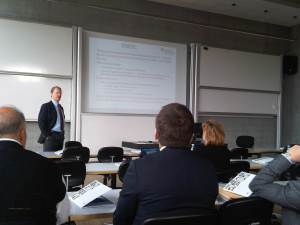
A few insights, interesting facts, provocative statements, and other things I managed to remember from the conference:
- As Nicolai mentioned in his post below, there is a lot of exciting work out there on the links between organizational design and characteristics (HRM practices, organizational culture, social learning processes, team characteristics, etc.) and entrepreneurial behavior. This is clearly a hot topic at the boundary of the strategic management, organizational behavior, entrepreneurship, and innovation literatures.
- This emerging literature is pretty eclectic, theoretically and empirically. The conference featured papers with formal models, conceptual theory papers, conventional econometric papers, simulation papers, and of course thought-provoking keynote addresses. The participants came from a variety of academic backgrounds and specialty areas.
- It’s a young field. The four keynote speakers (Mike Wright, Bill Schulze, Shaker Zahra, and Jeff Hornsby) are pioneers in the field, and not that old. (Shulze noted that he had been present “at the birth” of the modern entrepreneurship field, and he looks pretty spry and vigorous to me.)
- The empirical literature still struggles to operationalize entrepreneurship in a meaningful way. Despite various sermons about entrepreneurship being a generalized function, rather than a job description or firm type, most empirical papers use self-employment, management of particular kinds of firms, etc. as proxies. (I’m guilty of this myself, of course.) (more…)
The Emerging Strategic Entrepreneurship Field
| Nicolai Foss |
“Strategic entrepreneurship” has emerged as a field in the intersection of strategic management and entrepreneurship. It has its own specialized journal, Strategic Entrepreneurship Journal, now in its fifth year of existence. Some of the pioneers of strategic entrepreneurship characterize the field in the following manner:
Strategic entrepreneurship is the integration of entrepreneurial (i.e., opportunity-seeking actions) and strategic (i.e., advantage-seeking actions) perspectives to design and implement entrepreneurial strategies that create wealth. Thus, strategic entrepreneurship is entrepreneurial action that is taken with a strategic perspective” ( Hitt, Ireland, Camp & Sexton, 2002:2).
I am excited by this research stream and think that its attempt to identify the antecedents of new value creation in the context of established firms is entirely warranted (at least in management research, entrepreneurship has too often been associated solely with new firm formation). And yet, strategic entrepreneurship is clearly a field in search of a core and an identity.
It is not yet entirely clear whether the field amounts to more than relabelling existing “dynamic” strategic management ideas (e.g., dynamic capabilities, real options), ideas that have been around in entrepreneurship research for some time (e.g., entrepreneurial orientation), and ideas from innovation theory. It is also not clear what fundamental view of the firm is underlying this research. Given that extant entrepreneurship has had a strong emphasis on individuals, it is striking that individuals do not really seem to be present in strategic entrepreneurship research. It is not made clear, or even discussed, what role organization design (the design of organizational structure and control) plays for the discovery, evaluation and exploitation of opportunities.
The Center (soon Department) of Strategic Management and Globalization at the Copenhagen Business School has arranged a conference that is dedicated to furthering strategic entrepreneurship by “bringing organization design and micro-foundations into the field.” The conference begins tomorrow and features such luminaries as Shaker Zahra, Jeff Hornsby, Bill Schulze and Mike Wright — and O&M’s Peter Klein. More to come …
CFP: Searle Center Conference on Entrepreneurship and Innovation
| Peter Klein |
I’m a big fan of the Searle Center conferences on entrepreneurship and innovation, organized by Dan Spulber. The Call for Papers for the fourth annual conference, 16-17 June 2011, has just been distributed. “The goal of this conference is to provide a forum where economists and legal scholars can gather together with Northwestern’s own distinguished faculty to present and discuss high quality research relevant to entrepreneurship and innovation.” Details below the fold. (more…)
Entrepreneurial Paradoxes
| Peter Klein |
A new working paper from the always-interesting Peter Lewin: “Entrepreneurial Paradoxes: Implications of Radical Subjectivism.” Sample paradoxes:
- Entrepreneurial opportunities are complicated by uncertainty but would not exist without uncertainty.
- An entrepreneurial opportunity for everyone is an opportunity for no one in particular.
- Entrepreneurial opportunities are subjective and objective; discovered and created.
See the paper for the full set of paradoxes and some informative and challenging discussion.
Entrepreneurial Firms and Job Creation: Size Matters Not
| Peter Klein |
 The view that small and new firms create a disproportionate share of new jobs is one of the most important stylized facts of the entrepreneurship literature. But, as always, the devil is in the details. Small and new firms naturally grow at a faster rate than their large, mature counterparts, ceteris paribus, simply because they have few employees to start with. But they differ on a number of other grounds and have a higher hazard rate. What’s the bottom line?
John Haltiwanger, Ron Jarmin, and Javier Miranda have taken a close look at the US data and conclude that age, not size, is what matters.
There’s been a long, sometimes heated, debate on the role of firm size in employment growth. Despite skepticism in the academic community, the notion that growth is negatively related to firm size remains appealing to policymakers and small business advocates. The widespread and repeated claim from this community is that most new jobs are created by small businesses. Using data from the Census Bureau Business Dynamics Statistics and Longitudinal Business Database, we explore the many issues regarding the role of firm size and growth that have been at the core of this ongoing debate (such as the role of regression to the mean). We find that the relationship between firm size and employment growth is sensitive to these issues. However, our main finding is that once we control for firm age there is no systematic relationship between firm size and growth. Our findings highlight the important role of business startups and young businesses in U.S. job creation. Business startups contribute substantially to both gross and net job creation. In addition, we find an “up or out” dynamic of young firms. These findings imply that it is critical to control for and understand the role of firm age in explaining U.S. job creation.
Missouri Information Encountering Workshop
| Peter Klein |
Sorry for the late notice, but my local readers may be interested in a two-day workshop today and tomorrow on the Opportunistic Discovery of Information, a version of information encountering with close parallels to Israel Kirzner’s concept of entrepreneurial discovery. Sanda Erdelez can provide more information.

Do Economic Freedom and Entrepreneurship Impact Total Factor Productivity?
| Nicolai Foss |
Cross-country studies of the antecedents and consequences of entrepreneurship have become something of a cottage industry. My contribution to the industry is an earlier paper with Christian Bjørnskov, as well as rather recent one, also written with Christian, “Do Economic Freedom and Entrepreneurship Impact Total Factor Productivity?” (and we have a third paper in the works with a certain Klein).
In the former paper we analyzed institutions and economic policies as determinants of entrepreneurship, paying particular attention to “freedom variables,” like sound money and a stable legal framework. In the latter paper, we focus on where the action is in the growth process, namely Total Factor Productivity, and proffer Austro-institutional arguments why entrepreneurship and the institutions associated with a free society may be expected to positively impact TFP.
While we find that entrepreneurship strongly and significantly impacts TFP, our results only partially support the intuition that institutions of liberty as well as liberal economic policies promote growth in productivity. In fact, we find no significant effects of sound money and legal quality on TFP in the medium run. When some of the freedom variables are interacted with the entrepreneurship variable, we in fact find that entrepreneurial activity is more effective in raising levels of TFP in environments dominated or strongly influenced by government activity, either through production in government-owned enterprises and investments or in its financing activities. Thus, increasing the active involvement of the government in the economy as well as the tax burden actually increases the impact of entrepreneurship on TFP. Our explanation of this somewhat surprising finding is that a reduced supply of entrepreneurship increases the marginal productivity of entrepreneurship; thus, the best ideas do survive even in the relatively hostile welfare state environment. (more…)
Upcoming Public Appearances
| Peter Klein |
It’s a slow news day, blogospherically speaking, so I thought I’d share information about some of my upcoming public appearances, for reasons that have nothing at all to do with self promotion:
“Entrepreneurship, Strategy, and the Financial Crisis: Lessons from the Austrian School”
Sherlock Hibbs Distinguished Lecture in Business and Economics
24 September 2010, 2:00-3:30pm
205 Cornell Hall, Trulaske College of Business
University of Missouri
“Entrepreneurship and the Financial Crisis”
27 September 2010, 7:00pm
N021 Business Complex
Michigan State University
“Getting Out the Word: Alternative Research, Teaching, and Outreach”
Mises Institute Supporters Summit
8-9 October 2010
Auburn, Ala.
Austrian Economics PhD Course
| Peter Klein |
This semester I am teaching a PhD course in the Austrian school of economics. Here’s a preview. Visitors to Columbia, Missouri are welcome to sit in!
Excerpt from the syllabus:
It is difficult to cover an entire school of thought in one semester. Austrian economics, after all, is not an applied field like development economics or international trade policy or biotechnology but an alternative approach to all fields of economics. The course objective is not to provide a comprehensive review and critique of the entire Austrian tradition, but to give students a sampler of high-quality Austrian writings, classic and modern, on a variety of issues and topics. One goal is to show that while Austrian economists share a common conceptual framework, theoretical core, and historical context, the Austrian literature contains tremendous variety, both stylistic and substantive. Like any living, breathing tradition the Austrian literature continues to expand and diversify, often at a dizzying pace.
Add to: Facebook | Digg | Del.icio.us | Stumbleupon | Reddit | Blinklist | Twitter | Technorati
New Books on Entrepreneurship
| Peter Klein |
 Princeton University Press has just published Will Baumol’s latest work, The Microtheory of Innovative Entrepreneurship. One of the celebrity dust-jacket endorsers (OK, me) says: “Baumol is one of the giants in the entrepreneurship field. The Microtheory of Innovative Entrepreneurship will be widely read, discussed, and debated, and is likely to have a significant impact on the scholarly conversation.” Hmmm, that’s a bit pedantic. But it’s really a very interesting book, though Baumol defines entrepreneurship differently than I do (as a Schumpeterian, he identifies entrepreneurship primarily with innovation and economic growth). The book is oriented more towards mainstream economists than management scholars, but both groups will benefit from Baumol’s careful and scholarly treatment.
 Next month Oxford is bringing out Amar Bhidé’s A Call for Judgment: Sensible Finance for a Dynamic Economy. HBR is running an excerpt titled “The Judgment Deficit” that is worth a read. There Bhidé writes:
As we rebuild from the economic crisis, we must renew the search for the appropriate balance — in finance and in other endeavors — not just between centralization and decentralization but also between case-by-case judgment and standardized rules. The right level of control is an elusive and moving target: Economic dynamism is best maintained by minimizing centralized control, but the very dynamism that individual initiative unleashes tends to increase the degree of control needed. And how to centralize — whether through case-by case judgment, a rule book, or a computer model — is as difficult a question as how much. But these are questions that we cannot afford to stop asking.
While Bhidé doesn’t offer a formal definition of judgment, his treatment in earlier books makes extensive use of Knight (and Hayek), and I think he has in mind the kind of middle ground between formal rule-following and randomness that was central to Knight’s understanding of entrepreneurship.
Add to: Facebook | Digg | Del.icio.us | Stumbleupon | Reddit | Blinklist | Twitter | Technorati
O&M in Lund
| Peter Klein |
 Nicolai and I, along with Jay Barney and John Matthews, are headlining the 2010 Holger Crafoord Memorial Symposium on “Strategy and Entrepreneurship,” 7 September 2010 at the Lund School of Economics and Management. The symposium is free but registration is required; details at the link above. Lund is a lovely university town, a short train ride (via the Øresund Bridge) from Copenhagen and hence easy to reach. A good time will be had by all.
Add to: Facebook | Digg | Del.icio.us | Stumbleupon | Reddit | Blinklist | Twitter | Technorati
WikiLeaks and Napster
| Peter Klein |
 Apropos my WikiLeaks post, comparing the recent data dump to the data-sharing and data-mining practices increasingly common in academia, a Thursday New Yorker post by Raffi Khatchadourian takes the New Economy framing even further, comparing Wikileaks to Napster. “Shutting WikiLeaks down — assuming that this is even possible — would only lead to copycat sites devised by innovators who would make their services even more difficult to curtail.” The recording industry shut down Napster, spawning Bittorrent — a far more dangerous competitor. Khatchadourian says the Defense Department should “consider WikiLeaks a competitor rather than a threat, and to recognize that the spirit of transparency that motivates [Wikileaks founder Julian] Assange and his volunteers is shared by a far wider community of people who use the Internet.” Had the DoD had released the footage of the 2007 Apache helicopter attack itself, rather than waiting for WikiLeaks to publish it on YouTube, it could probably have contained the damage much more effectively. Naturally, I wouldn’t expect the DoD — or the RIAA — to be that smart. (HT to TechDirt via David Veksler.)
Add to: Facebook | Digg | Del.icio.us | Stumbleupon | Reddit | Blinklist | Twitter | Technorati
Uncertainty and Human Action in Fiction
| Peter Klein |
 From Ursula Le Guin’s 1969 novel The Left Hand of Darkness:
“The unknown,” said Faxe’s soft voice in the forest, “the unforetold, the unproven, that is what life is based on. Ignorance is the ground of thought. Unproof is the ground of action. If it were proven that there is no God there would be no religion. No Handdara, no Yomesh, no hearthgods, nothing. But also if it were proven that there is a God, there would be no religion. . . . Tell me, Genry, what is known? What is sure, predictable, inevitable — the one certain thing you know concerning your future, and mine?”
“That we shall die.”
“Yes. There’s really only one question that can be answered, Genry, and we already know the answer. . . . The only thing that makes life possible is permanent, intolerable uncertainty: not knowing what comes next.”
The phrase “permanent, intolerable uncertainty” brings to mind Knight’s famous remark in Risk, Uncertainty, and Profit about the “the sheer brute fact that the results of human activity cannot be anticipated.”
Add to: Facebook | Digg | Del.icio.us | Stumbleupon | Reddit | Blinklist | Twitter | Technorati





 Organizations and Markets
Recent Comments