Posts filed under ‘Entrepreneurship’
Strategic Entrepreneurship Conference at CBS
| Nicolai Foss |
As many O&M readers will know, “strategic entrepreneurship” has emerged as an exciting new research field in the intersection of, well, strategic management and entrepreneurship. In a very broad (perhaps too broad) reading, the field is taken up with explaining the emergence of essentially entrepreneurial acts of those competitive advantages that are so central to the strategic management field. In recognition of the very close links between the strategic entrepreneurship field and the strategic management field, the Strategic Entrepreneurship Journal was established in 2007 as a sister journal to the Strategic Management Journal.
However, like many other macro management fields, strategic entrepreneurship pays rather little attention to the micro-foundations of the explanation of its macro explanandum, firm-level entrepreneurship. Moreover, the influence of formal structure and organizational control on the discovery, evaluation and implementation of opportunities at the firm level has been remarkably under-researched.
To meet these challenges, I have arranged, assisted by my two highly able PhD students, Stefan Linder and Jacob Lyngsie, a conference, “Strategic Entrepreneurship: Bringing Organization Design and Micro-foundations Into the Field,” to take place at the Copenhagen Business School, 11-12 November 11-12 2010. Keynote speakers include such luminaries as Jeff Hornsby, Bill Schulze, Mike Wright and Shaker Zahra. Peter Klein fans will be pleased to be informed that it is quite likely that he will participate!
Here is the — still quite preliminary — conference site. Submit a paper!
Add to: Facebook | Digg | Del.icio.us | Stumbleupon | Reddit | Blinklist | Twitter | Technorati
Intro to The Capitalist and the Entrepreneur
| Peter Klein |
Here’s a nicely formatted HTML version of the introduction to The Capitalist and the Entrepreneur. I’d apologize for the self-promotion but, well, isn’t that the whole point of blogging?
(PS: Those of you who like to run your transactions through Amazon can get the book here. Not sure about a Kindle edition but I’m told an epub version will be available soon.)
Add to: Facebook | Digg | Del.icio.us | Stumbleupon | Reddit | Blinklist | Twitter | Technorati
Manne on Fama and French
| Peter Klein |
An open letter to Gene Fama and Ken French from Henry Manne (also running today at Truth on the Market):
Dear Gene and Ken:
I must say that I was totally flabbergasted when I read your recent blog posting on insider trading. I know that your usual posts on investments, which I often cite to friends, are well-informed and empirically supported; your work over the years on these topics is important and influential — and rightly so. Unfortunately, in this post, you have deviated from your usual high quality. Anyone current on the topic of insider trading will recognize that you have been careless in your selection of anti-insider-trading arguments and that you omitted from your brief note the major part of the argument about insider trading: whether and how much it contributes to market efficiency. To say this is a strange omission coming from Fama and French would be an understatement.
Your first error is to assume that the insider trading debate is about informed trading only by “top management.” I suspect that this error may flow from my original argument for using insider trading to compensate for entrepreneurial services in a publicly held company, a matter you do not mention and which I will not pursue here except to note that “entrepreneurial services” does not equate to top management. Strangely no one seems to notice that most of the celebrated cases on the subject have not involved corporate personnel at all (a printer, a financial analyst, a lawyer, and Martha Stewart). (more…)
Scribd Version of Book
| Peter Klein |
I just learned I can embed the full document right here in a blog entry. Very cool!
Add to: Facebook | Digg | Del.icio.us | Stumbleupon | Reddit | Blinklist | Twitter | Technorati
The Capitalist and The Entrepreneur: Available Now!
| Peter Klein |
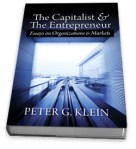 My new book, The Capitalist and the Entrepreneur: Essays on Organizations and Markets (Mises Institute, 2010), is now available. For a limited time, you can get it for just $15 — a bargain at half the price! Actually, the resource-constrained among you can read the Full Monty here, free of charge. A PDF version is also available. A promotional essay appears today on Mises.org.
The editorial and production staff did a terrific job, and I’m thrilled with the volume’s look and feel. The contents aren’t bad either!
Order two or more and I will personally send you a set of Ginsu knives.
Add to: Facebook | Digg | Del.icio.us | Stumbleupon | Reddit | Blinklist | Twitter | Technorati
Readings for Hayek-Klein Day
| Peter Klein |
Here are some readings to help you celebrate tomorrow’s Hayek-Klein Day:

- Klein’s Biography of Hayek
- Hayek and Entrepreneurship
- Austrian Economics and Strategic Management
- The Use of Knowledge in Firms
- Austrian Economics and the Transaction Cost Approach
- Rothbard and Hayek
- Hayek versus Hayek
Add to: Facebook | Digg | Del.icio.us | Stumbleupon | Reddit | Blinklist | Twitter | Technorati
The Invention of Enterprise: Reviews
| Peter Klein |
If you haven’t yet had a chance to read Landes, Mokyr, and Baumol’s 600-page baby, The Invention of Enterprise: Entrepreneurship from Ancient Mesopotamia to Modern Times, here are reviews by Mansel Blackford and Reuven Brenner. Blackford is impressed; Brenner, not so much. Brenner is worth quoting at length:
[L]arge chunks of the book are more about the topic of inhibitions to enterprise and both the variety of ideas people came up with to rationalize them and the institutions rulers and governments put in place to enforce these ideologies. . . .
Unfortunately most of the chapters dealing with the topic of inhibitions miss the forest from the trees, as not one addresses what is to me the basic issue when examining “the invention of enterprise.” There is nothing more threatening to an established order — any order — than opening up, deepening, democratizing capital markets — accountably, allowing people to leverage their inventive, enterprising spirit. True, this would also disperse power — political power in particular. The deeper capital markets would also threaten established industries and commerce. Entrepreneurs, brilliant and ambitious as they might be, are not a threat. They can be sent to Siberia, forced into complacency by the Maos of this world, and the opportunistic ones will channel their ambition through the established powers.
But entrepreneurs with access to different, independent sources of risk capital — now that’s threatening, be they Brin and Page, Jobs or Milken at the time (quickly taking away much of the banks’ bread and butter of providing loans). Understanding this, even if not wanting to articulate it, provides enough incentives for those in power to subsidize, spread, and promote ideas and institutions inhibiting the deepening of capital markets under a wide variety of jargons, and thus inhibiting the invention and reinvention of enterprises. With time, people get accustomed to these institutions, their origins lost in the mist of time, inhibiting entrepreneurship and business for centuries. Today this may be happening a bit before our eyes. Suddenly, everything becomes a “bubble” — Internet, oil, houses, gold, bonds. Guess what: if everything is — why have capital markets to start with? If pricing no longer offers guidance to allocate capital; if stock and bond markets are not there to help correct mistakes faster — why should they continue to exist? And if they do not exist, who else remains but politicians, bureaucrats and the academics surrounding them — none of whom ever worked in a business even one day in their lives — who would then tax and borrow and subsequently allocate capital and “invent enterprises” based on — well — whatever.
Add to: Facebook | Digg | Del.icio.us | Stumbleupon | Reddit | Blinklist | Twitter | Technorati
Lazear on Leadership
| Peter Klein |
Ed Lazear tries his hand at the leadership literature in “Leadership: A Personnel Economics Approach.” The paper fits closely with his earlier work on entrepreneurship (here and here). Intuition:
The view presented [here] is that leaders are individuals who confront new situations often and choose the right direction in a high proportion of cases. Leaders also have the ability to identify situations where their skills will be needed and to do this frequently in a public setting. As a result of their success in choosing direction, and because the success is observable to others, leaders acquire followers who turn to the leaders for guidance in new and ambiguous situations. Individuals follow those who make correct decisions for a variety of reasons, the most direct of which is that they will boost their own probabilities of being correct by mimicking the decisions of the leaders. Thus, a leader is someone who has both vision and wisdom and who attracts a coterie of followers because of displayed superiority of decision making.
Because leaders are confronted with a wide variety of choices and because these choices span many fields, leaders tend to be generalists rather than specialists. Further, the broader the organization that an individual leads, the more general are the skills. . . .
An additional key ingredient is that leaders also possess the skills necessary to convince others that they have leadership ability. Consequently, communication skills are likely to be an important component in the leadership mix.
A formal model generates some testable propositions: “1. Ability and visibility, manifested in number of contacts per period, are complements. The most able seek to be the most visible in decision making settings. 2. The most able leaders are in the highest variance industries. 3. Leaders are generalists.” Survey data from Stanford MBAs are consistent with #2 and #3. Overall, a useful contribution to the small economics-of-leadership literature pioneered by Ben Hermalin.
Update: I neglected to mention this very important paper on leadership.
Add to: Facebook | Digg | Del.icio.us | Stumbleupon | Reddit | Blinklist | Twitter | Technorati
ICC Special Issue on Alfred Chandler
| Dick Langlois |
The most recent number of Industrial and Corporate Change is a special issue: Management Innovation-Essays in the Spirit of Alfred D. Chandler, Jr. Guest editors are Bill Lazonick and David Teece. Some interesting articles and definitely many interesting contributors. Yours truly was not involved — indeed, I didn’t learn about it until the table of contents appeared in my inbox. But I am cited in at least four of the papers. Indeed, the paper by Susan Helper and Mari Sako, both of whom I admire greatly, spends considerable time comparing my argument with Chandler’s. For the most part, I don’t disagree with their assessment except in respect of spin (more on which in a moment); but at one point they make an assertion that had me scratching my head.
Some argue that as a central tendency, the buffering and coordination functions of management are devolving to the mechanisms of modularity and the market — informational decomposition, flexibility, and risk spreading (Langlois, 2003: 377). In contrast, in Chandler’s world, “Increased specialization must, almost by definition, call for more carefully planned coordination if the volume of output demanded by the mass market is to be achieved” (Chandler, 1977: 490). The disagreement lies in different assumptions made. Langlois assumes that thickness of the market is exogenously given or that it is already established, while Chandler assumes that the mass market is something that has to be developed. Chandler’s view seems more correct here. (Helper and Sako 2010, p. 420)
Hello? One can argue that I have spent most of my career making precisely the point they attribute to Chandler: it’s the basis of the theory of dynamic transaction costs. Neither markets nor firms snap into existence but evolve slowly and — as I often quote Brian Loasby as pointing out — both require managerial coordination. (more…)
Miscellaneous Conference and Paper Links
| Peter Klein |
SSRN has a new Philosophy and Methodology of Economics working-paper series, sponsored by the International Network for Economic Method.
Here’s a CFP for a Special Issue of the E-conomics e-Journal on the Social Returns to Higher Education, R&D and Innovation.
You can watch a live stream of this weekend’s SEJ Special Issue Conference on Knowledge Spillovers & Strategic Entrepreneurship.
The registration and accommodations section of the ISNIE 2010 website is now open.
Add to: Facebook | Digg | Del.icio.us | Stumbleupon | Reddit | Blinklist | Twitter | Technorati
Edgerati
| Dick Langlois |
I just received an email from John Hagel informing me that I am among the inaugural class of what he and John Seeley Brown call the Edgerati. According the website, “Edgerati are people who venture out onto various edges, engage with participants on those edges, develop deep insight from their involvement on the edge and report back to the rest of the world what they have learned.” I’m glad to learn that what I had always thought to be the fringe or the margin is actually the edge. (Actually, I’m genuinely flattered.) Among the other Edgerati is one Nicolai Foss.
Add to: Facebook | Digg | Del.icio.us | Stumbleupon | Reddit | Blinklist | Twitter | Technorati
Lachmannian Entrepreneurship
| Dick Langlois |
The new issue of Organization Studies carries an article by John Mathews called “Lachmannian Insights into Strategic Entrepreneurship: Resources, Activities, and Routines in a Disequilibrium World.” Here’s the abstract.
Recent contributions to the organizational literature see the radical subjectivist and disequilibrium framework of Ludwig Lachmann as providing a suitable foundation for strategic entrepreneurial studies, in that his approach seeks independence from conventional equilibrium-based reasoning. In a Lachmannian spirit, this article suggests that strategizing can fruitfully be viewed as choices made by the entrepreneur in terms of the organization’s constituent resources, activities and routines together with their recombinations and complexifications. Cast in a general, disequilibrium setting, the strategic goals that guide the organizational entrepreneur’s strategizing can be formulated in terms of the construction and capture of resource complementarities, the pursuit of increasing returns through activities reconfiguration, and the generation of learning and dynamic capabilities through reconfiguration of routines. Once formulated in this way, the strategizing issues may be seen to make sense not just in the comparative static and imperfect equilibrium frameworks within which they have hitherto been posed, but in a more general dynamic and disequilibrium setting that corresponds to the real conditions in which firms are required to make entrepreneurial decisions. The simplified framework offers some hope for overcoming the balkanization of management scholarship that is so widely deplored.
Add to: Facebook | Digg | Del.icio.us | Stumbleupon | Reddit | Blinklist | Twitter | Technorati
The Chris Dodd Strangle Entrepreneurship Act, or, Where’s Creative Destruction When You Need It?
| Craig Pirrong |
Back in January, Tool Time star Tom Friedman lamented that Mr. Cool had turned his back on the “amazing, young, Internet-enabled, grass-roots movement he mobilized to get elected.” Friedman all but begged Obama to spur entrepreneurship and innovation:
Obama should launch his own moon shot. What the country needs most now is not more government stimulus, but more stimulation. We need to get millions of American kids, not just the geniuses, excited about innovation and entrepreneurship again. We need to make 2010 what Obama should have made 2009: the year of innovation, the year of making our pie bigger, the year of “Start-Up America.”
How’s that working out for you, Tom? With all the taxes on capital in the health care law, and the implicit tax on business expansion in the law (e.g., insurance mandates on companies with more than 50 employees), and all the taxes to come (there are murmurs of a VAT), it is becoming the year of Shut-Down America. The whole Obama program is poison to entrepreneurship.
And that’s just the start. Dodd’s banking bill explicitly targets startups:
Dodd’s bill would require startups raising funding to register with the Securities and Exchange Commission, and then wait 120 days for the S.E.C. to review their filing. A second provision raises the wealth requirements for an “accredited investor” who can invest in startups — if the bill passes, investors would need assets of more than $2.3 million (up from $1 million) or income of more than $450,000 (up from $250,000). The third restriction removes the federal pre-emption allowing angel and venture financing in the United States to follow federal regulations, rather than face different rules between states.
And just what are the apparatchiks in the SEC going to do in that 120 days? Just what knowledge and expertise can they bring to bear in evaluating the funding plans? The question answers itself; this adds costs and delay, for no perceivable benefit. And what reason is there to restrict the free flow of capital from consenting adults with over $1mm to startups? (more…)
Third Searle Center Entrepreneurship Symposium
| Peter Klein |
The schedule is up for the Third Annual Searle Research Symposium on the Economics and Law of the Entrepreneur, 17-18 June 2010 in Chicago. Registration information is here. I participated in the 2008 version and enjoyed it very much.
New Issue of QJAE
| Peter Klein |
The new issue of the Quarterly Journal of Austrian Economics (volume 12, no. 3) has several papers of likely interest to O&Mers. For instance:
Jack High, “Entrepreneurship and Economic Growth: The Theory of Emergent Institutions”
This paper enlarges Menger’s theory of the origins of money by making explicit the role of entrepreneurship in the theory and by extending the theory to market institutions other than money. Drawing on the research of anthropologists, archaeologists, and historians, the paper considers the origins of three institutions that underlie economic growth — the division of labor, monetary accounting, and private property. Menger’s generalized theory of the origins of institutions is used to interpret each of these institutions.
Laurent A.H. Carnis, “The Economic Theory of Bureaucracy: Insights from the Niskanian Model and the Misesian Approach”
Governmental interventions in the economy take numerous forms, and they require the existence of a public authority, a bureaucracy, to implement them. This article proposes an analysis of the origins and the dynamics of bureaucracy, and discusses means of escaping bureaucracy’s disadvantages. I will proceed by means of a comparison between the theories of Niskanen and Mises, two impressive and very representative works from the Public Choice School and the Austrian School of economics. Although Mises and Niskanen share a common analysis of the defect of bureaucratic management, there are strong disagreements between the two authors about the reasons for the existence of bureaus and about their functioning and their deficiencies. Inevitably, the means proposed by Niskanen and Mises for escaping the disadvantages of bureaucracy are different and cannot be reconciled.
Kauffman Economic Outlook
| Peter Klein |
Here’s the inaugural release of the Kauffman Economic Outlook, based on a survey of distinguished economics bloggers (including Yours Truly). “America’s top economics bloggers represent a diverse group of writers with wide-ranging intellectual and political vantage points on one of the most important issues of the day — the economy. As independent thinkers who are immersed in discourse through the innovation of blogging, these economics writers have a unique voice and perspective, and potentially profound influence.” Take that, Old Media!
Lots of interesting charts. And who says economists don’t agree?
Despite being a balanced panel in terms of political alignment (16 percent Republican, 19 percent Democratic, 47 percent independent, and roughly 18 percent libertarian/other), there is a strong consensus around many policy recommendations. Seventy-one percent of economics bloggers think the U.S. government is “too involved in the economy,” with only 17 percent calling for greater involvement. When asked what the government should be doing, the only policies with more than 50 percent support are: 1) to increase high-skill immigration (63 percent), and 2) to increase legal immigration at all skill levels (57 percent). Two policies stood out sharply with near-unanimous opposition: increasing business regulation (9 percent) and increasing tariffs (4 percent). . . .
According to economics bloggers, the top three variables that policymakers should emphasize in a model of economic growth are human capital, innovation, and economic freedom. In a related question, bloggers were asked to rate the beneficial importance of numerous key players in the U.S. economy. One hundred percent of the panel rate entrepreneurs as “important” or “very important,” and innovation also had unanimous support. Only slightly less important are free trade and education, with nearly all respondents rating them as “important” or “very important.” In contrast, only 30 percent of economics bloggers think labor unions are important, and nearly 70 percent rate them as “unimportant” (numbers may not add to 100 due to non-responses and rounding). Opinion is decidedly mixed on manufacturing, while there is mild support for the importance of big business.
CFP: “Understanding Firm Growth”
| Peter Klein |
The Ratio Institute invites paper proposals from young scholars (sorry, O&M bloggers!) in economics, economic history, entrepreneurship, management, sociology, statistics, psychology, and related disciplines for a workshop on firm growth in Stockholm, 12-14 August 2010. David Audretsch and Alex Coad are keynoting. Suggested topics include the role of high-growth firms, determinants of the growth of firms, growth ambitions and attitudes towards growth, firm growth and the characteristics of the entrepreneur, the persistence of firm growth, barriers to growth, post-entry performance, firm growth in a historical perspective, and innovation and firm growth. Details here.
OECD Data on Entrepreneurship
| Peter Klein |
A new OECD report provides data on startups and similar measures for 39 countries. Lots of variables, e.g.:
- Number of enterprises by size class
- Employment by size class
- Value added by size class
- Exports by size class
- Employer enterprise birth rates (manufacturing and services by industry, by size class)
- Employer enterprise death rates (manufacturing and services, by industry, by size class)
- One- and two-year survival rates (manufacturing and services)
- Share of one- and two-year-old employer enterprises in the population (manufacturing and services)
- Share of high-growth firms (employment)
- Share of high-growth firms (turnover)
- Share of gazelles (employment)
- Share of gazelles (turnover)
- Employment creation by enterprise deaths
Call for Applications: “International Business in Historical Perspective: The Emergence of Global Entrepreneurship”
| Peter Klein |
The Henley Business School at the University of Reading and the Institute for Economic and Social History at the Georg August University of Göttingen are organizing a Conference/Summer School on “International Business in Historical Perspective: The Emergence of Global Entrepreneurship,” 19-20 March (conference) and 21-25 March (summer school) 2010. Details here. “During the combined conference and summer school, scholars and students will explore the concept of entrepreneurship applied to historical examples in an international context. Topics include, for instance, the performance of multinationals in foreign markets, immigrant entrepreneurship, international family firms, and the institutional framework in which entrepreneurial decisions were made.”
Experimental versus Conceptual Entrepreneurs?
| Peter Klein |
The latest paper in David Galenson’s artist series deals with architects, distinguishing between “experimental” and “conceptual” designers. The distinction calls to mind the different emphases of Knight’s and Kirzner’s concepts of the entrepreneur, the former centered on action and market feedback, the latter on the cognitive act of discovery. What do you think?
Innovators: Architects
David W. Galenson
NBER Working Paper No. 15661
Issued in January 2010Frank Lloyd Wright, Le Corbusier, and Frank Gehry were experimental architects: all worked visually, and arrived at their designs by discovering forms as they sketched. Their styles evolved gradually over long periods, and all three produced the buildings that are generally considered their greatest masterpieces after the age of 60. In contrast, Maya Lin is a conceptual architect: her designs originate in ideas, and they arrive fully formed. The work that dominates her career, the Vietnam Veterans Memorial, was designed as an assignment for a course she took during her senior year of college. The dominance of a single early work makes Lin’s career comparable to those of a number of precocious conceptual innovators in other arts, including the painter Paul Sérusier, the sculptor Meret Oppenheim, the novelist J.D. Salinger, and the poet Allen Ginsberg.





 Organizations and Markets
Recent Comments