Posts filed under ‘Ephemera’
Your Vote Counts After All!
| Peter Klein |
The average American had a 1-in-60 million chance of affecting the outcome in the last Presidential election. Boy, do I feel bad!
John Hughes
| Peter Klein |
You probably heard that John Hughes, director of the great youth comedies of the 1980s, passed away last week. Perhaps his most lasting achievement was making a star out of Ben Stein. Everyone knows “Bueller? Bueller?” and “Anyone? Anyone?” But do you remember the subject of Stein’s famous lecture?
Naturally, when Hollywood wants to portray the most boring academic subject imaginable, it turns to. . . .
Better Coauthoring Tools in Office 2010
| Peter Klein |
Despite several highly rewarding coauthoring relationships I do write some papers by myself. One problem with coauthored papers and presentations, as you probably know, is version confusion: Am I editing the latest version? Is one of my coauthors editing the same version at the same time? Did I remember to accept or reject her changes before working on mine? As the number of coauthors increases to three or even four, these coordination problems multiply.
According to WWD the new version of Office includes much better coauthoring tools:
Word 2010, OneNote 2010, and PowerPoint 2010 now include a co-authoring feature, enabling multiple authors to work on the same document at the same time. This is a welcome change from having to use SharePoint, where only one author at a time can check a document out for editing. The addition of co-authoring is really ratcheting Office 2010’s collaboration options.
In related news, the newest version of Skype allows you to share your desktop with a colleague, which might be another good way to make slides for a joint presentation.
The History of England and the Future of the Archive
| Dick Langlois |
I just received a newsletter from our Humanities Institute announcing (among other things) a graduate student conference at Yale in February on “The Past’s Digital Presence: Database, Archive, and Knowledge Work in the Humanities.” Here are some of the suggested possible topics:
- The Future of the History of the Book
- Public Humanities
- Determining Irrelevance in the Archive
- Defining the Key-Word
- The Material Object in Archival Research
- Local Knowledge, Global Access
- Digital Afterlives
- Foucault, Derrida, and the Archive
- Database Access Across the Profession
- Mapping and Map-Based Platforms
- Interactive Research
I draw your attention to the fourth from the bottom. It reminds my childhood, which I spent in Catholic schools through twelfth grade: no matter how secular the topic, there had to be at least a perfunctory mention of religion. (We were even encouraged to inscribe JMJ, for Jesus, Mary, and Joseph, at the top of our papers, though as I recall only the girls actually did this.) In the humanities, there has to be some obeisance to Postmodernism, however irrelevant to the topic.
The newsletter also mentioned, and rightly praised, a fascinating article in the Harvard alumni magazine called “Who Killed the Men of England?” My Scandinavian colleagues may want to take particular note.
Plus ça change. . .
| Peter Klein |
Another quip from 1215:
The politician’s need to peer at least a short distance into the future, in the hope of getting the timing of difficult choices right, meant that few rulers could afford to dismiss astrology. Non-astronomical methods were tried too: Henry II’s chancellor, Thomas Becket, consulted a palm-reader before embarking on an expedition against the Welsh in 1157. But the transfer of Arabic science made astrology the most impressively academic of all methods for telling the future in the twelfth-century West and many rulers turned to astrologers much as politicians today turn to economists.
Danzinger and Gillingham go on to discuss some twelfth-century critics of astrology: “Evidently then, as now, different people held varying opinions about the science of forecasting.”
IBM Buys SPSS for $1.2 billion
| Peter Klein |
Wow. “In acquiring SPSS, IBM said it was expanding its focus on business-analytics technology and services to meet a growing client need to cut costs. According to IDC estimates, the world-wide market for business analytics software will grow by 4% to $25 billion this year.” SPSS must be the most valuable product ever created by a political science professor. (I may or may not mean just monetary value.) HT: Cliff.
Patenting Economics (and Other Things)
| Nicolai Foss |
The Google Empire appears to be expanding continually, and it is not easy to keep track of its recent conquests. Actually, I learned only yesterday that Google indexes patents and patent applications from the United States Patent and Trademark Office under www.google.com/patents.
The engine — which comprises 7 million patents — is fun to explore. Surprisingly many patent (applications) relate to economics. Many seem downright cranky, such as the application for a Method for the Determination of Economic Potentials and Temperatures (or perhaps I am just ignorant). Lots of management tools are also patented. For example, here is a patent describing a tool for analyzing “strategic capability networks.”
Ian Stewart claims (here) that two prime numbers have been patented (here is the short one: 7,994,412,097,716,110,548,127,211,733,331,600,522,93757,046,707,3,776, 649,963,673,962,686,200,838,432,950,239,103,981,070,728,369,599,816,314,646, 482,720,706,826,018,360,181,196,843,154,224,748,382,211,019 (now, don’t reproduce this, unless you want to get into trouble ;-)), but I haven’t been able to locate them.
The Zen (or Feng Shui) of Copyright
| Dick Langlois |
Peter blogged some time ago about intellectual property rights in comedy. Turnabout is fair play; and here, in a kind of post-modernist twist, is a comedic take on intellectual property rights — from the Onion.
Intellectual Property Rights as Fleeting as the Scent of Jasmine, Mayfly’s Wing
BEIJING — Settling not on the industrious sons of China, nor on their ware-covered blankets, ownership rights of intellectual property fluttered silently by, unseen, on Monday, as does the gentle mayfly on a warm harvest-time breeze. “Is this a pirated DVD of Transformers 2 dreaming it is an original? Or is it an original Transformers 2 dreaming of an adventurous life as a pirate?” a sidewalk merchant in Tiananmen Square whispered to a moment already gone, as his hands clutched some worldly illusion of the Michael Bay film. “Eight dollars. Plays anywhere in the world.” In their great wisdom, the merchants also carried forth the ancient teachings of Zhuangzi — who spoke of how time is a riddle answered by eternity — to the equally fleeting earthly conceits of trademarked wristwatches, electronics, clothing items, Starbucks, and automobiles.
The piece is part of a new online issue whose conceit is that the Onion has been sold to Chinese interests. It’s quite good — the Onion is at its best when it has an overarching theme, as in the Our Dumb Century book. Of course, one of the multiple layers of meaning in the joke may have to do with the fact that the real magazine actually is apparently up for sale.
More on Wall Street
| Peter Klein |
Further to my recent Wall Street post, see Jeff Tucker’s take, “Capitalism as Drama”:
In the same way that the Godfather movies shaped the culture of organized crime, Wall Street continues to influence the way traders and high-flying capitalists understand themselves.
And it’s no wonder. The impression one is left with is all about the courage, the thrill of the fight, the riskiness of entrepreneurship, that struggle to obtain vast wealth, and the striving for the status of “master of the universe.” It pictures commerce as a gladiator fight, a magnificent and relentless struggle for progress, an epoch and massively important terrain in which the fate of civilization is determined. (more…)
Social Media Venn Diagram
| Peter Klein |
In case you haven’t seen it (via Randy):
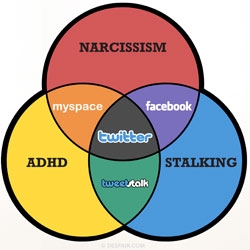
From the good folks at Despair, Inc. Don’t miss their new bailout-themed tees here and here. And here’s a good one for Facebook users.
The Five-Minute University
| Peter Klein |
This clip is making the rounds. How many of you Old Timers remember Father Guido Sarducci? Both economics and business get mentioned.
Journalists Duped Again
| Peter Klein |
From Walter Duranty to Judith Miller to recent reporting on the financial crisis (1, 2), the mainstream press continues to do what it has always done: print what it wants to be true, rather than investigate what’s actually going on. I got a chuckle out of the latest example: a French magazine that gave its student photojournalism award to a series of dramatic pictures of French youth living in poverty, only to learn the pictures were fakes. Oops! Not quite in the same class as the Sokal affair, but in the same spirit. (HT: Mario Rizzo.)
Copenhagen Fun
| Peter Klein |
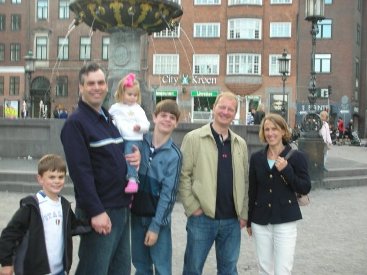
A selection of Kleins and Fosses at Gammel Torv in central Copenhagen (another Foss is in the background, hiding behind a lamppost, and the head of Clan Klein is behind the camera). No real reason to post this except to prove that Nicolai and I both smile occasionally. Note to colleagues at home: This is a business trip, I promise.
Show Us Some Love
| Peter Klein |
Thanks to Randy for these pictures of science-related tatoos. The phrase “beyond awesome” comes to mind. Who among you will be the first to get an O&M-themed body decoration?
Men of Few Words
| Peter Klein |
Those of you into Flesch-Kincaid scores and similar metrics probably appreciate men who can say a lot with a few words. The Bud Light “Dude” guy — whose Fog index, if my calculations are correct, is 1 — may be the best-known modern example:
He’s good, but before him there was Donnie Brasco:
Can your favorite academic writers be that parsimonious?
Fughetaboudit.
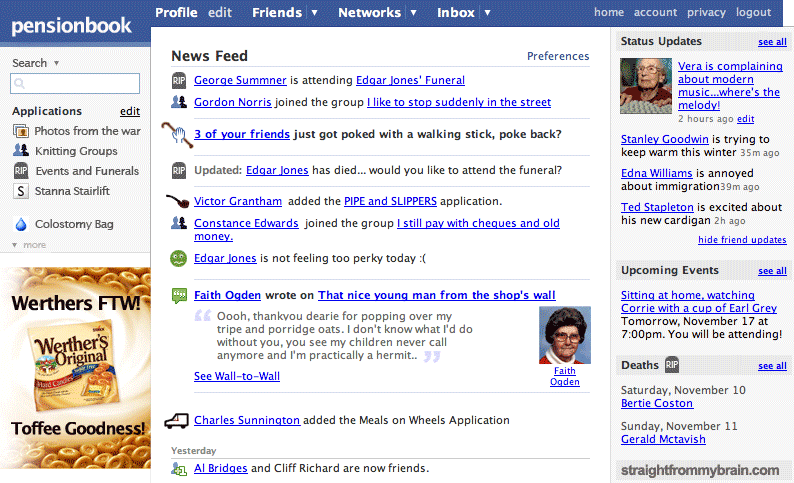
Obama’s Facebook Feed
| Peter Klein |
I admit, it made me laugh. (Thanks to Cliff for the pointer.)
I like pensionbook too.
The Book (Value) of Revelations
| Dick Langlois |
Here’s the abstract of the day:
Irrational Exuberance in the U.S. Housing Market: Were Evangelicals Left Behind?
Christopher W. Crowe
Summary: The recent housing bust has reignited interest in psychological theories of speculative excess (Shiller, 2007). I investigate this issue by identifying a segment of the U.S. population — evangelical protestants — that may be less prone to speculative motives, and uncover a significant negative relationship between their population share and house price volatility. Evangelicals’ focus on Biblical prophecy could account for this difference, since it may enable them to interpret otherwise negative events as containing positive news, dampening the response of house prices to shocks. I provide evidence for this channel using a popular internet measure of “prophetic activity” and a 9/11 event study. I also analyze survey data covering religious beliefs and asset holding, and find that ‘end times’ beliefs are associated with a one-third decline in net worth, consistent with these beliefs providing a form of psychic insurance (Scheve and Stasavage, 2006a and 2006b) that reduces asset demand.
Interestingly, the author is with the International Monetary Fund. When I googled to find where I had seen this abstract, the search returned several links pointing out that many Evangelicals consider the IMF (and the World Bank) to be the work of the Devil. (Not a few economists feel this way as well, of course, but wouldn’t put it in quite the same terms.) If you believe the end times are imminent, why would you bother to hold assets at all?
Way to Go Curtis
| Peter Klein |
A teacher’s greatest accomplishment is seeing his students go where he himself has never gone. So it was with great delight that I saw that one of my former undergraduate students, Curtis Melvin, got his picture on the front page of last Friday’s Wall Street Journal. Larry White and Radley Balko have already written on the substance of the story, which profiles Curtis’s activities as a North Korea sleuth. Way to go, Curtis!

Economists or Catherine Zeta-Jones?
| Peter Klein |
Who would you rather spend time with? I mean, come on, really?
Tweeting Too Hard
| Peter Klein |
Do these people remind you of any of your favorite bloggers — or academic seminar participants? (Via Cliff.)





 Organizations and Markets
Recent Comments