Posts filed under ‘Ephemera’
Best Time Waster of the Day
| Peter Klein |
No, not reading these. It’s this online version of wastepaper-basket basketball. I’ve already wasted about 30 minutes today playing. (Via EclectEcon)
Nifty Little Nuggets for Improving Your Impact
| Nicolai Foss |
OK — since we are apparently doing the ligther posts currently (cf. Lasse’s recent post, the Mahoney and Pitelis list, etc.), here’s some potentially useful (?), hands-on advice on how to improve your academic impact.
Academic impact is obviously a multi-dimensional construct. While often measured simply in terms of publications in high-ranking journals, many universities now increasingly look at citation counts (i.e., SSCI numbers). This makes considerable sense. While an uncited paper in, for example, the Academy of Management Journal (and such exist) may have some social value (after all, it does certify the author as a competent researcher), there is no social value in terms of broader knowledge dissemination (and the results thereof). While the US seems to have the lead (in social science) when it comes to letting citation counts matter, the European scene is rapidly changing towards an increasing emphasis on citation figures. After all, these figures can be easily gathered, compared, etc. by research and university bureaucrats, looking for new areas where they can meddle in a low-cost manner.
Here are some simple ideas that may help to increase your citation numbers: (more…)
21 Economic Models Explained
| Lasse Lien |
In celebration of Mahoney and Pitelis’s impressive achievement in strategic management, here is a related classic on economic systems (HT: K. Isrenn):
21 Economic Models Explained
SOCIALISM
You have 2 cows.
You give one to your neighbour.
COMMUNISM
You have 2 cows.
The State takes both and gives you some milk.
FASCISM
You have 2 cows.
The State takes both and sells you some milk.
NAZISM
You have 2 cows.
The State takes both and shoots you.
BUREAUCRATISM
You have 2 cows.
The State takes both, shoots one, milks the other, and then throws the milk away.
TRADITIONAL CAPITALISM
You have two cows.
You sell one and buy a bull.
Your herd multiplies, and the economy grows.
You sell them and retire on the income.
SURREALISM
You have two giraffes.
The government requires you to take harmonica lessons.
AN AMERICAN CORPORATION
You have two cows.
You sell one, and force the other to produce the milk of four cows.
Later, you hire a consultant to analyze why the cow has dropped dead. (more…)
Economist Quote of the Day
| Peter Klein |
John Nye gets the honor, quoted in a St. Louis Post-Dispatch story on the newfound popularity of economists (via Travis):
For economist John Nye, the financial crisis has meant new questions at dinner parties and children’s birthday parties.
But Nye, a former Washington University professor who now teaches at George Mason University in Virginia, noted an irony in his profession’s new-found popularity. He said most people — including government officials — seemed to ignore economists during the good times, but they are turning to economists now, even though there is little consensus among economists about what to do.
“We’re confused,” said Nye, “and yet folks want to listen to us even more.”
I sometimes think that being an economist today is like being an epidemiologist during the Black Plague. Everybody has questions, but nobody likes the answers.
Markets in Everything, Valentine’s Revenge Edition
| Peter Klein |
A local bar is hosting a “Valentine’s Day Massacre” party this weekend. The centerpiece is a commercial tree shredder. Patrons can bring mementos or personal effects from old boyfriends and girlfriends (and, I guess, former spouses) and have them pulverized into tiny bits. “We’ve even had a wedding dress!” says the radio ad. Presumably more extreme scenarios, like that depicted in the famous wood-chipper scene in Fargo, are prohibited.
Alex Rodriguez Admits to Personal Stimulus Package
| Peter Klein |
NEW YORK — Yankees’ star third baseman Alex Rodriguez admitted to receiving a series of personal stimulus packages from 2001 to 2003. “My trainer said my actual output was well below my potential output so we needed to pursue an expansionary nutritional policy.” Now suffering from a debilitating disease caused by prolonged exposure to stimulus, Rodriguez said he had “little choice” but to ask the trainer for even more stimulus, as well as putting every aspect of his personal and professional life under the trainer’s control. “Bold action is needed,” said a spokesperson for Major League Baseball. “We cannot depend on stimulus alone to create home runs or long-term athletic growth, but at this particular moment, only stimulus can provide the short-term boost necessary to lift Alex from a recession this deep and severe.”
Rodriguez’s trainer said he was pleased with his new authority and blamed the player’s health problems on “lack of oversight” by baseball officials. “We didn’t have enough regulation,” he complained. Baseball analyst Paul Krugman said he supported additional stimulus and the trainer’s new powers but worried that the plan “doesn’t go far enough.”
Sociology Beats Economics — Again!
| Peter Klein |
This was only the beginning. Now I learn from this paper, summarized by Henry Farrell (who supplies the graph below), that economists rank dead last among social scientists in RateMyProfessors.com’s “hot or not” ranking system. Sociologists are right up there near the top. How can this be?
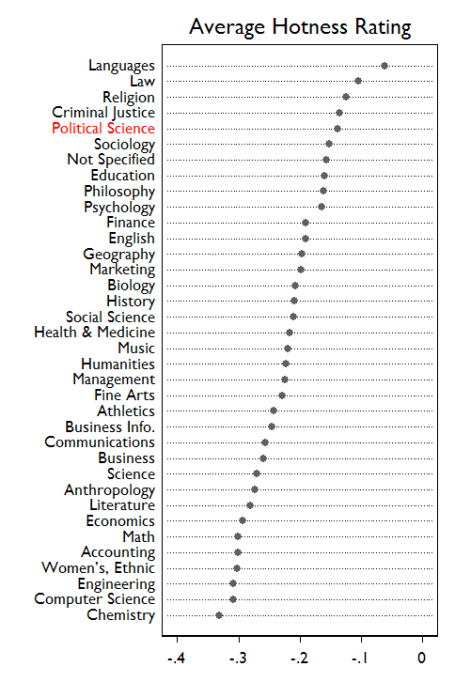
As Henry points out, all the academic disciplines have “hotness quotients” below zero, meaning more likely “not” than “hot.” I’m tempted to ask commentators to supply their favorite counter-examples, but would prefer not to encourage lawsuits.
How To Write a Term Paper and Get an F
| Peter Klein |
While Googling for some entrepreneurship references I stumbled upon this entry from one of those term-paper download sites. The site is called how-to-write-a-term-paper.net. Unfortunately, whoever created the site neglected to check the content of the papers because this one, which happens to be in one of my research areas of interest, is pretty bad. Sample passage: “We must first debunk the idea, advocated by Knight and Mises, of the entrepreneur as risk-bearer (Peter Swoboda, 1984). Aside from making every stock market participant an entrepreneur, this definition simply does not describe actual entrepreneurs and must be discredited.” Um, OK. Aside from misunderstanding the distinction between risk and uncertainty — which, after all, is supposed to be Knight’s main contribution — and arguing by begging the question, this reads like, well, a high-school term paper. But maybe that’s the point — when you plagiarize, it should look authentic.
Getting Serious about Economic Stimulus
| Peter Klein |
WASHINGTON – President-Elect Barack Obama called on Congress to quickly pass a new fiscal stimulus package that would provide nearly $100,000 trazillion gaquillion frijillion in an effort to revive the U.S. economy, which some experts believe has entered a recession.
Sadly, some ethics-free Republican hacks fail to see the wisdom of the plan, which also includes:
- $43 nurpillion for job training
- $89 bibblydefrillion for community reinvestment
- $505 frappakrillion for infrastructure and public works
- $732 hominavillion for health care and education
- $986 giggitysquillion for Goldman Sachs
Majority Leader Harry Reid is said to be optimistic about the bill’s chances, as the Senate “has already adopted legislation increasing the national debt ceiling to $4,000 pigglywigglyjibbityjabbityfrippityfroppitybadaboomillion.” Nobel Laureate Paul Krugman approves but worries the plan “doesn’t go far enough.”
Sociology Finally Beats Economics!
| Peter Klein |
A new study by Les Krantz ranks 200 U.S. occupations by environment, income, employment outlook, physical demands and stress. Sociologist comes in at #8, while economist ranks only #11. (The top five are mathematician, actuary, statistician, biologist, and software engineer, while the five worst are lumberjack, dairy farmer, taxi driver, seaman, and EMT.) Yes, I’m sure within-job heterogeneity is an issue. My colleague Mike Cook, who sent me the link, suggests that sociology must be a low-stress profession.
Darth Vader on Leadership
| Peter Klein |
The Dark Lord’s leadership secrets, sure to become a staple of future MBA courses:
- Use fear.
- Don’t tolerate dissent.
- Punish incompetence.
- Deal exclusively on your terms.
- Use loyalty judiciously.
- Always look for talent.
- Know that power is what matters.
- Get out there and lead. [Remember the end of Episode IV: Vader ended up better than Grand Moff Tarkin.]
- Finally, always remember that an elaborate, far-reaching plan, which relies on people reacting exactly how you plan for them to react, is always better than a simple plan.
Full story here (via Art). Can’t wait for the book.
What First-Year Economic Theory Courses Are Like
| Peter Klein |
Bob Higgs sends this clip, adding: “Those of you who were unable to obtain admission to the Ph.D. program at MIT or UC Berkeley may go here for a quick look at what you missed.” He’s right, it was a lot like that.
Thirteen Ways of Looking at a Burrito
| Peter Klein |
I
On twenty pasty faces,
The only thing in common
Was burrito breath.II
I had three dollars,
Like a street person
Who panhandles three hours per burrito.V
I can’t decide between them.
The pleasure of obsession,
Or the pleasure of abandon.
The burrito in the mouth
Or the throat.VIII
I think clever phrases
And bipartisan, utopian ideas;
But I think, somehow,
That the burrito is more useful
than what I think.
Selected stanzas from Klipschutz’s “Thirteen Ways of Looking at a Burrito,” a parody of the famous Wallace Stevens poem “Thirteen Ways of Looking at a Blackbird.” Why am I blogging this? Because several years ago my wife and I picked up a print of the Klipschutz poem at the City Lights Bookstore in San Francisco. It spent years in a closet, rolled in a tube, but we finally got it mounted and framed, and I hung it in the dining room yesterday. Who says we aren’t haute culture here at O&M?
My Favorite Student Questions
| Peter Klein |
Everybody loves the classics. This one, which I received today, is one of my favorites:
I can’t be in class tomorrow. Will I miss anything important?
What are your favorites? (If you’re not an educational professional, you can still play by listing favorite questions received from colleagues, subordinates, etc.)
Nixon Quote of the Week
| Peter Klein |
In case you missed it, a few days ago the Nixon Library released a new batch of tapes from December 1972. My favorite Nixon exhortation, issued to Kissinger on 14 December:
“Never forget,” Nixon tells national security adviser Henry Kissinger in a taped Oval Office conversation revealed Tuesday. “The press is the enemy. The establishment is the enemy. The professors are the enemy.
“Professors are the enemy,” he repeated. “Write that on a blackboard 100 times and never forget it.”
You can listen to the recordings here. Remember, it ain’t paranoia if they really are out to get you.
Neuroscientist Sam Wang on Crackberry Addiction
 | Peter Klein |
Email in small does is productivity enhancing but in large doses it is not productivity enhancing and can even slow down productivity. You don’t even notice because you’re just busy getting those little drops of dopamine. There’s a disconnect between the perceived reward and actual reward.
From an interview in Fast Company. I too suffer from the disease. I never thought of incoming messages as little drops of dopamine, but it makes sense.
Towards Beyond
| Lasse Lien |
We all know that there is an enormous amount of papers published under the title “Beyond . . . (insert whatever)” and “Towards . . . (insert whatever).” On the theory that using these words in the title almost ensures publication (I admit sampling on the dependent variable here), I have decided to take this to the limit in a series of four papers.
The first one will have the snappy title: “Towards Beyond.” The second: “Beyond Towards.” The third: “Towards Towards.” And finally, the most ambitious one: “Beyond Beyond.” I only have the titles so far, so I am interested in coauthors who can fill in the rest. But given these great titles I consider this a trivial task, and insist that I get to be first author.
Price Gouging: The Latest Victims
| Peter Klein |
Please join me in support for poor, beleaguered gas station owners, the victims of unconscionable price gouging by ruthless consumers who are taking advantage of market conditions to reduce their demand for gasoline, driving down the price by nearly $2 per gallon over the last four months. Fortunately, governments are swinging into action. Georgia governor Sonny Perdue issued this statement: “The financial crisis has disrupted the consumption of gasoline, which will have an effect on prices. However, we expect the prices that Georgian gasoline station owners receive at the pump to be in line with changes in consumers’ incomes and the prices of substitutes and complements. We will not tolerate consumers taking advantage of Georgian business owners during a time of emergency.”





 Organizations and Markets
Recent Comments