Posts filed under ‘Ephemera’
Recycling an Old Post
| Peter Klein |
These important announcements appeared originally April 1, 2007.
Foss, Klein, Postrel Join Harvard Faculty
Nicolai, Steve, and I are pleased to announce that we have accepted chaired positions at Harvard University:
Cambridge, Mass., April 1, 2007 — World-renowned scholars Nicolai J. Foss, Peter G. Klein, and Steven R. Postrel will join the Harvard faculty as University Distinguished Professors and co-directors of the newly formed Long Tail Institute for the Global Economy. Says incoming President Drew Faust: “I am delighted that Professors Foss, Klein, and Postrel are joining our team. I have always admired Foss and Klein’s work on judgment-based entrepreneurship, and I enjoyed Postrel’s columns in the New York Times before he changed his name to ‘Steve.’ After reading their blog I knew they were the ones to lead Harvard into the global information age.”
Announcing Guest Bloggers Jeff Pfeffer and Bob Sutton
We’re delighted to welcome Stanford University professors Jeff Pfeffer and Bob Sutton as our newest guest bloggers. Sutton writes: “Jeff and I have recently come out of what we call our ‘Blue Period,’ characterized by moodiness and irritability toward toward economists. We now realize that economic analysis is vital to the proper understanding of organizations. What better way to flaunt our new perspective than by joining the outstanding bloggers at Organizations and Markets? We’ll also be working on our new book, Not Ready to Make Nice in the Workplace.” Welcome, Jeff and Bob!
Google Acquires O&M
This hit the news wires today:
Mountain View, April 1, 2007 — Google Corporation announced today it has acquired a majority stake in the weblog Organizations and Markets, a leading provider of news and information on organizations, strategy, entrepreneurship, and anti-postmodernism. Google CEO Larry Schmidt noted that Google is seeking to expand beyond the search-engine business. “Let’s face it, search is yesterday’s technology. There’s too much junk out there. Instead of using computers to sort our information with confusing page-ranking algorithms, the time has come to hire experts to tell us what the world is really like. The authors of Organizations and Markets are just the experts we’ve been looking for.” Google shares dropped 42% in heavy trading upon the announcement.
Here are some important April 1 stories from prior years.
An Early Example of a Hold-up. . .
| Scott Masten |
. . . in which two Irishman sweep fifteen or thirty Italians into an open ditch.
The context is a dispute over a contract for the supply of water to Bayonne, NJ., circa 1896, as reported in The First History of Bayonne, NJ (1904: 92):
At the mayoralty election in the spring of 1895, Egbert Seymour, on the Democratic ticket, was elected Mayor. Several of the Councilmen who were elected at this election, and two or three city officials, were opposed to the new water contract, and attempted a “hold-up.” The trouble reached its height one day during the first year of Seymour’s administration.
While employees of the water company were tapping the old mains to make the necessary water connection, some city officials arrived on the scene. Immediately there was trouble.
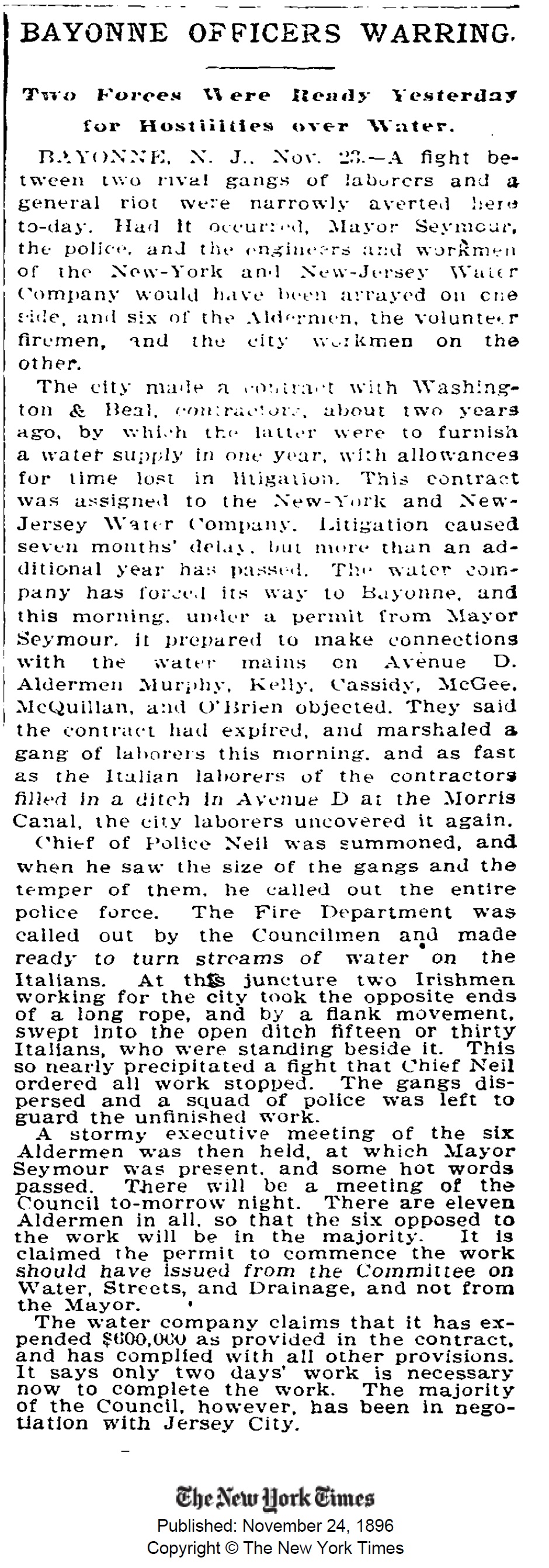
The New York Times article (Nov. 24, 1896) on the right (click to enlarge) elaborates, amusingly, on the manner in which the holdup was executed.
I have not yet been able to verify it but, according the previous source, “The matter was taken before the Supreme Court of the United States by the water company, and an injunction was obtained against the city. United States marshals were stationed at the scene until the work was completed, to arrest any city official who interfered.” The city eventually bought out the company in 1918.
(Wish that I had found that quotation before completing this.)
Women and Children First
| Peter Klein |
 Everything you ever wanted to know about the Titanic disaster. Well, everything behavioral economists want to know, namely who survived — a case study in “Behavior under Extreme Conditions” (Journal of Economic Perspectives, Winter 2011). Bruno Frey, David Savage and Benno Torgler note that the “common assumption . . . that in such situations, self-interested reactions will predominate and social cohesion is expected to ate and social cohesion is expected to disappear. . . . However, empirical evidence on the extent to which people in the throes of a disaster react with self-regarding or with other-regarding behavior is scanty.” Fortunately (?), the sinking of the Titanic provides “a quasi-natural field experiment to explore behavior under extreme conditions of life and death.”
Examining data on the social and demographic characteristics of survivors and non-survivors they find that women and children were more likely to survive, other things equal, as well as the wealthy and those in a stronger social network (traveling with family members, or being part of the crew). A morbidly interesting paper, to be sure.
Coasian or Coasean?
| Peter Klein |
For years I described things relating to Ronald Coase as “Coasian.” Walter Block continually needled me about this, insisting the proper spelling was “Coasean,” but I resisted. Now I see more people using the latter spelling, and I’ve started using it myself. But which is correct? I beats e, but not by much, in a Googlefight. But I think a more targeted crowdsourcing arrangement is warranted. So, dear O&M readers, which do you prefer? Vote below.
Addendum: Thanks to Scott for pointing out that this was debated before at Volokh, where many of the critical issues — and the most obvious snarks — were already presented. To me, the fact that Coase himself, and people at Chicago Law, use “Coasian” seems a pretty strong argument in favor of the non-standard spelling. But one can make a good case for either.
Paper Titles I Wish I’d Written
| Peter Klein |
“Schumacher meets Schumpeter” by Raphael Kaplinsky (Research Policy, March 2011). Asks if tech innovation benefits mostly the wealthy or the poorest in society as well. Great alliteration. (Thanks to Christos Kolympiris for the tip.)
I could still write books on Herbert Simon’s contributions (Simon Says), new developments in the resource-based view (Barney and Friends), or Marxist eschatology (Serf’s Up).
Stockman on the Crisis that Wasn’t
| Peter Klein |
 I’ve been complaining since 2008 that the justification for TARP and other forms of monetary and fiscal stimulus was never clearly stated. “The financial system would have collapsed” if Paulson and Bernanke had not made their unprecedented moves. But there was never any serious analysis or argument for this, just a series of bold (bald?) assertions.
This weekend’s ASC speech by former Reagan OMB Director David Stockman took the same line:
Based on the panicked advice of Paulson and Bernanke, of course, the president had the misapprehension that without a bailout “this sucker is going down.” Yet 30 months after the fact, evidence that the American economy had been on the edge of a nuclear-style meltdown is nowhere to be found. . . .
Still, the urban legend persists that in September 2008 the payments system was on the cusp of crashing, and that absent the bailouts, companies would have missed payrolls, ATMs would have gone dark and general financial disintegration would have ensued.
But the only thing that even faintly hints of this fiction is the commercial-paper market dislocation. Upon examination, however, it is evident that what actually evaporated in this sector was not the cash needed for payrolls, but billions in phony book profits, which banks had previously obtained through yield-curve arbitrages that were now violently unwinding.
Stockman argues (persuasively, in my view) that the commercial-paper market was going through a much-needed correction, and that the best response would have been to let the loan market adjust, according to market forces. After all, “nowhere was it written that GE Capital or the Bank One credit-card conduit, to pick two heavy users of the space, had a Federal entitlement to cheap commercial paper — so that they could earn fat spreads on their loan books.”
Something to Ruin Your Weekend
| Lasse Lien |
On a Monday morning, a professor says to his class, “I will give you a surprise examination someday this week. It may be today, tomorrow, Wednesday, Thursday, or Friday at the latest. On the morning of the examination, when you come to class, you will not know that this is the day of the examination.”
Well, a logic student reasoned as follows: “Obviously I can’t get the exam on the last day, Friday, because if I haven’t gotten the exam by the end of Thursday’s class, then on Friday morning I’ll know that this is the day, and the exam won’t be a surprise. This rules out Friday, so I now know that Thursday is the last possible day. And, if I don’t get the exam by the end of Wednesday, then I’ll know on Thursday morning that this must be the day (because I have already ruled out Friday), hence it won’t be a surprise. So Thursday is also ruled out.”
The student then ruled out Wednesday by the same argument, then Tuesday, and finally Monday, the day on which the professor was speaking. He concluded: “Therefore I cannot get the exam at all; the professor cannot possibly fulfill his statement.” Just then, the professor said: “Now I will give you your exam.” The student was most surprised, but the professor seems to have kept his word.
Citizenship and Biopower
| Dick Langlois |
That’s the title of seminar scheduled somewhere in the University later this month. I’m sure the ideas will be of great interest to readers of this blog.
What happens to the state under globalization? This often-asked but still relevant question has produced competing responses. Some scholars have re-theorized the nation-state and citizenship while others have jettisoned the nation-state as a category altogether, instead turning to Foucauldian theories of biopower to explain how power extends beyond the law-based operations of the state, managing life through the production of norms, and in so doing, relegates even greater populations to death and devastation.
Dr. Grace Hong’s presentation will argue that the shift into globalization must be contextualized within a history of gendered racial capital. She situates the decolonization/liberation movements in Asia and Africa and the new social movements in the US as turning points that marked the triumph, but also the limits of nationalism. In articulating alternatives to nationalism, Dr. Hong looks to women of color feminism and queer of color critique in texts by Cherrie Moraga, Frances Beal, and the Combahee River Collective, to theorize the newly complicated relationship between race, gender, sexuality, and vulnerability to death in the wake of the transnational turn.
What I want to know is whether the third sentence of the first paragraph counts as a paraprosdokian, “a figure of speech” — and I here quote from a humorous junk email I received recently — “in which the latter part of a sentence or phrase is surprising or unexpected in a way that causes the reader or listener to reframe or reinterpret the first part. It is frequently used for humorous or dramatic effect, sometimes producing an anticlimax.” Perhaps in this case the latter part of the sentence retheorizes the first part.
What the Seminar Speaker Really Means
| Peter Klein |
A useful guide. Written primarily for natural scientists, but applies more-or-less across the curriculum. Updates Stigler’s famous “Conference Handbook.” Sample:
When the speaker says: I’m pleased to give you this talk this morning because I always enjoy sharing my research with young scientists.
The speaker really means: I was promised a small honorarium.
When the speaker says: First, a little background.
The speaker really means: I am about to show you the only slide in which I have any confidence.
When the speaker says: This has been an incredibly exciting field for us to research.
The speaker really means: Five or six labs in the world care about this. You don’t.
When the speaker says: To be fair, there has been some debate in the scientific community about this point.
The speaker really means: We have a laboratory of mortal enemies at another institution, and they are so very wrong.
When the speaker says: This led us to ask a different question.
The speaker really means: Our grant ran out.
When the speaker says: I’ll just talk briefly about this.
The speaker really means: I will talk about this for at least an hour. I am unaware that time is finite. I am your overlord.
When the speaker says: This result was completely unexpected.
The speaker really means: This result pissed us off. Two postdocs cried.
When the speaker says: At this point, I went back to the literature.
The speaker means: At this point, I instructed my graduate student to go back to the literature.
Although, actually, the speaker really means: At this point, I instructed my graduate student to go back to the literature, but he just used Wikipedia, so I went back to the literature. (more…)
John Nye on the New Institutional Economics and Economic Development
| Peter Klein |
The always-thoughtful and interesting John Nye, speaking last December on the New Institutional Economics and economic development.
BTW, for your convenience, a copy of the hard-to-find 1989 Nabli and Nugent paper, “The New Institutional Economics and Its Applicability to Development,” is available here.
Too Cool to Update …
| Nicolai Foss |
We generally think of setting up a webpage (or a blog or a CV) as great fun, and maintaining it as less fun. But not maintaining your webpage (in terms of design and content) may be a signalling device. For example,
- “I am so big that the minor details since 2001 are really best left to my biographers.”
- “I remain the master of 1994-style animated GIFs.”
- “Please — I am a mathematical economist, not a mere web designer.”
And your examples?
Snow Days
| Dick Langlois |
The University canceled classes yesterday and today because of the snow, for the third and fourth times already this semester. I had to email my large lecture class with rearranged assignments. Apparently, some of my colleagues were even more upset at this than I was. (If it’s not obvious: Jay Hickey is the functionary in Human Resources who sends out the emails canceling classes.)
Academic Discourse – Math Edition
| Lasse Lien |
(01-27) 05:04 PST San Fernando, Calif. (AP) —
A California university professor has been charged with peeing on a colleague’s campus office door.
Prosecutors charged 43-year-old Tihomir Petrov, a math professor at California State University, Northridge, with two misdemeanor counts of urinating in a public place. Arraignment is scheduled Thursday in Los Angeles County Superior Court in San Fernando.
Investigators say a dispute between Petrov and another math professor was the motive.
The Los Angeles Times says Petrov was captured on videotape urinating on the door of another professor’s office on the San Fernando Valley campus. School officials had rigged the camera after discovering puddles of what they thought was urine at the professor’s door.
In Defense of Big Words
| Peter Klein |
A cardinal rule of clear communication is never to use a long, obscure word or phrase when a shorter, more common one will do. Orwell thought this was of Brobdingnagian importance — sorry, a big deal — and Hemingway famously rebutted Faulkner’s critique of his writing style by pitying
Poor Faulkner. Does he really think big emotions come from big words? He thinks I don’t know the ten-dollar words. I know them all right. But there are older and simpler and better words, and those are the ones I use.
Mencken, referring to the Danish linguist Otto Jespersen, says “[t]he prevalence of very short words in English, and the syntactial law which enables it to dispense with the definite article in many constructions . . . are further marks of vigor and clarity.” And of course we can all name scholars, even whole fields and genres, marked by particularly murky and obscure prose. (Question: Does academic jargon reform pass the remediableness criterion? LOL.)
However, according to a group of MIT linguists, as reported in Nature (via Azra Raza), big words often contain more information than their shorter counterparts, and word choice is mostly a function of information content:
For many years, linguists have tended to believe that the length of a word was associated with how often it was used, and that short words are used more frequently than long ones. This association was first proposed in the 1930s by the Harvard linguist George Kingsley Zipf.
Zipf believed that the relationship between word length and frequency of use stemmed from an impulse to minimize the time and effort needed for speaking and writing, as it means we use more short words than long ones. But Steven Piantadosi and colleagues at the Massachusetts Institute of Technology in Cambridge say that, to convey a given amount of information, it is more efficient to shorten the least informative — and therefore the most predictable — words, rather than the most frequent ones. . . .
But after analyzing word use in 11 different European languages, Piantadosi and colleagues found that word length was more closely correlated with their information content than with how often they are used.
My New Favorite Journal
| Peter Klein |
It’s the Journal of Universal Rejection (HT: Joshua Gans). From the journal’s website:
The founding principle of the Journal of Universal Rejection (JofUR) is rejection. Universal rejection. That is to say, all submissions, regardless of quality, will be rejected. Despite that apparent drawback, here are a number of reasons you may choose to submit to the JofUR:
- You can send your manuscript here without suffering waves of anxiety regarding the eventual fate of your submission.
- You know with 100% certainty that it will not be accepted for publication.
- There are no page-fees.
- You may claim to have submitted to the most prestigious journal (judged by acceptance rate).
- The JofUR is one-of-a-kind. Merely submitting work to it may be considered a badge of honor.
- You retain complete rights to your work, and are free to resubmit to other journals even before our review process is complete.
- Decisions are often (though not always) rendered within hours of submission.
If I submit a paper titled “The Ubiquity of Knightian Uncertainty,” would that constitute a performative contradiction?
Famous Figure Omission
| Scott Masten |
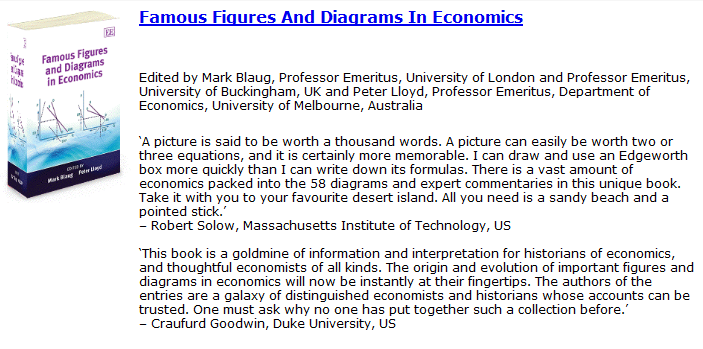
My inbox today contained an advertisement for a new Elgar publication: Famous Figures and Diagrams in Economics:
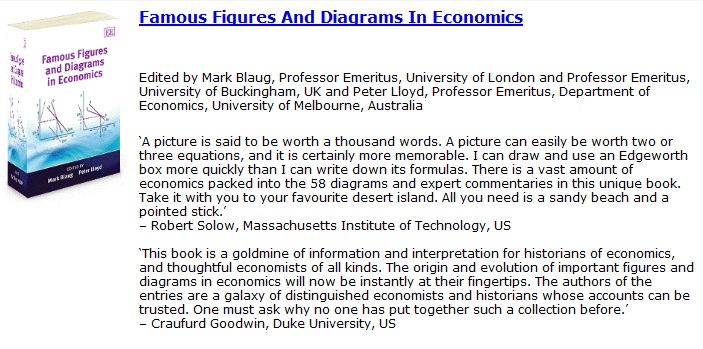
I’m sure that everyone in the O&M-isphere will agree that such a volume is incomplete without (more…)
Guilt by Association?
| Peter Klein |
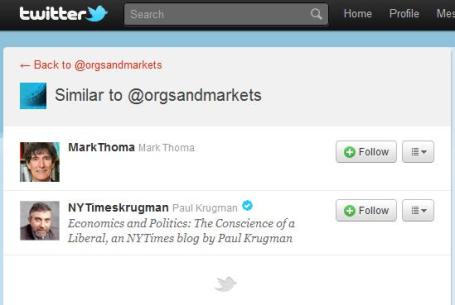
You may know that we have a Twitter feed, @orgsandmarkets. Twitter recently added a recommendation feature, “Similar to,” showing feeds its software judges similar to a given feed. See below what Twitter deems similar to O&M. I don’t mind being associated with Mark Thoma, who seems like a good guy even though I usually disagree with him, but that other one? I’m offended!
Remediableness Quote* of the Day
| Scott Masten |
In the matter of reforming things, as distinct from deforming them, there is one plain and simple principle; a principle which will probably be called a paradox. There exists in such a case a certain institution or law; let us say, for the sake of simplicity, a fence or gate erected across a road. The more modern type of reformer goes gaily up to it and says, “I don’t see the use of this; let us clear it away.” To which the more intelligent type of reformer will do well to answer: “If you don’t see the use of it, I certainly won’t let you clear it away. Go away and think. Then, when you can come back and tell me that you do see the use of it, I may allow you to destroy it.”
— G.K. Chesterton, The Thing (1929)
*Shouldn’t it be quotation of the day?
Impressive Lunch Bunch
| Peter Klein |
Whenever the economics Nobel goes to an American, the AEA has a luncheon at the next (year+1) annual meeting, and this year the 2009 recipients were honored. Elinor Ostrom was unable to attend, so Oliver Williamson was the lone honoree. Avinash Dixit gave a nice talk summarizing Ostrom’s and Williamson’s achievements and Williamson offered some informal, personal remarks.
The head table, pictured below — sorry for the poor picture quality, my phone is megapixel-challenged, but you can click to enlarge — seated an impressive bunch: Bengt Holmström, Bob Hall, David Teece, Paul Joskow, Carl Shapiro, Steve Tadelis, Pablo Spiller, Orley Ashenfelter (behind podium), Avinash Dixit (at podium), Williamson, Gérard Roland, John Morgan, Dale Mortensen, Jackson Nickerson, Scott Masten, and David Kreps.
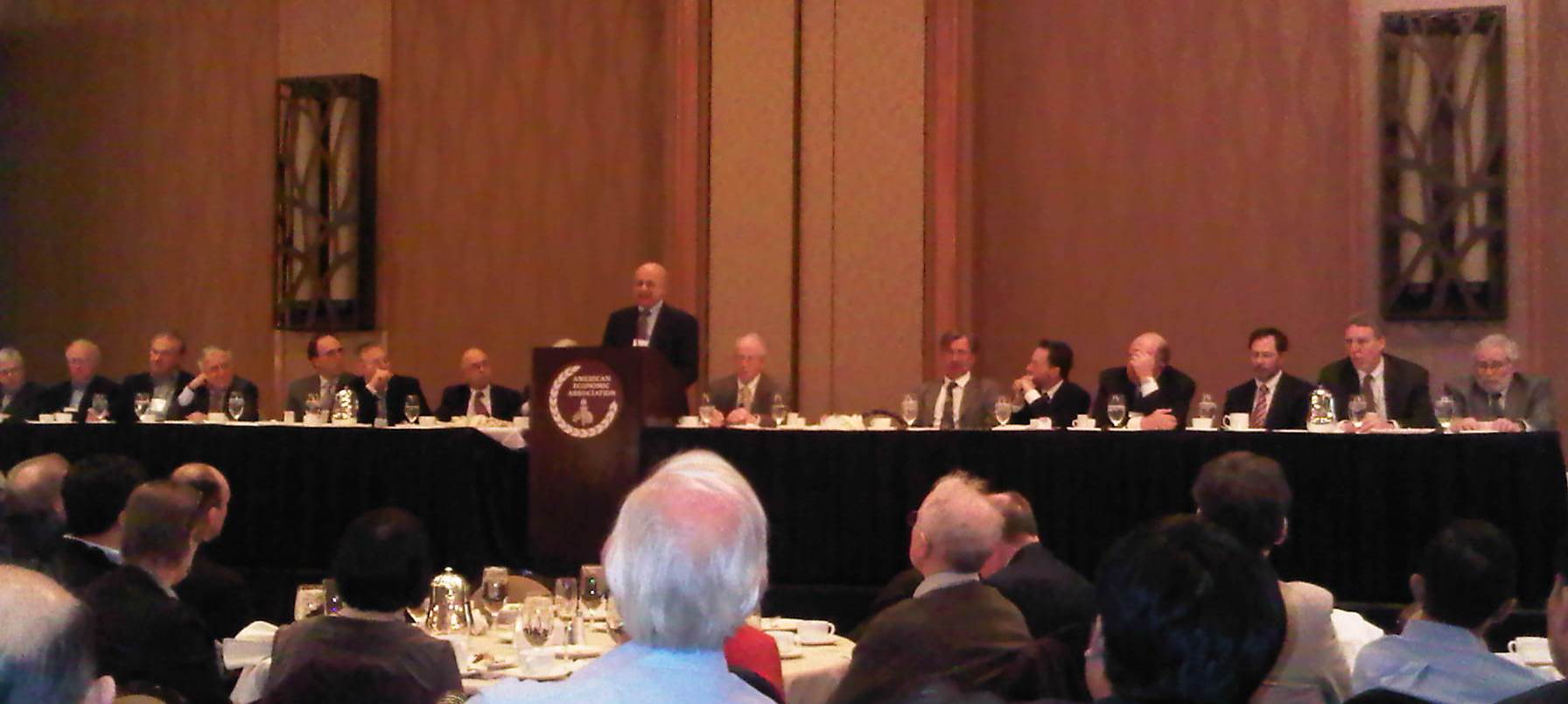
To my knowledge the only blogger among that group is our own Scott Masten, making O&M the sole blog represented on the panel. Take that, self-styled rivals!
Top Posts of 2010
| Peter Klein |
 Our most popular post published in 2010:
- Summary of Dodd-Frank Act
- Management Journal Impact Factors 2009
- Intellectual Steam
- How to Read an Academic Article
- The Era of Laissez-Faire?
- Does Behavioral Economics Offer Anything New and True?
- Pomo Periscope XX: Thomas Basbøll vs. Karl Weick
- Political and Methodological Individualism
- The Role of Assumptions in Management Research
- Ig Nobel Economics and Management Prizes
- Assessing the Critiques of the RBV
- PowerPoint Version of “I Have a Dream”
- Teaching Analytical Writing
- Ronald Coase’s New Book
- Isomorphism in Higher Education
Thanks to all our readers, commenters, linkers, lurkers, secret admirers, public admirers, etc. for a great 2010!





 Organizations and Markets
Recent Comments