Posts filed under ‘Ephemera’
Happy Holidays
| Peter Klein |
Warmest holiday wishes from the gang at O&M. We’re too lazy — I mean, too busy researching, writing, lecturing, etc. — to come up with a new holiday post, so we’ll just bask in the glories of past seasonal posts. To wit:

In Defense of English
| Peter Klein |
Co-bloggers Nicolai and Lasse probably speak better English than I do, despite the handicap of Scandinavian birth, but I sure like it. So does Rishidev Chaudhuri:
To me, the most striking thing about English is its diversity of vowels, something I only noticed after many years of speaking the language. English, in many dialects, has about 15 vowels (not counting diphtongs). Listen to the vowels through these words: a, kit, dress, trap, lot, strut, foot, bath, nurse, fleece, thought, goose, goat, north. There are languages that have more (Germanic ones tend to be vowel rich), but there aren’t many of them, and none that I know well enough to frame a sentence in. And compare this vowel list to the relative paucity of vowels in so many other languages. Hindi really has only about 9 or 10 vowels; Bengali, which has lost several long-short distinctions has slightly fewer (though lots of diphtongs). Some languages (including these two) do include extra vowels formed by nasalizing existing ones; these nasalized vowels often sound lovely, but feel very similar to their base vowels. It’s more a flourish than a genuinely new creation. Japanese and Spanish have about 4 or 5 apiece, and I’m told that Mandarin and Arabic have about 6.
English, then, is capable of exceptionally rich assonance and exuberant plays on vowel sound.
I mean, savor the delights of “methodological individualism” or “apodictic certainty” or “heteroskedasticity consistent standard errors” and tell me it isn’t sheer poetry!
Social Networking, 1700 to 1750
| Peter Klein |
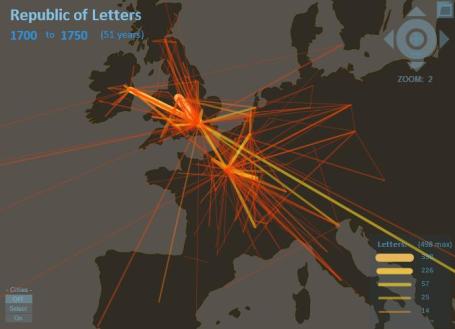
Some cool dataviz, via the NYT. Social networkers analyzed include Newton, Leibniz, Locke, Voltaire, Bentham, Boyle, Smith, etc. But really, how useful is a super-poke that takes a month to arrive?
Another Proud Non-Voter
| Peter Klein |
It’s Larry Ribstein. Will he get the same treatment I received a few years ago?

Influences
| Scott Masten |
Oliver Williamson has obviously had an enormous influence on my research and career, but I encountered Olly only fairly late in my education; in fact, I didn’t take Olly’s Industrial Organization course until my last semester of course work, in the fall of my third year in graduate school. Prior to that, my primary field had been comparative economic systems or, as it was called at Penn, comparative economic planning. My interest in the latter field and, indeed, my decision to go to graduate school in the first place I owe to Edwin Dolan. I had entered college intending to go to law school and enrolled in Dolan’s Economic Analysis of Law seminar in the winter of my sophomore year. That course was eye-opening for me in two respects. First, after spending long days in the library stacks reading law cases (when the next best alternative activity was skiing), I decided that that was not what I wanted to do for the rest of my life. Second, I learned that I could engage the “fun” (that is, the analytical) part of law by continuing in economics, which I already found appealing. (more…)
Cui Bono Blues
| Scott Masten |
No, not some long lost Robert Johnson classic. I’m referring to the Justice Department’s suit filed earlier this week against Blue Cross Blue Shield of Michigan, with “hints” from the Justice Department that more health industry suits are in the pipeline. The allegation is that BCBCM used most-favored nation agreements with hospitals to reduce “competition in the sale of health insurance in markets throughout Michigan by inhibiting hospitals from negotiating competitive contracts with Blue Cross’ competitors.”
I don’t know enough about the case to say anything about its merits at this point. But I do find curious the DOJ’s choice of a nonprofit for its demonstration project on controlling healthcare costs through the antitrust laws. It reminds me of [uh-oh, here it comes — Ed.] (more…)
Earning My Keep. . . .
| Scott Masten |
I would post something on this morning’s Wall Street Journal article, “Putting a Price on Professors,” but (i) I risk becoming the obsessed, repetitous guest who spoils the party for everyone else (it’s not my fault this stuff is showing up a lot in the news right now!), and (ii) I have 163 midterms to grade and, having read the article, I need to make sure that I earn my compensation. [That shouldn’t require much work — Ed.]
Update: Go read Craig Pirrong’s post on the WSJ article at Streetwise Professor. That’s an order.
Lock-In, Path Dependence, and Efficiency: Railway Gauge Edition
| Peter Klein |
 Doug Puffert’s new book on the history of railway gauge standardization apparently takes a middle position between the “lock-in always” position of Paul David and the “lock-in rarely” position of Liebowitz and Margolis. Writes reviewer Dan Bogart:
Puffert’s narrative convincingly dispels the extreme version of the Liebowitz and Margolis critique which argues that market participants had perfect foresight. On the other hand, it does suggest historical actors understood the role of positive feedbacks and tried to manipulate gauge adoption in an effort to lock-in their preferred standard. The degree to which gauge selection was efficient is a lingering question throughout the book. Puffert does not take a stand on the relative efficiency of different gauges, but an argument is made that diversity entailed large costs.
I’m not sure what Bogart means by the “extreme version” of the Liebowitz-Margolis critique; L&M have certainly never used the concept of perfect foresight in their analysis of alleged QWERTY effects. Indeed, their critique of Paul David is based mostly on comparative institutional analysis. As Peter Lewin puts it in his excellent summary of the QWERTY debate:
Somewhat paradoxically both Liebowitz and Margolis and their critics (in varying degrees) are critical of mainstream neoclassical (textbook) economics and its standards of welfare. That is to say, they are both highly critical of the kind of neoclassical economics that assumes perfect knowledge, perfect foresight, many traders, etc., the kind that derives perfect competition as a Pareto optimal efficient standard against which to judge real world outcomes. Both focus (to a greater or lesser extent) on the importance of ignorance and uncertainty (and the importance of institutions) in rendering such a standard problematic. Where they differ decisively, however, is in the policy lessons that they take away from this.
The critics argue that the ideal of perfect competition is an ideal that, for one reason or another, the free market is incapable of attaining, and that, therefore, one should look to the government to obtain by collective action or regulation, what the market, with decentralized actors, cannot. Liebowitz and Margolis have explained clearly why the endorsement of government intervention does not follow from a valid critique of neoclassical welfare economics (and, for that matter, why a defense of neoclassical welfare economics, in itself, is insufficient to establish an argument against intervention).
See here for a previous discussion on path dependence and Williamson’s “remediableness” criterion.
We Resemble That Remark
| Peter Klein |
The BBC’s Andrew Marr: “A lot of bloggers seem to be socially inadequate, pimpled, single, slightly seedy, bald, cauliflower-nosed young men sitting in their mother’s basements and ranting. They are very angry people.” Ha ha, the joke’s on him — I haven’t been “young” in years!
Suing in America
| Lasse Lien |
As a temporary resident of the US I find much to enjoy and admire. What I find slightly less admirable is the American litigiousness and the transaction costs it creates (for example the endless number of forms and paperwork needed to get simple services ). Here are some “random” examples of lawsuits (via Clean Laughs):
An inmate filed a $5 million lawsuit against himself (he claimed that he violated his own civil rights by getting arrested) — then asked the state to pay because he has no income in jail. He said, “I want to pay myself 5 million dollars, but ask the state to pay it on my behalf since I can’t work and am a ward of the state.” The judge was not impressed by his ingenuity, and dismissed the suit as frivolous. (Source: CALA)
A convicted bank robber on parole robbed a California Savings and Loan Branch. The bank robber placed the money roll containing the hidden Security Pac in his front pants pocket. The Security Pac released tear gas and red dye resulting in second and third degree burns requiring treatment at a hospital. The bank robber sued the bank, the Security Pac manufacturer, the city the police and the hospital. (Source: ATRA)
A writer was sued for $60 million dollars after writing a book about a convicted Orange County serial killer. Although the inmate is on death row, he claimed that he was innocent in all 16 murders, so the characterization of him as a serial killer was false, misleading and “defamed his good name”. In addition, he claimed those falsehoods would cause him to be “shunned by society and unable to find decent employment” once he returned to private life. The case was thrown out in a record 46 seconds, but only after $30,000 in legal fees were incurred by the writer’s publisher. (Source: CALA)
A minister and his wife sued a guide-dog school for $160,000 after a blind man learning to use a seeing-eye dog trod on the woman’s toes in a shopping mall. South-eastern Guide Dogs Inc., a 13-year old guide-dog school and the only one of its kind in the Southeast, raises and trains seeing-eye dogs at no cost to the visually impaired. The school is located about 35 miles south of Tampa. The lawsuit was brought by Carolyn Christian and her husband, the Rev. William Christian. Each sought $80,000. The couple filed suit 13 months after Ms Christian’s toe was stepped on and reportedly broken by a blind man who was learning to use his new guide dog, Freddy, under the supervision of an instructor. They were practicing at a shopping mall. According to witnesses, Ms Christian made no effort to get out of the blind man’s way because she “wanted to see if the dog would walk around me”. (Source: ATRA and Houston Chronicle, 95-10-27) (more…)
Fire Footnote
| Scott Masten |
Apropos our earlier discussion, today is the anniversary of the Great Chicago Fire of 1871.
Hail to the Hackers
| Scott Masten |
You may have read recently that District of Columbia election officials put out an invitation to computer scientists to hack an experimental Internet voting system. Apparently a team from the University of Michigan successfully took over the system within 36 hours. The part I found amusing, however, is that they programmed the system to play “Hail to the Victors” (official name “The Victors”) after each vote was cast.
Burning Down the House
| Scott Masten |
Peter posted a Facebook link to a Jeff Tucker post on the Mises Economics Blog commenting on the news report about the Tennessee man who didn’t pay his annual $75 fire protection services fee, and the fire department from the neighboring town let his house burn down. Peter, Jeff, and Clifford Grammich (who commented on Peter’s post) cover the issues pretty well. My guess is that the reason governments rather than private companies generally provide fire services has a lot to do with the difficulty of pricing fire services. (The Tennessee case involved a quasi-market transaction in that residents outside of South Fulton paid the city of South Fulton for fire protection.) It is certainly conceivable that private fire companies could offer homeowners and businesses a choice between (i) prepaid fire service for an annual fee and (ii) on-demand fire service. But how would you determine the price of the latter? I’m pretty sure you wouldn’t want to negotiate the price while your house is burning down. (Talk about temporal specificity!) And you wouldn’t want to negotiate the price after the fact either: Gee, guys, thanks for saving my house; can I buy you all a beer? (more…)
Ig Nobel Economics and Management Prizes
| Peter Klein |
Thanks to Stéphane Saussier for reminding me that the 2010 Ig Nobel Prizes have been announced. The Economics award is a bit predictable:
ECONOMICS PRIZE: The executives and directors of Goldman Sachs, AIG, Lehman Brothers, Bear Stearns, Merrill Lynch, and Magnetar for creating and promoting new ways to invest money — ways that maximize financial gain and minimize financial risk for the world economy, or for a portion thereof.
But I’m particularly interested in the Management prize. I hadn’t heard of the paper, but anything with “Peter” in the title must be good:
MANAGEMENT PRIZE: Alessandro Pluchino, Andrea Rapisarda, and Cesare Garofalo of the University of Catania, Italy, for demonstrating mathematically that organizations would become more efficient if they promoted people at random.
REFERENCE: “The Peter Principle Revisited: A Computational Study,” Alessandro Pluchino, Andrea Rapisarda, and Cesare Garofalo, Physica A, vol. 389, no. 3, February 2010, pp. 467-72.
Oliver Williamson to Win Physics Nobel
| Scott Masten |
At least that’s what the writers of The Simpsons are predicting. (See upper left-hand corner.) Their Economics Prize predictions: Jagdish Bhagwati, Avinash Dixit, Bengt Holmstrom, and Elhanan Helpman. (via Marginal Revolution)
Spam Alert
| Peter Klein |
We’ve been bombarded by comment spam the last several days — a much higher volume than usual — and our spam filter is surely making some Type I errors. If you posted a (legitimate) comment and it never appeared, please let us know so we can mark it as legit.
Blogs About Organizations
| Peter Klein |
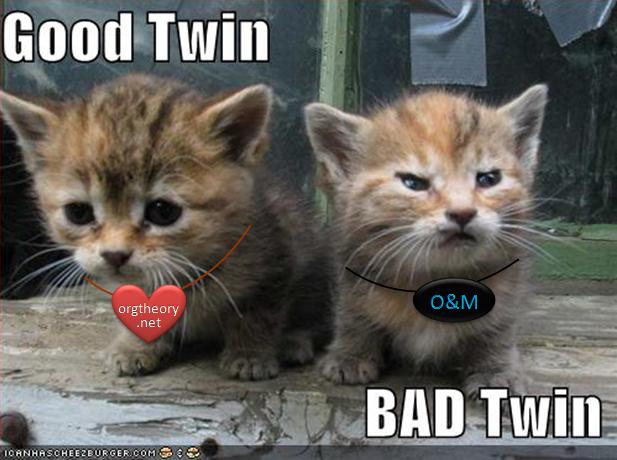
Who’s more fun? Good Spock or Evil Spock? Bedford Falls or Pottersville? The Narrator or Tyler Durden? Orgtheory.net or Organizations and Markets? As Dick Vitale would say, “Are you serious?” (Thanks to SL for the image.)
ScienceCodex
| Nicolai Foss |
ScienceCodex is the name of a great resource for serious procrastination, amusement, and — sometimes — useful inputs to research and teaching. Signing up for the feed will result in about 20 daily pieces of science news, and, at least for me, a couple of them are usually great fun and potentially useful for teaching. For example, those who teach OB or HRM may find this piece, “Over 50? You probably prefer negative stories about young people,” useful for classroom discussion. There are also potentially offensive stories (e.g., “You Kick Like a Girl“), so be forewarned ;-)





 Organizations and Markets
Recent Comments