Posts filed under ‘Ephemera’
An Industry Study for the Beautiful People
| Peter Klein |
It’s Beauty Imagined: A History of the Global Beauty Industry by Geoffrey Jones (Oxford University Press, 2010). From the blurb:
This book provides the first authoritative history of the global beauty industry from its emergence in the nineteenth century to the present day, exploring how today’s global giants grew. It shows how successive generations of entrepreneurs built brands which shaped perceptions of beauty, and the business organizations needed to market them. They democratized access to beauty products, once the privilege of elites, but they also defined the gender and ethnic borders of beauty, and its association with a handful of cities, notably Paris and later New York. The result was a homogenization of beauty ideals throughout the world.
Sounds like a great study of entrepreneurship, industry dynamics, clustering and network effects, and the relationship between business and culture. Reviewer Ingrid Giertz-Mårtenson says it’s “one of the more fascinating stories in modern business history,” the journey of an industry once seen as “fickle, superficial, and feminine” to a “brand-driven global power house.” The book should make a beautiful addition to your collection!
Texting Victorians
| Peter Klein |
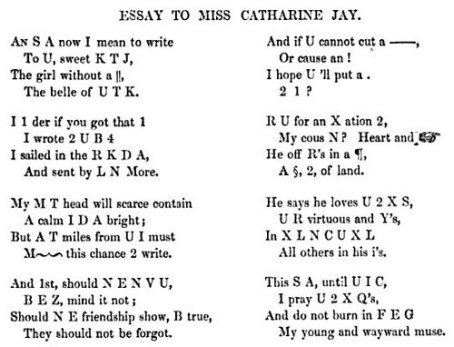
I knew that the Victorians had their own Internet, that information goods and open innovation are old hat, and that S-curves go back a hundred years. But apparently the Victorians used texting language too! We instruct our students to avoid it, but apparently Victorian poets thought writing I “love U 2 X S” or “U R virtuous and Y’s” was exceedingly clever. LOL! (Discovery! via Gizmodo.)
Note on Anonymous Comments
| Peter Klein |
 We interrupt our regular programming for a note from the site administrators: When you comment here at O&M, the server asks you for a name, email address, and (optionally) a URL. The email address is hidden (to protect your privacy), while the name and URL (if provided) are published with the comment. Rest assured that we keep your private information private — we don’t sell your email address to spammers, laugh about your funny username, or otherwise violate your dignity. But the server knows the email address you entered and the IP address whence you came, and provides this information to the site administrators and/or post author. In other words, even if you don’t use your real name, we probably know who you are!
Of course, anonymous comments are welcome (though the spam filter may hold them if they contain bad words or other stuff it doesn’t like). We understand that you may wish to use a pseudonym and keep your identity hidden from the wider world, and that’s fine. But I recently discovered that some commenters thought they were anonymous from us too, and that isn’t the case.
Add to: Facebook | Digg | Del.icio.us | Stumbleupon | Reddit | Blinklist | Twitter | Technorati
Students: Do It for the Panda
| Peter Klein |
Words — and pictures — of wisdom for the new academic year:
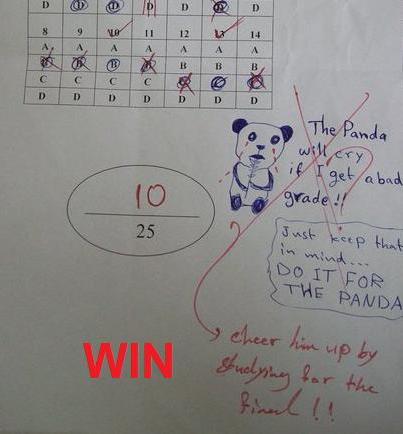
An epic win, courtesy of FAIL Blog.
Add to: Facebook | Digg | Del.icio.us | Stumbleupon | Reddit | Blinklist | Twitter | Technorati
Business Communication Tool of the Day
| Peter Klein |
It’s UnsuckIt, an online tool that translates business jargon into regular English. The graphic is a little crude for my taste, by the spirit is admirable. You can browse a list of popular terms, and there’s a handy button to share a term’s translation with a colleague or, as the site puts it, “e-mail the douchebag who used it.” (Via BoingBoing.)
Add to: Facebook | Digg | Del.icio.us | Stumbleupon | Reddit | Blinklist | Twitter | Technorati
The Unbearable Hotness of Being
| Peter Klein |
 Does blogging reduce research productivity? Are we O&Mers worried about posting something we’ll later regret? Nah, we think blogging is good for us, professionally. But we have another problem, more difficult to remedy: we are hot. I mean smokin’ hot. Harrison Ford in the first Indiana Jones movie? Forget it. He looks like some dork philosopher compared to us. Colleagues and students — females, especially — don’t take us seriously. “We know why you got this job!” We get one-line student evaluations: “Yum.”
Apparently, this is a real problem for some faculty members, according to a recent Chronicle story. “[I]n academe, being hot has a downside: Professors who are considered too good-looking can be cast by their peers as lightweights, known less for their productivity than for their pulchritude.” As the article points out, students have been falling in love with their professors for years, but only now do they have a chance to express themselves, often anonymously, at sites like RateMyProfessor.com. One professor — an economist, no less! — got so annoyed with the leering after making a hot professor list that he moved out of town. “He found notes under his door asking ‘what it would take to lasso me.’ And female students coyly ask his advice on whether it’s OK to date professors once a class is over.” I feel for the guy, really I do.
One anonymous professor quoted in the article puts things in their proper perspective, however: “on a scale of hotness academics aren’t all that hot, relatively speaking, and to make a list of hot ones is thus, relatively laughable.”
Add to: Facebook | Digg | Del.icio.us | Stumbleupon | Reddit | Blinklist | Twitter | Technorati
The Noir Institutional Economics
| Dick Langlois |
The Visible Hand
By Raymond Chandler
It was eight o’clock in the morning, sharp, with the sun not shining and a look of hard wet rain on the Manhattan pavement. I was wearing my heavy gray flannel suit, with rounded collar, display handkerchief, and gold tie with streamlined mechanical shapes on it. As always, I was neat, clean, shaved and sober, and I didn’t care who knew it. I was everything the well-dressed professional manager ought to be. I was calling on the head of General Motors.
From two blocks away I stared at the GM building at 57th and Broadway, its terra cotta façade now etched gray as the pavement, as it wrapped itself around the gothic fantasy of the Broadway Tabernacle at 56th Street. I knew which one was really the cathedral. I didn’t get to inspect the building’s interior for as long as I had the outside. The minute I walked through the front door I was met by a tall, striking female, platinum blonde in finger waves. She wore a cardigan jacket over a skirt and sweater. Her eyes were slate-gray, and had almost no expression when they looked at me.
“Mr. Sloan?”
I admitted as much.
“Follow me, please.”
Following her was easy. She led me into a black-and-gilt elevator. Like all New York elevator men, the operator was small and pinched but looked as though he knew something we didn’t. He brought us up to the top floor, where the cast iron grille of the elevator opened onto an anteroom of the inner-sanctum. When I glanced back, the blonde had already disappeared. I walked in. (more…)
Misc Academic Links
| Peter Klein |
- Academia’s love-hate relationship with wikis.
- Deathbed witticisms from Voltaire, Hegel, and other interesting persons.
- Should research universities exploit the internal division of labor?
- Tips on academic job talks from Fabio’s valuable series.
Add to: Facebook | Digg | Del.icio.us | Stumbleupon | Reddit | Blinklist | Twitter | Technorati
Miscellaneous Organizational Links
| Peter Klein |
- The much-anticipated KKR IPO turned out to be a snoozer. But what the heck is a publicly traded private-equity firm anyway?
- Is the flattening hierarchy an illusion, driven by job-title inflation?
- How call centers use behavioral economics.
- Belén Villalonga’s new paper on ownership concentration and internal-capital-market efficiency — highly recommended.
Add to: Facebook | Digg | Del.icio.us | Stumbleupon | Reddit | Blinklist | Twitter | Technorati
Incentives Matter, Little Big Horn Edition
| Peter Klein |
Thanks to Norman Van Cott for this tidbit, which I hadn’t known before:
The crux of Roger McGrath’s review of Nathaniel Philbrick’s “The Last Stand” (Bookshelf, June 18) is that George Custer’s “undoing was the wildly inaccurate information he [Custer] received about the number of Indian warriors he might face.” Left unnoted by Mr. McGrath is the role perverse public-sector economic incentives played in generating this information.
To wit, Indian reservation agents’ salaries varied directly with reservation populations. More Indians, more money. This provided agents an incentive to inflate reservation population counts, which led in turn to underestimates of the number of Indians on the warpath. For the economist, the Little Bighorn debacle is an excellent example of public choice economics in action.
Details about how these incentives affected the population counts appear in a previous decade’s classic study of Custer, Evan Connell’s 1984 “Son of the Morning Star.” For example, prior to the battle, agents reported 37,391 Indians on the reservations. A U.S. Army count after the battle turned up 11,660. That Custer’s soldiers ended up facing perhaps twice as many Indians as they had been told to expect is not surprising. Incentives matter.
Add to: Facebook | Digg | Del.icio.us | Stumbleupon | Reddit | Blinklist | Twitter | Technorati
The Reverse Peltzman Effect
| Peter Klein|
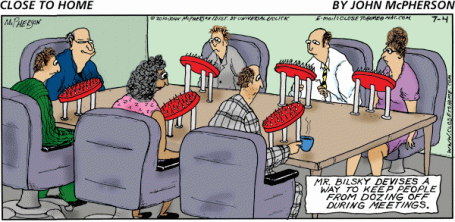
An example of the Reverse Peltzman Effect, a lot like Alchian’s (or Tullock’s) spear:
Add to: Facebook | Digg | Del.icio.us | Stumbleupon | Reddit | Blinklist | Twitter | Technorati
Guru Drivel in Fiction
| Peter Klein |
A funny passage from Neal Stephenson’s The Confusion, the second volume of his Baroque Cycle trilogy. In this scene, set in 1690, a motley crew of galley slaves, victims of Barbary Corsair raiding parties, discuss their plan to escape and get rich. Each is giving his backstory:
“The winter before last, I made the acquaintance of Moseh, who was asking many questions about the market in tutsaklar ransom futures. We had several conversations and I began to perceive the general shape of his Plan.”
“He told you about Jeronimo, and the Viceroy?”
“No, I learned of that on the same night as you.”
“Then what do you mean when you say you understood his plan?”
“I understood his basic principle: that a group of slaves who, taken one by one, were assigned a very low value by the market, might yet be worth much when grouped together cleverly. . . .” Vrej rolled up to his feet and grimaced into the sun. “The wording does not come naturally in this bastard language of Sabir, but Moseh’s plan was to synergistically leverage the value-added of diverse core competencies into a virtual entity whose whole was more than the sum of its parts. . . .”
Jack stared at him blankly.
“It sounds brilliant in Armenian.” (more…)
Interview with Josh Lerner
| Peter Klein |
Paul Kedrosky interviews Josh Lerner for Kauffman’s “Infectious Talk” series. Josh is one of the top researchers and teachers working at the intersection of entrepreneurship and finance, and is always worth reading (or listening to, if you prefer the podcast version).
Add to: Facebook | Digg | Del.icio.us | Stumbleupon | Reddit | Blinklist | Twitter | Technorati
The Unbearable Lightness of Economics (?)
| Nicolai Foss |
The always-helpful Peter suggested “a quick-and-easy Foss blog post,” specifically a post on what sounds like an interesting conference on “Economics Made Fun in the Face of the Economic Crisis,” organized by Jack Vromen and N.E. Aydinonat, at the Erasmus University Rotterdam, 10-11 December 2010. The Call builds up a tension between the emerging econ-made-fun genre (Levitt, Cowen et al.) with its implied view of econ as a universal tool for understanding behaviors and their implications, and the claimed inability of econ to come to grips with the current crisis. You may think what you like of this claimed tension, but Jack Vromen always represents quality, and with keynote speakers like Diana Coyle, Robert Frank, and Ariel Rubinstein, this conference will be fun.
Add to: Facebook | Digg | Del.icio.us | Stumbleupon | Reddit | Blinklist | Twitter | Technorati
Admongo
| Dick Langlois |
 Slate has a piece on a video game called Admongo, which the Federal Trade Commission has created to teach children the dangers of commercial advertising. Characteristically, the author rather likes this idea, and the only criticism of this micro-Orwellianism he can imagine is that it doesn’t go far enough in bashing commercial advertising and is fact in bed with commercial interests like Scholastic.
Add to: Facebook | Digg | Del.icio.us | Stumbleupon | Reddit | Blinklist | Twitter | Technorati
Why People Resist Marginal Cost Pricing
| Peter Klein |
Hahn and Passell get it right, I think:
Consumers everywhere seem to like all-you-can-eat/drink/exercise/drive pricing, even if their own consumption is modest and they are net losers in the process. This may simply be irrational. But (as cruise ship lines understand very well) it may also reflect the real psychological benefits of being able to imagine oneself in an environment of no scarcity, in which everything is “free” including calories. By the same token, salad-bar-style blanket pricing may relieve consumers of the very real costs of weighing costs against benefits at every turn of the menu.
One could interpret this in terms of bounded rationality, e.g., Akerlof and Yellen’s concept of near-rationality (1, 2): small deviations from “rational” behavior aren’t too costly, in such cases, so why be fully rational? Alternatively, call these decision-making costs some kind of transaction costs and deem the behavior fully rational, once all relevant costs are taken into consideration. (Some hand-waving required in both cases.) But some kind of cognitive explanation is probably best here.
Add to: Facebook | Digg | Del.icio.us | Stumbleupon | Reddit | Blinklist | Twitter | Technorati
Nerd Merit Badges
| Peter Klein |
 How many of these could you earn?
My favorite is Inbox Zero (right), perhaps because it’s the least attainable. (And no, I didn’t know what foursquare was either.) Thanks to Wired for the pointers.
The cynical among you may prefer The Onion’s take on merit badges.
Add to: Facebook | Digg | Del.icio.us | Stumbleupon | Reddit | Blinklist | Twitter | Technorati
O&M Four-Year Anniversary
| Peter Klein |
 O&M went live April 25, 2006. Our inaugural post said: “Welcome to all readers. (Hopefully the plural is appropriate.)” Since then we’ve spread our message to literally tens of people around the world. Actually, the numbers aren’t bad: over these four years we’ve delivered 2,247 posts and 6,036 comments to 797,965 unique visitors (based on IP address). The comments are of consistently high quality too. Thanks to all current and former guest bloggers, commenters, pingbackers, lurkers, and other friends.
For a blast from the past, why not try our random post link? You never know what you’ll find. . . .
Add to: Facebook | Digg | Del.icio.us | Stumbleupon | Reddit | Blinklist | Twitter | Technorati
New Klein Book
| Peter Klein |
The Mises Institute is publishing a collection of my papers as The Capitalist and the Entrepreneur: Essays on Organizations and Markets (love that subtitle!). You can view some promotional materials, the table of contents, and drafts of the introduction and a sample chapter at the link above. Publication is scheduled for May 2010. I’ll post ordering information as soon as I have it. Start saving your pennies today!
Add to: Facebook | Digg | Del.icio.us | Stumbleupon | Reddit | Blinklist | Twitter | Technorati
Recommendation Letters
 | Peter Klein |
Like most academics, I often write recommendation letters for students and colleagues, and sometimes ask for them myself. There’s an art to getting a good recommendation letter, much of it nicely summarized by Jodi Glickman Brown on her HBR blog. In short, 1) highlight [the writer’s] qualifications, 2) provide a template, and 3) offer a “no questions asked” policy. I’d add a conceptual note: Consider the recommendation letter an additional channel for information, beyond those the letter-reader will already have. Letters that simply repeat information contained in the candidate’s CV, academic transcripts, writing samples, application forms, and the like do not add value Ask yourself what you want the reader to know about you that isn’t otherwise be obvious from the rest of your dossier. The letter is your opportunity to get this information out. But the letter-writer has to know what you have in mind.
Add to: Facebook | Digg | Del.icio.us | Stumbleupon | Reddit | Blinklist | Twitter | Technorati





 Organizations and Markets
Recent Comments