Posts filed under ‘Ephemera’
Best Acknowledgements Section in an Academic Book
| Peter Klein |
From the preface to James Scott’s The Art of Not Being Governed: An Anarchist History of Upland Southeast Asia (which I heard about from Drake Bennett, via LRC):
There is a large number of colleagues who, having better things to do with their time, nevertheless read part or all of the manuscript and gave me their frank advice. I hope they see, here and there, evidence of their impact as I bobbed and weaved my way to a more nuanced and defensible argument. They include, in no particular order, . . . [a list of 60 names follows]. Wait! I have secreted in this list four colleagues who failed to send their comments. You know who you are. For shame! If, on the other hand, you collapsed trying to carry the manuscript from the printer to your desk, my apologies.
Add to: Facebook | Digg | Del.icio.us | Stumbleupon | Reddit | Blinklist | Twitter | Technorati
An Industry Lobbyist’s Definition of “Efficiency”
| Peter Klein |
Gordon Smith, head of the US National Association of Broadcasters (not the good Gordon Smith), explains his understanding of “efficiency”:
In calling for broadcast TV spectrum to be reallocated for mobile broadband use, [Gary] Shapiro falsely suggests that TV broadcasters are “inefficient” users of spectrum. We are not. In fact, when compared with Internet-enabled handheld devices — the primary beneficiaries of Mr. Shapiro’s spectrum plan — TV broadcasters are far more efficient.
Indeed, every single American could turn on his TV set right now without placing any additional capacity strain on the airwaves. You can’t be more efficient than that.
Right. Massive excess capacity, near-zero consumer demand . . . perfect efficiency! (File under economic illiteracy, or maybe public choice.)
Top Recruiting Classes
| Peter Klein |
Memphis, Ohio State, and North Carolina have the top-ranked US college basketball recruiting classes for 2010. But how about the Berkeley economics department’s 1963 recruiting class? As I learned this weekend, department head Andreas Papandreou hired five brand-new assistant professors that year: Dan McFadden, Oliver Williamson, Sid Winter, Peter Diamond, and David Laidler. Not a bad haul!
Share with First-Year MBA Students
| Peter Klein |
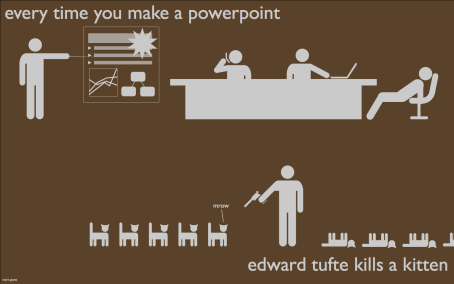
Mark Goetz’s new wallpaper (via Lynne Kiesling). Cory Doctorow translates: “Militant arm of the infoviz movement gets serious about PowerPoint.”
Too Blue for You
| Peter Klein |
 I’m partial to Klein Blue, but some of you may prefer Prussian Blue — apparently the first Crayola color to be renamed, as US kids had no idea who or what a “Prussian” could be. See this very cool online essay (via William Bostwick).

It Was the Best of Times, It Was the Worst of Times
| Peter Klein |
Many are enjoying the irony of Sandra Bullock winning a best-actress Oscar (for The Blind Side) and a worst-actress Razzie (for All About Steve) in the same year. It made me think of Robert Hodgson’s recent paper in the Journal of Wine Economics, noting that wines winning awards in a particular competition are no more likely to win awards in other competitions. “An analysis of the number of Gold medals received in multiple competitions indicates that the probability of winning a Gold medal at one competition is stochastically independent of the probability of receiving a Gold at another competition, indicating that winning a Gold medal is greatly influenced by chance alone.” Perhaps acting awards work the same way?
Hayekian Comments on Student Papers
| Peter Klein |
A grad student inspired these:
“The writer clearly suffers from a fatal conceit.”
“Reading this proposal helps me understand the knowledge problem.”
“Your paper appears to be the result of human action, but not human design.”
“The proposed outline reveals how little people really know about what they imagine they can design.”
Your suggestions?
Keynes vs. Hayek Rap Battle
| Lasse Lien |
If you’re teaching macro or the history of economic thought and you feel you’re not getting through to the kids, this video might be worth a try.
Thanks to Eirik Sjåholm Knudsen for the pointer.
PowerPoint Version of “I Have a Dream”
| Peter Klein |
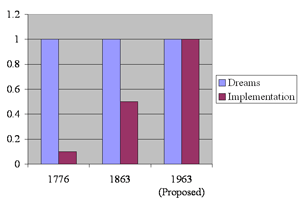
Bill Easterly tries his hand at PPTParody and hits a winner. The Gettysburg Address version remains the standard, of course. See also our PowerPoint archive.

Separated at Birth?
| Dick Langlois |
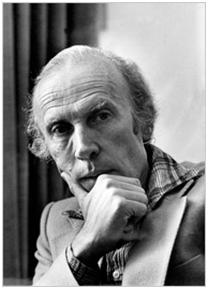
In reading the obituary of French New Wave director Eric Rohmer, I was struck by his uncanny resemblance to (fellow Frenchman) Gérard Debreu. Many things to ponder here, including the relationship of general-equilibrium theory to the cinema of the nouvelle vague.

A Ranking We Like
| Peter Klein |
An analysis published in the Eastern Economic Journal ranks O&M the sixth-best economics blog, based on the academic reputation of its authors. As you can see from Table 2, we outpaced such obscure sites as Freakonomics, DeLong’s blog, Marginal Revolution, and The Blog Formerly Known as the Austrian Economists. I wonder how we would fare against our good-twin site, were it included?
Finally, a Humanities Book Worth Reading
| Peter Klein |
It’s The Year’s Work in Lebowski Studies, edited by Edward P. Comentale and Aaron Jaffe (Indiana University Press, 2009). Says one dust-jacket endorsement: “There is something here for the slacker as well as the scholar, for all Lebowskis, big and small.” HT to the NYT, which titles its review “Dissertations on His Dudeness.” Look for Cornel West to offer a Princeton course soon on Lebowski Studies.
Call for a Slow-Word Movement
| Peter Klein |
If you like slow food, maybe you’ll like slow words. Forbes columnist Trevor Butterworth (via John Hagel) calls for journalists, educators, parents, and executives to spend time in the information superhighway’s slow lane:
the crisis of journalism is, at this point, sufficiently real to be seen as part of a wider conceptual crisis brought about by new-media technology: a crisis that is located, primarily, in the cognitive effects of acceleration and its cultural backwash. In short, a relentless, endless free diet of fast media is bad for your brain. Generation Google — those who have never known a world without the Internet — it turns out, not only cannot use Google effectively, they don’t even know enough about how to search for information to know they can’t use Google effectively. The idea that the kids are whizzes at multimedia tasking is a platitude confected by middle-aged techno gurus to peddle their expertise as explainers of generational difference. In fact, relentless multitasking erodes executive function. And while the brain may not be overloaded by 34 gigabytes of brute information a day, it appears that too many of these mental quanta are the equivalent of empty calories. PlayStation and texting need to be balanced out by reading novels, handwriting (for old-fashioned digital dexterity) and playing with other live people if you want your child to develop to be an effective, skill-acquiring, empathetic adult.
The tone is a bit curmudgeonly, even for me, and smells like yet another apologia for the Old Media. Some good points, nonetheless. And I’m sure there’s material for a good multitask principal-agent paper in there somewhere.
Here’s wishing you a Curmudgeonly New Year!
We Feel Your Pain
| Peter Klein |
From all of us here at O&M, we hope you have the same problem as the guy below (click to enlarge), and we wish you a happy, healthy, and productive 2010!

Granger Causality in Film Studies
| Peter Klein |
Did Sidney Poitier Granger-cause Denzel Washington? Chris Cagle discusses. Imagine similar questions in management: Did Harold Geneen Granger-cause Jack Welch? Did Schumpeter Granger-cause Nelson and Winter? Who Granger-caused Nicolai Foss? (Answer: he’s sui generis.)
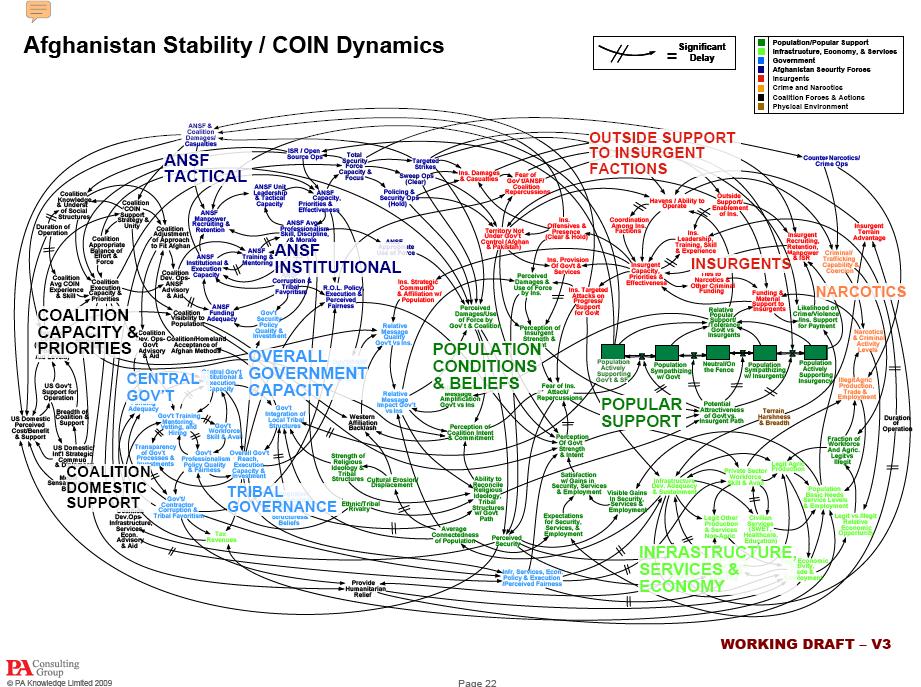
A Boxes-and-Arrows Diagram Even the Academy of Management Review Couldn’t Love
| Peter Klein |
From a stunningly awful slide show (both substantively and aesthetically) on US Afghanistan policy (via Chris Coyne).
Ironies of Avatar
| Peter Klein |
I took the kids to see Avatar this weekend. From a technical standpoint, Jim Cameron’s film is remarkable, a breakthrough, as good as advertised. The alien world Pandora is stunningly realistic, detailed, convincing. The computer-generated characters look and move like real actors. The battle scenes are phenomenal.
But the storyline didn’t grab me. It’s a twist on that familiar Hollywood trope: evil, materialist, capitalist, militarist humans versus nature-loving, low-carbon-footprint, New Agey savages so noble they would have made Rousseau blush. The computer-generated landscapes are dazzlingly three-dimensional, but the characters, both human and alien, are cartoonish and one-dimensional (especially the Head Evil Capitalist, played here by Giovanni Ribisi, essentially reprising Paul Riser’s role from Cameron’s Aliens). The Pandorans are in their own way as clichéd as Peter Jackson’s much-derided Skull Islanders. I appreciate the film’s antiwar, anti-imperialist message, but really, the Earth First! propaganda is way, way over the top. And consider these ironies:
1. Avatar was written and directed by bazillionaire businessman Jim Cameron, is produced and distributed by giant corporation 20th-Century Fox, and will likely gross hundreds of million dollars. Naturally the film’s villain is — you guessed it — a giant corporation! Because, you know, businesspeople and money and corporations are evil and stuff.
2. The film was made possible by Cameron’s highly innovative, beyond-the-state-of-the-art, years-in-the-making technological innovations. Yet one of the film’s main themes is the evils of technology and capital accumulation and the beauty of live-for-today, pre-industrial society. The Pandorans literally worship their planet and don’t just hug their animals and tress, they physically bond with them through some mystical (and anatomically curious) process. The poor humans, one of the characters explains, have destroyed their own “Mother.” Blech.
Update: Peter Suderman beat me to it, calling Avatar
one of the stupidest major movies in recently memory, blithely peddling a message that its entire production process actually undermines. That Avatar’s melodramatic attacks on corporate interests and its defense of simple, natural living come packaged as one of the most expensive, and probably the most technically advanced, corporate films in history would seem to indicate that only quality bigger than the movie’s stupidity is its head-in-the-clouds hypocrisy. Cameron’s made a movie that he intends to be epic and awesome, but the only thing that’s awesome here is his total lack of self-awareness.
Stephan Kinsella sees a libertarian defense of property rights, and so do I, but for me that message was buried beneath the eco-propaganda. Had the earthlings homesteaded some piece of unoccupied Pandoran land, put it to productive use, and then the natives decided they needed the land or that its economic value belonged to “Mother Pandora,” is there any doubt what side Cameron would be on?





 Organizations and Markets
Recent Comments