Posts filed under ‘Ephemera’
Paper Titles I Wish I’d Written
| Peter Klein |
“Shift Work and Business Cycles,” by Lucas Engelhardt, a PhD candidate at Ohio State (and former participant in the Rothbard Graduate Seminar).
Oh, wait, it’s “shift” work. . . . I thought it was a study of my daily routines and their effect on the economy.
Peer Review ca. 1945
| Lasse Lien |
Here is a typical reaction to the peer-review process around 1945. I reckon it hasn’t changed all that much. (Not for the faint at heart.)
HT: Svenn-Åge Dahl
Mechanism Design and the Office Holiday Party
| Peter Klein |
 Holiday office parties, far from being a waste of time (and booze), can be effective screening mechanisms, according to information forwarded by Doug French:
The Banc Investment Group’s “Banc Investment Daily” email report from December 6, 2005, urged its banker readers to turn the troops loose at the holiday season, because “the holiday party serves an important professional purpose — Darwinian selection.”
It turns out that people do and say the darnedest things while under the influence. Christmas party incidents are relived over and over for years at the office. Banc Investment points out that those employees who make the holiday party highlight film, “tend to do the same things at the office, but co-workers don’t notice as much.” . . .
Holiday parties are “effective at highlighting trouble makers,” according to Banc Investment Daily. “Now while we admit that one banker’s inappropriate behavior is another’s entertainment, knowing where your trouble spots are is a gift worth opening every year.”
Of course, there’s also the entertainment value for the rank-and-file: “For us, the appeal of the holiday bank party is the same as watching NASCAR. We know the bulk of the time will be a total snooze, but you have to go to see the outfits and the spectacular crashes.”
Opening Lines You’re Glad You Didn’t Write
| Dick Langlois |
Now here is an opening line you will be glad you didn’t write. (From our local newspaper, the Willimantic Chronicle, November 25, 2009.)
WINDHAM — After being vacant for six years, former Windham First Selectman Jean de Smet appointed two co-town historians to preserve and share their knowledge about the town.
This is especially funny in light of the controversial character of de Smet’s administration, although vacancy wasn’t among the complaints, and indeed increased vacancy actually might have improved things. (She was elected on the Green Party slate.)
I have added this article to my file of amusing pedagogical examples of faulty agreement and misplaced clauses. Here are two of my favorites from that file, one from the UConn Daily Campus and another from the Chronicle.
More Graduate Student Humor
| Peter Klein |
Found this posted on a classroom wall in our building. Not quite as witty as this one, but then again, we keep them heavily sedated:

On a more serious note, here’s a conference celebrating the 50th anniversary of Coase’s landmark 1959 and 1960 papers, with an all-star lineup.
The Igon Value of Football
| Dick Langlois |
 My last post implicitly lauds the science reporting of the New York Times. And I think they generally do a good job. But, still basking in the glow of UConn’s remarkable football win over Notre Dame on Saturday, I am reminded of a — presumably unintentionally — funny bit of science reporting recently in the Times. Reporter Alan Schwartz has been waging a (perhaps justified) campaign about the problem of head-injury risk in football. In one article last month, he quotes a neurosurgeon on the physics of football collisions.
“I go back to Einstein and E = mc2,” said Julian Bailes, a former Pittsburgh Steelers neurosurgeon and one of the leading researchers in the neurological effects of football concussions. “The players are definitely much more massive and that’s one factor. But you have 300-pound linemen running 4.3s — and that factor is squared. The impacts that players face today, not just the big ones that everyone sees but the routine ones in the trenches, is what really worries me.”
Converting the mass of a 100Kg football player (light by NFL standards) into energy according to the Einstein formula would yield about 2,000 megatons of energy, probably enough to cause head trauma even in an NFL lineman. (It is the quoted source who makes the mistake, but the reporter and his editors didn’t catch it or at least didn’t remark on it or change it.)
When I was in high school, the assistant football coach was also the physics teacher. He tried to psych us up for one game against (as always) a bigger and more talented opponent by quoting the correct version of the mechanics of collision — energy goes up as the square of your velocity, not the square of the speed of light. How fast you get going, he was telling us, is much more important than the weight of the opponent. I found this a refreshing change from the usual cliché about the manner in which the opposing players were likely to don their athletic supporters. But under the circumstances, and especially as I was one of the few who had any idea what he was talking about, I declined to point out that smacking into another football player is an inelastic collision, so energy isn’t conserved. Momentum is always conserved, but that’s linear in both mass and velocity. I didn’t play football very seriously or for very long, but I am happy to blame the experience for my increasing mental lapses as I grow older.
Extra point. By the way, the inelastic collision pictured above is between Notre Dame running back Armando Allen and UConn middle linebacker Greg Lloyd (son of the former Pittsburgh Steeler of the same name) at the goal line on Saturday. UConn won the game in the second overtime. In college football, each overtime session allows both teams a single possession from the 25-yard line. In the first overtime, both teams scored a touchdown and an extra point. In the second overtime, UConn held ND to a field goal and then scored a touchdown on their turn, thus winning the game. This differs from the professional rule: sudden death. On Sunday, the Patriots beat the Jets in overtime because they won the coin toss and then quickly got close enough to score a field goal. Thus, in the pro game, the coin flip determines the outcome with high probability, a circumstances that rightly causes consternation among fans. Economists have suggested auctioning off possession in overtime, with the currency being the field position from which you are willing to start. At the very least, they ought to use something like the college system.
My Career in One Sentence
| Peter Klein |
Geoff Manne to me and others: “The Intel-AMD settlement, over an alleged Sherman Act Section 2 violation, seems to violate Section 1 of the same act. I’ve written an informed and thoughtful blog post on this. What do you think?”
Me: “This is further evidence that antitrust law is inherently contradictory, that the enforcement system is irretrievably broken, and that antitrust laws should be ditched entirely. Is that flippant?”
Geoff: “Just because it’s flippant doesn’t mean it isn’t true!”
Citation Format Pet Peeve
| Peter Klein |
Many thanks to June Flanders for expressing, on the HET listserv, one of my own pet peeves about citation formats: using the reprint date, rather than the original date, in the in-text citation:
At the risk of sounding school-marmerish I should like to raise an issue that has been bothering me for a long time, and which reached a crisis point this afternoon. . . .
The issue is the dating of citations in papers and books on the basis of their most recent publication. As a result of this, generations of students undoubtedly think that Ricardo wrote The High Price of Bullion in 1956, and Keynes wrote The General Theory in 1973, etc. What broke my camel’s back today was a citation in an NBER paper that cited “Tacitus, Cornelius (1996). The Annals of Imperial Rome. New York: Penguin.” Not every reader of that paper (though, of course, every reader of this letter) will know that this is off by some 2,000 years.
I prefer the simplest solution, namely putting “Smith (1776)” in the text and specifying the particular edition in the bibliography entry, e.g.:
Smith, Adam. 1776. An Inquiry Into the Nature and Causes of the Wealth of Nations. Indianapolis: Liberty Fund, 1981.
Some people like to write the in-text citation, and maybe the bibliography entry too, as “Smith ([1776] 1981),” but I find that cumbersome. In any case, putting the original publication date in the text lets the experienced reader know, immediately, what is being referred to. In my field everybody knows Smith (1776), Menger (1871), Coase (1937), Mises (1949), Porter (1980), etc. It’s a nuisance having to flip to the back to find that “Menger (1981)” is Menger’s Grundsätze (the NYU Press edition). While I’m reading the article or book in question, I don’t care if the writer was referring to the original hardbound edition or the paperback edition or the large-print edition or the books-on-tape edition or whatever. If I want to check page numbers, then I flip to the back to find out what edition was used, but otherwise I breeze right along. Simple enough?
Cultural Economics Conference in Copenhagen
| Nicolai Foss |
My colleague Dr. Trine Bille is the organizer of next year’s “International Conference of the Association of Cultural Economics International” in Copenhagen (CBS). Here is the Call. Submit a paper!
Best Part About Winning a Nobel Prize at Berkeley
| Peter Klein |
I might not believe it if I hadn’t seen these parking spaces — in very choice locations — with my own eyes. (Thanks to Peter H. for the link.)
The spaces are marked with special signs that read: “Reserved For NL/Special Permit Required At All Times.” That “NL,” of course, stands for Nobel laureate.
Physics professor George Smoot, who won the Nobel Prize in 2006, said there’s a catch to the permit: It’s free, but it’s not automatically renewed each year. Some of Berkeley’s Nobel laureates have let their permits lapse.
“It’s a temporary permit,” Smoot explained. “You’ve got to renew it every year — like your Nobel laureate’s going to go away, or something! And so, twice now I’ve gotten tickets because I didn’t, you know, remember to renew it on time.”
But Williamson says a little paperwork will not discourage him from getting the permit.
“I think it ought to be automated, but apply if I must, apply I will,” he said.

The Most Interesting Scholar in the World
| Peter Klein |
With apologies to Dos Equis:
His work would pass peer review . . . if he had peers.
Students take his classes, just because they find them interesting.
His main intellectual predecessor . . . is himself.
His Erdős number is negative.
He once rejected one of his own articles, just to see how it felt.
He reads Sanskrit . . . in mathematics.
A man came out of a coma after touching one of his books.
Football players at his university have season tickets to his lectures.
Stay thirsty for knowledge, my friends.
Nerd Rap
| Peter Klein|
Weird Al’s version — already deconstructed by our friends at orgtheory.net — has style, but the CERN Rap has substance. As do these econ vids.
Famous Misquotes
| Peter Klein |
What are your favorite famous misquotes in social science? E.g., everybody knows Lord Acton’s dictum: “Power corrupts, and absolute power corrupts absolutely.” Except he actually wrote “power tends to corrupt, and absolute power corrupts absolutely.” Likewise, Adam Smith didn’t say that the merchant is led “as if by an invisible hand” to promote an end not his intention; he said the merchant “is in this, as in many other cases, led by an invisible hand. . . .” And, to get to the really deep thinkers, Gordon Gekko didn’t say “greed is good,” but “greed, for lack of a better word, is good. Greed is right. Greed works. Greed clarifies, cuts through and captures the essence of the evolutionary spirit. . . .” I love you, man!
On a related note, David Levy and Sandra Peart explain that Thomas Carlyle’s description of economics as the “dismal science” had nothing to do with Malthusian overpopulation. Carlyle actually despised the economists because they supported the emancipation of slaves and believed, in Levy and Peart’s words, “it was institutions, not race, that explained why some nations were rich and others poor.”
The Roadmap to Success
| Lasse Lien |
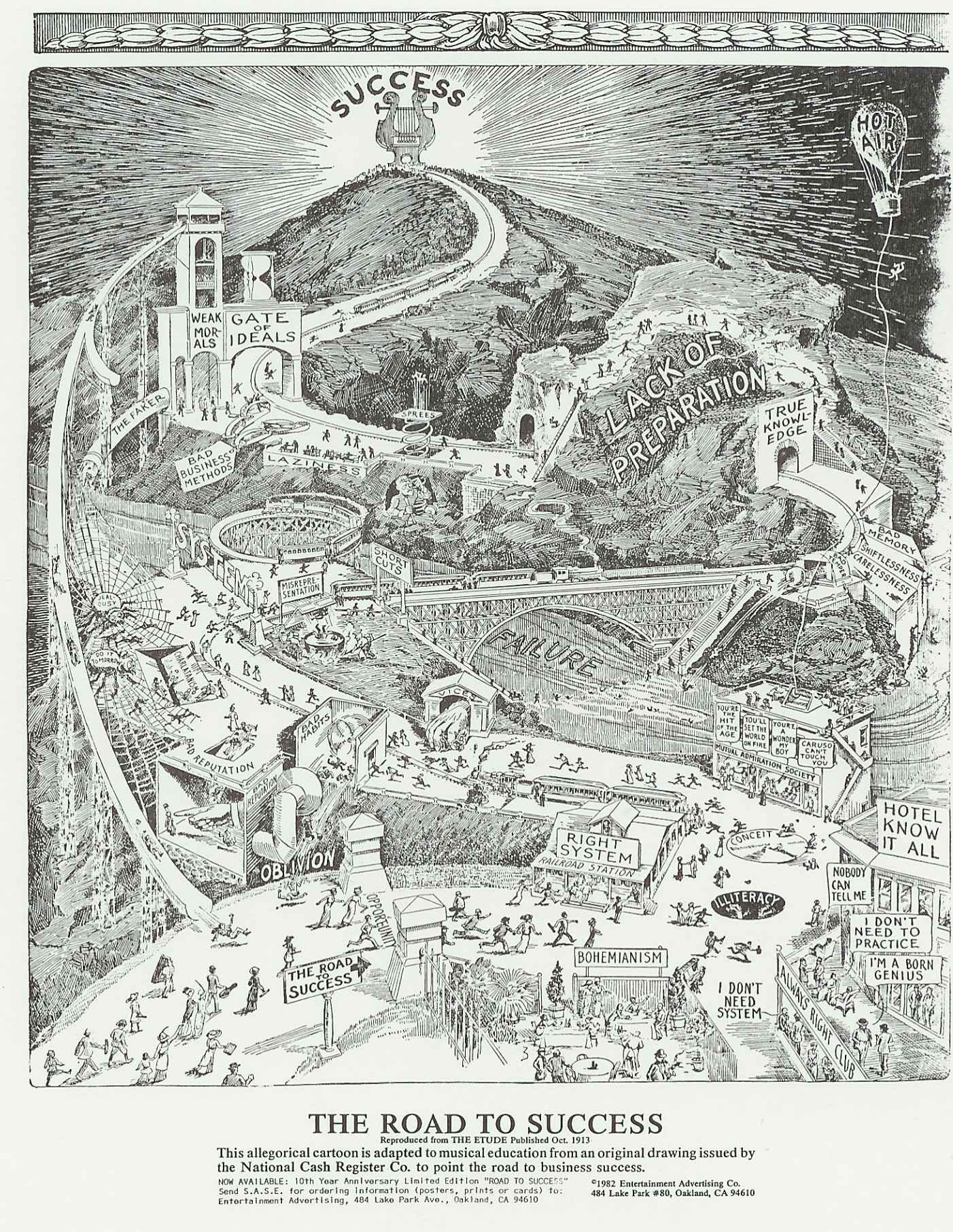
Here it is. The roadmap to success.
I guess it was Bohemianism that sealed my fate.
BTW: Peter, you’ll be glad to know that apparently there is no sidetrack for blogging.
(Via Flowingdata)
Who Says Data-Visualization Tools Aren’t Useful?
| Peter Klein |
When they can produce beauties like this map of time-travel timelines from movies and TV? (Not quite as awesome as the Heavy Metal Band Names Flow Chart but still pretty cool.) HT: /Film.

Bonus: Here’s another one, from John Hagel, that many of you will appreciate.
Not Even the Slightest Soupçon of Correlation
| Dick Langlois |
Another interesting article from the Journal of Wine Economics:
The lead article is again by Robert T. Hodgson, who analyzes the reliability of Gold medals awarded at 13 California Wine Fairs. “An analysis of over 4000 wines entered in 13 U.S. wine competitions shows little concordance among the venues in awarding Gold medals. Of the 2,440 wines entered in more than three competitions, 47 percent received Gold medals, but 84 percent of these same wines also received no award in another competition. Thus, many wines that are viewed as extraordinarily good at some competitions are viewed as below average at others. An analysis of the number of Gold medals received in multiple competitions indicates that the probability of winning a Gold medal at one competition is stochastically independent of the probability of receiving a Gold at another competition, indicating that winning a Gold medal is greatly influenced by chance alone.” The full article can be accessed free of charge at Abstract Full Text (PDF).
How to Publish a Scientific Comment in 123 Easy Steps
| Peter Klein |
This is floating around the web and good for a chuckle. The situation in social science is in some ways better and in other ways worse than that described here (the author claims it’s based on a true story). Our journals are not quite as space constrained, on average, but our publication lags are typically much longer.
Be sure to read all the way through to the Addenda, in which the author makes interesting and important suggestions for revising the system. (HT: Randy.)
The Amish Internet
| Peter Klein |
It’s the Budget, a 119-year-old Amish weekly newspaper published in Sugarcreek, Ohio. “The Budget is the dominant means of communication among the Amish, a Christian denomination with about 227,000 members nationwide who shun cars for horse-drawn buggies and avoid hooking up to the electrical grid,” says an AP story. The national edition, which has a strong following in the US and Canada, simply aggregates dispatches produced by local writers. “People call the Budget the Amish Internet,” says its publisher. “It’s non-electric, it’s on paper, but it’s the same thing.”
The example highlights the benefits and costs of different types of networks. Open-access, open-source networks governed by just a few simple protocols like TCP/IP and HTML are not necessarily the best solution for every problem. Sneakernet is more secure, for example. In the Amish case, according to the AP story, the Budget’s customers limited access, threatening a rebellion when the newspaper recently announced plans to produce an online edition. “The writers, known as scribes, feared their plainspoken dispatches would become fodder for entertainment in the ‘English,’ or non-Amish, world.”
Preaching from the Choir
| Dick Langlois |
It’s hard to top Bruce Kogut on the Daily Show. But by sheer coincidence I happened upon a video that offers a quite different perspective on corporate social responsibility.





 Organizations and Markets

Recent Comments