Posts filed under ‘Evolutionary Economics’
Hayekian Ants
| Dick Langlois |
A former student of mine (thanks, Don) sent me a link to a fascinating piece in the Proceedings of the Royal Society called “Rationality in Collective Decision-making by Ant Colonies.” Here’s the abstract.
Economic models of animal behaviour assume that decision-makers are rational, meaning that they assess options according to intrinsic fitness value and not by comparison with available alternatives. This expectation is frequently violated, but the significance of irrational behaviour remains controversial. One possibility is that irrationality arises from cognitive constraints that necessitate short cuts like comparative evaluation. If so, the study of whether and when irrationality occurs can illuminate cognitive mechanisms. We applied this logic in a novel setting: the collective decisions of insect societies. We tested for irrationality in colonies of Temnothorax ants choosing between two nest sites that varied in multiple attributes, such that neither site was clearly superior. In similar situations, individual animals show irrational changes in preference when a third relatively unattractive option is introduced. In contrast, we found no such effect in colonies. We suggest that immunity to irrationality in this case may result from the ants’ decentralized decision mechanism. A colony’s choice does not depend on site comparison by individuals, but instead self-organizes from the interactions of multiple ants, most of which are aware of only a single site. This strategy may filter out comparative effects, preventing systematic errors that would otherwise arise from the cognitive limitations of individuals.
Mizzou Seminar on Evolutionary Models in Economics and Organization Theory
| Peter Klein |
Thanks largely to the organizing efforts of my colleague and former O&M guest blogger Randy Westgren, a group here at Missouri is examining evolutionary models in economics and organization theory. The centerpiece is a philosophy of science seminar directed by André Ariew, a leading American scholar in the philosophy of biology, especially Darwin and evolutionary theory.
I’ll let Randy explain:
The course is PHL 9830. Normally it is a traditional philosophy of science seminar aimed at graduate students in the department of philosophy, but we hijacked it to examine a specific theme. The subject focus is evolutionary theory applied to biology, economics, and management. There are three general types of questions we ask, (a) clarification, (b) conceptual, and (c) general philosophy of science. (more…)
For Hire: Neo-Schumpeterian Economist
| Dick Langlois |
I was recently contacted by Robert Atkinson of the Information Technology and Innovation Foundation in Washington. His group is looking for a neo-Schumpeterian economist interested in the role of innovation in addressing climate change. Here’s the position listing. Surely there is a reader of O&M out there who fills the bill.
The Age of Constructivism
| Craig Pirrong |
I am reading Vernon Smith’s Rationality in Economics. I highly, highly recommend it. Largely a homage to Hayek, it explores the implications of Hayek’s distinction between constructivist rationality and what Smith relabels ecological rationality. It contains a wealth of methodological and substantive insights. Smith is knowledgeable and thoughtful. He is almost John Stuart Mill-like in his even handed and fair characterizations of competing views, even those he disagrees with. He integrates experimental economics, game theory, institutional economics, neoclassical economics, neurology, and much, much more.
What fascinates Smith is the ineffable process by which an ecologically rational order emerges from the actions of myriad imperfectly informed and incompletely rational (in the constructivist sense) individuals. This process — a sort of economic transubstantiation — is the most fascinating economic mystery. It is also, alas, one that has received far too little attention from economists whose formal tools permit them to analyze (constructively) equilibrium, but which are virtually powerless to analyze the process of getting there; the proverbial drunks looking for their keys under the lamppost.
We live in an era of constructivism regnant. In health care and finance, especially, constructivist schemes will reshape for better or worse — and almost certainly worse — vast swathes of the American economy. What’s more troubling still, this is constructivism refracted through the flawed lens of politics and public choice. Appreciation of the emergent order, the ecologically rational, is sadly rare. Vernon Smith appreciates it, deeply, with an almost religious sense of awe. Read his book and you will appreciate it too.
Making and Unmaking Economic Orders
| Dick Langlois |
The new issue of the online journal Capitalism and Society has a number of articles that should interest readers of this blog. Each is probably deserving of its own post. (Ah, but time prohibits.)
Jon Elster has a piece called “Excessive Ambitions” that criticizes not only mainstream rational-choice models (as we would expect from Elster) but also modeling in general. Roman Frydman and Michael Goldberg have a piece that applies something like Leijonhufvud’s “corridor” to risk regulation: when swings of asset values are small, government should stay out, since such swings are actually beneficial; but when asset prices get too far from “underlying values,” government regulation is called for.
My favorite paper is by Thorbjørn Knudsen and Richard Swedberg. Here’s the abstract:
This is a theoretical paper in which we attempt to present an economic and sociological theory of entrepreneurship. We start from Schumpeter’s idea in Theory of Economic Development that the economy can be conceptualized as a combination and innovations as new combinations. Schumpeter also spoke of resistance to entrepreneurship. By linking the ideas of combination and resistance, we are in a position to suggest a theory of capitalist entrepreneurship. An existing combination, we propose, can be understood as a social formation with its own cohesion and resistance — what may be called an economic order. Actors know how to act; and profit is low and even in these orders. Entrepreneurship, in contrast, breaks them up by creating new ways of doing things and, in doing so, produces entrepreneurial profit. This profit inspires imitators until a new order for how to do things has been established; and profit has become low and even once more. Entrepreneurship is defined as the act of creating a new combination that ends one economic order and clears the way for a new one. The implications of this approach for a number of topics related to entrepreneurship are also discussed.
This has some affinities to arguments I have made in the past. I am thanked in the acknowledgements, presumably for conversations that Richard and I had at a Schumpeter conference at Harvard last year; but I’m not cited. (Assume sad-faced emoticon here.)
I will talk about the fourth paper in the issue soon in a separate post.
QWERTY in the Long Run
| Dick Langlois |
The new issue of Industrial and Corporate Change has an article by Andreas Reinstaller and Werner Hölzl called “Big Causes and Small Events: QWERTY and the Mechanization of Office Work.” Although it’s an interesting paper in many respects, I think it fails in its avowed aim to defend Paul David against the attack of Liebowitz and Margolis. Mostly, they don’t get L&M right (and explicitly get them wrong in footnote 1). The issue is whether the QWERTY keyboard is an example of what L&M call “third-degree” path dependency, that, is path dependency leading to an outcome that is both regrettable ex post and would somehow have been remediable ex ante. The criterion of “remediable” to R&H seems to be whether contemporaries “knew about” superior alternatives. That’s not quite right, of course: the real issue is whether any alternative institutional structure could have done a better job of choosing a standard under the conditions of knowledge at the time. Their only example is the existence of a French “Ideal” keyboard layout (which some people “knew about”) that was swept aside by the tidal wave of the American QWERTY standard (and became AZERTY in France). But they have no evidence about how much better this keyboard was — or if it was better at all. In footnote 1 they cite Donald Norman’s interesting book on design to the effect that the Dvorak keyboard is 10 per cent faster than QWERTY. But (A) Norman’s point in the book is how insignificant this difference is and (B) that doesn’t demonstrate third-degree path dependency, since no one “knew about” the Dvorak keyboard until Dvorak invented it (an extremely laborious process, according to Norman).
Again, I don’t want to be too hard on R&H: I think there’s a lot that’s interesting in the paper, especially the discussion of the mechanization of office work. What really struck me in this context, however, is how irrelevant, or at least dated, the QWERTY saga is. And I say this not for the usual reason: that computers now allow us to have any keyboard layout we like. Rather, what struck me is that the production of documents has long since become demechanized, making even more-than-nominal differences in typing speed irrelevant. Since we now all (or almost all) compose right on the computer, and never send our documents out to the typing pool, manuscript production has become a craft again. What is slowing us down is how quickly we think of something to say, not how fast we can type. And I doubt that, fifties nostalgia notwithstanding, we are unlikely to see the return of the typing pool anytime soon. So, from a historical perspective, QWERTY will have been technically inefficient (though not therefore economically inefficient) only for that brief historical period between the invention of Dvorak and the coming of the personal computer.
The same issue of ICC also has a paper by Ashish Arora and coauthors that’s worth a look.
Economic Institutions of Strategy
| Peter Klein |
That’s the title of a forthcoming volume of Advances in Strategic Management edited by Jackson Nickerson and Brian Silverman. You’ll recognize the allusion to a certain classic book. Like that book, this volume maps out an ambitious agenda for new scholarship on institutions and organizations, particularly within the field of strategic management. The chapters provide critical reviews and syntheses of various strands of the strategy literature, intended to support and to challenge new and established scholars starting work in these areas. (They should make excellent readings, for example, for doctoral courses in strategy and the economics of organization.)
Lasse and I contributed a chapter, “Diversification, Industry Structure, and Firm Strategy: An Organizational Economics Perspective,” that you can download on SSRN. Here’s the abstract:
We review theory and evidence on corporate diversification, industry structure, and firm strategy from an organizational economics perspective. First, we examine the implications of transaction cost economics (TCE) for diversification decisions. TCE is essentially a theory about the costs of contracting, and TCE sheds light on the firm’s choice to diversify into a new industry rather than contract out any assets that are valuable in that industry. While TCE does not predict much about the specific industries into which a firm will diversify, it can be combined with other approaches, such as the resource-based and capabilities views, that describe which assets are useful where. We also discuss the transaction-cost rationale for unrelated diversification, which focuses on the potential efficiencies from exploiting internal capital markets. We review this argument as it emerged in the transaction cost literature in the 1970s and 1980s and, more recently, theoretical and empirical literature in industrial organization and corporate finance. We then discuss how diversification decisions, both related and unrelated, affect industry structure and industry evolution. Here, the stylized facts suggest that diversifying firms have a crucial impact on industry evolution because they are larger than average at entry, grow faster than average, and exit less often than the average firm. We conclude with thoughts on unresolved theoretical, methodological, and empirical issues and problems and provide suggestions for future research.
Railway Gauges and Path Dependency
| Dick Langlois |
 You’ve all read the viral email asserting that the railroad gauge we have today — and, in some versions, the size of the space shuttle fuel tanks, which had to be transported by rail — is a direct result of the wheel gauge of Roman chariots. Not surprisingly, the real story is more complex, and many gauges coexisted (and to some extent continue to coexist) in the U.S. and around the world. My former colleague Doug Puffert tells this story in full detail in his new book, Tracks across Continents, which has just appeared from the University of Chicago Press. The book is a useful addition to the catalog of case studies of path-dependent technology.
The book came out of Doug’s thesis at Stanford, where he worked with Paul David and Brian Arthur. He was a visitor at UConn in the 1988-89 academic year. I can still remember his seminar presentations, which involved simulating the evolution of railways on a Macintosh of the era. (One thing you probably won’t learn in Doug’s official bio is that, before coming to UConn, he won a car on Wheel of Fortune. I always tell students about this when I teach the QWERTY story — a student of Paul David who really knew his letter frequencies.)
Irrational Behavior and Rational Addiction
| Dick Langlois |
In 1962, Gary Becker published an article in the JPE called “Irrational Behavior and Economic Theory,” which prompted an interchange with Israel Kirzner (here, here, and here). Becker had tried to argue that one could derive the law of demand without recourse to an assumption of rationality: when relative prices change, the budget constraints of consumers will also change, making some previously available combinations infeasible. This will mean that, in the aggregate, consumers will demand less of the good that has become relatively more expensive. Kirzner pointed out that Becker still hadn’t eliminated rationality, since he is assuming that the consumers are price takers and that the prices are set on the supply side, presumably by firms who notice and respond rationally to price changes. (I discussed the issues here in some detail back in my 1986 book, which, by the way, is back in print in paperback thanks to the new technology of on-demand printing.)
I thought of the Becker-Kirzner exchange recently when I saw the abstract of this article: “So You Want to Quit Smoking: Have You Tried a Mobile Phone?”
Tobacco use, which is rising quickly in developing countries, kills 5.4 million people a year worldwide. This paper explores the impacts of mobile phone ownership on tobacco consumption. Indeed, mobile phone ownership could affect tobacco consumption because individuals might pay for their communication with money they would have spent on tobacco. Using panel data from 2,100 households in 135 communities of the Philippines collected in 2003 and 2006, the analysis finds that mobile phone ownership leads to a 20 percent decline in monthly tobacco consumption. Among households in which at least one member smoked in 2003, purchasing a mobile phone leads to a 32.6 percent decrease in tobacco consumption per adult over the age of 15. This is equivalent to one less pack of 20 cigarettes per month per adult. The results are robust to various estimation strategies. Further, they suggest that this impact materializes through a budget shift from tobacco to communication.
I leave it as an exercise to the reader to decide whether this sheds any light on the Becker-Kirzner exchange. Extra credit: what does this say about Becker’s theory of rational addiction?
More Evidence Against the QWERTY Effect
| Peter Klein |
Via MR, an experimental study on path dependence finds that subjects do not get stuck using second-best technologies, even in the presence of network effects:
In this paper, we offer new evidence regarding the economic importance of QWERTY type outcomes. We use laboratory experiments to study platform competition. Experiments have several advantages in studying platform competition: the identity of the inferior platform is clearly defined; the degree to which a platform has a “head start” is controlled; and the “life cycle” of platform competition is reproducible. So far as we are aware, we are the first to study QWERTY in the lab.
We can easily summarize our results: Somehow, the market always manages to solve the QWERTY problem. In sixty iterations of dynamic platform competition, our subjects never got stuck on the inferior platform — even when it enjoyed a substantial first-mover advantage.
For more on path dependence, network effects, and QWERTY see this, this, and this. The more I learn about so-called QWERTY effects the more I’m convinced that they have no economic significance (and even less policy signficance).
The Emergence of English Commercial Law
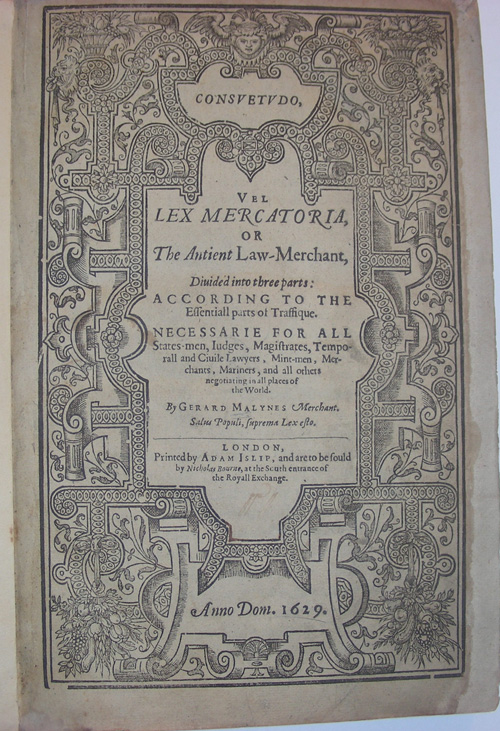
 The English system of commercial law or the lex mercatoria has been described as an example of “spontaneous order,” a set of rules that emerged without central direction and yet provided remarkable stability and favorable institutional environment for trade. Harold Berman and Bruce Benson, among others, have written extensively on this. Here’s an interesting paper by Daniel Klerman on the early history of English commercial law, framed as a comparison of the English and Ottoman systems:
Thirteenth-century England was a commercial backwater whose trade was dominated by foreigners. To accommodate and encourage foreign merchants, England modified its legal system by creating legal institutions which were available to both domestic and foreign traders. Among the most important of these institutions were streamlined debt collection procedures and mixed juries composed of both Englishmen and foreigners. By introducing institutions which treated locals and foreigners equally, England created a level playing field which enabled English merchants to become increasingly prominent in the later Middle Ages. England’s ability to modernize its law was facilitated by the secular nature of English law, the representation of merchants in Parliament, and legal pluralism. Medieval England contrasts sharply with the early modern Ottoman Empire. The latter created special institutions for foreign merchants, which eventually put Ottoman Muslims at a competitive disadvantage.
Rival Teams and Non-Rival Knowledge
| Dick Langlois |
A recent issue of the Journal of Quantitative Analysis in Sports, an all-electronic Bepress journal, carried a piece provocatively titled “Quantifying NFL Coaching: A Proof of New Growth Theory” by Kevin P. Braig. The paper is a rambling mix of sports anecdotes and goofy math. My favorite of the latter is:
| lim f(x) = 1 first down
x→10 |
But the piece is amusing reading and does make some interesting points.
The title is more than a bit fatuous, of course. What the author has in mind is that one can increase output not only by increasing the inputs but by learning to reorganize the way those inputs are combined. This was the growth theory of Smith and Marshall, of Rosenberg and Mokyr. The only contribution of the New Growth Theory has been to cram a diminished and mechanized version of these ideas into the formalism of the production function — and, of course, to receive credit in the popular mind for the very notion that growth is about the search for new “recipes.” Braig is on firmer ground when he associates himself with Carliss Baldwin‘s notion of designs.
What has this got to do with sports? Consider baseball, which is probably the most modular of major (American) sports. In baseball, the only real way to be more successful is to improve the quality of the players, what Braig likes to call their human capital. This is because the way players interact is relatively hard-wired and invariant among teams. Small adjustments are possible — shifts, bunting strategy — but no one ever redefines how to turn a double play. The so-called moneyball approach has been to find better statistical measures of the effectiveness of player human capital — not to reorganize how the players interact. (In testimony to the almost mystical numerology of this article, Braig finds wonder in the fact that average on-base percentage has remained nearly constant over the live-ball era at about 0.331, exactly the ratio one gets by recognizing that “the hitters’ needs (4 bases) exceed their resources (2 outs) by a 2-to-1 margin.” But this presumes that human capital in batting should somehow exactly keep pace with human capital in pitching — even though there is arguably more room for innovation in pitching. I think a closer examination would find that baseball rulemakers have tweaked subtle rules like the size of the strike zone or the height of the mound to keep the ratio constant.) (more…)
Notes from the Schumpeter Society Conference
| Dick Langlois |
 I’m in Rio De Janeiro, where the biennial conference of the International Joseph A. Schumpeter Society has just finished up. I was involved in, among other things, a plenary session on the first day with Dick Nelson and Carliss Baldwin on “Varieties of Knowledge in the Economy.” The session was organized by Peter Murmann, who promises to post the slides and notes eventually on his very interesting website.
At the conference banquet last night — in the elegant Copacabana Palace Hotel — the Schumpeter Prize was split among three recipients. One was Tom McCraw for Prophet of Innovation, his biography of Schumpeter, which Peter blogged about some time ago. (See also my review.) Another was Martin Fransman for The New ICT Ecosystem: Implications for Europe, the latest of Martin’s many interesting books on ICT industry structure and government policy. In his acceptance remarks, Martin mentioned the picture of Schumpeter that had adorned the office wall of his first (and perhaps most influential) economics teacher, Ludwig Lachmann, at the University of the Witwatersrand in South Africa. The third recipient(s) were Mario Amendola and Jean-Luc Gaffard for a book I’ve have not yet seen.
The conference was set in a beautiful part of Rio called Urca, right on the water and surrounded by giant jutting granite hills. The area houses not only some older parts of the Federal University of Rio but also a compound of military facilities and academies. There is also an edifice called the Instituto Benjamin Constant, a school for the blind, which is apparently not named, however, for the eighteenth-century Swiss liberal thinker but for a nineteenth-century army officer who was the leading Brazilian adherent to the positivism of Auguste Comte.
From Rumination to Rumelt via Dobzhansky
| Randy Westgren |
I was perusing the website of the Oxford Symposium on Food and Cookery to find the references to last year’s theme: food and morality. Some interesting reads there. I noticed that the Symposium awards the Sophie D(obzhansky) Coe Prize in Food History annually. Dr. Coe was an anthropologist who wrote on pre-Columbian diets and was the daughter of Theodosius Dobzhansky, one of “the Four Horsemen” of the modern synthesis of genetics and evolution (American Philosophical Society). Dobzhansky emigrated from the University of Kiev in 1927 to Columbia University, thence to Caltech, where he and his colleagues bred squillions of generations of fruit flies and provided the empirical basis for the mathematical models of evolution of the other horsemen: Haldane, Fisher, and Wright.
In 1937, Dobzhansky had two publications. One was his landmark book, Genetics and the Origin of Species, which was the siren song that drew Ernst Mayr and other biologists to the field of evolutionary biology. Mayr has often been credited with developing the concept of the isolating mechanism as the basis for speciation. Methinks that Mayr’s long shadow at Harvard fell on Richard Rumelt, who ported the concept to strategic management without much attribution in his 1984 and 1987 pieces. Mahoney and Pandian must be credited with the most complete exposition of the concept. (more…)
Aoki on North
| Peter Klein |
Masahiko Aoki’s contribution to a forthcoming North symposium, “Understanding Douglss North in Game-Theoretic Language,” is available on SSRN. North’s 1990 book Institutions, Institutional Change and Economic Performance, writes Aoki,
laid the foundation for New Institutional Economics by conceptualizing institutions as the rules of the game, pointing out the vital importance of effective enforcement and arguing for the crucial roles they play in determining economic performance. Thus it became a seminal book. But if the rules of the game are so crucial, then why doesn’t a lagging economy emulates the rules that prevail in more advanced economies? Why cannot the rules of the game be changed and enforced by emulation? It seemed that in his [1990] book North regarded it as the essential role of polity to change and enforce the (formal) rules of the (economic) game. But in his view, political markets are imperfect and inefficient so that better rules cannot be emulated/devised or enforced as desired. Thus a further question is raised regarding how rules of political games are determined. This problem of potential infinite regression needs to be answered by going back in historical time to the past. Thus history matters to our understanding of institutions and thus the performance of an economy. . . .
In [Understanding the Process of Economic Change, 2005], particularly in Part I, he has made critical progress toward understanding to the nature of this process. He is now more explicit and vocal about the evolutionary nature of institutional change. . . . He innovatively focuses on the evolution of belief systems that human agents hold, arguing that we perceive the “human landscape,” interpret it, discover problems within it and intend to solve them. In this way, we collectively and incrementally change the societal rules of the game. In other words, we may say that there is a coevolution of belief systems and institutions.
See also reviews of the newer book by Alex Field, Stefan Voigt and Stanley Engerman.
Fed Intervention Policy
| Steve Phelan |
Greg Mankiw reports that Myron Scholes has a novel idea to fix the credit crisis – rather than simply guaranteeing to underwrite asset losses (as they have with the JP Morgan/Bear Stearns ) Scholes proposes that the Fed takes senior equity and debt positions in a distressed bank thereby improving the capital adequacy ratio, and thus preventing a credit freeze which would damage the real economy. I like it – what do YOU think?
Upcoming Events: A Busy June
| Peter Klein |
June is an exciting month for O&Mers looking for research conferences. First up is ACAC 2008, 12-14 June in Atlanta. ACAC, which has received high marks on this blog, is an annual workshop organized by Rich Makadok emphasizing the “big issues” in strategic management. Next is the DRUID 25th Anniversary Conference, 17-20 June in Copenhagen, with the theme of “Entrepreneurship and Innovation.” The distinguished participant list includes Rajshree Agarwal, Carliss Baldwin, Bo Carlsson, Kathy Eisenhardt, Maryann Feldman, Bronwyn Hall, Steve Klepper, Anita McGahan, Joanne Oxley, Olav Sorenson, Scott Stern, Sid Winter, and some Foss guy. Immediately afterward is ISNIE’s 12th annual meeting, 20-21 June, in Toronto. I am on the program committee, working with president-elect Scott Masten, and we got a bunch of great submissions this year. Barry Weingast and Robert Ellickson are keynoters. The preliminary program should be up on the ISNIE website soon.
Also, for graduate students in economics, history, philosophy, political science, business administration, and related disciplines there’s the Rothbard Graduate Seminar, 13-18 June in Auburn, Alabama. The RGS is an intensive workshop and research seminar on Austrian economics that uses Murray Rothbard’s Man, Economy, and State as its core text. I am one of the discussion leaders.
If I could teleport I’d attend all four!
Marshallian Industrial Economics
| Peter Klein |
Almost every recent paper on networks, clusters, agglomeration economies, and the like mentions Alfred Marshall’s concept of the “industrial district” and gives the obligatory cite to Book IV of Marshall’s Principles (Marshall’s term was the more colorful “thickly peopled industrial district”). But what exactly were Marshall’s views on industrial districts, and on industrial economics more generally? Attend this workshop to find out:
International Workshop: “Marshall and the Marshallians on Industrial
Economics”March 15-16th 2008, Mercury Tower, Hitotsubashi University, Tokyo (more…)
Is Britney Inefficent?
| Peter Klein |
My colleague Thom Lambert has a nice piece on Britney Spears over at Truth on the Market. Yes, really. Thom asks whether Britney’s popularity, which seems unrelated to intrinsic merit, is due to network effects — people are interested in her because other people are interested in her, and so on — leading us down an irreversible path toward Britneymania. Paul David, call your office! Britney, Thom suggests, may be like the QWERTY keyboard — grossly inefficient but hard to replace.
I like Thom’s analysis but think he should go further in exploring the welfare implications. Paul David’s fable of the inefficient typewriter keyboard has been pretty well demolished by Liebowitz and Margolis, among others; perhaps with Britney we finally have an example of market failure due to network effects! Then again, it’s hard to predict, ex ante, which promising young artists will achieve long-term success; given imperfect knowledge, there is always room for ex post regret, which doesn’t necessarily imply inefficiency. Moreover, if Britneymania isn’t remediable, to use Oliver Williamson’s term, then it’s not inefficient. Finally, what’s the alternative? Do we want a trade association or, even worse, a Ministry of Culture choosing the next pop diva? We might get the next Oleg Gazmanov.
Adoption and Diffusion of Organizational Innovation
| Peter Klein |
Most theories of organizational form are framed in comparative-static, equilibrium terms. What organizational forms — degree of vertical integration, use of incentive pay, assignment of decision rights, and the like — are “optimal” in given circumstances (transactional attributes, industry conditions, legal or political environments)? There are lots of theoretical and empirical studies on these questions. And yet, we know relatively little about how new organizational forms emerge and how existing organizations change. Is change explained best in a comparative-statics framework — some underlying condition changed, leading firms to jump from the previously optimal, equilibrium form to a new, equilibrium form? Or is some kind of experimental, evolutionary, or institutional model required?
A new paper by Lisa Lynch, “The Adoption and Diffusion of Organizational Innovation: Evidence for the U.S. Economy,” addresses these questions empirically:
Using a unique longitudinal representative survey of both manufacturing and non-manufacturing businesses in the United States during the 1990’s, I examine the incidence and intensity of organizational innovation and the factors associated with investments in organizational innovation. Past profits tend to be positively associated with organizational innovation. Employers with a more external focus and broader networks to learn about best practices (as proxied by exports, benchmarking, and being part of a multi-establishment firm) are more likely to invest in organizational innovation. Investments in human capital, information technology, R&D, and physical capital appear to be complementary with investments in organizational innovation. In addition, non-unionized manufacturing plants are more likely to have invested more broadly and intensely in organizational innovation.
See also this paper on the evolution of contractual practices in US agriculture.





 Organizations and Markets
Recent Comments