Posts filed under ‘Former Guest Bloggers’
Self Employment, Entrepreneurship and Economic Growth
| Peter Lewin|
Interesting new monograph from the IEA (Institute of Economic Affairs) in the UK on: Self Employment, Small Firms and Enterprise. A pdf is available for free here. And here is the executive summary.
Summary
- Self-employment is a form of contractual relationship which, in certain circumstances, will have greater benefits to the parties involved than an employer–employee relationship. Government intervention, however, may make selfemployment artificially more attractive by raising the costs of employment relationships.
- Certain ethnic minority groups, older people and those without English as a first language tend to be overrepresented among the self-employed. This is partly because of the flexibility the arrangement provides but also because self-employment offers a ‘safety valve’ for those who find it difficult to find employment in the formal labour market.
- It is vital that businesses are not impeded from moving from a situation where the owner is self-employed without employees to a situation where the business has employees. There is evidence that businesses are impeded in this way. In just nine years to 2009, the proportion of micro-businesses with employees fell by almost one fifth. At the same time the proportion of self-employed with no employees rose rapidly.
- Women, individuals from certain ethnic groups, those with young dependants, those with low or no qualifications, those for whom English is not a first language and those who have recently experienced unemployment make up a much greater proportion of the workforce of small firms. For example, whereas 11 per cent of employees of small firms had no qualifications, only 4 per cent of employees of large firms had no qualifications.
- Some workers will prefer to work for small firms because of the greater flexibility they offer in their working practices. In many cases, however, small firms will employ people who are talented but who are not able to negotiate the more formal recruitment processes of larger firms. Micro-businesses therefore perform an important economic and social function – employing people who might be overlooked by larger employers.
- Genuine entrepreneurial insight and discovery tends to come from small firms. Entrepreneurship is crucial for economic growth. The nature of entrepreneurial insight is such, however, that we have no idea where it will come from – not even in the most general terms. Probably only one in every thousand ‘start-up’ firms will become one of the large businesses of the future.
- Policies to promote entrepreneurship must come in the form of removing impediments to business and should not involve the promotion of particular business activities. It is simply not possible for government intervention to pick this tiny number of winners. All government can do is create a climate in which entrepreneurship can thrive.
- The smallest firms are a key driver of job creation. Businesses do not start big. One quarter of employees working in firms that were established ten years earlier are working for firms that started from a position of employing only one person.
- The cost of regulation has grown enormously over the last fifteen years. This particularly affects small firms with employees because regulatory costs act like a ‘poll tax’. Wide ranging exemptions from employment regulation and the minimum wage would be appropriate for small firms. Such exemptions would have the additional advantage of allowing the government to ‘experiment’ with deregulation. Standard terms and conditions of employment could be drawn up which would ensure that employees clearly understood the exemptions. Radical reforms of the tax system would also assist small firms which experience much greater compliance costs than large firms.
- Moves by the government to promote entrepreneurship through the state education system or provide specific tax exemptions and reliefs for particular forms of business activity are wasteful or counterproductive.
New Book on the Austrian School from Austria, Featuring Schumpeter and Others
| Peter Lewin |
I am reading an interesting new book from the Mises Institute — The Austrian School of Economics: A History of its Ideas, Ambassadors, and Institutions by two living Austrian authors, Eugen Maria Schulak and Hebert Unterköfler. I will leave the task of a full-blown critical review to experts in the history of thought, but a few passing observations might be of interest to this audience.
One might wonder about yet another history of the Austrian School, but there may be a genuine claim for value-added here, certainly in my case. For one thing, this is a translation from the German edition, so the majority of the references are in German. We parochial English speakers often proceed in isolation from important contributions in other languages. I was struck for example by the volume of work Carl Menger has done in German that has never been translated. And this is the case with all of the usual suspects.
As it turns out, this is particularly important in one case: the case of Schumpeter’s Theory of Economic Development — to which one of the short chapters is devoted. The one English edition that exists is a translation of an earlier German edition. So it fails to capture many aspects of Schumpeter’s later vision.
Many things derive from this early work, namely, Schumpeter’s entrepreneur, in its earliest incarnation (and its evolution in subsequent editions), the idea of the entrepreneur as the combiner of capital goods, and, of course, the notion of entrepreneurship bringing gales of “creative destruction.” The authors describe the development of the work through its various editions as Schumpeter matured as a scholar and became more confident, less nuanced, in his assertions. An example is his story of the business cycle — how the innovating entrepreneur was necessarily involved in “credit creation,” which thus precipitated a cycle (Richard Ebeling has recently done some interpretative work on this). At the time he first proposed this idea, he was vigorously criticized by Böhm-Bawerk and others — and our authors see this as the emergence of the first significant breech with the Austrian School. Dare I be so bold as to suggest that the contemporaries might have gotten it wrong, and, along the lines of Ebeling’s interpretation (reference below, also see my blog here and here), that Schumpeter may be understood more plausibly within a modern central bank institutional setting as hatching a variation of the Austrian Business Cycle story? (more…)
Of Categories and Killers
| Peter Lewin |
A recent issue of the Review of Austrian Economics (edited by Virgil Storr) honors the contributions of Don Lavoie who died at a very young age in 2001. It contains contributions by Storr, Boettke and Prychitko, Klamer, Chamlee-Wright, Horwitz, Lewis, and High. In addition, published for the first time is a seminal article by Lavoie on the interpretive turn in economics.
Lavoie was an audacious pioneer. Like many such pioneers he was ahead of his time. The newly re-emergent Austrian school was not ready for him — did not understand what he was about. Most of them either ignored Lavoie’s products (and those of his collaborators at the Program on Social and Organizational Learning — a center he co-founded with Jack High), or else marginalized him. To the latter his preoccupation with late Continental Philosophy and hermeneutics was seen as a real threat to doing social science. His young, loyal and creative collaborators were caught in the crossfire. After his death the furor simply died down.
With the publication of this issue it is possible to gain a fresh perspective (something Lavoie’s hermeneutics might have predicted). For me it is a case of “distance lends enchantment to the view.” I confess I was in the group who neglected his work for lack of sufficient understanding of its significance.
For management and industrial organization types Lavoie’s work is highly relevant. There is a growing appreciation of the connection between language, communication, meaning, action, purpose and organization — about which Lavoie’s approach has much to say, not to mention his prescient contributions on culture, modularity, and computer science. For those wishing to benefit from his work, unless you have an interest in the epistemology of Continental philosophers, I would suggest concentrating on the contributions that have to do with information, knowledge, computing, and organization. (more…)
Pirrong on Regime Uncertainty
| Peter Klein |
 A nice post from former guest blogger Craig Pirrong on regime uncertainty and its role in hampering economic recovery. As Craig points out, it’s not the level of government intervention per se that delays investment, but uncertainty about anticipated changes in government intervention. Options theory provides a useful way to see this.
Bob Higgs approves. And here are Craig’s old O&M posts.
The Stresses of New Technology in Firm and Family
| Peter Lewin |
Many of the same theoretical tools and concepts that we use for the business firm are applicable to that other ubiquitous social institution, the family; though of course there are important differences (even though I am sure you know people who are “all business”). Steve Horwitz and I have written a paper that illustrates some of this.
The affects of the march of technology on the firm — for example, rendering obsolete certain kinds of physical and human capital, reducing production cost, increasing specialization and product variation, etc. — receive considerable attention. I have not seen much on these affects insude the family. Our article does analyze the long-term effects of the rising opportunity cost of labor in general and of women’s work in particular, which is the theme of a massive research literature. I have in mind rather the “mundane” effects on the family, and on the marriage, of unanticipated technological changes that, for example, affect the spouses differently. In effect, this is an unanticipated change in the marriage bargain that will plausibly bring with it additional un-bargained for stresses and tensions — an unanticipated rise in the cost of marriage (or of staying in the marriage).
I love my wife and I am not contemplating leaving, but I do feel the stress of having to perform all of the 21st century tasks for which I have a substantial comparative advantage, and which have become necessary and routine — like ordering things online, backing up data, downloading audio books (a necessity for exercising!) and so on. I wonder how common this is.
I might be in real trouble for this one :-).
Two Interesting and Different Strategies for Tie-in
| Peter Lewin|
I have an all-in-one color printer, fax, scanner (Canon MX7600). It is pricey, but the real kicker is the cost of the toner. It uses 6 different cartridges. Some of them run out pretty frequently. Each costs around $20, basically for a small container of ink. When any one of the cartridges runs out the machine shuts down — though it could easily print black and white when one of the colors runs out. Also, and this is the interesting thing, when any toner cartridge runs out all of the other functions of the machine shut down — no outgoing faxes, no scanning — even though these have nothing to do with printing. This way I am inclined to replace the cartridge sooner rather than later. Annoying. I suspect this is deliberate and maybe not enough of a nuisance to be a selling point in the competition for consumers.
Very different: I am running out of my blood-pressure medicine. I have my own blood pressure machine, and as horrendously complicated as it is to use it, I have somehow managed to master the art. My blood pressure is normal while on the medication. I attempt to refill the prescription (which costs $12 without insurance — not even worth claiming). No refills left. The pharmacy calls the doctor. The doctor’s office calls me to make an appointment. For what? To get my blood pressure taken. I have my own machine. That is not good enough. We have to do it! My appointment is at 10:45. I see the nurse at 11:15, after filling out paperwork that I have filled out multiple times before. I see the doctor at 11:45. I leave the doctor’s office at 12:05 after he has sent in my refill prescription. I pay him $30 copay. The insurance pays him about $150 for an office visit. Do the math to see how much this $12 prescription cost me (include the opportunity cost of my time and the cost of the office visit — which is reflected in my insurance premium). This ability to tie-in the purchase of a prescribed medicine with the purchase of an office visit is a massive social cost that we all face. It is the result of the non-market delivery of health-care.
Entrepreneurial Studies and Applied Economics at the AOM 2011
| Peter Lewin|
Back from the AOM 2011 meetings in San Antonio, it is worth adding a few words on the Professional Development Workshop (PDW) on Austrian Economics organized by the Henrik Berglund, Todd Chiles, and our own Peter Klein. Also there were Roggl Koppl and Maria Minniti.
I, for one, found the session extremely enjoyable and worthwhile. I am not good at estimating numbers, but I believe there were in excess of fifty people there of diverse backgrounds — all shapes and sizes. The one thing they had in common was an interest in Austrian economics as applied to entrepreneurship. Some appeared to know more about it than others, but they all seemed to be genuinely curious. Very encouraging for those of us laboring for many years on behalf of the Austrian School.
Henrik began with a nice introduction, which he later followed up with a discussion of Kirzner on entrepreneurship. Peter Klein was first up with a masterful overview of Austrian Economics for newcomers, and Todd finished up with an interesting account of Lachmann’s work drawing on his recent work. We then split into spontaneously organized small groups to discuss various topics leading to suggested research topics. The group I was in arrived at the topic “The Anatomy of Disequilibrium Order.”
As I suggest to Peter K, this might be a manifestation of a development many of us have anticipated — in a nutshell, the bifurcation of the discipline of economics. While the mainstream has moved on to ever more narrowly technical and precisely irrelevant scholarly activities, those wishing to do real economics (economics that matters for the real world) are drawn to other closely related fields. I see this developing into a kind of “applied economics.”
Confronting Convenient Historical Distortions
| Peter Lewin |
From management professor Richard Rumelt. This is very interesting.
Today, households carry a much greater relative debt burden than they did in 1929, largely due to a 25-year mortgage binge. Between 1980 and 2007, disposable income grew at 5.9% per year while household indebtedness grew at 8.7% per year — a clearly unsustainable situation. As in 1939, this hangover of debt blocks new rounds of consumption and dulls the impact of fiscal and monetary stimuli.
From today’s WSJ: here.
What Do Universities Produce?
| Peter Lewin |
Naomi Riley’s new book on university tenure is creating a bit of a stir. It is of a kind with a number of similar works reflecting growing unease about the traditional arrangements in academe. One reads frequently about the lack of value for money that students get for persistently rising tuition fees. And a colleague of mine says he thought he was hired to do research and found out he was actually hired to create publications — and these can be drastically different things. (Witness the recent post by Nicolai).
I wonder how these arrangements have survived in the marketplace. Clearly, universities are multi-product firms. Education (for which tuition is paid) is only one of the products. Another is “research.” This is supposedly a public good (in large part — I guess some products of research could be proprietary). So it is reimbursed by the public purse — aka we have a rent-seeking situation with all its dysfunctions, including minimal feedback on product quality. There is no constituency of consumers to speak of. In effect the producers (the researchers) end up judging their own work and setting the standards and (perhaps most importantly) the rules of the game. Put this in motion and you get a system that serves only the players of the game — provides them with formidable isolating mechanisms and protections.
One implication is that the larger the share of revenue accounted for by tuition (as with liberal arts colleges) the higher the quality of teaching should be. And a growing share of tuition dollars should put pressure on these isolation mechanisms. Of course, where this tuition is paid mainly by the state (state schools) this would not be the case.
So, its a bit of a puzzle to me why the liberal arts colleges don’t have a larger market share. Why do the big “research” schools maintain their prestige attraction when they cost so much and produce such low quality teaching? Maybe its a kind of screening effect — the job market rewards students who graduate from prestigious schools so good students tend to go there and the teaching is irrelevant — a network effect.
Somewhere Over the Rainbow!
| Peter Lewin |
I am envious. My brother in law and my nephew are in the Serengeti National Park in Tanzania. He is sending short reports via his Blackberry. His descriptions are graphic — he is awe-struck. Sounds incredible, beyond imagination — to those of us veteran Africans used to having to search hard for game on our game park safaris. In the Serengeti there is game in exaggerated profusion. Lions, leopards, and cheetah virtually next to each other. Huge migrations of herds, hundreds of thousands strong. A trip for a lifetime. I should live so long.
It seems clear that this wonder of nature (a giant crater-bubble full of wild life) would not exist in the absence of the revenue from international tourism. Though government managed, it is subject to vigorous competition from other game parks in that part of Africa. The area is the traditional homeland of the legendary Masai tribe, who have a cattle-based economy. Population growth, technological change, and the pace of modernity threatened to destroy their world. Now they seem to be flourishing. The Masai have turned out to be successful entrepreneurs! I wonder if this is an instance of Ostrom’s successful local initiatives.
More generally, the preservation of wild-life in Africa has turned on the successful management of a plethora of wild-life game parks (many of them quite small relatively speaking), some having the status of super luxury hotels. There is an irony in there somewhere. (I wonder what it is like to have to manage a wild-life park as a business firm).
Of course most of the environmentalists never tell you about the preservation successes of market competition.
A Capital Approach
| Peter Lewin |
My thanks to Peter Klein (we have to be careful now to indicate which Peter is being addressed :-) ) and to O&M for this wonderful opportunity to participate in this forum. Though I have commented infrequently I have followed its musings with interest and profit. I am delighted to be here.
Perhaps, for my opening post, I might just mention a few areas of my past and current research that might be of interest.
- As part of the Routledge series on the Foundations of the Market Economy I wrote a book entitled Capital in Disequilibrium which was published in 1999. It is still available, but it is very expensive ($200) — certainly not worth that price! Routledge recently released their copyright to me exclusively and I have just got through revising the book for a second edition to be published very soon by the Mises Institute. I had hoped to have some copies available at the upcoming AOM meetings in San Antonio, but this seems very unlikely now. Still, it will be easily available on their website and an open source version will also be there. The price of the book will be $15 I believe. Based on inquiries I have received, this will be welcome news for a few interested scholars.
- I have made very few changes to the book — mainly stylistic improvements and corrections — but I have added a few references to relevant work that appeared after the first edition. For those who don’t know the work, it is basically an evaluative survey of capital theory Austrian-style. Capital theory has often been feared or avoided by economics students, never mind other interested scholars. I hoped and still hope that this book will provide them a comprehensive, sophisticated, yet accessible course in the subject. Of course, the amazing thing is the timing. The relevance of capital theory has, all of a sudden, burst upon the field of management and organization studies. Having discovered and digested Schumpeter and Kirzner, management scholars have now, in turn, discovered Lachmann. How delightful it is for me to see Lachmann’s insights being applied in this kaleidic, digital world. I know this would have pleased him beyond words. (A real paradox of sorts, because I cannot imagine he would ever have mastered the technology for his own personal use :-) ).
- Regarding the book, of course the material is at least twelve years old. Yet, those wishing to understand the recent work using concepts like radical subjectivism, capital heterogeneity, capital complementarity and subsititutability, etc. would probably find it useful — and need not pay attention to the every page. Chapters 2 and 3 seem to me particularly important for an understanding of the concept of equilibrium and disequilibrium about which so much confusion is evident in the literature. Chapter 9, and less so Chapter 10, address specifically the question of capital combinations in business organizations. The final part of the book is about human capital and creates a bridge between the work of Lachmann and Gary Becker. (more…)
Introducing Guest Blogger Peter Lewin
| Peter Klein |
 We’re grateful to Scott for his excellent contributions. As we bid him fond farewell, we’re also excited to welcome Peter Lewin as our newest guest blogger.
Peter studied with Ludwig Lachmann at University of the Witwatersrand and earned a PhD in economics at Chicago under Gary Becker. He is currently clinical professor of economics at the University of Texas at Dallas, School of Management, where he has taught since 1979. Peter has published in monetary economics, human capital, the economics of discrimination, and a variety of other subjects but is best known for his work on capital theory, where his teacher Lachmann made seminal contributions. Peter’s work on capital, and its relation to the theory of the firm, has inspired much of my and Nicolai’s thinking on these issues.
Besides his academic work Peter is also an entrepreneur, helping co-found Soft Warehouse in 1984, the firm that became CompUSA.
We’re delighted to have Peter on the team and look forward to his insights.
Thanks to the O&M Proprietors . . .
| Scott Masten |
. . . for the opportunity to post a few thoughts on O&M over the last few months. (Errors and, especially, omissions are the sole responsibility of the author.) As I told Peter, it was nice to have a location from which to broadcast items from time to time that wouldn’t otherwise make it beyond lunch partners and the unlucky panhandler. As I discovered, even occasional musings take time, and participating, even sporadically, has given me a greater appreciation for the benefits that Peter, Nicolai, Dick, and Lasse provide us O&M consumers. It’s worth every penny!
And so, with gratitude, I take my leave.
Mahoney and Pitelis Talk Public Entrepreneurship
| Peter Klein |
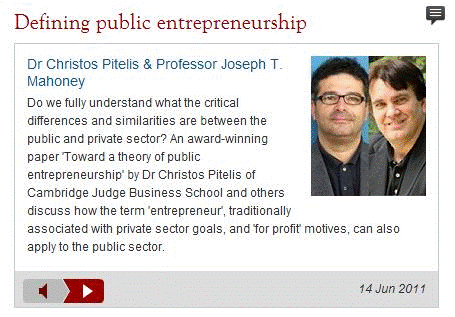
Here’s a podcast with my colleagues and good friends Joe Mahoney and Christos Pitelis on public entrepreneurship, part of an ongoing research project on public-private boundaries. Check it out!
Mahoney Invested as Caterpillar Chair
| Peter Klein |
Congratulations to O&M friend and former guest blogger Joe Mahoney for his investiture as the Caterpillar Chair in Business at the University of Illinois at Urbana-Champaign. Here is the official announcement, which includes the following summary of Joe’s many accomplishments:
Joseph T. Mahoney is a professor of business administration at the University of Illinois who specializes in corporate governance and organizational economics. He is an editor for several top management journals, a prolific author, frequent advisor to Ph.D. candidates, and a professional consultant. For more than 20 years Mahoney has been an award winning teacher to undergraduates, MBAs and other graduate students. He holds a B.A. in Economics from the University of Pennsylvania, and M.S. and Ph.D. degrees in Business Economics from the Wharton School of Business.
Joseph Mahoney has published more than 50 scholarly articles in respected journals like the Academy of Management Review, Journal of Management, Journal of Management Studies, and Strategic Management Journal. His publications have been cited over 5,600 times by scholars in 65 countries. His book, Economic Foundations of Strategy has been adopted by over 30 top doctoral programs. Mahoney is an editor for the International Journal of Strategic Change Management and the Strategic Management Journal, and he contributes to 21 additional journals. Mahoney’s passionate teaching has garnered him many outstanding teacher awards since coming to Illinois in 1988. In that time he also served on 47 completed doctoral dissertation committees and currently serves on 8 others that are in progress.
You may recall that Joe is also this year’s recipient of the Academy of Management’s Irwin Award. Way to go, Joe!
An Early Example of a Hold-up. . .
| Scott Masten |
. . . in which two Irishman sweep fifteen or thirty Italians into an open ditch.
The context is a dispute over a contract for the supply of water to Bayonne, NJ., circa 1896, as reported in The First History of Bayonne, NJ (1904: 92):
At the mayoralty election in the spring of 1895, Egbert Seymour, on the Democratic ticket, was elected Mayor. Several of the Councilmen who were elected at this election, and two or three city officials, were opposed to the new water contract, and attempted a “hold-up.” The trouble reached its height one day during the first year of Seymour’s administration.
While employees of the water company were tapping the old mains to make the necessary water connection, some city officials arrived on the scene. Immediately there was trouble.
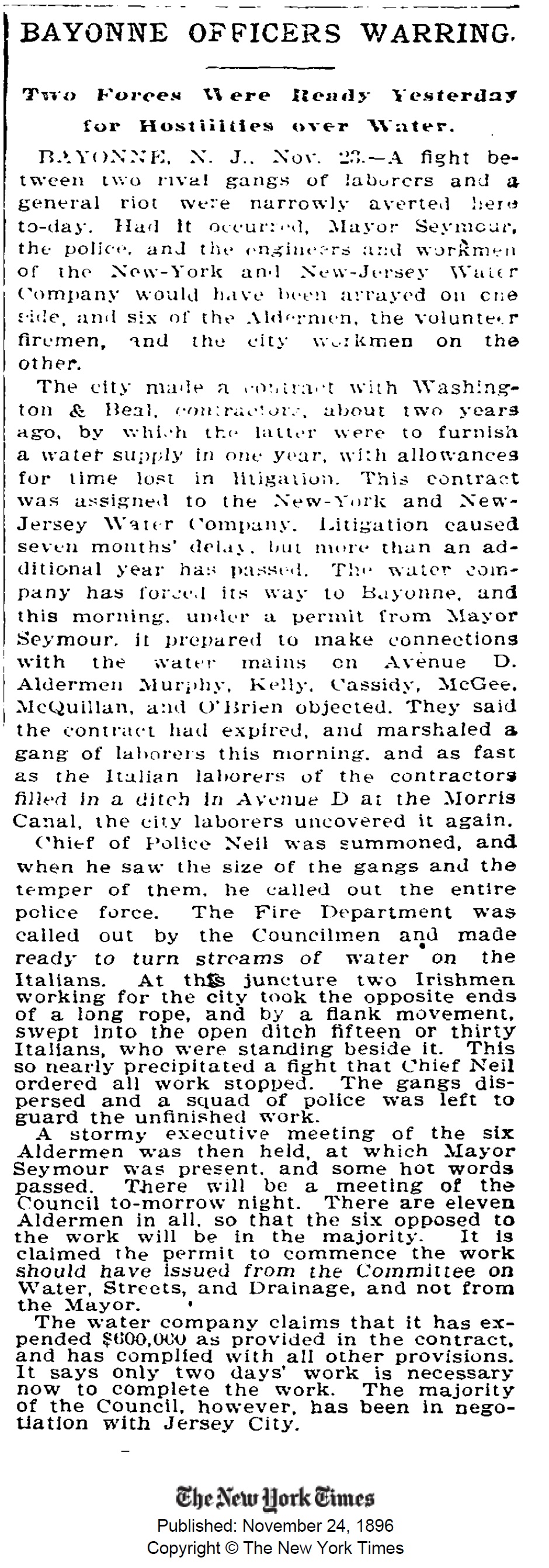
The New York Times article (Nov. 24, 1896) on the right (click to enlarge) elaborates, amusingly, on the manner in which the holdup was executed.
I have not yet been able to verify it but, according the previous source, “The matter was taken before the Supreme Court of the United States by the water company, and an injunction was obtained against the city. United States marshals were stationed at the scene until the work was completed, to arrest any city official who interfered.” The city eventually bought out the company in 1918.
(Wish that I had found that quotation before completing this.)
ISNIE Annual Conference, Stanford University, June 16–18
| Scott Masten |
The 15th Annual Conference of the International Society for New Institutional Economics will be held this year at Stanford University on June 16-18. The conference is being organized by President-Elect Barry Weingast, and my inside, not-yet-public information is that the conference will have two very interesting keynotes. The ISNIE website has the just-released Call for Papers.


Famous Figure Omission
| Scott Masten |
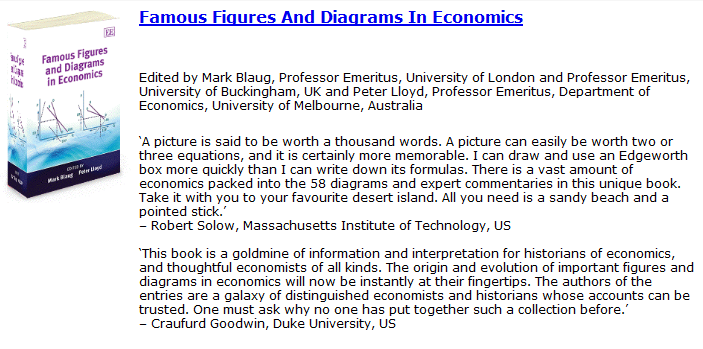
My inbox today contained an advertisement for a new Elgar publication: Famous Figures and Diagrams in Economics:
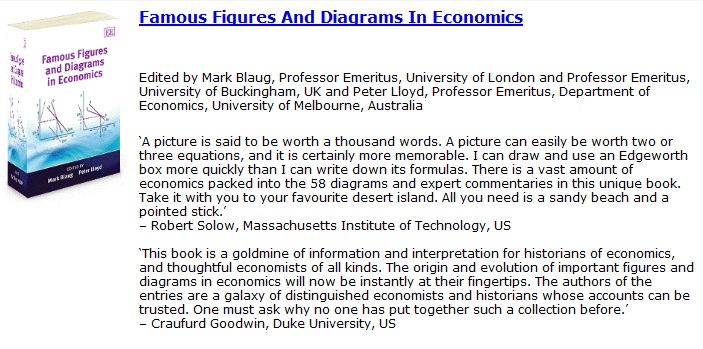
I’m sure that everyone in the O&M-isphere will agree that such a volume is incomplete without (more…)
Remediableness Quote* of the Day
| Scott Masten |
In the matter of reforming things, as distinct from deforming them, there is one plain and simple principle; a principle which will probably be called a paradox. There exists in such a case a certain institution or law; let us say, for the sake of simplicity, a fence or gate erected across a road. The more modern type of reformer goes gaily up to it and says, “I don’t see the use of this; let us clear it away.” To which the more intelligent type of reformer will do well to answer: “If you don’t see the use of it, I certainly won’t let you clear it away. Go away and think. Then, when you can come back and tell me that you do see the use of it, I may allow you to destroy it.”
— G.K. Chesterton, The Thing (1929)
*Shouldn’t it be quotation of the day?
Entrepreneurship Lives!
| Scott Masten |
At the ASSA meetings in Denver this weekend, O&M impresario Peter Klein gave a typically (for him) enlightening and entertaining presentation on “Institutions and Entrepreneurial Opportunities: A New Approach.” (An audience member gushed afterward that it was one of the best presentations she had ever seen. Perhaps Peter can provide a link to the paper.) To illustrate one of his points, Peter used images of ruins from once-glorious buildings in Detroit such as this one:

Peter’s point was that, though on its face, such abandoned structures would appear to present unrealized entrepreneurial opportunities, such opportunities were probably illusory in light of Detroit’s decline.
In fact, Peter, in a rare lapse, simply failed to look deeply enough into the question. Entrepreneurship is alive and well even in Detroit! (more…)





 Organizations and Markets
Recent Comments