Posts filed under ‘Former Guest Bloggers’
GM vs. TCE: Another “Block Upon Block”?
| Mike Sykuta |
Ronald Coase has spent the past two decades or more lamenting the lack of progress in economic theory. He bemoans the fact that economics, unlike its physical-science counterparts, fails to dispose of (or pursue new versions of) theories when facts show that prevailing theories are inaccurate or incomplete.
Among his many arguments, Coase has pointed to Williamson’s Transaction Cost Economics (TCE) as one that seems impervious to the facts. Part of Coase’s discontent with the TCE story rests on his observation that many firms sustain relationships characterized by high degrees of asset specificity using contractual means. While Ben Klein and others pointed to General Motors-Fisher Body as evidence to support the TCE story, Coase pointed to relations with auto frame manufacturer A.O. Smith at the same time that were not subsumed by vertical integration. This eventually led to the infamous GM-Fisher Body debate that seems for want of a real conclusion (see some of Peter’s previous comments on this here, here and here).
Well once again, General Motors seemingly plays the foil against TCE. Several weeks ago, GM announced plans to purchase Delphi Group’s global steering manufacturing operations. Delphi operated the steering unit solely for GM’s use. Delphi, in bankruptcy since October 2005, has been able to use GM’s dependence on Delphi’s operations to secure roughly $450 million in liquidity capital from GM to maintain its operations. Sounds like the classic hold-up problem, doesn’t it? But wait! (more…)
Another Regulation Not Worth Its Salt
| Mike Sykuta |
Thanks to Randy Westgren for calling attention to an April 7 article in the New York Times concerning a new regulatory initiative in the Big Apple. It seems Mayor Bloomberg has decreed that salt consumption should be cut in half and has pledged the coercive power of New York City’s food industry regulatory system to launch a “nationwide initiative” to pressure the food industry to change its salty ways.
Apparently Mayor Bloomberg has identified salt consumption as a major public health crisis. Never mind that scientific research fails to demonstrate a causal relationship between salt consumption and actual health outcomes. Never mind that the human body requires some level of salt and there is no research demonstrating the potential health consequences of restricting persons’ salt intake to the level the Mayor prescribes. And don’t even think about the idea of personal responsibility and liberty in choosing what to eat and whether (and how much) salt to consume.
“if the salt has become tasteless, how can it be made salty again? It is no longer good for anything, except to be thrown out and trampled under foot by people.” Perhaps a better approach would be to throw out such ill-founded regulations and trample them under foot.
Another Attack on Outrageous Bonuses
| Mike Sykuta |
For the second time in a week, the Obama Administration attacked what it referred to as “outrageous” bonuses paid during a time of economic struggle for so many Americans. The announcement came as a reaction to Walmart’s announcement that the Arkansas-based retailer paid almost $1 billion in bonuses to its employees. Adding in profit-sharing, 401K contributions, and employee discounts, the total giveaway is closer to $2 billion, according to company officials.
The White House reacted strongly to such “corporate largess” less than a week after reports that bailout target AIG paid millions in bonuses to its employees. “At a time when so many Americans are losing their homes and unable to put food on their tables, it is unconscionable that a retailer that has benefited so much from consumers should be paying out such astronomical sums in bonuses to its employees. To make matters worse, we understand these bonuses were not even contractually obligated, as in the AIG case,” stated White House spokesman Robert Gibbs. “Obviously Walmart’s ‘Every Day Low Prices’ are not as low as they should be.” Congressional Democrats said they are considering legislation to tax Walmart employees’ bonus payments and to force the retailer to lower its prices further. (more…)
Passing the Hat for Jon Stewart’s Mother
| David Gerard |
No doubt you have all seen or at least heard of the bloodletting of CNBC’s Jim Cramer at the hands of Jon Stewart. Stewart took Cramer to task for the financial “journalists'” role as cheerleaders rather than as investigative reporters leading up to the financial meltdown.
What seems to be lost in the discussion is the fate of Mr. Stewart’s poor mother.
Mr. Stewart: My mother is 75. And she bought into the idea that long-term investing is the way to go. And guess what?
Mr. Cramer: It didn’t work.
Although I think it is a bit premature to malign the viability of equities and long term investing, I found it even more distressing was that Mr. Stewart’s mother doesn’t seem to have access to any competent financial advice. I would hope that the host of a popular television show would have sufficient financial resources to hook his mother up with a financial planner. Or, she might have stayed in-house and asked her son who is the “head of U.S. Markets and Global Technology at NYSE Euronext.”
Well, I am willing to help out by imparting a bit of my investment knowledge (actually, all my investment knowledge) that I picked up in graduate school to the cause.
(1) It’s tough to beat the market. Most funds don’t beat a simple index fund, so buy a simple index fund.
(2) Stocks tend to be more volatile than bonds. There is a bigger upside, yes, but there is also a bigger potential downside. As you hit your golden years, consider rebalancing to reduce your portfolio risk.
If you have any further questions, please consult the comments.
The Adults Are In Charge
| David Gerard |
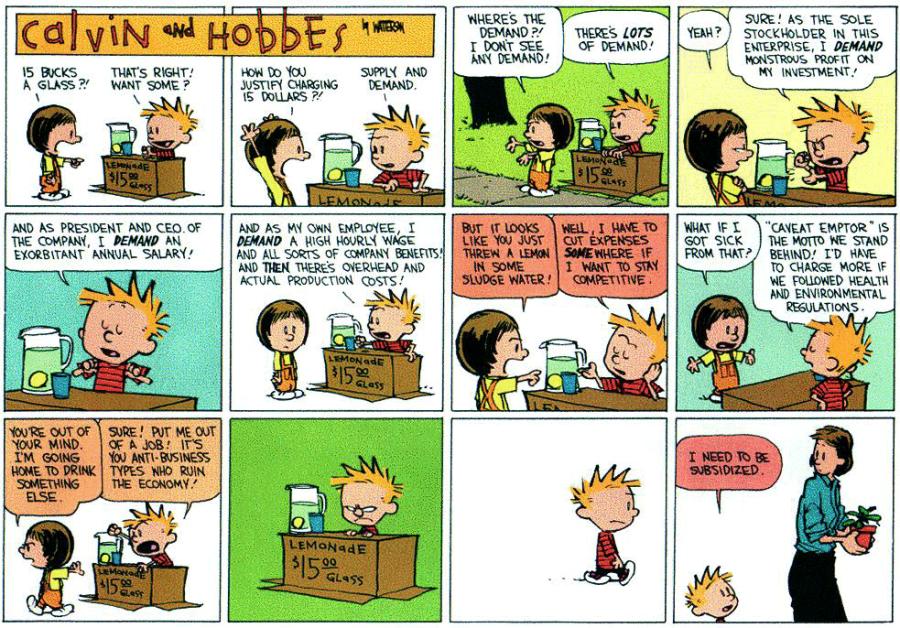 A common refrain heralding the arrival of a new Administration is that “the adults are in charge now.” The expression came to mind when I saw that this classic Calvin and Hobbes strip was making the internet rounds.
I certainly don’t envy the adults these days.
Global (Daylight) Savings Glut?
| David Gerard |
I almost hate to bring this up given the levels of scorn and derision I was subjected to over this (and that was just from my friends), but a few years ago Paul Fischbeck and I used our traffic safety website to look at the change in risks and fatalities surrounding daylight savings time. There weren’t any obvious changes for drivers and vehicle occupants, but there did appear to be some dramatic changes in pedestrian risks (e.g., deaths per trip). For the “Spring” forward, we observed considerably lower risks during the evening rush offset by elevated morning risks.
Because we observed pedestrian risk numbers spike during the time change and then return to trend, we attributed the effect to people adjusting to the time change. This conjecture is consistent with some published research that looked at this question. Our basic message (we thought) was to “look both ways or you might get run over,” and thought we might get some good Samaritan points along with the people who remind you to change your fire alarm batteries.
Instead, what we found was that the time change is quite the lightning rod for controversy, over energy savings, traffic fatalities, depression, heart attacks, and many other societal ills. As a policy matter, however, we received feedback from across the spectrum. These are some of the tamer selections:
I am a professional working adult, actually a senior, and I as well as hundreds of others, would like to have our clocks left alone. All of us do not enjoy driving to and from work in darkness. The psychological effects are more than depressing as I am sure you are aware. — Muriel
Thank you both for helping our cities to understand that people should come before cars. — Steve
Now do a study about the dangers of children waiting for school buses in the dark. My elementary school age child was leaving the house in the dark at 7am to get her bus until daylight savings time ended this week. — Sylvia
I am not sure what to conclude from all of this. I have no idea what a benefit-cost analysis of the alternatives would look like, but we certainly learned there are more dimensions of the policy issue than we imagined. As a political economy story, the status quo does not appear to be completely locked in. A few years back, the federal government pushed back the return to standard time until after Halloween in order to reduce the risk of vehicular trick-or-treating incidents.
Perhaps in November I will be able to shed some additional light on the issue.
Reducing Transaction Costs in Government Procurement
| Mike Sykuta |
Lest anyone think I (or, by association, O&M) am just a disgruntled Obama-basher, let me applaud the Administration’s announcement today of its intent to overhaul the ways in which the government contracts for goods and services, particularly in the Department of Defense. I suspect the collective “we” are all in favor of identifying methods and processes that will reduce transaction costs (and overall costs) in government procurement programs.
On this point, there is economic research that should help guide the Administration’s deliberations. To wit, William Rogerson provides a pretty thorough assessment of the economic incentives in defense procurement (JEP, 1994) and has a follow-up article on the optimal structure of fixed-priced cost reimbursement contracts (AER, 2003). Bajari and Tadelis (RAND J., 2001) provide a study of incentives versus transaction costs in procurement contracts. Although focused on private-sector construction, their findings are likely relevant to government procurement as well. Important lesson: cost-plus is not necessarily bad.
Helland at Missouri
| Mike Sykuta |
Eric Helland will be on campus this Friday, 6 March, to give a seminar on the effects of insurance reimbursement policies on the provision of medical services. In this paper, Helland and his co-author Paul Heaton compare the level and number of treatments recommended for auto-injury trauma patients in Colorado before and after a change in state law that shifted the burden from more generous auto-policy reimbursements to less generous, traditional health-insurance policies. Following the change, doctors recommended more reimbursable treatments per patient despite negligible changes in the character of auto injuries or in the health outcomes of those cases.
This is the latest in a stream of research Eric has done examining the (sometimes perverse) incentive systems created by different market and regulatory structures and the political economy of such outcomes, including issues of corporate governance (here), class-action lawsuits (here), and workings of the judicial system (here and here).
Eric’s talk is part of the Economics Department’s seminar series. If you are within driving distance, I’m sure you would find it worth your while.
Blogging to Fame on CNN
| Mike Sykuta |
Nicolai’s recent post about improving your impact factor led to some friendly banter about the efficacy of being cited on O&M as a means to increase one’s exposure. Turns out there may be some truth in that nifty little nugget. I was contacted last week by a senior producer at CNN concerning my skeptical views on the U.S. stimulus package. I can only imagine some of my posts on O&M and my appearance on Brad Delong’s list of ethics-free-Republican-hacks had something to do with my reputation as an stimulus stickler.
The CNN crew came to town yesterday as part of their reporting on how (and how well) stimulus funds are being spent and interviewed me regarding the wisdom (or lack thereof) in the stimulus effort and the veracity of claims about job creation. I’m told the segment will air twice tonight on CNN, once on Campbell Brown’s “No Bias. No Bull” (8:00pm Eastern) and again on Anderson Cooper 360 (10:00pm Eastern). I tried to figure out a way to reference O&M directly. I hope the administrators will forgive my inability to work it into the conversation.
New Theoretical Developments in Strategic Management
| Mike Sykuta |
“New Theoretical Developments in Strategic Management: Opportunities for Research Contributions” is the topic of an interactive online seminar Thursday, 26 February, 12:00-1:30pm EST. The speaker is Michael Hitt, Distinguished Professor of Management and the Joe B. Foster Chair in Business Leadership and the C.W. and Dorothy Conn Chair in New Ventures at Texas A&M University. During the 90-minute seminar participants will explore theoretical developments in strategic management including the resource-based view, institutional theory, and a new concept of strategic entrepreneurship, and will offer updates on how more established theories such as TCE and agency theory are being applied.
The seminar is sponsored by the Agribusiness Economics & Management (AEM) Section of the Agricultural & Applied Economics Association (AAEA). The AEM Section has sponsored online seminars previously on topics that may be new or less familiar to its members, one of the more valuable contributions any professional society provides. Although many of the “new theoretical developments” described above may not seem quite so new to frequent O&M readers, they are certainly more novel in the context of agribusiness research.
You can register for the conference as an individual or as a host location for as many people as can fit into your local class or conference room. This is an especially good opportunity for graduate students and faculty to learn more about the research opportunities in this area. I expect several of our Missouri colleagues and grad students will be participating. Check out the conference website for information about technical requirements and registration.
The Recipe for Recovery Is Revealed
| Mike Sykuta |
The Obama administration has apparently revealed its recipe for economic recovery. Based on the rhetoric and policy proposals fronted thus far, the recipe appears as follows:
- Do everything possible to discourage potential high-value executives from working in troubled industries by capping executive pay in struggling industries.
- Eliminate high-powered market-based incentives for mid-level employees to perform their jobs well.
- Encourage distressed companies to renege on long-term contracts that populist politicians find offensive (or consider easy to target so as to appear they are being responsible with taxpayers’ money).
- Dole out a trillion dollars of taxpayer funds to pet projects and interest groups in the name of “economic stimulus” (enabled by the perception of “responsibility” created by their railing against the targets of #1-3).
- Ignore the economic consequences of the incentives created (or destroyed) in #1-3 as well as the fact that someone at some point will have to pay that trillion dollar bill.
- Half-bake under the heat of political pressure and serve to the masses who are starved for quick-fix solutions that only impose costs on “that other guy” or “the rich fat-cats of corporate America.”
I don’t know about you, but I think it will be interesting to see how quickly the soufflé crashes . . . though I’m not looking forward to it being force-fed.
Yet More “Shameful” Interventionist Rhetoric
| Mike Sykuta |
It’s obviously not enough for regulators from the Obama administration to march down Wall Street and mandate changes in the incentive systems of rank-and-file workers or even mandating that these “bonus” payments be rescinded (see here and here). Now banks that received bailout money are being chastised and brow-beaten from the bully pulpit of the White House for honoring long-term contracts signed years before the current “crisis.”
Today’s Wall Street Journal reports Citigroup is considering reneging on its 20-year stadium naming rights deal with the New York Mets to appease the White House and the populist press. Citi has already caved on its commitment to purchase a new corporate jet to replace two aging planes (a move that would likely have enhanced both fuel and environmental efficiency, ironically enough). Although Citi and the Mets claim the deal is still on, the attitude from Washington is remarkable in its complete disregard for the complexity of business deals, if not for the very essence of the institutional structures that support exchange (and contracting).
First, despite all the clamoring about Citi spending $400 million on naming rights while receiving $350 million in TARP funds, the reality is Citi is obligated to pay $20 million a year for 20 years. So while taxpayers are being told they are paying to name the new Mets stadium Citi Field, only a relatively small amount — certainly by bailout standards — is being spent this year. If the purpose of the bailout is to get firms through these troubled times and into a more stable future, we’re not talking about taxpayers taking on a 20-year commitment. (more…)
Pittsburgh School Superintendent Tackles Absenteeism
| David Gerard |
Those of you that think that a football is round might not be aware that the Super Bowl is taking place this Sunday, where my hometown Pittsburgh Steelers will face the Arizona Cardinals. Every year brings its own story lines, and among the many questions surrounding this year’s game is: what is your favorite public-choice explanation for why Pittsburgh schools are opening late on Monday?
The Pittsburgh Public Schools will operate on a two-hour delay Monday because of the Super Bowl, Superintendent Mark Roosevelt said today. Noting that Sunday’s big game means a “late night,” Mr. Roosevelt said the delay should cut down on student and staff absenteeism.
Of course, not all work places are observing the delay, so this will create a few headaches for working parents who don’t happen to be teachers or staff in the Pittsburgh public school system. Perhaps Superintendent Roosevelt thinks parents will already have headaches Monday morning, so the incremental costs will be low.
Burying the Carbon Issue
| David Gerard |
As noted here, a “small” chunk of the House stimulus package is earmarked for carbon capture and sequestration (CCS) demonstration projects. For a coal-fired electric power plant, CCS entails the separation of the carbon dioxide during the combustion stage, compression into a fluid, and injection into a deep (> 1 km) geological formation where it will remain indefinitely.
Regardless of one’s views on global climate change or the government’s role in addressing it, it seems pretty clear that policy makers are moving us toward a carbon-constrained world. The rationale for CCS in such a world is straightforward. Unlike conventional pollutants, today’s carbon emissions will remain in the atmosphere for close to 100 years. Stabilizing atmospheric CO2 concentrations at current levels will require extraordinary (perhaps 80%+) reductions from current emissions levels. However, carbon or no carbon, it is highly improbable that we can meet our projected energy needs (at least in the near term) without continued reliance on fossil energy sources.
I am involved with the CCSReg project that is developing recommendations for the development of a regulatory framework for CCS if the US legislates reductions in carbon emissions. Earlier this month, we issued an interim report with several preliminary recommendations, including putting money toward demonstration projects (summary).
The potential regulatory issues range from identifying and mitigating environmental and safety risks to addressing public acceptance issues associated with the NUMBY (not under my back yard) syndrome. The property rights issue might interest many in this audience, as it is not clear who owns the underground pore space (if anyone), or how much these owners should be compensated for having CO2 filling it up (if anything). This could be resolved on a state-by-state basis, though many potential sequestration sites are located in multiple states. (more…)
Fortunes Even A Hack Can Tell
| Mike Sykuta |
A couple weeks ago, Brad DeLong included me in a list of ethics-free Republican hacks because I was among a number of economists who posted comments on Rep. John Boehner’s website critical of the proposed Democratic “stimulus plan.” To wit, I posted:
History has shown that the Obama team’s proposed ‘stimulus’ is not only going to have little to no effect in the short run, but will create a larger bureaucratic structure, lead to tremendous investments in unproductive political lobbying among ‘stimulus project’ wannabes, and dissuade/delay private investment, recovery and growth.
So imagine my surprise (or lack thereof) to see the headline article of today’s Wall Street Journal. The ink is not even dry on the legislative draft that Congress is expected to vote on sometime today, and lobbyists from stimulus project wannabes such as the concrete and asphalt industries are battling over how we should rebuild and repair roads and bridges; dairy and beef cattle producers are battling over talk of a government program to slaughter dairy cattle and increase milk prices. States are clamoring for bailouts. And the labor unions are singing on their way to the bank with plans for massive infrastructure spending.
In the spirit of Art Carden’s recent post, “Everything is proceeding precisely as I have foreseen.” Ethics-free hack or no.
What Drives Traffic Fatality Risks?
| David Gerard |
Does the inclement weather have you worried about sliding off the road to an icy death? If so, I’ve got some good news for you. On a per-mile driven basis (or per-trip or per-minute traveled), winter is actually the least likely time to get killed behind the wheel. Summer drivers have a risk of 1.24 fatalities per 100 million miles driven compared with 1.01 during the winter. For males behind the wheel of an SUV, those summer and winter numbers are 1.39 and 0.87, respectively.
That’s what we discovered when we teamed with the AAA Foundation for Traffic Safety to develop TrafficSTATS — an interactive website that merges traffic fatality and personal travel information to generate risk estimates. The site generates risk estimates for combinations of age, day of week, month of the year, gender, hour of the day, drivers, passengers, and vehicle types. Did you know that a man behind the wheel is 80% more likely to get killed than a woman? Or that 16-20 year-old drivers have about the same fatality risk as 75-84 year-olds?
Although our estimates are a simple ratio generated by merging federal fatalities and personal travel behavior databases, we believe that our risk estimates frame risk in a far superior fashion than using fatalities or other risk proxies. For example, one common metric is deaths per registered vehicle. By this measure it looks like SUVs are more dangerous than cars. Adjusting for the fact that SUVs are driven more miles and carry more passengers than cars do provides a much different picture — SUVs are a lot safer (0.85 SUV and 1.02 passenger car fatalities per 100 million passenger miles traveled). Not only that, we also found that even the rollover risk for SUVs and cars are virtually the same for 25-50 year old drivers, and the divergence in rollover risks stems predominantly from high fatality risks for young and old drivers (PowerPoint and paper).
One caveat, the site was developed with MS tools and works best in Internet Explorer. What was that post about path dependence? Aaack.
Another Voice in the (Contracts) Wilderness
| Mike Sykuta |
I have always been a bit reticent when it comes to blogging, as Peter (and my friend Thom Lambert over at Truth on the Market) can attest. But I’ve come to realize not everyone posts at the (obviously OCD-induced) rate that Peter does, and as a guest there is certainly less pressure to keep up with the Joneses . . . or the Kleins anyhow. Thanks, Peter, for your persistence and continued offer to join in the fun. I have long enjoyed lurking around O&M and posting an occasional comment or two.
As Peter mentioned, I am the Director and one of the co-founders of the Contracting and Organizations Research Institute (CORI). CORI was formed in 2000 as a collaborative effort with my colleague Steve Ferris in Finance and former colleague Bob Lawless in (ironically) the Law School. The purpose was to provide a forum for interdisciplinary discussion and research on issues of law, economics, and organization. Since then, we’ve been able to bring in additional faculty positions related to CORI and help recruit other new faculty with aligned interests to create a fairly large group of scholars with complementary, and in some cases congruent, research interests. (more…)
Introducing Guest Blogger Mike Sykuta
| Peter Klein |
I’m delighted to introduce my friend and colleague Mike Sykuta as our newest guest blogger. Mike is Director of the Contracting and Organizations Research Institute (CORI) here at the University of Missouri. Mike and CORI played a big role in attracting me to Missouri in 2002 and we’ve worked closely together on many projects since then.
Mike got his Ph.D. in economics at Washington University in St. Louis and identifies with the Coase and North branch of the new institutional economics. (He is sympathetic to Williamsonian TCE but has not yet drunk the Kool-Aid.) Mike is co-editor of SSRN’s NIE Abstracting Journals, along with Mary Shirley, and is involved with ISNIE and ESNIE. He works on contracting, corporate governance, and the political economy of regulation. He teaches an MBA/MS-level course on the economics of transactions and contracting, doctoral seminars on firm and industry organization, and the capstone undergraduate strategy course in the agribusiness management program. Mike is almost as much a Luddite as Nicolai — he acquired his first mobile phone just a short while ago — and I’m glad he’s finally decided to give some 21st-century technology a try. Welcome, Mike!
High-Powered Incentives
| David Gerard |
As I pack my bags for the American Economic Association meetings this weekend in San Francisco, I am reminded of a recent New Yorker article on the impacts of medical marijuana legalization. This is probably a rather mundane topic for you left-coasters, but here in Pennsylvania where we can’t even buy beer in grocery stores, it is a pretty exotic concept.
The article highlights a number of ways in which legalization foments organizational change, and also gives some anecdotal evidence on sharecropping terms, suggesting different terms for indoor and outdoor operations.
The easiest way to make this kind of small indoor scene work is to live in someone else’s house and nurture the plants in exchange for a third or half the profits, and that is how the Kid would be spending her time for the next two months.
On the outdoor side, however, this description of the “Humboldt Slide” suggests that landlords appear more willing to change the contracting terms:
“You start at this really great percentage, and you’re buddy-buddy and everything’s great,” Emily said. As the harvest approaches, growers inevitably begin to run out of money and get greedy, and the sharecroppers lose whatever leverage they had earlier in the growing cycle, when their daily attention was necessary for the young plants to survive. Emily’s wage the previous year was initially set at a third of the value of the plants that she harvested. Later, her boss “slid” her percentage to a sixth, meaning that she owned only a dozen of the eighty plants that she grew that season.
The explanation is that the laborers have no legal recourse, so the landlord is free to rewrite contracts as he pleases, but then wouldn’t we expect a slide in the case of the indoor operations as well?
I welcome suggestions for more systematic treatments for effects of the California legalization. One effect that I don’t expect is for it to have much of an impact on the average sobriety level at this weekend’s conference.
A Hostage Situation in Pittsburgh?
| David Gerard |
 I would like to thank Peter for inviting me to guest blog, as I have been a fan of Organizations & Markets for some time. I spent the better part of the past year developing courses that emphasized organizations, entrepreneurship, and innovation. O&M has been an invaluable resource, whether to “borrow” slides from Richard Langlois, or to get ideas for classroom topics.
I am writing from the “Steel City” of Pittsburgh, though the steel industry has largely fled the region. For evidence of that we need to look no further than our skyline (which we can now see because there is less smog), where the University of Pittsburgh Medical Center’s UPMC logo is now emblazoned atop the US Steel Tower. Health care accounts for about 15% of the region’s workforce.
Aside from being a case-study in post-industrialization, UPMC is also an interesting point of departure for exploration of some fundamental organizational questions. One that leaps to mind: Are non-profits where the real money is? Last year, UPMC generated $6 billion in revenue and cleared more than $600 million in “non-profit.”
A more traditional organizations question is the question of organization boundaries, and the tortured negotiations between UPMC and Highmark illustrate concepts such as transaction costs (hint for the exam: if it takes 3+ years to strike a deal, transaction costs may be high), vertical integration versus arm’s-length contracting, market power, bilateral dependency, credible commitment, and the hostage model. Indeed, the linchpin of the deal was Highmark kicking in for the construction of the new Children’s Hospital:
Highmark and UPMC have had a good working relationship since 2002, when the two companies signed a landmark 10-year deal. UPMC won a contract with its best customer, and hundreds of millions in loans and grants from Highmark so UPMC could build a new Children’s Hospital in Lawrenceville. Highmark, meanwhile, was guaranteed access to the wide UPMC network for a decade.
Having students explain why Highmark built a hospital rather than simply writing a check turned out to be a pretty good exam question.
The Pittsburgh Post Gazette ran a nice five-part series on the growth of UPMC growth and its phenomenal role in medical innovation. Despite the is long-term agreement, UPMC and Highmark are at odds over a proposed merger between Highmark and Independence Blue Cross. The federal authorities granted antitrust clearance, but Pennsylvania regulators won’t rule on the matter until next month. The state’s hesitation to give the green light gave Senator Specter and federal regulators time to reexamine the matter, and this might be a case to follow to see how the new Administration exercises its antitrust authority.





 Organizations and Markets
Recent Comments